Introduction
Violence, blackouts and a polarised vote: Ecuador heads to a tense run-off
Ecuador’s presidential election will head to a run-off after a tight general election in early February 2025 left Daniel Noboa and Luisa González neck and neck. With more than 92 per cent of ballots counted, Noboa secured about 44.3 per cent and González 43.8 per cent. The country’s Constitution requires an outright win of more than 50 per cent or at least 40 per cent with a 10-point lead. The two will face each other again on 13th April 2025.
The vote came as Ecuador grappled with spiralling violence, daily blackouts lasting up to 16 hours, and an extractive economy driving deeper into the Amazon. Noboa, who rose to power in late 2023 after Guillermo Lasso cut short his term, has consolidated authority across state institutions and sidelined his vice-president, Verónica Abad, creating tensions at the highest level of government. On 18th February 2025, UN experts raised concern over reports of political, administrative and judicial harassment of Abad Rojas, including measures undermining her political rights and due process.
The campaign unfolded against a backdrop of organised crime violence, militarised security operations and grave human rights abuses. Officials point to a 17 per cent fall in homicides in 2024, but killings spiked again, with January 2025 among the bloodiest months on record. According to the International Crisis Group, Ecuador is one of South America’s most violent countries. In 2023, five cities—including Guayaquil, the country’s main port and commercial hub—were listed among the world’s ten cities with the highest murder rates.
Since declaring an “internal armed conflict” against criminal groups in January 2024, Noboa has expanded emergency measures without providing enough information to justify their existence. The toll has fallen hardest on the historically discriminated communities. A coalition of civil society organisations has compiled a “map of state violence” during Noboa’s presidency, documenting at least 35 cases of abuse by security forces, 20 forced disappearances and 11 extrajudicial killings. Four in ten of the victims were Afro-Ecuadorian.
For example, in December 2024, four Afro-descendant children—Steven, José, Ismael, and Saúl—were victims of forced disappearance and murder, and their bodies were destroyed. According to official sources, the children were detained by military personnel and were taken away in Armed Forces vehicles.
Meanwhile, Ecuador’s economic outlook remains grim. Debt has soared above USD 5 billion. Noboa’s austerity measures have raised VAT, cut fuel subsidies and failed to resolve electricity shortages rooted in drought and years of neglected infrastructure. The president has also used state resources to boost his visibility on the campaign trail.
As the April run-off looms, much of the focus is on Leonidas Iza, the Indigenous leader whose movement captured over 5 per cent of the vote. Iza has called for strengthening national agriculture and industry as an alternative to the country’s reliance on extractive capitalism.
Canada–Ecuador trade deal threatens human rights
On 4th February 2025, Canada and Ecuador concluded negotiations on a free trade agreement that, if ratified, could undermine the rights of Indigenous Peoples, deepen socio-environmental conflicts and place defenders at heightened risk. The deal is framed by Canada as a win for diversification, but civil society organisations warned it “will harm the rights and ways of life of Indigenous Nations on the front lines of climate change.”
On 7th February 2025, the Confederation of Indigenous Nationalities (CONAIE), along with other organisations, including Asociación Flor de Caña, Alliance for Human Rights in Ecuador, Amazonian Women Defenders of the Forest, Amnesty International Canada, and MiningWatch Canada, strongly opposed the agreement. They stated that the agreement will accelerate Canadian mining projects in Indigenous territories without free, prior and informed consent.
Of particular concern is the inclusion of an investor-state dispute settlement (ISDS) clause, despite Ecuador’s 2024 referendum banning such mechanisms. ISDS enables corporations to sue governments in private arbitration, deterring States from protecting human rights.
“The conclusion of this Free Trade Agreement and the inclusion of exorbitant investor privileges through ISDS exposes Canada’s real priorities in Ecuador: championing the interests of mining companies over the protection of human rights and the environment. There is widespread concern that this trade deal will lead to increased violence and impunity related to Canadian mining operations in the country. How does this align with Canada’s human rights and feminist foreign policy?”, said Viviana Herrera, Latin America Program Coordinator, MiningWatch Canada.
Canada is already one of Ecuador’s largest investors, with more than C$1.8 billion (around USD 1.3 billion) in mining projects, and at least 15 Canadian companies are active in the country. Communities resisting mining projects have reported human rights violations, with some protesters labelled as “terrorists.” In 2023, Amazon Watch documented that 24 Canadian mining projects in Latin America violated Indigenous rights.
At least 70 per cent of the world’s mining firms are headquartered in Canada. This dominance has translated into widespread abuses: “Canadian mining companies operating abroad face minimal oversight and regulation from their home country, leading to widespread accusations of human rights violations, environmental destruction, and the trampling of Indigenous sovereignty across multiple continents with almost no accountability”, said independent journalist Brandi Morin.
Association
Criminalisation of environmental defenders opposing mining project
On 11th February 2025, the Criminal Guarantees Court of Guaranda sentenced three environmental defenders—Fausto A., Wilfrido E. and Gilberto T.—to four years’ imprisonment on charges of violating private property. The conviction comes amid growing concerns over the use of criminal law to silence communities resisting the Curipamba “El Domo” mining project in Las Naves, Bolívar province. On 24th March 2025, a court in Guaranda suspended prison terms for the three defenders convicted of alleged trespass, subject to conditions.
According to the Ecumenical Human Rights Commission (Comisión Ecuménica de Derechos Humanos, CEDHU), the project, granted to Curimining S.A. without a process of free, prior and informed consultation, has faced strong opposition from communities who defend water and land.
The proceedings gave rise to concerns about evidentiary sufficiency and judicial impartiality. Experts in site recognition and audio-visual analysis testified that the alleged trespassers had their faces covered and that those with visible features could not be identified. No evidence placed the three defenders at the scene. Despite this, the court proceeded with a conviction.
During the hearings, the complainant acknowledged that her son worked for Curimining S.A. Questions over conflicts of interest have deepened, as the same lawyers who represented the complainants in this case also acted on behalf of Curimining in other criminal proceedings brought against environmental defenders.
In May 2024, the Penal Guarantees Court of Bolívar sentenced six environmental defenders of Las Naves to three years in prison and imposed a USD 600 fine on charges of “illicit association”. The six had opposed the copper and gold project, which is partly owned by a company linked to President Daniel Noboa’s family. On 19th February 2025, the Bolívar Provincial Court of Justice upheld their convictions, while at least three other cases against defenders continue.
Civil society organisations warned that these prosecutions form part of a systematic pattern of judicial harassment aimed at silencing those who oppose extractive projects. Instead of protecting defenders, authorities are enabling companies to weaponise criminal law to suppress dissent.
🔴#URGENTE #DefensoresCriminalizados#BoletíndePrensa
— Comisión Ecuménica de Derechos Humanos (@Cedhu) February 12, 2025
Campesinos sentenciados a prisión por su labor como defensores de derechos
Ayer 11 de febrero de 2025, el Tribunal Penal de Garantías Penales de Guaranda @BolivarCJ integrado por Luis Eduardo Guanan Paucar, Mayra Dolores… pic.twitter.com/5yB647glWR
Threats against relative of Waorani leader
On 28th February 2025, three UN Special Rapporteurs addressed an urgent communication to the Government of Ecuador regarding the security and physical integrity of Indigenous Waorani human rights defender Juan Bay and other Waorani leaders.
The communication highlighted that on 14th January 2025, an unknown individual allegedly threatened a close relative of Bay with death during a phone call. This incident followed a pattern of intimidation directed at Bay since he assumed the presidency of NAWE in March 2023. Since that time, he has reportedly received repeated threatening calls and messages demanding that he end his work in defence of Indigenous people’s rights.
NAWE represents 87 Waorani communities and approximately 4,500 people across the provinces of Pastaza, Orellana and Napo. It advocates for territorial and environmental rights in Yasuní National Park against oil exploitation and promotes alternatives to extractivism.
The UN Special Rapporteurs expressed particular concern that the death threat against Bay’s family member may indicate an expansion of intimidation tactics to target next of kin, heightening risks and pressure on Waorani defenders and their communities.
Electoral Tribunal dismisses complaint against human rights defender
On 11th February 2025, the Electoral Contentious Tribunal (TCE) archived a complaint filed by Zaida Rovira, Minister of Economic and Social Inclusion, against lawyer and human rights defender María Dolores Miño. Electoral Judge Guillermo Ortega ruled that the complaint did not meet the minimum procedural requirements, including the obligation to specify in detail the alleged electoral infraction.
As previously reported, the case arose from an exchange on the social network X on 30th November 2024. Following a post by Minister Rovira congratulating President Noboa on his birthday, Miño replied: “De ser alfrombra del autoritarismo no se regresa” (“Once complicit with authoritarianism, there is no way back.”) This exchange prompted further words between the two and led to the minister’s filing before the TCE. The complaint remains pending before the TCE.
Rovira alleged that Miño’s response constituted political gender-based violence under Article 280(3) of the Organic Law on Electoral Matters and Political Organisations. The provision defines such violence as any expression that denigrates women during electoral processes or in the exercise of political functions, based on gender stereotypes, and with the purpose or effect of undermining their public image or restricting their political rights. The Tribunal, however, found that the complaint lacked substantiation and therefore dismissed it.
Expression
Journalist fatally shot in Quinindé amid rising violence in Esmeraldas
On 4th March 2025, unidentified gunmen fatally shot journalist Patricio Aguilar, founder and editor of the community newspaper El Libertador, in Quinindé, Esmeraldas province. According to police reports, Aguilar’s body showed approximately 30 bullet wounds. He had reportedly left his home minutes earlier to cover the release of a kidnapping victim in the neighbourhood of Fundo Limón.
Aguilar had more than three decades of experience as a journalist, working as a correspondent for national outlets before creating El Libertador. He regularly reported on crime, violence and community issues in Quinindé. Days before his death, he had posted on Facebook about ongoing shootouts in the area. Local media reported that he had received a tip regarding a kidnapping before he was ambushed. His wife and colleagues stated that Aguilar’s work frequently exposed him to risk.
Esmeraldas province has experienced one of the highest rates of violence in Ecuador. Homicides doubled between 2021 and 2022, reaching 81 per 100,000 inhabitants, with some estimates placing the figure as high as 139 per 100,000. Between 1st and 28th January 2025 alone, 27 violent deaths were recorded. Quinindé has become one of the most dangerous localities, with organised crime expanding and targeting journalists, echoing regional trends.
The killing of Aguilar is the first recorded case of a journalist murdered in 2025. His death comes as drug-related violence sweeps the country, with threats against journalists on the rise. Press freedom organisations in Ecuador and abroad—including Fundamedios, Fundación Periodistas Sin Cadenas, the International Federation of Journalists (IFJ) and the Committee to Protect Journalists (CPJ)—condemned the killing. They urged authorities to guarantee an independent investigation and to adopt real protection measures for reporters.
🔴La Fundación @SinCadenasECU, a través de un #comunicado, condenó asesinato de Patricio Aguilar ocurrido el pasado 4 de marzo y exigió una exhaustiva investigación. Este es el primer asesinato de un periodista ecuatoriano en el 2025. https://t.co/8Vgo14D53X pic.twitter.com/T3OdWQOSZm
— Fundación Periodistas Sin Cadenas (@SinCadenasECU) March 12, 2025
Journalists face attacks during the February 2025 elections
The first round of Ecuador’s 2025 elections took place in February in a context of political polarisation and violence (see introduction). Fundamedios reported 78 cases of aggression against the media between September 2024 and February 2025, with 22 tied directly to electoral coverage.
On 13th January, members of the security team of presidential candidate Luisa González (Revolución Ciudadana) physically and verbally assaulted Iván Rodríguez, correspondent for Teleamazonas in Azuay and journalist at La Voz del Tomebamba radio, while he covered her arrival in Cuenca. Video evidence circulating on social media shows a security agent pushing Rodríguez and ordering him to “get out of the way” (“quítese de en medio”) as he attempted to raise his equipment to film González’s arrival.
La seguridad extranjera de Luisa González de @RC5Oficial maltrata a miembros de prensa que tratan de hacer su trabajo. Pensaría que el reportero era un sicario? Quién paga esa seguridad? Estarán con visa de trabajo y todo legal? Quién controla? Ven algo malo ahí? Qué opinan? pic.twitter.com/FzqKPBtyer
— Jonnathan Carrera (@jcarreraandrade) January 12, 2025
On 4th February, Boris Sarango, journalist at the digital outlet Primer Reporte, received a criminal complaint from Giovanny Loayza, candidate for the National Assembly with the Avanza party. Loayza accused Sarango of making statements that allegedly caused “discredit or dishonour” after Primer Reporte published an investigation into the backgrounds of 2,089 legislative candidates.
The investigation, coordinated by Fundamedios and carried out by 38 journalists, compiled and verified publicly available judicial information on all candidates. More than 40 national outlets reproduced the findings. In its Loja edition, Primer Reporte noted: “Eight of the 76 candidates for Assembly in Loja have faced criminal complaints in the last ten years.” The report listed Loayza in a database that included candidates with previous legal proceedings, even when the judiciary had archived those cases at the investigative stage.
Loayza rejected the publication, describing it as “malicious and reckless,” and demanded that his name be removed from the database. Sarango explained that the investigation had a collaborative nature and adhered to strict verification standards, and that removing a name would undermine its integrity. Fundamedios also responded formally, clarifying that the database draws exclusively on information from the Judiciary’s Automated Judicial Processing System (SATJE), and that inclusion in the list does not imply guilt or wrongdoing but serves the public interest by ensuring transparency.
On 9th February, more than ten journalists reported denial of access to information while covering events in electoral precincts. Most cases occurred in the province of El Oro, although journalists in Guayaquil and Quito also documented similar incidents. According to Fundamedios, these violations took place despite assurances by the Armed Forces and the National Electoral Council (CNE) that they had granted the press full access to polling centres:
- In Machala, police officers blocked Jhonny Crespo, director of Conexión Informativa Ec, from entering the Colegio Kleber Franco Cruz to cover voting. Crespo repeatedly identified himself as a journalist and presented his accreditation from the National Electoral Council (CNE), yet police insisted on blocking his entry, citing “directives” against filming inside precincts. Finally, a local CNE coordinator confirmed he had the right to enter.
- At the University of Guayaquil, navy lieutenant Sebastián Naranjo told journalists that the Joint Command of the Armed Forces had prohibited coverage of the vote count. Only after 18:15 did the CNE issue a statement authorising press access, which finally allowed Diario Expreso to document proceedings.
A dos minutos de las 17:00, Haylis Herrera, capacitadora del CNE, informó a EXPRESO que no podía estar en el colegio 28 de Mayo para el conteo de votos, a pesar de la autorización previa. Lo mismo ocurrió en la Universidad Católica, donde también se bloqueó la cobertura.
— Diario Expreso (@Expresoec) February 9, 2025
Conoce… pic.twitter.com/zHBwyHyjjc
- Security forces also blocked Mishelle Espinoza of Radio Candela 90.7 at Colegio José María Velasco Ibarra in El Guabo. A soldier and two police officers ordered her to leave, forcing her to report from outside.
- In Arenillas, a military officer forced Ivette Coronel of Diario Correo to delete photos showing police authorising vehicle entry at a precinct. In the same district, CNE staff barred Luis Chalan, also of Diario Correo, from entering the Colegio de Bachillerato to cover the vote.
- In Quito, José Luis Andrade of GamaTV reported that military personnel blocked him from filming at three different polling stations, including the Academia Cotopaxi, where he attempted to record the ballot count. Karen Mantilla of Ecuador Chequea also faced obstacles when soldiers demanded her national ID and searched her belongings despite her press accreditation. Ana María Cañizares of CNN reported similar obstructions in Quito, where military staff claimed that she needed “authorisation” to film but failed to specify the source of that order.
- In Cotacachi, Imbabura province, a journalist from the community outlet APAK TV reported being detained by two armed men wearing black face coverings and military uniforms. The perpetrators demanded to see his credentials and access to his phone. Although he identified himself with a press vest and national ID, they confiscated his belongings and forced him into a white vehicle. He was later released near the Redondel de la Madre, on the outskirts of Ibarra. While he was not physically harmed, he lost his phone and broadcasting equipment, leaving him unable to return home with transport or resources.
🛑#Atención | Durante la cobertura electoral en Otavalo, un periodista de APAK TV fue retenido por personal militar y despojado de los equipos con los que realizaba su trabajo periodístico. Además, según un comunicado publicado por el medio de comunicación, el periodista también… pic.twitter.com/VVRbI3Osp3
— Radio Pichincha (@radio_pichincha) February 10, 2025
Media outlet threatened after reporting on Cuenca public spending
On 13th February 2025, the digital media outlet Prensa Virtual reported receiving a threatening message through its publicly available WhatsApp number. The message stated: “Be careful with what you do and say” (“Ten cuidado con lo que vayas haciendo y diciendo”). The outlet linked the threat to its recent reporting on the management of public resources. Prensa Virtual indicated that it had identified a possible author of the message. A screenshot shared with the complaint showed a WhatsApp number with a Venezuelan prefix.
In recent weeks, Prensa Virtual published investigations regarding the Municipal Public Sanitation Company and the Municipality of Cuenca. The outlet questioned a contract valued at USD 200,000 for a cultural event during carnival, noting that the municipality awarded it under a “special regime” that allows direct contracting.
Journalists forced into exile amid rising threats
On 10th February 2025, Fundación Periodistas Sin Cadenas reported the exile of a journalist from a coastal city following repeated threats and intimidation in January 2025. The organisation withheld the journalist’s identity for security reasons.
This case reflects a concerning pattern. Between 2023 and 2025, 19 journalists in Ecuador have gone into exile or relocated internally due to threats connected to their professional activities. Since mid-2021, a total of 1,031 incidents against journalists and media outlets have been recorded.
Businessman accused in corruption scandal sues journalists abroad
On 11th March 2025, businessman Xavier Jordán—who faces pending judicial proceedings in connection with the country’s largest corruption scandal, known as the Metástasis case— announced on X that he had begun legal action in the United States of America against two journalists. He targeted Juan Carlos Calderón, director of the investigative outlet Plan V, and Roberto Aguilar, a columnist for Diario Expreso, alleging defamation over reports linking him to the late drug trafficker Leandro Norero, killed in 2022.
Jordán posted images of letters signed by his lawyer, demanding that both journalists retract their reporting within five days. The letter to Calderón asserted that Plan V had published false claims about Jordán’s ties to Norero, while the letter to Aguilar accused him of citing unverified chat messages and alleging Jordán’s involvement in a criminal organisation.
According to Fundamedios, Jordán has initiated more than eight legal proceedings, both in Ecuador and abroad, against journalists and outlets, often beginning with formal retraction demands before filing lawsuits.
Police block journalist from covering a crime scene
On 24th March 2025, Marlon Torres, journalist with the outlet Marlon Digital TV, reported that a National Police officer prevented him from conducting a live transmission of a contract-style killing in Shushufindi, Sucumbíos province. The officer ordered Torres to identify himself and immediately end his coverage while he was broadcasting from more than ten metres away from the crime scene.
Torres explained that he and other local reporters had gone to the site to document the incident. In his live video, the officer can be heard instructing the journalists to leave or identify themselves. Several reporters showed their press credentials, but the officer reportedly rejected them as invalid.
Torres stated that the police have increasingly obstructed media coverage in Shushufindi, where at least five killings occurred in recent days.
Radio Pichincha targeted in sustained cyberattacks
On 16th February 2025, Radio Pichincha, a publicly funded media outlet, reported that a cyberattack had disabled its website, forcing the main platform offline. The attack was allegedly carried out by the X account @YourAnonHunters, which publicly claimed responsibility and announced a systematic operation against the station’s servers.
In a statement, Radio Pichincha said that over the previous two months it had logged more than 20,000 attempts to breach its systems, describing the scale of the assaults as part of efforts to silence the broadcaster. The outlet also noted that its YouTube, Instagram and X accounts had been compromised in earlier attacks. It warned that the frequency and persistence of these incidents reflected a serious and sustained threat to its infrastructure.
OTRO ATAQUE CONTRA RADIO PICHINCHA
— Radio Pichincha (@radio_pichincha) February 16, 2025
Denunciamos a la comunidad nacional e internacional que un grupo de cyber delincuentes denominados como 'Cyber Hunters' vulneraron los servidores de Radio Pichincha y dieron de baja la página de nuestro medio de comunicación.
Hacemos un… pic.twitter.com/K5df8R1IgI
IACHR Rapporteur sounds alarm on Ecuador’s media crisis
In January 2025, the Inter-American Commission on Human Rights’ Special Rapporteur for Freedom of Expression concluded a two-day visit to Ecuador. The mission was part of ongoing technical assistance to monitor the country’s press protection mechanism.
The findings were stark. Since 2021, at least 11 journalists have been killed. In 2024, 131 aggressions were recorded, and 15 journalists fled into exile. Armed attacks on media outlets, constant online harassment, judicial intimidation, and digital abuse against women reporters are now commonplace. Community journalists, particularly those covering demonstrations against mining in Amazonian regions, reported worsening threats.
The Rapporteur noted positive steps, including regulations issued in 2023 and civil society initiatives such as the Articulation Board for the Protection of Journalists. But it also highlighted serious shortcomings: insufficient funding, poor coordination among state institutions, and limited awareness of the mechanism among at-risk journalists.
It also called on Ecuador to strengthen the protection mechanism, ensure accountability for crimes against the press, and guarantee access to public information.
Peaceful Assembly
Residents block Oyacoto toll in Quito to protest rising insecurity
On 16th February 2025, residents of San Miguel del Común and San Miguel de Calderón, in northern Quito, held a protest at the Oyacoto toll on the Panamericana Norte highway. Protesters denounced rising levels of insecurity, pointing to frequent assaults on public transport users and the absence of a consistent police presence in the area.
Protesters chanted slogans such as “We demand more security” (“Exigimos más seguridad”) and announced that they would continue mobilising until authorities addressed their concerns. They also demanded a meeting with representatives of Panavial, the company that manages the concession of the Panamericana Norte, one of the main roads in the northern Sierra region.
The Metropolitan Transit Agency (AMT) closed traffic in both directions on the Panamericana Norte during the protest. As a result, the Quito–Guayllabamba route experienced significant congestion.
A’i Cofán community demands court ruling after six-year wait
On 18th February 2025, members of the Indigenous Community A’i Cofán of Sinangoe marched in Lago Agrio, Sucumbíos province, urging the Sucumbíos Provincial Court to issue a ruling without further delay. Community members, joined by children, demonstrated outside the Sucumbíos Provincial Court with the call “We have waited six years, our patience is over” (“Seis años esperamos, la paciencia se acabó”.
In 2023, a judge in Lumbaquí granted the community an action for protection, ruling that the Ministry of Education had violated the children’s right to education. The ruling found that 56 children studied in unsuitable spaces, including a covered sports court and a community storage facility, instead of proper classrooms. The Ministry of Education appealed the decision, and the case has remained unresolved for more than six years since the community first raised its demands.
🚨Hoy nos manifestamos por el derecho de la niñez de @CofanesS a una educación digna y con pertinencia cultural.
— Cofanes Sinangoe (@CofanesS) February 18, 2025
Han sido más de seis años de lucha en los que @Educacion_Ec no ha hecho nada. No aceptaremos más excusas. Exigimos a @CorteSucumbios que emita #SentenciaYa.
👇 pic.twitter.com/NB7JN29v3G
Workers protest court ruling ordering return of collective benefits
On 25th February 2025, around 300 workers of the National Electricity Corporation (CNEL) held demonstrations in Manabí and Guayaquil to reject a ruling of the Constitutional Court ordering the return of USD 79 million in benefits previously recognised under a collective bargaining agreement. Protesters chanted “We are honourable, not golden” (“Somos honrados, no dorados”), rejecting the label of “golden bureaucracy” (“burocracia dorada”) often used in reference to the benefits they received.
Earlier in February 2025, the Constitutional Court admitted an extraordinary protection action filed by CNEL, overturning lower court rulings that had extended collective benefits to approximately 1,800 public workers not originally covered by the agreement. The decision obliges workers to return amounts already received, totalling over USD 79 million, within 36 months.
Richard Gómez, Secretary General of CNEL’s Workers’ Committee, announced that the union had filed a motion for clarification of the ruling. He also stated that workers would evaluate further actions, including additional demonstrations and the possibility of a hunger strike, to defend what they consider acquired labour rights.
Deployment of military in response to water protests
On 18th March 2025, residents of Esmeraldas, Rioverde and Atacames staged protests demanding access to safe and adequate water. Families from neighbourhoods along the Esmeraldas River reported that the water distributed to their homes appeared oily and that the same tanker trucks used to transport fuel also delivered water.
Authorities deployed military personnel to the affected neighbourhoods in response to the protests. This decision generated additional discontent among residents, who criticised the use of security forces instead of concrete measures to resolve the water crisis.
#Esmeraldas
— Wambra Medio Comunitarioᅠ (@wambraEc) March 19, 2025
Habitantes de los Cantones de Esmeraldas, Rioverde y Atacames exigen al gobierno la entrega de agua en buenas condiciones. La gente denuncian que el agua entregada tiene apariencia aceitosa y que los tanqueros que transportan combustible son los mismos que entregan… pic.twitter.com/wLRuDGXzQk
Indigenous Communities block Rumichaca bridge in protest over demolished border crossings
On 26th February 2025, Indigenous communities from both Ecuador and Colombia blocked the Rumichaca international bridge, the main border crossing between the two countries. The demonstration began at around 10:00, when members of the Pastos and Quillasingas peoples (Colombia) and the Awá community (Ecuador) gathered at the bridge to protest the destruction of smaller crossings along the border. By 11:00, vehicular passage was completely suspended.
Community leaders explained that residents regularly used the demolished crossings for everyday activities such as commerce, access to health services and education. Authorities justified the demolitions on the grounds that these structures constituted illegal crossings often exploited for criminal activities. This explanation has generated discontent among border communities, who argue that the closures disproportionately affect their livelihoods and mobility.
Community leaders stated that the demolition of crossings infringes on their rights and daily life. They demanded that the governments of Ecuador and Colombia provide solutions, including the reconstruction of affected infrastructure. Leaders announced that the blockade of Rumichaca will continue indefinitely until authorities address their concerns.
#ATENCIÓN | 🇪🇨🇨🇴 Las comunidades Awá, que viven en Ecuador y Colombia, anunciaron protestas en por la destrucción de puentes en el límite fronterizo. Aseguran que paralizarán el puente de Rumichaca hoy. 👉🏻 https://t.co/4kLYZVYCYH pic.twitter.com/2lsDywo0Hr
— La Hora Tungurahua (@horatungurahua) February 26, 2025
Thousands march on International Women’s Day
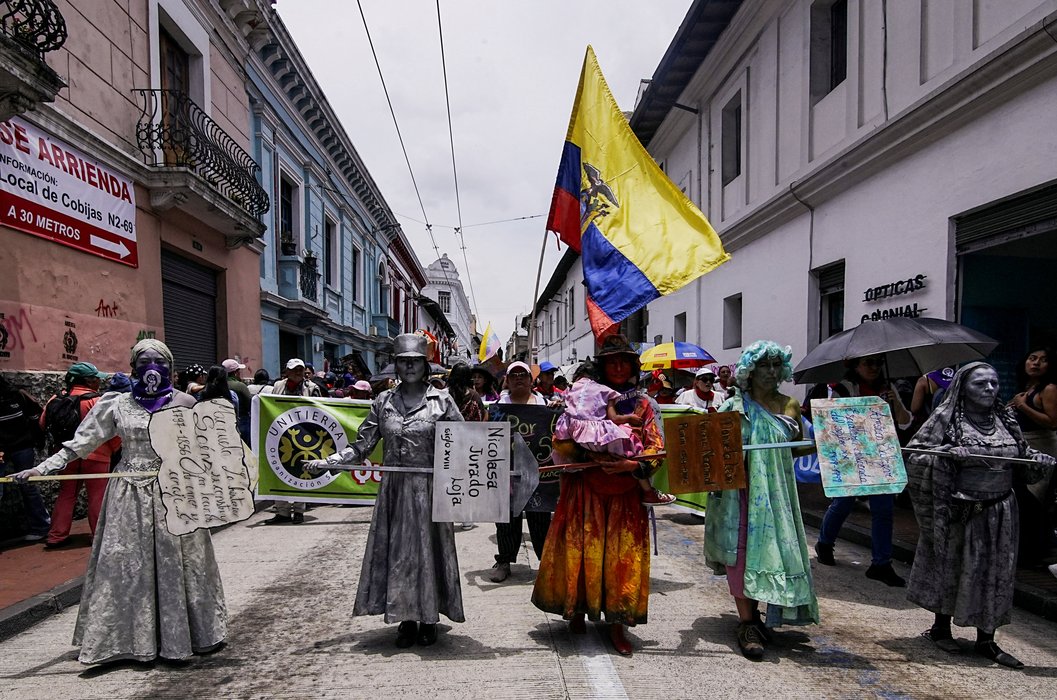
On 8th March 2025, thousands of people marched in cities across Ecuador to mark International Women’s Day and to denounce rising levels of gender-based violence. The largest march took place in Quito, where women, Indigenous and Afro-descendant leaders, LGBTQI+ people, and families of femicide victims walked through the city centre to Santo Domingo square, near the Government Palace, which was surrounded by police and barriers. Demonstrations also occurred in Cuenca and Guayaquil, where participants highlighted cases of sexual violence, femicide, and disappearances of women and children.
Other developments
Communities put mining on trial in People’s Tribunal
On 19th February 2025, communities across Ecuador came together in Quito at the 15th Local Tribunal on the Rights of Nature to put mining projects—particularly operations dominated by Canadian companies—on trial. Cases from six territories—Las Naves, Kimsacocha, Warintza, Nabón, Fierro Urco and Palo Quemado/Las Pampas—revealed how extractive projects are eroding fragile ecosystems and threatening water, biodiversity and community survival.
The tribunal underscored the need for accountability, stronger safeguards, and recognition of community sovereignty. It forms part of a wider international movement, linking with the 6th International Tribunal on the Rights of Nature in Toronto, which will focus on the role of Canadian mining companies. Together, the tribunals illustrate a growing international movement demanding that extractive industries face scrutiny and that ecosystems receive stronger protections.
Organisers emphasised that these civil society-led tribunals are pioneering tools for challenging extractive practices. They argued that the hearings not only documented systemic violations but also helped to establish legal precedents that could guide future cases. People’s Tribunals are grassroots forums that operate like courts to investigate human rights violations. Their rulings don’t carry legal force, but they have moral and symbolic power, shining a spotlight on cases that governments and courts often ignore.
Case of the Tagaeri and Taromenane Peoples v. Ecuador
On 13th March 2025, the Inter-American Court of Human Rights notified its judgment in the case of the Tagaeri and Taromenane Indigenous Peoples v. Ecuador. The Court found the State responsible for violations of collective property and other fundamental rights after authorising mining and oil projects in their territories, despite constitutional protections.
The case, the first in the Court’s 45-year history to address Indigenous peoples in voluntary isolation (PIAV), concerned the international responsibility of Ecuador for violations of the rights of the Tagaeri and Taromenane peoples—two Waorani sub-groups living in voluntary isolation in the western Amazon. These groups inhabit nomadic territories in and around Yasuní National Park, an area subject to significant oil and logging pressures. Although Ecuador had designated the Zona Intangible Tagaeri Taromenane (ZITT) to prohibit external interference, the State failed to enforce its protections.
The ruling requires Ecuador to adopt legislative, administrative and judicial measures to guarantee the rights of the Tagaeri and Taromenane. It ordered the closure of extractive activities in Block 43 of Yasuní National Park, reparations for material and immaterial damages, and the creation of a technical commission to monitor the ZITT. The Court also instructed investigations into past massacres and reparations for two Taromenane girls who were forcibly captured and separated during a violent conflict in 2013.
As analysed by legal experts, this judgment consolidates and extends the Court’s Indigenous jurisprudence in three important ways. First, it explicitly situates voluntary isolation within the category of protected statuses under the American Convention, aligning with earlier case law on vulnerable groups but expanding its application to communities whose survival depends on remaining uncontacted. Second, by identifying non-contact as a binding principle, the Court reconciles the tension between free, prior and informed consent and isolation, clarifying that the refusal of contact itself constitutes a form of consent that must guide State action. Third, the transformation of the precautionary principle into a justiciable obligation marks a bold integration of environmental and human rights law, carrying implications for both Inter-American and universal systems.
The decision’s broader significance lies in its precedent value. Approximately 200 groups of Indigenous peoples in voluntary isolation or initial contact live globally, with at least 66 confirmed in the Americas. The Court’s recognition of voluntary isolation as a protected status and its articulation of non-contact as a binding principle may shape the interpretation of the United Nations Declaration on the Rights of Indigenous Peoples (UNDRIP), ILO Convention No. 169, and future jurisprudence in both regional and international human rights forums.