This update covers developments relating to the freedoms of expression, association and assembly in Mexico from 1st November 2024 to 31st March 2025.
Introduction
Teuchitlán mass grave discovery rekindles spotlight on Mexico’s enforced disappearance crisis
On 5th March 2025, Guerreros Buscadores de Jalisco—a collective searching for their missing relatives—found three clandestine crematoria and charred human remains at a ranch in the municipality of Teuchitlán, Jalisco. Searching mothers also uncovered hundreds of shoes and garments, notebooks, photographs, personal belongings, and even a farewell letter—alongside bullet casings, magazines, and metal restraints.
Authorities had already inspected the same ranch in September 2024, but according to Jalisco’s Attorney General they found nothing at the time due to the property’s large size. However, that earlier operation resulted in the arrest of ten people and the rescue of two others.
The proximity of the Teuchitlán site to federal security installations raised urgent questions about state complicity and the blurred lines between organised crime and law enforcement. Security forces have repeatedly been implicated in high-profile cases, including the abduction of 19 construction workers in Nuevo León in 2011, and the 2014 enforced disappearance of 43 students from Ayotzinapa.
The Teuchitlán site has become a grim symbol of Mexico’s deepening crisis of enforced disappearances. According to the IBERO Human Rights Programme, Mexico registered a record 31,083 disappearances in 2024 alone. Jalisco remains the epicentre with over 15,500 recorded disappearances. The country’s national registry has listed more than 125,000 people as disappeared in the 21st century.
Despite the scale of the crisis, President Claudia Sheinbaum initially omitted enforced disappearances from her policy agenda. It was only after the Teuchitlán discovery that the issue re-entered public discourse. The president announced a series of measures, including a decree to allocate funding to key institutions and proposed reforms to existing laws.
Mothers and fathers searching for their relatives carry out field investigations in conditions marked by fear, threats and insecurity. As documented by civil society, over 300 people involved in locating the disappeared currently remain under protective measures issued by the federal Mechanism for the Protection of Human Rights Defenders (see association).
🇲🇽"The discovery exposed the brutality of organised crime and the omissions, negligence and cover-ups that have allowed it to operate with total impunity for so long."- @AnnaKarolinaCh of @CEPAD_AC on enforced disappearances in Mexico
— CIVICUS (@CIVICUSalliance) April 24, 2025
🔗https://t.co/ubJ9DwSC20 pic.twitter.com/wgSw7VRhke
Association
Disappearances, killings and stigmatisation of searchers
On 5th November 2024, Luz Alejandra Lara Cárdenas and Óscar Iván Jiménez disappeared on the Pan-American Highway in Apaseo el Grande, Guanajuato. Both are members of the Search Project Collective (Colectivo Proyecto de Búsqueda), a group formed by relatives of disappeared persons to organise and carry out search activities, and advocate for truth and justice.
They are also the son and daughter-in-law of Blanca Patricia Torres, a searching mother who has spent seven years looking for another of her children, Jesús Abel Jiménez, who went missing in the same municipality in 2017. Torres, also a member of the collective, has long denounced the lack of progress in the investigation and has publicly challenged official figures on disappeared persons.
The collective has repeatedly called for stronger protection for searchers, who often carry out investigative work themselves in the absence of effective state action. Their disappearance follows that of Lorenza Cano Flores, a member of Salamanca United Searching for Missing Persons Guanajuato (Salamanca Unidos Buscando Desaparecidos Guanajuato), who went missing in January 2024.
On 9th November 2024, the UN Office of the High Commissioner for Human Rights in Mexico (OHCHR in Mexico) urged authorities to coordinate investigative and search efforts, ensuring relatives’ participation in line with international standards, including the Guiding Principles for the Search for Disappeared Persons.
1/2 Expresamos nuestra preocupación por la desaparición de Óscar Iván Jiménez Torres y Luz Alejandra Lara Cárdenas, integrantes del Colectivo Proyecto de Búsqueda, quienes fueron vistos por última vez el martes 5 de noviembre de 2024, en Apaseo el Grande, #Guanajuato.
— ONU-DH México (@ONUDHmexico) November 9, 2024
In a separate case, on 10th March 2025, municipal police in Poza Rica, Veracruz, allegedly arbitrarily detained and beat Magdaleno Pérez Santes, a searching father from the “Colectivo de Búsqueda María Herrera de Poza Rica.” He died hours later at his home. Pérez Santes was the father of Diana Paloma Pérez Vargas, a high school student who disappeared in November 2019 on her way to school. According to civil society organisations, police officers detained him, assaulted him, and released him a few hours later. He returned home the next day, reported feeling unwell, and died shortly afterwards. Families of the disappeared in Veracruz denounced his death and demanded justice.
🕊️ Colectivos de búsqueda exigen la disolución de la Policía Municipal de Poza Rica tras la muerte del padre buscador Magdaleno Pérez Santes. #Veracruz pic.twitter.com/8boo2ds5aO
— e-veracruz.mx (@econsulta_ver) March 13, 2025
Searching mothers, fathers, and other next of kin in Mexico face constant security risks. In the past 15 years, 28 people engaged in search work have been killed or disappeared. According to data from Article 19, between 2010 and March 2025, there were 24 documented killings and four disappearances of searchers. The states with the highest number of such cases are Guanajuato, Michoacán and Sonora, and Sinaloa, Veracruz and Jalisco. In Jalisco, the discovery of Rancho Izaguirre in Teuchitlán earlier this month underscored the ongoing dangers (see introduction).
Searchers also face illegal surveillance, doxxing, online attacks, smear campaigns and public vilification that stigmatise and delegitimise their work. For instance, on 18th December 2024, during a hunger strike in Tuxtla Gutiérrez, Chiapas, various individuals publicly accused members of the Mothers in Resistance Collective (Colectiva Madres en Resistencia) of receiving money from the government. The Collective has worked for more than three years in Chiapas to defend human rights, pursue truth and justice in femicide cases they accompany, and search for their disappeared relatives.
On 1st February 2025, while the Collective carried out search activities in Berriozábal, municipal staff posted on the Collective’s social media that “those women searchers should be beaten so they stop bothering.” On 5th February, municipal staff from Berriozábal removed and discarded the organisation’s search notices from public spaces. On 17th February, according to the Collective, an unidentified individual monitored the home of one of its members.
The Collective stated that these incidents form part of a series of acts of aggression perpetrated by state and municipal authorities, as well as private actors, with the intention of obstructing their legitimate work in pursuit of truth and justice. Civil society organisations have documented a marked increase in attacks and attempts to criminalise the group, generating an increasingly unsafe environment for its members.
#México @FrontLineHRD, la @RedTDT y @sipazchiapas expresamos profunda preocupación ante el reciente incremento de agresiones y hostigamiento hacia la Colectiva Madres en Resistencia del estado de #Chiapas. Lee el comunicado conjunto en: https://t.co/EgtVpZv7po pic.twitter.com/3fsaajalmZ
— FLD Américas (@FLDAmericas) February 21, 2025
Killings and criminalisation of Indigenous leaders amid pushback to megaproject in Oaxaca
Serious concerns over civic space violations have emerged in Oaxaca as four Indigenous leaders were killed between January and February 2025, in the context of opposition to the Interoceanic Corridor of the Isthmus of Tehuantepec, a state-backed infrastructure project crossing ancestral lands. The corridor aims to connect Mexico’s Pacific and Atlantic coasts through ports, railways, highways, airports, gas pipelines and a fibre-optic network.
On 21st January 2025, Indigenous Ayuuk leader Arnoldo Nicolás Romero was found dead with multiple gunshot wounds. He was a municipal commissioner of the ejido of Buena Vista in San Juan Guichicovi (Oaxaca) and a former member of the Union of Indigenous Communities of the Northern Zone of the Isthmus (Unión de Comunidades Indígenas de la Zona Norte del Istmo, UCIZONI).
His body was located on a private ranch, hidden in bushes approximately 50 metres from a rural road connecting Buenavista with Santa Ana. At the time of writing, no suspects have been identified, and no arrests have been reported. Romero’s community and civil society organisations have linked the fatal attack to his public opposition to a megaproject.
Three weeks later, on 13th February, three Indigenous members of the UCIZONI—Wilfrido Atanacio, Victoriano Quirino and Abraham Chirino— were killed in an armed attack in the border area between Santo Domingo Petapa and San Juan Mazatlán, also in Oaxaca. Additionally, The “El Platanillo” community remains barricaded due to ongoing threats, according to the Gobixha Comprehensive Human Rights Defence Committee (Comité de Defensa Integral de Derechos Humanos Gobixha, CODIGODH).
These incidents form part of a broader pattern of violence against Indigenous communities opposing the corridor. In July 2023, a civil observation mission visited Mogoñé Viejo, Santa María Mixtequilla, Santa Cruz Tagolaba and Puente Madera. Its report found that communities defending land and territory—whether by rejecting the corridor outright or raising specific questions—had faced continuous aggression over the past three years.
Perpetrators identified included state authorities, companies and individuals with vested interests in the project’s construction. Between May 2021 and May 2024, at least 72 attacks were recorded, comprising more than 226 documented acts of aggression, including harassment, physical assaults, suspected enforced disappearances, forced internal displacement, arbitrary detention, criminalisation and killings.
Peace Brigades International Canada called for further research on the role of private actors involved in the project, including Canadian companies.
Furthermore, by the end of 2024, at least 61 defenders—predominantly Indigenous—faced criminal proceedings for peaceful opposition to the corridor. In January 2025 alone, UCIZONI reported new charges against 24 community leaders from Mogoñé Viejo and Rincón Viejo
📢 Exigimos un alto a los ataques contra personas indígenas defensoras del territorio en el Istmo de #Oaxaca
— ARTICLE 19 México y Centroamérica (@article19mxca) February 18, 2025
🗣️ La Misión Civil de Observación ha denunciado agresiones contra personas y comunidades indígenas que se oponen al Corredor Interoceánico:https://t.co/uTv5O9LMuS pic.twitter.com/TIMhI2xXTe
Killings of environmental and Indigenous defenders in Jalisco, Oaxaca and Puebla
A series of targeted killings has intensified concerns over the safety of environmental and Indigenous rights defenders in Mexico, a country already facing one of the world’s highest rates of lethal attacks against human rights defenders. Some of the cases are summarised below:
On 4th November 2024, two unknown people fatally shot environmental defender Abraham Alejandro Gobel Gómez 12 times at close range when he arrived at a location in Jalisco, where they had arranged to meet under the pretext of purchasing his motorcycle. They fled immediately, leaving behind all of his personal belongings. Civil society organisations stated that his environmental work likely motivated the attack.
Gobel Gómez belonged to two organisations that opposed Jalisco’s vehicle verification programme. For over ten years, he criticised the programme as a scheme by governments to raise money and force people to update their vehicles, mainly to benefit large foreign companies, according to several organisations.
On 6th November 2024, two armed men fatally shot Triqui Indigenous defenders Adriana and Virginia Ortíz García in the historic centre of Oaxaca City, moments after they exited a taxi. Both women had travelled to the city in connection with their community advocacy work. Adriana and Virginia, Indigenous women from the Triqui people, actively defended land and territory rights. As members of the Triqui Unification and Struggle Movement (Movimiento de Unificación y Lucha Triqui, MULT), they denounced the dispossession of ancestral lands and natural resources impacting Triqui communities in Oaxaca.
The Observatory for the Protection of Human Rights Defenders—a joint initiative of FIDH and OMCT—urged the authorities to investigate the possibility that the killings were carried out in reprisal for their environmental and human rights work, and to prioritise this line of inquiry in the ongoing criminal investigation.
📣⚠️🚨#AlertaDefensoras MÉXICO / Asesinan en Oaxaca a Adriana y Virginia Ortiz García, defensoras indígenas triquis.
— IM-Defensoras (@IM_Defensoras) November 6, 2024
📌Más información➡️ https://t.co/lTeKV2yC1i pic.twitter.com/P4VNqblkzV
On 27th November 2024, armed men shot and killed environmental defender Marcos Sánchez Pereira inside his private vehicle while he travelled to a communal landholding meeting (asamblea ejidal) in San Salvador El Verde, Puebla. Marcos led efforts to protect forests in the region and opposed illegal logging.
The Puebla State Attorney General’s Office directly linked his killing to the murders of three other environmental defenders from the same ejido: José Ángel Pelcastre, Ventura Ojeda, and Florentino Castro. All three, like Marcos, served as forest guards and members of the same communal landholding (ejido), and organised collectively to prevent illegal logging operations affecting communal lands.
On 17th January 2025, two unidentified persons on a black motorcycle shot and killed Sergio Cruz Nieto, an Indigenous Nahua human rights defender, while he was driving his vehicle in Tehuacán, Puebla. Cruz Nieto was a member of Unity for Coyomeapan (Unidad por Coyomeapan), a community-based organisation seeking justice for the violent deaths and arbitrary detentions of members of the Nahua community in Puebla.
Members of the Unity for Coyomeapan had previously requested inclusion in the Federal Protection Mechanism for Human Rights Defenders and Journalists, following repeated security incidents. However, the authorities did not implement the measure. Relatives and members of Unity for Coyomeapan publicly condemned the killing and called for an impartial, prompt and effective investigation to identify, prosecute and sanction those responsible. They expressed concern that the killing may be linked to Cruz Nieto’s human rights work.
On 28th February 2025, two unidentified persons on a motorcycle fatally shot environmental defender Cristino Castro Perea while he was at the community kiosk in Barra de la Cruz, Oaxaca—a space used for information sharing, community services and local engagement. Castro founded the Collective of Environmental Defenders of Barra de la Cruz in 2013 to protect beaches and combat mangrove deforestation.
He and his colleagues had received protective measures under Mexico’s Protection Mechanism for Human Rights Defenders and Journalists after previous attacks, including a 2021 armed assault that left a fellow defender seriously injured. The Oaxaca State Attorney General’s Office confirmed that the family had not reported direct threats but is investigating his environmental and land defence work as a possible motive.
Barra de la Cruz, home to around 1,300 people, is part of a key biological corridor for jaguar conservation and hosts extensive forests, coastal dunes and mangroves. It is also a critical nesting site for three species of sea turtles. In January 2024, then-President Andrés Manuel López Obrador declared the Barra de la Cruz–Playa Grande area a protected natural sanctuary, banning land-use changes and permitting only low-impact tourism. Despite this, local organisations have warned that the area remains under threat from private interests and land speculators. Civil society reports that land grabs often follow patterns of intimidation, aimed at pressuring communities to relinquish communal rights.
The OHCHR in Mexico and national civil society organisations condemned the killing. They urged the state to fully implement the Escazú Agreement to prevent attacks against environmental defenders. According to the grassroots organisation Wings and Roots of Social Movements in Oaxaca (Alas y Raíces de los Movimientos Sociales en Oaxaca), Oaxaca is the most dangerous state in Mexico for human rights defence. Between December 2018 and October 2024, of the 225 defenders killed nationwide, 58 were from Oaxaca—nearly 26 per cent.
1/2 Condenamos el asesinato del defensor de #DerechosHumanos Cristino Castro Perea, ocurrido ayer en la comunidad de Barra de la Cruz, Santiago Astata, #Oaxaca.
— ONU-DH México (@ONUDHmexico) March 2, 2025
Su colectivo, “Defensores Ambientalistas de Barra de la Cruz”, es beneficiario del Mecanismo de Protección.
Human rights defenders face attacks and criminalisation amid escalating violence in Chiapas
As previously reported, Chiapas is experiencing a significant escalation in violence and forced internal displacement. Civil society organisations have attributed this displacement primarily to intensifying conflicts between organised criminal groups, including the expansion of the Jalisco New Generation Cartel (CJNG) into territories traditionally controlled by the Sinaloa Cartel. The struggle for territorial control has led to violent confrontations with local armed groups and increased the vulnerability of the civilian population.
Between January 2023 and June 2024, the Fray Bartolomé de Las Casas Human Rights Centre documented 20 incidents of forced internal displacement affecting approximately 15,780 persons from the municipalities of Pantelhó, Frontera Comalapa, Chicomuselo, Oxchuc, Las Margaritas, Huixtán, Chenalhó, Ocosingo, La Trinitaria, Socoltenango, La Concordia, Bella Vista and Tila. In the Frontera and Sierra regions alone, 8,190 persons were displaced as a result of violence attributed to the criminal organisation.
This context of unrestrained expansion of organised crime and paramilitary groups has created an extremely hostile environment for defenders. Moreover, civil society reported that these dynamics have been facilitated, through acts, omissions or acquiescence, by the armed forces and by local and federal public security institutions, in collusion with officials at municipal, state and federal levels.
Within this deteriorating security situation, defenders who denounce organised criminal activity, defend Indigenous territorial rights, or support victims of human rights violations have faced heightened threats, targeted attacks, and criminalisation. For instance, since October 2022, Indigenous Tzotzil human rights defenders Reynaldo Pérez Pérez and José Vásquez Gutiérrez have faced repeated security incidents, including death threats, an attempted abduction and two armed attacks. According to civil society organisations, public officials may have participated in these incidents.
Both defenders filed at least three complaints with the authorities, but the authorities failed to investigate, prosecute, and sanction those responsible with due diligence. Although the two defenders benefit from the Protection Mechanism for Human Rights Defenders and Journalists, the measures adopted have not addressed the level of risk they face.
These attacks have taken place amid escalating violence in the Los Altos region of Chiapas, where Pérez and Vásquez work. Both support victims of human rights violations, including enforced disappearance and forced displacement. Pérez collaborates with Human Rights Diplomatic Peace Corps (Derechos Humanos Cuerpos Diplomáticos de Paz), and Vásquez belongs to The Bees of Nuevo Yibeljoj.
On 3rd December 2024, the conflict intensified when an armed group seized the municipal presidency of Pantelhó after the election of a municipal council allegedly composed of people linked to organised crime. The seizure also responded to a series of attacks on residents attributed to organised crime.
In response, on 17th February 2025, four UN Special Rapporteurs expressed deep concern for the safety of Pérez and Vásquez. The Rapporteurs urged the authorities to investigate the attacks promptly, impartially and effectively, prosecute those responsible, and adopt all necessary measures to guarantee the defenders’ protection in line with international human rights standards.
In a separate case, an Indigenous human rights defender is facing charges over violent unrest in which his own home was burned down. On 30th January 2025, the Control and Trial Judge of the Common Jurisdiction in Chiapas confirmed the detention of Mario Gómez López, notwithstanding a ruling in an amparo proceeding ordering his release.
The Court charged him with “offences against the peace, bodily integrity, and patrimony of the community and the State” under article 369 of the Chiapas Penal Code, in connection with events in San Cristóbal de Las Casas on 17th April 2023. On that date, armed men set fire to several houses—including Gómez López’s—and blocked roads following the killing of a market leader. Gómez López denies any involvement, stating that he was caring for his ill mother when the attack took place.
Municipal police had detained him arbitrarily on 14th January 2025 at a checkpoint without a warrant or explanation. Authorities entered false information into the National Detention Registry, held him incommunicado and refused family visits under an unpublished rule. His relatives only confirmed his location on 25th January, finding him at the State Centre for Social Reintegration (CERSS) No. 14 “El Amate.” Prison authorities continued to deny visits, citing the unverified regulation.
On 4th March 2025, the UN Special Rapporteur on Human Rights Defenders and Working Group on Arbitrary Detention expressed serious concern that Gómez López’s detention and prosecution may constitute a misuse of criminal law in retaliation for his legitimate human rights defence work, including denouncing organised criminal activity in his community and seeking justice for the killing of his son.
They also highlighted allegations of due process violations, including incommunicado detention, false detention records, and the use of an unverified visitation rule. Such measures undermine the work of Indigenous human rights defenders and create a chilling effect on others engaged in similar activities.
Gómez López is a Maya-Tzotzil human rights defender and construction worker from the Santa Cruz community, part of the Cuxtitali El Pinar ejido in San Cristóbal de Las Casas, Chiapas. From his community, he has promoted the rights of Indigenous peoples by denouncing the presence of criminal groups competing to seize Indigenous territories through violence. He has worked locally to defend the community, organised peaceful protests, and advocated for justice in the killing of his son, Mateo Gómez López, in 2021 in the same context of insecurity.
Due to his human rights work, Gómez López and his wife, Pascuala López López—also a human rights defender—have faced threats and attacks. In April 2022, she survived an attempted femicide after denouncing the presence of criminal groups in the community and demanding justice in Mateo’s case. Both defenders have benefited from precautionary measures granted by the Inter-American Commission on Human Rights (IACHR) since 2023.
Recibo noticias muy preocupantes sobre la presunta detención arbitraria del defensor de derechos humanos Marío Gómez López en Chiapas, #México. Como su esposa, la defensora Pascuala López López, Marío es beneficiario de medidas cautelares de la CIDH. Debe ser liberado…
— Mary Lawlor UN Special Rapporteur HRDs (@MaryLawlorhrds) January 25, 2025
Women’s rights defender targeted
In early February 2025, unknown people tried to force open the gate of the home of Mariana Ávila Montejano, a human rights defender and President of the Observatory on Social and Gender Violence in Aguascalientes (Observatorio de Violencia Social y de Género de Aguascalientes), putting her security at risk. Over the same weekend, members of the collective reported other security incidents.
This is not the first time the collective has faced attacks. In June 2024, a fire damaged part of the Observatorio’s facilities shortly after the organisation filed a series of complaints involving high-level public officials. The National Network of Women Human Rights Defenders in Mexico (Red Nacional de Defensoras de Derechos Humanos en México, RNDDHM) reported that between 2020 and 2023, 33 women human rights defenders and journalists were victims of femicide, and attackers attempted to kill another 23. The network’s national registry recorded 1,547 women defenders and journalists suffering a total of 6,870 different attacks during that period.
Civil society organisations called on the authorities to activate the necessary protection mechanisms to guarantee the free exercise of human rights defence. They stressed that these incidents represent a serious threat to the safety of the collective.
Maya environmental defender in Yucatán faces criminal charges
On 7th November 2024, Wilberth Nahuat Puc, Sub-Commissioner of the Maya community of Santa María Chí and an environmental human rights defender, was summoned to appear before an Interim Judge of the Second Court of Control in Yucatán’s First Judicial District. The State Public Prosecutor’s Office has brought charges of alleged unlawful dispossession of property and illegal deprivation of liberty, stemming from a peaceful protest in May 2023 in which community members blocked access to a large pig farm.
The facility, which houses around 49,000 pigs, is located within the Ring of Cenotes subzone and close to ecologically significant areas, including the “Sitpach aguada” and the “Xpuchil” and “Altillo” cenotes. Community members, represented by Nahuat Puc, have filed constitutional injunctions (amparos) against the company and federal, state and municipal authorities, alleging violations of the rights to health, water and a healthy environment. The farm reportedly operated for more than three decades without community consent or an environmental impact assessment, in breach of Yucatán’s Ecological Zoning Programme.
The criminal complaint against Nahuat Puc was filed by the company’s legal representative, after Puc played a leading role in advancing legal action to halt the farm’s operations. Civil society organisations view the proceedings as part of a wider pattern of criminalisation of environmental defenders in Yucatán. In 2023, residents of Sitilpech, in Izamal municipality, also faced judicial harassment and repression for opposing an industrial pig farm.
According to the Mexican Centre for Environmental Law (Centro Mexicano de Derecho Ambiental, CEMDA), Mexico is among the most dangerous countries in the world for environmental defence, with 123 documented incidents of aggression in 2023, including 20 killings.
Civil society organisations called on authorities to terminate the proceedings and close any investigation connected to Nahuat Puc’s defence of human rights. They also urge state and federal authorities to halt large-scale projects in Maya territory that undermine Indigenous people’s right to self-determination, threaten land rights and weaken social cohesion.
Expression
Journalists murdered across the country
In the first quarter of 2025, Mexico has witnessed lethal violence against the press, with at least four journalists killed in different states, underscoring systemic failures in protection mechanisms and entrenched impunity.
On 17th January 2025, unidentified assailants gunned down journalist Calletano de Jesús Guerrero in Teoloyucan, State of México. Guerrero was deputy director general of the news website Global México, which mainly covers national political news. Four days before his death, unknown people violently attacked his home. Guerrero had been under the protection of the Federal Protection Mechanism for Human Rights Defenders and Journalists since 2014, following repeated threats related to his professional work.
International press freedom organisations, including Reporters Without Borders (RSF), condemned the killing and called on the Government of Mexico to urgently take steps to protect the lives and physical safety of journalists. “RSF strongly condemns the murder of Calletano de Jesús Guerrero and calls on the Mexican government to take urgent measures to protect the lives and physical safety of journalists. Impunity and shortcomings in the protection system must be addressed without delay to avoid further tragedies. It is essential that concrete measures are taken to end the violence against journalists and to guarantee they can work in a safe environment. We urge President Claudia Sheinbaum to honour her pledge to our organisation and her country’s journalists and establish a working group responsible for creating a protection plan for Mexico’s journalists and information space”, said Artur Romeu, Director of RSF’s Latin America Bureau.
Subsequently, the State of Mexico Attorney General’s Office (FGJEM) issued a press release alleging links between Guerrero and his relatives to organised crime, without prior contact with his family or colleagues, and without granting them access to the investigation file. In response, the press freedom organisation ARTICLE 19 – Regional Office for Mexico and Central America, stated that this public narrative, amplified by national media, constitutes stigmatisation and criminalisation, placing his family and Global México staff at further risk. They also affirmed that the authorities failed to apply the Standardised Protocol for the Investigation of Crimes Committed against Freedom of Expression, omitting a contextual analysis of his recent reporting.
📌#Comunicado
— ConsejoMecanismo (@CMecanismo) January 19, 2025
El Consejo Consultivo del @Mecanismo_MX condena el asesinato del #periodista Calletano de Jesús Guerrero ocurrido en el #EstadoDeMéxico
La libertad de expresión y ejercicio periodístico son un derecho y actividad fundamentales para la vigencia de la democracia pic.twitter.com/iFcSi1tZMm
One week later, on 24th January 2025, unidentified persons abducted journalist Alejandro Gallegos León in Tabasco. The next day, authorities located his remains in the town of Cárdenas. Gallegos edited the Facebook-based news outlet La Voz del Pueblo, worked as a lawyer, and taught at Alfa y Omega Presbyterian University in Tabasco. His outlet primarily published short news articles and videos on regional politics, generally in a neutral tone, and did not extensively cover the recent spike in criminal violence in the state.
The Tabasco State Prosecutor’s Office opened an investigation on 25th January but did not release further details. Four days later, Governor Javier May announced the arrest of a suspect without providing additional information. The Committee to Protect Journalists (CPJ) reported that Gallegos was not enrolled in the Federal Mechanism for the Protection of Human Rights Defenders and Journalists.
On 2nd March 2025, two unidentified assailants on a motorcycle shot and killed journalist Kristian Zavala and another man while they travelled along a highway in Silao, Guanajuato. Zavala, founder and editor of the Facebook-based news outlet El Silaoense MX, reported on local politics and security.
Zavala had requested state protection in 2021 after receiving threats and had enrolled in the Federal Mechanism for the Protection of Human Rights Defenders and Journalists. In its statement, the CPJ was unable to confirm whether he remained under state protection at the time of the killing.
The State Attorney General’s Office is investigating the killing. CPJ’s Mexico representative described Zavala’s death as the third fatal attack on journalists in Mexico in 2025, underscoring the country’s status as the deadliest nation in the Western Hemisphere for the press. CPJ ranked Mexico fourth on its 2024 Global Impunity Index, reflecting the country’s high rate of unpunished killings of journalists.
Less than two weeks later, on 13th March 2025, armed assailants abducted and killed journalist Raúl Irán Villarreal Belmont in San Luis de la Paz, Guanajuato. Witnesses reported that the attackers entered a colleague’s law office, threatened Villarreal’s young daughter and two assistants and forced him into his own vehicle. Neighbours assisted the three women, who immediately filed a complaint with the State Prosecutor’s Office. Hours later, authorities found Villarreal’s body, bearing multiple gunshot wounds, on the Victoria–Xichú highway.
Villarreal Belmont, founder and director of the Facebook news outlet “Observatorio Ciudadano”, also worked as a lawyer and human rights defender. Three days before his killing, he had published an article denouncing an alleged fraud involving a local business leader and government officials, calling on the public to file a collective complaint.
Villarreal Belmont received repeated threats for his investigative reporting, which frequently exposed corruption in the administration of San Luis de la Paz Mayor Rubén Urías (National Action Party) and recently highlighted alleged electoral fraud in Xichú, Guanajuato. In addition to his journalistic work, he engaged in local politics, running for the San Luis de la Paz city council with the Movimiento Ciudadano party in 2024 and for mayor in 2021. The Guanajuato State Prosecutor’s Office is investigating the killing under the Unified Protocol for Crimes Against Freedom of Expression. Governor Libia Dennise García Muñoz Ledo pledged her administration’s cooperation and confirmed that Villarreal Belmont’s family is receiving legal and psychological support.
According to RSF, Guanajuato is one of Mexico’s most dangerous regions for journalists, amid violence linked to organised crime. Mexico ranks 121st of 180 in the 2024 RSF World Press Freedom Index and remains the deadliest country for journalists outside of war zones.
📸 Ante la desaparición y homicidio de Raúl Irán Villareal en #Guanajuato, el Estado debe actuar.
— ARTICLE 19 México y Centroamérica (@article19mxca) March 19, 2025
📢 Exigimos a FEADLE de la @FGRMexico atraiga el caso e investigue de manera expedita.
⬇️ Aquí más información:https://t.co/9mjquvW7pM pic.twitter.com/ZYMVMREqZo
Armed attack on journalist in Nuevo León
On 1st December 2024, unknown assailants shot and injured journalist Victoria Monserrat García in Montemorelos, part of Nuevo León’s citrus-producing region. García, a reporter for Marmat Noticias, had been returning from covering a Christmas tree lighting event in Montemorelos’ main square. Around 20:30, as she drove along Bulevar Capitán Alonso de León in her silver Jeep Cherokee Laredo, the attackers opened fire, striking her vehicle multiple times and injuring her in both arms.
Despite her injuries in both arms, García continued driving to the facilities of the State Investigations Agency in the Zaragoza neighbourhood to seek help. Paramedics from the Mexican Red Cross provided first aid and transported her to hospital under police guard. Medical staff later confirmed she was in a stable condition.
The Coalition for Women in Journalism condemned the attack and criticised the lack of public response from the Nuevo León State Prosecutor’s Office. It also urged authorities to ensure García’s immediate protection, conduct a prompt and impartial investigation, and bring those responsible to justice.
#Mexico: Women Press Freedom strongly condemns the shooting of journalist #VictoriaMonserratGarcía in Montemorelos. Her truck was riddled with bullets, leaving her wounded after she was shot at by unknown assailants on Dec 1.
— #WomenInJournalism (@CFWIJ) December 11, 2024
The reporter for Marmat Noticias, suffered a gunshot… pic.twitter.com/lb7aEA7AoY
Police assault on journalists in Nuevo León and Tabasco
On 14th March 2025, municipal officials and security personnel from the government of Cadereyta, Nuevo León, assaulted journalist Ana Edith Ronquillo García inside the Municipal Palace. While covering a public council session, Ronquillo approached Mayor Carlos Rafael Rodríguez Gómez to request information on his administration. A woman municipal officer handcuffed her and forced her to leave the building.
The Advisory Council of the Federal Mechanism for the Protection of Human Rights Defenders and Journalists condemned the excessive use of force and described the incident as a violation of freedom of expression, the right to information, and women’s right to live free from violence. The Council stressed that Mexican law requires municipal council sessions to be public and obliges public officials to ensure transparency and accountability.
The Council also called on the Nuevo León State Human Rights Commission, the Nuevo León State Prosecutor’s Office, and the Special Prosecutor’s Office for Crimes against Freedom of Expression (Fiscalía Especial para la Atención de Delitos cometidos contra de la Libertad de Expresión, FEADLE) to conduct a prompt, gender-sensitive investigation.
In a separate case, on 11th March 2025, a police officer from the Tabasco State Secretariat of Security and Citizen Protection injured photojournalist Luis Manuel López Chablé while he covered a homicide case. López, who works for El Universal, photographed the crime scene from the Frontera–Coatzacoalcos highway when the officer pushed him onto the asphalt.
López reported that the push caused a fall, head injury and other physical harm, despite his position more than 100 metres from the scene and beyond the perimeter set by forensic personnel. ARTICLE 19 – Regional Office for Mexico and Central America reported that this attack followed an earlier incident on 5th February 2025, when ministerial police officers and forensic services personnel from the Tabasco State Prosecutor’s Office threatened to detain López as he covered the discovery of two bodies. They argued that his filming “impeded their work” and “violated crime scenes.”
The press freedom organisation also condemned both incidents and called on the Tabasco government to adopt a comprehensive public policy for journalist protection, and on the State Human Rights Commission to open a complaint to ensure accountability and non-repetition.
▶️ El fotógrafo de EL UNIVERSAL en Tabasco, Luis Manuel López fue agredido este martes por un elemento de la policía estatal cuando hacía su labor periodística para este medio.
— El Universal (@El_Universal_Mx) March 11, 2025
VIDEO: Especial pic.twitter.com/SkxuKsiA4S
Journalist covering organised crime in Guerrero assaulted outside his home
On 9th November 2024, unknown armed men in black uniforms assaulted journalist Luis Daniel Nava Jiménez outside his home in Chilpancingo, Guerrero. Nava Jiménez, a correspondent for Proceso and El Sur: Periódico de Guerrero, had just completed coverage of the disappearance and killing of 11 people, in which residents accused state authorities of inaction. The assailants threatened him, saying “We know what you do” (“Ya sabemos a lo que te dedicas”), and stole his mobile phone and laptop containing sensitive information and investigative material on violence in Guerrero, particularly in the state capital.
According to civil society, in the weeks leading up to the attack, between 10th and 22nd October 2024, people posing as military personnel repeatedly called Nava Jiménez to request his home address, claiming they wished to invite him to an event. The 35th Military Zone in Chilpancingo later confirmed that no such event had been scheduled. During this period, the journalist had reported on several incidents linked to violence in Guerrero, including the killing of municipal officials and the role of organised crime in politics.
Press organisations in Guerrero condemned the attack, stressing that journalists operate in an extremely high-risk environment due to the state’s ongoing wave of violence. ARTICLE 19 – Regional Office for Mexico and Central America documented 48 attacks against journalists in Guerrero in 2023, including killings, armed assaults, kidnappings, threats, forced displacement, unlawful entry and theft. The organisation called on the authorities to comply with the state and federal governments’ obligations to provide special protection to journalists.
Arbitrary detention and assault of journalists
On 3rd November 2024, municipal police officers in Irapuato arbitrarily detained, assaulted, and threatened journalists Humberto Gutiérrez Quiroz and Verónica García Pérez, director and cameraperson/editor of the digital outlet Irapuato Despierta y la Región. They were covering a traffic accident on Boulevard San Roque when Gutiérrez approached the scene—still unfenced—to film from a distance of approximately 20 metres. An officer blocked his way, verbally abused him, and assaulted him despite Gutiérrez identifying himself as a journalist. When García began recording, two officers escalated the violence: they repeatedly struck and handcuffed Gutiérrez, while another officer forcibly restrained García, threw her to the ground, handcuffed her, and pressed a boot to the back of her neck.
The officers transported them to a civic judge’s office while issuing threats, tightening their handcuffs, and continuing to assault them. They also told the journalists they knew their identities and workplace. At the holding facility, police reportedly violated due process by confiscating Gutiérrez’s mobile phone without justification and denying both access to legal representation. A forensic doctor failed to conduct a proper medical examination. At around 01:00 on the following day, a judge imposed a 24-hour detention and a fine of nearly 10,000 pesos (USD 537), blaming them for the incident and warning them against testifying. They were released at midday.
In a separate case, on 15th December 2024, security forces arbitrarily detained journalists from Línea Directa and a local Mazatlán outlet while they covered a military operation in the Federico Velarde neighbourhood of Mazatlán, Sinaloa. The journalists were later released. The Institute for the Protection of Human Rights Defenders and Journalists condemned the detentions, stressing that no journalist should face arrest or aggression for exercising the right to inform, given the essential role of journalism in strengthening democracy and safeguarding the right to information.
Death and sexual violence threats against women journalists
On 28th November 2024, unknown persons threatened independent journalist and writer Yohali Reséndiz in Morelos with death and sexual violence. She received a threat and an intimidating video via WhatsApp showing a corpse. Hours later, a man called her from an unknown number, told her to “stop publishing” and threatened to rape and kill her. Reséndiz publicly disclosed the threats on social media.
According to press freedom organisations, including Comunicación e Información de la Mujer A.C. (CIMAC), these incidents form part of a pattern of violence she has faced in recent years in retaliation for her reporting, particularly investigations exposing alleged corruption in the Morelos state government and agencies such as the State Mobility and Transport Coordination. CIMAC also noted the specific and compounded risks that women journalists face, particularly in the digital sphere, where threats often combine digital, psychological and physical harm.
ARTICLE 19’s data from the previous administration recorded 979 attacks against women journalists—28.73 per cent of all documented cases—many aimed at silencing them through fear, including digital attacks that represented more than a quarter of all incidents.
Civil society organisations urged FEADLE to coordinate with the state prosecutor in conducting a prompt, thorough and gender-sensitive investigation, in line with the Homologated Protocol for Crimes against Freedom of Expression. They also called on the Federal Mechanism for the Protection of Human Rights Defenders and Journalists to urgently reassess Reséndiz’s risk level and swiftly strengthen her protection measures.
#Morelos #México
— Yohali Reséndiz (@yohaliresendiz) December 1, 2024
En días pasados fui amenazada por el trabajo periodístico que realizo.
Escuchar que “si no dejo de escribir mamadas van a violarme y luego hacerme pedacitos” es una frase cobarde, anónima, violenta, machista, perversa.
Los números desde donde me amenazaron… pic.twitter.com/VtHnIot5fz
On 20th March 2025, unknown persons threatened journalist Ruby Soriano in Puebla, Puebla, by leaving a toy gun on the windscreen of her car outside her home. Soriano, an independent journalist and director of Los Alquimistas del Poder, has an extensive career covering state and national politics. Her reporting has made her the target of repeated attacks.
The incident occurred days after ARTICLE 19 – Regional Office for Mexico and Central America issued an alert, noting that Soriano had become the subject of a political gender-based violence complaint. As part of the proceedings, the Puebla Electoral Institute ordered her on 25th February 2025 to remove a social media post as a precautionary measure. ARTICLE 19 and CIMAC warned that these actions form part of a sustained pattern of aggression linked to her journalistic work.
Both organisations have urged Mexico’s Federal Mechanism for the Protection of Human Rights Defenders and Journalists to coordinate immediate protection measures for Soriano. They also called on the Puebla State Prosecutor’s Office to investigate the threat without delay, stressing that authorities must ensure an enabling environment for media workers and uphold the right to freedom of expression.
Sports journalist beaten and threatened
On 8th December 2024, a Mediotiempo sports journalist experienced multiple attacks while covering the Liga MX semi-final at Estadio Ciudad de los Deportes, Mexico City. Cruz Azul’s sporting directors and their security staff surrounded him outside the press room, insulted him, attempted to seize his mobile phone, pushed him, and struck him in the ribs. Security personnel removed him from the area. At Gate 1, at least four stadium security staff and officers from the Secretariat of Citizen Security (SSC) held him and issued a death threat, “Tomorrow you won’t wake up”, took his press accreditation, and forced him to walk several streets away.
The following day, the journalist received an intimidating email from an unknown sender. The message reads in Spanish: “No te pares en la cancha pinche [sic] ridículo.” He sustained injuries that required medical treatment and reported fear of reprisals against himself and his family.
ZETA weekly faces threats and cyberattacks
On 29th December 2024, an anonymous banner was hung in the Otay district of the city, carrying threatening messages directed at the press and naming ZETA, a Tijuana-based investigative weekly. Signed “La FEA” and allegedly linked to a criminal group, the banner appeared just days after the outlet published allegations that a suspected cartel member had paid USD 300,000 to avoid arrest:
“This goes out to all the CDS traitorous lowlifes and newspapers — the Flechas have nothing to do with the brothers, no truce or anything; this war is between bastards, not against women and children as you did in SD and in TJ. You haven’t been able to and you never will. X (two crossed arrows) 19. 100% Flechas. The shopkeepers who have been killed are because of the extortion by the CDS themselves. [SIC]. They want to stir up the Flechas. ZETA newspaper, where did your reputation go? Now your reports are unfounded. Tijuana for the Tijuana people. Sincerely, La FEA.”
ARTICLE 19 – Regional Office for Mexico and Central America, which has documented repeated attacks against the paper since its founding, recalled previous assassination attempts on its reporters and noted that at least 19 aggressions have been documented since 2020. The IACHR has warned that the growing influence of organised crime—capable of intimidating communities and infiltrating state institutions—constitutes a grave threat to journalism in Mexico.
The threat was swiftly followed by a new form of digital attack. Between 20th and 23rd January 2025, ZETA’s website experienced sustained Distributed Denial of Service (DDoS) attacks, peaking at 6,750 automated requests per second—over 583 million daily. The scale and sophistication of the assault, aimed at overloading servers and cutting public access to the outlet’s investigations, suggested significant resources and intent to silence. Technical protections were deployed immediately, but disruptions persisted for several days, with full service restored only on 22nd January.
Puebla news outlet hit by cyberattacks after reporting on alleged corruption
In early February 2025, unknown people launched sustained DDoS attacks against the website of MTP Noticias in Puebla to overload its servers and restrict public access. At around midday on 4th February, Director Elvia Cruz López noticed abnormal slowness on the site. A review of traffic logs revealed a surge of atypical automated requests consistent with a DDoS attack. Despite existing digital safeguards, the attack continued, keeping the newsroom on heightened alert.
The cyberattacks began shortly after MTP Noticias published a series of investigations alleging misconduct and corruption. These included the alleged diversion of nearly 700 million pesos (USD 376,000) at the Benemérita Universidad Autónoma de Puebla (BUAP), the issuance of fraudulent academic degrees by a state institution, procurement processes involving conflicts of interest—including the local Congress’s land purchase from the mother of a then–PRI legislator—municipal acquisitions of armoured vehicles, and allegations of nepotism that placed up to 90 relatives on public payrolls. According to the newsroom, three individuals sought the removal of articles through phone calls and in-person visits. Their identities have been withheld due to fears of reprisals.
ARTICLE 19’s Regional Office for Mexico and Central America noted that the incident fits a wider pattern of digital aggression: out of 3,408 documented attacks against the press in the last presidential term, 962 occurred online—28.23 per cent of the total. Puebla ranks third nationwide with 241 recorded incidents, representing 7.07 per cent.
Doxxing and stigmatisation of journalists in Chiapas
On 28th March 2025, at least 18 journalists in Chiapas were subjected to a doxxing attack, when a website and a Facebook page published their names, photographs, employers, and—in some cases—unsubstantiated allegations of links to organised crime.
Among those targeted was freelance photojournalist Damián Sánchez Adrián de Jesús, a contributor to Cuartoscuro. Several of the journalists regularly cover migration, human rights and the work of grassroots collectives defending rights along Mexico’s southern border.
Press freedom organisations have recorded prior incidents in Chiapas, including online threats, physical assaults, arbitrary deprivation of liberty and killings.
Intimidation of journalists
On 22nd November 2024, three correspondents—Alejandro Gómez Sotelo (El Sol de Chilpancingo), Raymundo Ruiz Avilés (El Guerrero) and Marco Antonio Toledo Jaimes (N3 Guerrero Noticias)—faced intimidation and an attempted theft by a security guard assigned to Taxco municipal syndic Viviana Rodríguez Burgos. The incident occurred while they covered a religious event at the Parroquia de Santa Prisca, Taxco de Alarcón, Guerrero.
After the mass ended, the guard approached Toledo Jaimes in a hostile manner and repeatedly asked, “Are you talking to me?” The journalists replied that they did not know him. Gómez Sotelo began recording the hostile situation, and the guard demanded to know why he was filming, grabbed his phone, and tried to leave with it. Gómez Sotelo chased him and recovered the device. Toledo Jaimes, who benefits from the Federal Protection Mechanism for Human Rights Defenders and Journalists, alerted the National Guard. Before they arrived, the syndic and her security team left the area.
On 28th February 2025, three unidentified men in civilian clothing intimidated journalist Miguel Ángel Anaya Castillo at his home in Pánuco, Veracruz. They arrived at his residence at night. A relative answered the door, and the men asked for Anaya Castillo, claiming they brought “a message from the municipal president.”
Anaya Castillo looked through the window and saw the men carrying waist bags; one appeared to hold an object inside. When he questioned their presence, they replied, “It’s just a message, nothing bad, come, let’s talk.” After he refused and they continued insisting, Anaya called the emergency number 911. Seven minutes later, a police siren sounded, and the men left in a grey Versa-type vehicle.
Two days earlier, the journalist had covered a protest in Pánuco where activists and residents demanded that municipal authorities stop operating a landfill that, according to local complaints, had caused illness due to poor waste management. That same day, a fire broke out at the landfill, intensifying community mobilisation.
Anaya Castillo stated that in December 2024, people who claimed to work with the municipal government offered him money and a place on the payroll in exchange for avoiding critical coverage of the administration. Veracruz continues to rank among the most dangerous states for journalists.
⚠️ Hostigan en su domicilio a periodista Miguel Ángel Anaya en #Veracruz.
— ARTICLE 19 México y Centroamérica (@article19mxca) March 4, 2025
Por ello, exigimos al gobierno municipal de Pánuco garantizar el ejercicio de la libertad de expresión.
🔍 Aquí más información:https://t.co/NKHx0f0QsU pic.twitter.com/A9IyCOGevH
Digital media outlet faces intimidation following publication of article
On 7th November 2024, digital news outlet En Primer Plano faced intimidation from Jonathan Catalán, who identified himself as the press officer for Guerrero state legislator Citlali Yaret Téllez Castillo. According to information provided to press freedom organisations, Catalán telephoned a member of the outlet shortly after it published an article about a video showing Téllez driving a Tesla Cybertruck. The article referred to the vehicle’s cost and the reaction it generated on social media. Catalán demanded that the article be removed “before it went viral” and, upon refusal, asked whether the journalist was “aware of the context of violence in the state.”
Following publication, En Primer Plano received stigmatising comments on its Facebook page, including messages condoning violence against the press. The following day, Téllez posted a video on Facebook asserting that the vehicle did not belong to her. While initially apologising for any “misinterpretation”, she also threatened legal action against “all platforms and media that disseminated the videos”, alleging that such dissemination endangered her safety.
Attacks on women journalists covering International Women’s Day protests
On 8th March 2025, at least 19 women journalists experienced multiple attacks while covering International Women’s Day demonstrations in several Mexican cities (see peaceful assembly). According to media reports, in Zacatecas, authorities detained at least five women journalists, including women human rights defenders.
In Morelia, Michoacán, masked protesters assaulted a group of women reporters documenting the march. One reporter from a local outlet was attacked and sprayed with glue. In a separate incident in the same city, protesters pushed another journalist and forced her to lower her phone after she asserted her right to report.
In Tlaxcala, a correspondent from Milenio reported that a woman threw water and chlorine at her and struck her on the back of the neck while she covered the march.
This is not the first occurrence of such repressive actions. Amnesty International’s 2021 report “Mexico: The (r)age of women: Stigma and violence against women protesters” documented the repression of feminist protests, including unnecessary and excessive use of force, arbitrary detentions and sexual violence by police forces in five states: Guanajuato, Sinaloa, Quintana Roo, the State of Mexico, and Mexico City.
Durante el #8M2024 organizaciones registramos agresiones en contra de las mujeres manifestantes y periodistas👓
— Red TDT (@RedTDT) March 13, 2024
Checa este #HiloEnRed🧵
Observación,monitoreo y trabajo documental: @RedDefensorasMx @RompeMiedo @article19mex @BrigadaMarabunt @CEPAD_AC @SerapazMexico @RedTDT (1) pic.twitter.com/KHokQtCKMj
Over 40 attacks on women journalists in three months
At least 47 incidents against women journalists in Mexico were recorded between December 2024 and February 2025, according to new figures from media rights organisation CIMAC. Most incidents involved psychological violence, often in the form of harassment, threats and intimidation.
The capital recorded the highest number of cases, with nine, followed by Guerrero, Chihuahua and Veracruz. Attacks were reported in at least 17 states, highlighting the nationwide scope of the problem.
Reporters accounted for most victims (23 cases), followed by directors of media outlets (16). Digital media journalists were the most targeted, representing over half of all cases (31), with political reporting the most frequent trigger.
Public officials at municipal, state and federal levels were allegedly involved in 20 cases.
Harassment was the most common rights-related incident, followed by threats and smear campaigns. Psychological violence was reported in 40 cases, physical aggression in six and property-related damage in one.
The data also show that institutional violence remains a major factor: 17 cases were linked to state institutions, 16 to community settings, and 14 to digital spaces.
Del 01 de diciembre de 2024 al 28 de febrero de 2025 registramos 47 agresiones contra #MujeresPeriodistas en el ejercicio de su labor. Conoce todos los detalles en el último 📈📊 reporte estadístico trimestral: https://t.co/VZmzPIiIC8
— CIMAC.org (@prensacimac) March 27, 2025
#DerechosHumanos #LibertadDeExpresión pic.twitter.com/m7c4bMmmUO
Two separate incidents in February 2025 have drawn concern from press freedom organisations over public vilification targeting journalists in Michoacán and Guanajuato. On 5th February 2025, during the weekly press conference of the Morelia City Council, journalist Dalia Villegas Moreno—who contributes to Quadratín, Contramuro and Regla de Tres—questioned city councillor Mariana Orozco Hernández about possible inconsistencies between her public statements and her votes in council sessions. The queries addressed the approval of housing construction in risk zones and a proposal to reduce the municipal advertising budget.
Orozco responded by defending her votes and implied that Villegas’s media outlet may have spread “disinformation”, remarking that she understood the outlet’s position “especially because Quadratín has a contract with the Morelia city council and certain media interests are affected.” Villegas requested respect and clarified that her questions concerned matters of public interest. Orozco subsequently apologised both in person and by telephone.
During the same press conference, journalist Naomi Martínez Carmona—who works with Radio Fórmula Morelia and Morelia.com—was approached by Janette Márquez Capiz, secretary-general of the National Regeneration Movement (Morena) in Michoacán, who offered a personal apology for the earlier exchange. During their conversation, Morena party member Julio Peguero interrupted, saying “journalists are arrogant and ignorant and don’t know the movement” and adding, “that’s why they need to be calmed.” Martínez asked him to identify himself. Both Orozco and Peguero later issued public apologies.
A separate incident occurred on 20th February in Guanajuato, where Lía Paloma Trueba Guzmán—former Director General of the Communication Unit of the Municipality of Guanajuato—shared a social media post by journalist Rosario Martínez de la Vega, correspondent for Los Ángeles Press, and suggested she engaged in corrupt practices: “I wouldn’t be surprised if she is also one of those who lives off hush money and extortion.” Subsequent posts continued targeting Martínez. ARTICLE 19 documented that other users amplified these narratives, with some incorporating gender-based abuse and sexualised insults.
The same press freedom organisation stressed that such incidents—particularly those with gendered or sexualised elements—can foster a hostile environment for the press, undermine journalists’ credibility, and increase their exposure to further threats. The organisation has urged political actors at all levels to refrain from rhetoric that discredits or endangers media workers, and to respect the right to seek, receive and impart information in line with Mexico’s constitutional and international human rights obligations.
Dismantling of Mexico’s transparency agency deepens concerns over government accountability
On 20th March 2025, the Congress of Mexico formally dissolved the National Institute for Transparency, Access to Information, and Personal Data Protection (INAI), ending more than two decades of independent oversight of the right to know. The move stems from a constitutional reform on “organic simplification” approved in November 2024, which replaced the autonomous body with “Transparency for the People” (Transparencia para el Pueblo), an entity under the direct control of the federal executive, alongside the Secretariat for Anti-Corruption and Good Governance.
According to legal experts, supporters of the reform cited cost-saving measures, arguing that the INAI was an unnecessary expense. Yet civil society organisations, academics and journalists have described the decision as a structural regression that undermines transparency, accountability, and compliance with international human rights standards.
With its dissolution, Mexico transitions from being a regional benchmark in access to information to a system where the state is, in effect, both arbiter and subject of disclosure requests, creating inherent conflicts of interest. As reported by the European Union System for an Enabling Environment (EU SEE)—a consortium of international civil society organisations and network members in 86 countries, citizens will now have to turn to the courts—an expensive and time-consuming process—to challenge refusals, a shift that transparency advocates warn will disproportionately affect those without legal resources.
🔎Preocupa que la nueva ley de acceso a la información tiene un modelo subordinado a los gobiernos, con más restricciones y menos instrumentos para hacer efectivo este derecho.
— México Evalúa (@mexevalua) March 30, 2025
🧐Veamos por qué 👉 https://t.co/Th6aRqktlC pic.twitter.com/HP7T4VB2ph
State of Mexico Repeals Criminal Offence of Slanderous Allegation
On 6th February 2025, the Congress of the State of Mexico unanimously repealed the criminal offence of slanderous allegation from the state’s Criminal Code, aiming to prevent disproportionate restrictions on freedom of expression and the criminalisation of criticism of public officials. The reform consolidates proposals from the Citizens’ Movement (MC) caucus and Governor Delfina Gómez Álvarez.
The state legislative change removes Chapter VI (Sub-title II, Title I) and repeals Articles 126 and 127. These provisions previously penalised any direct or indirect expression or act against a state or municipal public official, or a public institution, that implied offence or contempt, imposing up to two years’ imprisonment for acts against institutions and up to one year for acts against a public official. Their repeal eliminates these custodial sanctions entirely.
Lawmakers described the measure as necessary to bring the state’s legal framework into line with the Constitution and with international human rights law, which protects freedom of expression subject to the tests of legality, legitimate aim, necessity and proportionality.
La #LXIILegislaturaEdomex deroga del Código Penal estatal el delito de ultraje.
— Congreso del Estado de México (@CongresoEdomex) February 6, 2025
De acuerdo con el resolutivo de la iniciativa propuesta por la titular del Ejecutivo estatal y el GP de #MC en la #LXILegislaturaEdomex, la finalidad es evitar restringir de manera desproporcionada… pic.twitter.com/SRXWHwkPPJ
Judicial ruling protects victims’ and society’s right to access human rights records
On 11th December 2024, the Seventh Collegiate Administrative Court of the First Circuit in Mexico ordered the National Human Rights Commission (Comisión Nacional de Derechos Humanos, CNDH) to restore full public access to 2,543 recommendations issued between 1990 and 2015. The ruling responds to a constitutional challenge filed by Elvira Martínez Espinoza—widow of a victim of the 2006 “Pasta de Conchos” mine explosion—supported by ARTICLE 19 and the Agustín Pro Juárez Human Rights Centre (Centro de Derechos Humanos Agustín Pro Juárez, Centro Prodh). Martínez argued that the CNDH’s removal and subsequent redaction of these documents violated her right to truth as a victim’s relative and the collective right of society to access information.
The Court found that the recommendations had been previously available in full and that their redacted republication breached the principles of maximum disclosure, the right to information, and the constitutional prohibition of retroactive laws. It rejected the CNDH’s claim that the General Law on Transparency justified the redactions, noting that the law could not apply retroactively to recommendations issued before its entry into force in 2015.
Recognising the recommendations as public documents that establish State responsibility for human rights violations, the Court confirmed that the right to truth constitutes a collective or diffuse right belonging to society as a whole. It concluded that Martínez had a legitimate interest in the integrity of all 2,543 recommendations, not only her case. In January 2025, the CNDH complied with the Court’s order and published all 2,543 recommendations in full.
1/2 Saludamos la sentencia del Séptimo Tribunal Colegiado en Materia Administrativa del Primer Circuito, que reconoce el “derecho colectivo o difuso a recibir información” y ordena la publicación íntegra de las recomendaciones emitidas por la #CNDH.
— ONU-DH México (@ONUDHmexico) December 20, 2024
Peaceful Assembly
Authorities and anti-rights groups target women’s rights protesters on International Women’s Day
On 8th March 2025, International Women’s Day, human rights organisations documented multiple incidents of violence, arbitrary detention and harassment against women’s rights defenders and protesters across several Mexican states.
According to IM-Defensoras, in Hidalgo, Chihuahua and Coahuila, security forces carried out arbitrary detentions of protesters—seven in Hidalgo, four in Chihuahua, and five in Coahuila, including a trans woman who also reported physical and verbal abuse by police. All those detained have since been released. In Yucatán, State of Mexico, Mexico City, Oaxaca, Chihuahua and Hidalgo, state-level security forces deployed tear gas against protesters. In Hidalgo, authorities also reportedly carried out physical assaults and “kettling” (encapsulation) tactics.
Anti-rights groups also engaged in harassment and violence. In Yucatán, online calls were made to mobilise against a woman human rights defender, while in Campeche, women providing protection during the marches were subjected to online harassment, including the circulation of their images and the dissemination of false information accusing them of violence.
In Orizaba, Veracruz, the National Network of Civil Human Rights Organisations “All Rights for All” (Red TDT) and the Toaltepeyolo Human Rights Centre (Centro de Derechos Humanos Toaltepeyolo) reported a heavy anti-riot police presence during the local march, which forced protesters to alter their route. Following the protest, a hate and defamation campaign was launched against two local activists, prompting calls to end the criminalisation, stigmatisation, and smear campaigns that have historically been used to undermine women’s and gender-diverse people’s rights movements.
Women’s organisations condemned the attacks and criminalisation of participants in the demonstrations and called for immediate protective measures for all women defenders at risk.
📣⚠️🚨#AlertaDefensoras MÉXICO / Durante #8Marzo registramos represión, ataques y detenciones arbitrarias en al menos 11 Estados.
— IM-Defensoras (@IM_Defensoras) March 10, 2025
👉🏾Yucatán, Edomex, CDMX, Oaxaca, Chihuahua, Cohauila, Hidalgo, Veracruz, San Luis Potosí, Campeche y Nuevo León.
📌Más info.➡️https://t.co/zt5IlEd9To pic.twitter.com/Q423zD3Rdb
Vigils demand justice following Teuchitlán mass grave discovery
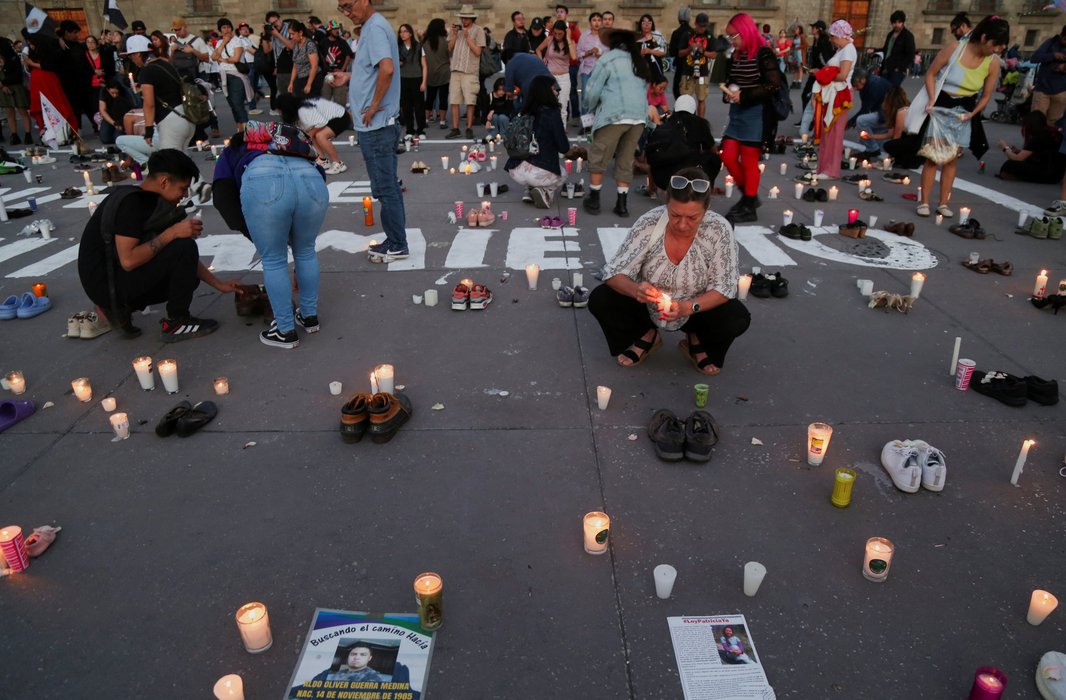
On 15th March 2025, more than 2,000 people gathered outside the Government Palace in Guadalajara, Jalisco, for a national vigil and mourning event following the discovery of a mass grave in Teuchitlán (see introduction). Protesters expressed deep frustration over the pervasive violence affecting not only the state but the country as a whole.
Martha Leticia García, leader of one of the participating collectives, stated that civil society organisations had undertaken the work that should be the responsibility of the authorities — a situation she described as deeply troubling: “We have had to carry out the work the State refuses to do. This grave omission exposes the impunity, negligence and collusion between authorities and criminal groups”, García said.
Parallel demonstrations took place in the main squares of 23 cities across 18 states, uniting relatives of the disappeared, search collectives, activists and citizens in a coordinated call for justice. In Guerrero, ceremonies were held at anti-monuments in Acapulco and Chilpancingo; in Veracruz, members of Colectivo Solecito reported that six of the remains recovered in Teuchitlán may belong to people from the state.
Jornada de #LutoNacional para exigir un esclarecimiento en Teuchitlán, Jalisco. 🧵 (1)
— Red TDT (@RedTDT) March 16, 2025
En #CDMX miles de personas se sumaron a la manifestación convocada por las familias de personas desaparecidas en México. pic.twitter.com/9Hz4PY4UY6
In Colima, protesters reported that belongings from a person in Tecomán had been found at the site. In Guanajuato, Sinaloa, Chihuahua, Michoacán, Oaxaca, Sonora, Nuevo León, Morelos, Quintana Roo, Chiapas, Zacatecas, Nayarit, Querétaro, Durango and Yucatán, vigils included shoes, clothing, candles and photographs of the missing, often accompanied by prayers, moments of silence, and public denunciations of state inaction.
In Mexico City’s Zócalo, dozens of pairs of shoes with candles illuminated the square, arranged as a symbolic recreation of Rancho Izaguirre. Mothers of the disappeared accused President Claudia Sheinbaum of failing to address the crisis and called for direct dialogue. Slogans included “Do not normalise terror” and “Every mother deserves to see her children return.” Families linked the crisis to decades of state and criminal violence, from the “Dirty War” to the militarised drug war, stressing its expansion under successive administrations.
While most vigils were peaceful, some confrontations occurred. In the capital, a small group removed barricades outside the National Palace, prompting police to form containment lines. Organisers urged participants to avoid violence and keep the focus on the disappeared.
Other developments
Federal Court orders Sinaloa congress to comply with Law on the Protection of Human Rights Defenders and Journalists
In late March 2025, a federal judge instructed the Congress of the State of Sinaloa to comply with the Law on the Protection of Human Rights Defenders and Journalists. The order follows a preliminary constitutional challenge filed on 28th January 2025 by the organisation “Iniciativa Sinaloa,” which challenged the legislature’s omission in creating the Specialised Prosecutor’s Office, despite the explicit legal mandate in force since May 2022, when the law was published in the Official Gazette. The law provided a period of 60 days for its implementation.
In its decision, the judge ordered the Congress to report on the existence and progress of legislative initiatives to amend the Organic Law of the Office of the Attorney General of the State of Sinaloa for the creation of the Specialised Prosecutor’s Office, and to take the necessary legislative action to comply with Article 4 of the transitory provisions of the Law for the Protection of Human Rights Defenders and Journalists.
🧑⚖️ Una jueza federal ordena a @congresosinaloa la creación de la Fiscalía Especializada para la Protección de Personas Defensoras de #DDHH y Periodistas en #Sinaloa, en cumplimiento con la Ley de Protección de la entidad emitida en 2022.
— Espacio OSC (@EspacioOsc) March 27, 2025
👇https://t.co/x8IUByoEsO
Coahuila’s new disappearance programme sets important precedent
On 12th November 2024, the Government of Coahuila published in its Official Gazette a pioneering Programme on the Disappearance of Persons, accompanied by reforms to legislation on victims’ rights, social assistance, education, development and the declaration of absence for disappeared persons. The plan is the first in Mexico to fully integrate international human rights standards and include clear indicators for monitoring progress.
The OHCHR in Mexico welcomed the programme, describing it as the result of “the organisation, drive and capacity for proposals of the families” and the authorities’ openness. It urged the state to ensure adequate funding and effective implementation, and to press ahead with pending programmes on search and living conditions for families. It also called for transparent appointments to top justice and victim-support roles.
COMUNICADO | ONU-DH saluda los avances en política pública y marco legislativo adoptados en el estado de #Coahuila, que fortalecen el marco de protección contra la #DesapariciónDePersonas.
— ONU-DH México (@ONUDHmexico) November 13, 2024
👉🏽 https://t.co/w15um9Hnte pic.twitter.com/i2qWkLaHy8
A ruling enforces Mexico’s duty to publish the National Programme Against Torture
In early February 2025, the Tenth Collegiate Administrative Court in Mexico City ordered the Office of the Attorney General (FGR) to publish the National Programme for the Prevention and Punishment of Torture and Other Cruel, Inhuman or Degrading Treatment or Punishment (PNT). The decision enforces the obligation under the General Law on Torture to issue the PNT within 180 days of the Law’s entry into force, as required by its transitional provisions. The ruling stems from a constitutional challenge (case 568/2022), in which the claimants challenged the FGR’s failure to meet this deadline. The Court instructed the FGR to publish the PNT within ten working days.
The Court held that the FGR’s omission violates both the rights of torture victims and the public’s right to effective policies aimed at eradicating the practice. It recognised the legitimate interest of civil society organisations in demanding compliance, given the collective dimension of the right to be free from torture. The judgment underscores the urgent need for coordinated national measures for prevention, investigation, prosecution, punishment and reparation, consistent with Mexico’s obligations under international human rights law.
Since 2019, civil society organisations, with technical advice from OHCHR, have engaged in a participatory process to draft the PNT together with the FGR, the Ministry of the Interior and national human rights institutions. This work included a diagnostic study recognising the persistence of torture in Mexico and formulating objectives, strategies, actions, indicators and monitoring mechanisms. Despite the completion of this process, the PNT has not been issued. The Tribunal stressed that, while multiple actors contributed to its preparation, the legal duty to publish rests solely with the FGR.
According to the Observatory against Torture (Observatorio contra la Tortura), in 2023 authorities opened at least 4,592 investigations into torture nationwide, but only 18 advanced to prosecution. These figures contradict public claims that torture has been eradicated in Mexico. The Court’s decision reinforces the imperative for immediate publication and effective implementation of the PNT to address a persistent and widespread human rights violation.
Tribunal ordena a la FGR publicar el Programa Nacional contra la Tortura en 10 días, reconociendo que su omisión vulnera derechos de las víctimas y de la sociedad. Organizaciones llamamos a su cumplimiento e implementación efectiva.
— Fundar (@FundarMexico) February 4, 2025
𝗖𝗼𝗺𝘂𝗻𝗶𝗰𝗮𝗱𝗼 👉 https://t.co/882b0NmEnK pic.twitter.com/iCscOhnp12