This update covers developments relating to the freedoms of expression, association and assembly in Bolivia from November 2025 to January 2026.
Association
Criminal charges against environmental defenders in Tariquía
On 14th January 2026, prosecutors in the Entre Ríos municipality, Tarija department, southern Bolivia, filed formal charges against 12 community members from the Tariquía National Reserve for Flora and Fauna, a protected area with high biodiversity. The charges - obstruction of public functions and alleged violations of the right to work - arise from peaceful protests against hydrocarbon exploration activities carried out by the state-owned company Yacimientos Petrolíferos Fiscales Bolivianos (YPFB) and the Brazilian company Petrobras.
Local representatives, including Juan Mendoza of the Chiquiacá Defence Committee, a community organisation, reported that the accused have faced legal proceedings for over a year. Several defenders reportedly face multiple parallel cases based on the same underlying facts, all linked to attempts to prevent oil companies from entering the reserve.
The transition from preliminary investigations to formal charges follows complaints submitted by YPFB in 2025 and marks an escalation of the proceedings. While earlier cases allowed the defendants to remain at liberty and were reportedly brought to the attention of the Inter-American Commission on Human Rights (IACHR), a regional human rights body, authorities have continued to pursue criminal action. In early January 2026, prosecutors also admitted a separate complaint filed by Petrobras against 17 people, including 16 community members and a local councillor, for alleged criminal association and related offences.
Civil society organisations have expressed concern that the use of criminal law in this context may constitute judicial harassment of environmental defenders. They warned that such proceedings risk creating a chilling effect on the exercise of the rights to peaceful assembly, association and participation in environmental matters, particularly in areas of strategic economic interest.
🟩Fiscalía de Entre Ríos presenta acusación formal contra 12 defensores de Tariquíahttps://t.co/IGR5VgyBlo#Tariquía #DefensoresAmbientales
— Sumando Voces (@SumandoVocesBo) January 13, 2026
Peaceful Assembly
Protests over fuel subsidies escalate into nationwide mobilisation
Bolivia was swept by nationwide protests between December 2025 and January 2026 after the government scrapped long-standing fuel subsidies, driving gasoline prices up by 86 per cent and diesel by 162 per cent, imposed austerity measures and deepened its reliance on the extractive industries model through Supreme Decree No. 5503.
Protests intensified in January. According to ACLED, nearly 270 protests were recorded during the month, marking the second-highest level of mobilisation since it began monitoring Bolivia in 2018. The demonstrations, largely led by the main union federation, the Bolivian Workers’ Centre (COB), teachers' unions, and some Indigenous groups, were mostly peaceful and took place across eight departments, with almost half occurring in La Paz. Protests subsided after the government and the COB reached an agreement to suspend the decree and issue a new one on 12th January 2026, though maintaining the elimination of fuel subsidies.
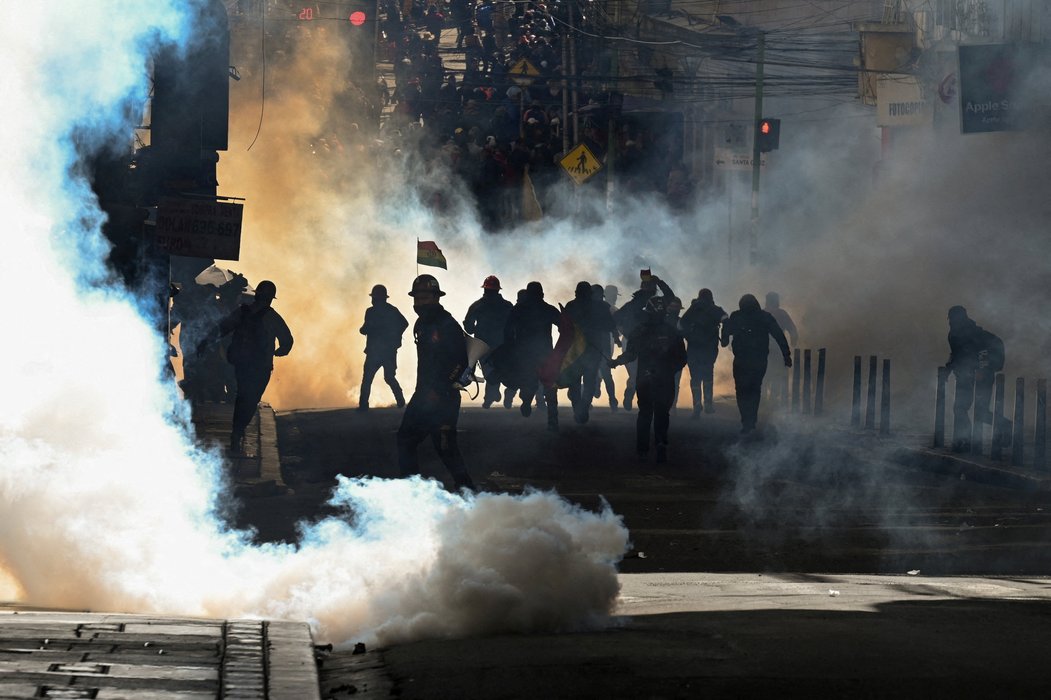
The protests began on 19th December with strikes led by transport workers in major cities and rapidly expanded into broader demonstrations. By 22nd and 23rd December, hundreds of protesters had set up road blockades across multiple departments. According to media reports, tensions escalated on 23rd December when police used tear gas after protesters attempted to enter restricted areas near the government centre, Plaza Murillo. Some protesters reportedly used petards, fireworks and, allegedly, dynamite. At least four police officers were injured, and 12 protesters were detained, according to preliminary reports.
On 30th December, during the eighth consecutive day of protests in La Paz, groups of miners allegedly used dynamite and fireworks against police forces while attempting to breach security barriers around the area of Congress. In response, police deployed tear gas and rubber bullets to disperse hundreds of protesters. No detentions were officially reported following the clashes.
Our protest is not only against the elimination of the (fuel) subsidy, but against this damned decree that will put the country and new generations in debt.
- said Mario Argollo, a leader for Bolivia’s Central Workers Union.
On 5th January 2026, a large mobilisation organised by the COB and allied groups drew thousands into central La Paz, where clashes broke out between protesters and police, with police using tear gas. The Ombudsperson’s Office confirmed that at least 12 protesters were detained. An elderly university professor was injured after being struck by a tear gas canister. During the same events, multiple incidents of violence against journalists were reported (see freedom of expression). Authorities reported material damage to public and private property, while police issued a limited apology to residents affected by the use of tear gas during dispersal operations.
On 6th January, following a breakdown in dialogue, the COB called for an indefinite nationwide blockade, increasing pressure on the authorities. By 10th and 11th January 2026, authorities reported at least 69 blockade points, primarily in the department of La Paz. These blockades partially encircled the cities of La Paz, Potosí, Cochabamba, and El Alto, restricting movement along major highways and affecting access to goods, including food supplies, as well as tourism.
On 12th January 2026, following sustained mobilisation and negotiations, the government agreed to abrogate Decree No. 5503 and replace it with a new decree. Despite this formal repeal, key economic measures, including the removal of fuel subsidies, were largely maintained.
Draft “anti-blockade” law raises concerns over freedom of peaceful assembly
On 15th December 2025, a draft “anti-blockade” law (PL-094/2025) was introduced by legislator Carlos Alarcón, a member of the coalition Comunidad Ciudadana, in the Plurinational Legislative Assembly (Asamblea Legislativa Plurinacional). Supporters argued that the proposal seeks to protect freedom of movement and reduce economic disruption, noting that road blockades are a common form of protest in Bolivia.
The proposed draft law introduces a blanket criminalisation of road blockades, establishing prison sentences of three to six years, aggravated to five to eight years for organisers and up to 10 to 20 years where violence occurs, with cumulative penalties potentially reaching 30 years (article 2).
Crucially, the bill explicitly provides that blockade “is not legally recognised as a means or instrument for the exercise of constitutional rights” (article 5). The severity of penalties appears manifestly disproportionate in relation to conduct that may, in many cases, constitute peaceful protest. Road blockades are frequently used as a form of social protest. By criminalising them without distinction, the draft law risks placing substantial restrictions on the exercise of the right to peaceful assembly.
Civil society organisations and legal experts raised concerns that the bill may be incompatible with international human rights standards. They warned that the proposal adopts a punitive approach, with broad definitions, severe penalties and risks of arbitrary application, potentially affecting social movements and dissenting voices. They also expressed concern about expanded protections for security forces and broad civil liability provisions, which may limit accountability in protest contexts.
Expression
Journalists attacked while covering protests in La Paz
On 5th January 2026, journalists from multiple media outlets faced physical and verbal attacks while covering protests and road blockades in La Paz. According to the National Press Association (Asociación Nacional de la Prensa, ANP), protesters targeted journalists and media workers from television and print media, shouting accusations such as “press for sale” and attempting to force them to leave protest sites. A cameraman from Red Uno was physically assaulted and struck multiple times with a whip.
Incidents were reported in Plaza San Francisco and Avenida Mariscal Santa Cruz, central locations in La Paz. The situation also escalated into broader confrontations, with reports indicating that protesters beat a member of the public after he expressed opposition to the blockades. Some journalists were forced to seek refuge to avoid further aggression.
The ANP condemned these acts and raised concerns about the lack of effective protection for media personnel by security forces.
Press access limited at inauguration of President Rodrigo Paz
On 8th November 2025, journalists covering the inauguration of President Rodrigo Paz at Plaza Murillo in La Paz reported restrictions, unsafe working conditions and obstruction of their work. According to the ANP, authorities confined media workers to limited spaces with restricted visibility, preventing them from capturing images or conducting interviews. Security forces, reportedly acting on official instructions, blocked access and formed physical barriers, further hindering coverage.
Journalists were also required to remain in designated areas for over 10 hours in heavy rain without adequate shelter. As a result, coverage of key moments remained largely limited to state media, while independent outlets struggled to obtain usable material.
Press freedom organisations criticised the situation, citing a lack of coordination and undue restrictions on press activity.