This update covers developments relating to the freedoms of expression, association and assembly in the Bahamas from June to October 2026.
Peaceful Assembly
Court injunction halts educators’ strike amid unresolved labour dispute
On 1st September 2026, the Supreme Court of The Bahamas granted an interim injunction restricting industrial action by members of the Bahamas Educators Managerial Union (BEMU), following a nationwide strike over longstanding employment grievances at the beginning of the 2026-2027 academic year. According to union president Stephen McPhee, over 90 per cent of BEMU’s approximately 500 members participated in the action, which disrupted public school operations and prompted the early dismissal of around 40,000 students across New Providence, Grand Bahama and the Family Islands.
The union had raised concerns about unresolved promotion cases dating back to 2016, vacancies for school administrators, employees performing higher-level duties without formal appointments or corresponding remuneration, and an industrial agreement that had expired in June 2025. McPhee maintained that BEMU had exercised its right to industrial action under a strike certificate issued by the Ministry of Labour, Public Service and National Insurance.
Later that day, Supreme Court Justice Darron Ellis granted an interim injunction sought by Education Minister Chester Cooper and Attorney General Wayne Munroe, ordering BEMU members to return to their workplaces and restraining the union, its officers and members from continuing any strike or other industrial action. The order also prohibited members from taking sick leave without a valid medical certificate and barred union representatives from encouraging, inducing or intimidating Ministry of Education employees to remain away from work.
On 2nd September, BEMU members returned to work following the court order and intervention by Prime Minister Philip Davis, who requested an opportunity to help resolve the dispute. McPhee acknowledged progress on some promotion matters but maintained that significant grievances remained outstanding, including administrative vacancies and the implementation of appointments.
On 8th October, McPhee reported that the government was continuing the court proceedings and seeking legal costs from BEMU despite the union having ended its industrial action. He characterised the continued legal action as an attempt to restrict the union’s right to strike and said BEMU intended to challenge the injunction. He also alleged that the authorities were considering identifying participating members and deducting their pay, although no completed deductions were independently confirmed.
On 14th October, McPhee reiterated concerns about staffing shortages and accused the Ministry of Education of excluding school administrators from discussions about repeated school closures.
Vendors and residents protest restrictions on public access to Cabbage Beach
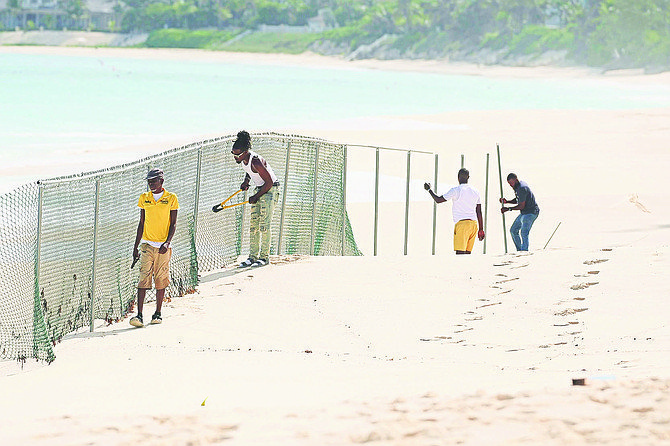
In late August 2026, beach vendors and residents denounced the fencing erected at Cabbage Beach on Paradise Island, a major public beach and tourist area near Nassau. The barriers stood near construction works linked to the Four Seasons Ocean Club Residences development. Vendors argued that the fencing restricted access to the shoreline and reduced the space available for businesses that had operated on the beach for decades, including beach-chair rentals, stalls and water-sports services. They also said developers had not adequately consulted them or clearly explained relocation arrangements.
On 30th August, authorities removed the initial fence after public opposition and intervention by the Department of Environmental Planning and Protection (DEPP), the government agency responsible for environmental regulation and oversight. The Ministry of Tourism said the removal would allow further discussions among government officials, developers and affected vendors over public access, livelihoods and measures to address beach erosion.
On 25th September, vendors protested over the fencing and unclear relocation arrangements: “They send some of us to Goodman’s Bay, there’s no space there okay, one person is staying here okay, the straw market they send some of them to they’re telling them its no space okay, I was supposed to go Baha Mar, I haven’t been placed yet.”
On 27th September, members of the Dis We Beach campaign, vendors and other residents gathered at Cabbage Beach, joined by Lincoln Deal, the elected Member of Parliament for the Freetown constituency, to demand removal of the renewed barrier. Protesters argued that the fence obstructed access to the shoreline and created safety risks for beach users.
On 28th September, police arrested Lincoln Bain, leader of the Coalition of Independents, a Bahamian political movement, after he and other protesters began dismantling sections of the chain-link fence. Police restrained and handcuffed Bain before removing him from the beach. According to media reports, police released him without charge, after which he returned to Cabbage Beach and continued calling for the fence’s removal.
The Dis We Beach campaign launched a petition demanding disclosure of the development’s environmental approvals, coastal surveys, construction boundaries, safety assessments and arrangements for public access and vendor relocation.
Teachers secure new agreement after threatening industrial action
On 3rd September 2026, the Bahamas Union of Teachers (BUT) placed more than 1,400 members on industrial action alert after rejecting the government’s latest financial offer during negotiations for a new industrial agreement. Union president Belinda Wilson said members had previously voted in favour of taking industrial action, while disputes over salary increases and other financial terms remained unresolved.
The negotiations subsequently produced an agreement. On 8th September, BUT and the government announced a five-year industrial settlement covering 2025 to 2030. Reported terms included higher salary scales, lump-sum payments, improved entry-level pay and hardship allowances for teachers working in the Family Islands. Wilson welcomed the outcome and withdrew the immediate threat of industrial action.
The 20 per cent increase was over a three-year period, so we pulled that back. What we did is, we did a five-year proposal that juxtaposed what the government had, and so we're pleased with what we've gotten today. And I think our members will be very, very happy.
- BET President, Belinda Wilson.
Nurses demonstrate over delayed appointments and raise workplace safety concerns
On 9th July 2026, nurses represented by the Bahamas Nurses Union (BNU) demonstrated outside the Ministry of Health and Wellness over delays in receiving employment appointment and confirmation letters. Union president Muriel Lightbourn said some nurses recruited between 2022 and 2024 had still not received documentation confirming their employment status, delaying access to benefits, professional progression and, in some cases, financial services. She also complained that persistent staffing shortages were being aggravated by administrative delays.
Health Minister Michael Darville acknowledged the concerns and apologised to affected nurses. He said the ministry had forwarded information to the Public Service Commission and that some letters had already been issued, while further cases were being processed. The available reporting does not establish that the outstanding appointments had all been resolved.
Pride Bahamas reportedly holds human rights march in Nassau
On 10th October 2026, Pride Bahamas held a march beginning at the University of The Bahamas in Nassau as part of events associated with Transcendence 2026, alongside community, cultural and health-related activities reportedly organised during the holiday weekend in association with the United Caribbean Trans Network.
Expression
Court grants absolute discharge to social media user prosecuted for criminal libel
On 9th September 2026, Acting Chief Magistrate Ancella Evans granted Addis Huyler an absolute discharge after he pleaded guilty to criminal libel over a Facebook post published in August 2026. In the post, Huyler called a woman a thief and warned others against doing business with her. He told the court that the statement arose from a contractual dispute in which the woman had allegedly failed to pay him approximately $600 after making a partial payment. The magistrate considered his explanation and granted an absolute discharge, imposing no punishment.
The case highlighted the continued application of criminal defamation legislation to expression in The Bahamas. Under Section 315 of the Penal Code, negligent libel carries a maximum penalty of six months’ imprisonment, while intentional libel carries up to two years’ imprisonment. Section 316 criminalises the unlawful publication of defamatory material, including written statements. The available information did not specify whether prosecutors charged Huyler with negligent or intentional libel.
In General Comment No. 34, the UN Human Rights Committee urged states to consider decriminalising defamation, emphasising that criminal proceedings should be reserved for the most serious cases and that imprisonment is never an appropriate penalty.
Freedom of Information regulations released for consultation after years of delay
On 14th September 2026, the government of The Bahamas opened public consultation on draft regulations intended to make the Freedom of Information Act, 2017 fully operational, following more than 14 years of delays in establishing an effective system for accessing government records. Parliament had adopted freedom of information legislation in 2012, but the law never entered into force. Its 2017 replacement had also been brought into operation only in stages, leaving key mechanisms for requesting information and challenging refusals unavailable. Attorney General Wayne Munroe said the proposals would establish procedures for processing requests, handling reviews and managing public records, but did not provide a firm timetable for full implementation.
The proposed Freedom of Information (General) Regulations 2026 would allow requests to be submitted electronically or in person and establish procedures for acknowledgements, internal reviews and appeals to the Information Commissioner and the Supreme Court. However, Regulation 3(1) would require every applicant to provide a copy of government issued identification, such as a passport, driver’s licence, national insurance card or voter card. Regulation 3(2) would also require officials to record the type and number of identification submitted.
In response, the Organisation for Responsible Governance (ORG) welcomed the publication of the draft regulations as an important step towards greater government transparency but raised concerns about the proposed identification requirements. ORG argued that requiring identification for every request could discourage individuals uncomfortable sharing personal documents, disadvantage people without current identification and create concerns about government tracking of information requests. It recommended limiting mandatory identity verification to circumstances in which it was necessary, including requests for personal records. The organisation also called for simpler procedures, affordable access, clear response deadlines, effective appeals and sufficient resources to enable public bodies to respond consistently.
On 28th September 2026, retired Supreme Court Justice Donna Newton was sworn in as Information Commissioner. Newton confirmed that the information access system remained unable to operate fully because the implementing regulations were outstanding. She could not provide a timetable for their adoption and identified institutional independence, public education and adequate administrative resources as priorities. Funding also remained a concern: the Commissioner’s Office had received an annual allocation of approximately $140,000, which former commissioner Keith Thompson had criticised as inadequate, although Finance Minister Michael Halkitis maintained that the allocation covered operational expenses and excluded salaries.
Association
Electricity workers’ union president suspended amid dispute over overtime arrangements
On 24th September 2026, digital outlet The Tribune reported that Bahamas Power and Light (BPL), the public electricity utility, had suspended Kyle Wilson, president of the Bahamas Electrical Workers Union (BEWU), and dismissed at least two other employees amid a dispute about overtime payments and revised working arrangements.
The dispute intensified in August 2026 after BPL introduced new controls on overtime in response to concerns about the utility’s expenditure. BEWU alleged that the changes had been imposed without consultation and contravened its industrial agreement. Wilson also accused BPL of pressuring employees to transfer to Bahamas Grid Company, which manages electricity transmission and distribution in New Providence. The union argued that workers who had previously declined to transfer were concerned about the possible loss of negotiated benefits, seniority and pension entitlements.
The Bahamas National Alliance Trade Union Congress supported BEWU and urged BPL to respect its collective agreement. According to contemporary reporting, the union referred the overtime dispute to the Department of Labour for conciliation and was also pursuing litigation. The suspension of union representatives in the context of collective bargaining raises questions about the protection of trade union activities and access to effective remedies.