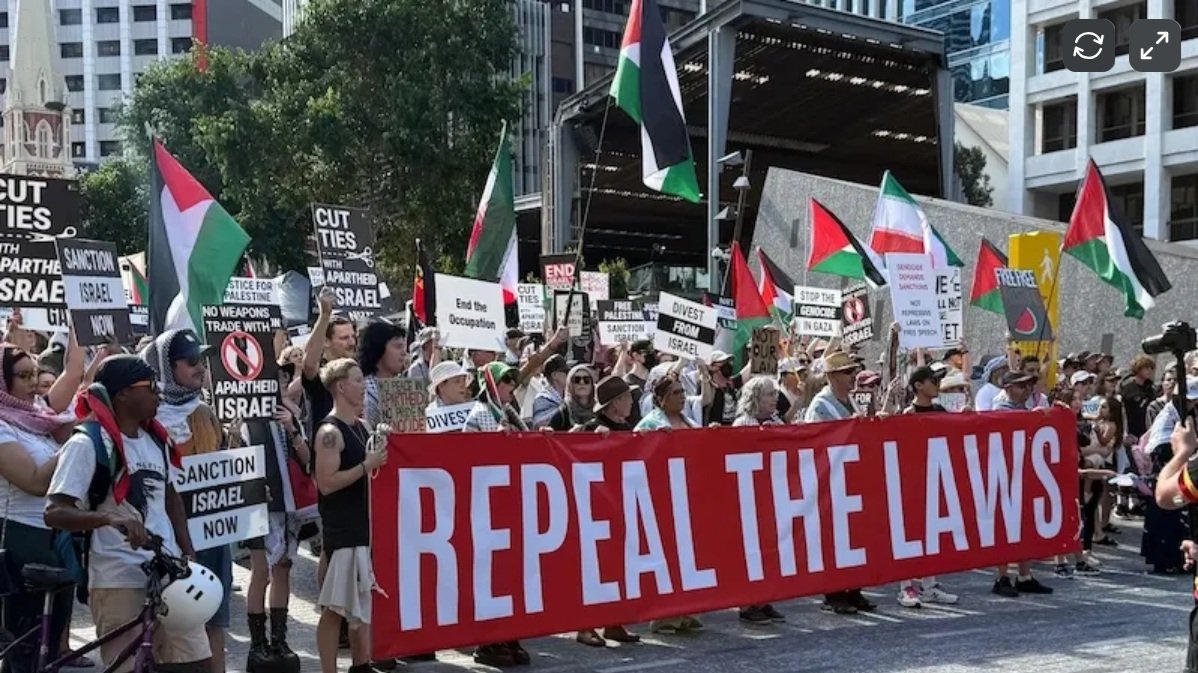
Australia’s civic space is rated as ‘narrowed’ by the CIVICUS Monitor. Concerns highlighted previously include the prosecution of whistle-blowers, the passage and use of anti-protest laws which are at odds with Australia’s international obligations, and the arrest of climate and pro-Palestinian protesters.
In May 2026, a coalition of 170 civil society organisations urged the Albanese Government to support and implement an Australian Human Rights Act, following the introduction of a Human Rights Act private members Bill to the House of Representatives. This renewed push comes nearly two years after the Parliamentary Joint Committee on Human Rights recommended the enactment of an Australian Human Rights act in its inquiry into Australia’s human rights framework.
Australia’s Universal Periodic Review at the UN Human Rights Council was adopted in July 2026. During the review in January 2026, the government received recommendations to amend anti-protest laws that restrict the right to peaceful assembly, ensure that law enforcement complies with international law and standards on the use of force when policing protests and to safeguard the exercise of freedom of expression for whistleblowers, academics and human rights defenders. However, the government did not support these recommendations.
In recent months, protesters have been arrested for violating Queensland's ban on pro-Palestinian phrases while protesters were arrested at Victoria Park amid the Olympic stadium dispute. Anti-protest bills in Western Australia have raised constitutional concerns, a report highlighted police violations during the anti-Herzog protest, while a protester’s house was raided by police. Police dropped charges against Rising Tide protesters, the courts struck down NSW anti-protest laws, while an army whistleblower was released on parole after more than two years in jail.
Peaceful Assembly
Protesters arrested for violating Queensland's ban on pro-Palestinian phrases
Hundreds protested in Brisbane, Australia, against a ban on the phrase “from the river to the sea” to show support for Palestinians, as Queensland police have arrested several people in recent weeks for saying the phrase.
— Al Jazeera English (@AJEnglish) April 18, 2026
🔴 LIVE updates: https://t.co/njqIsxObaI pic.twitter.com/cQsaCzbbGr
In April 2026. pro-Palestinian protesters were arrested for chanting "from the river to the sea". About 300 gathered in central Brisbane on 18th April 2026 to protest the state government's decision to ban two phrases associated with the pro-Palestinian movement: "globalise the intifada" and "from the river to the sea".
Officers arrested 20 people on 14 charges of displaying a prohibited expression and seven charges on reciting a prohibited expression. At least two more people were arrested the following days in a march on Parliament House.
On 14th June 2026, seven people were arrested and charged at a pro-Palestine rally in Brisbane’s CBD under the same law. On 1st July 2026, as dozens of activists faced court on 30th June for defying the law, Helen O’Sullivan, a participant in the recent Gaza Freedom Flotilla, was arrested for saying one of the banned slogans outside court.
As previously documented, in March 2026, a sweeping new hate speech law banning certain expressions was passed in the Queensland Parliament. It specifically bans the phrases “from the river to the sea” and “globalise the intifada”. The new laws include both written and spoken use of the phrases, such as chants or placards at a protest, with penalties of up to two years in prison. The bill was rushed through with only seven days provided for consultation, followed by further last‑minute amendments.
Human rights groups have called the called the law ‘divisive and discriminatory’, threatening freedom of expression. It risks conflating peaceful political expression with antisemitism and undermining freedom of expression in Queensland.
Arrests of protesters at Victoria Park amid Olympic stadium dispute
Police in Brisbane have arrested several protesters after dismantling a camp opposing construction at Victoria Park, the planned main stadium site for the 2032 Olympic Games.
— insidethegames (@insidethegames) May 29, 2026
Environmental activists and Indigenous campaigners have criticised the project and new legislation… pic.twitter.com/0FSSDEFYWk
In May 2026, five protesters were arrested at Brisbane's Victoria Park after police and Brisbane City Council officers entered a camp standing in opposition to a planned Olympic stadium development for the 2032 Olympic and Paralympic Games.
Council officers instructed protesters to pack up their belongings and questioned them about dogs and campfires. Tents were also removed from the site.
Ownership of the land is due to be transferred to the Games Independent Infrastructure and Coordination Authority (GIICA), with the Queensland state government vowing that construction work will begin immediately.
The protest group was awaiting a federal government decision on an application for cultural heritage protection for the inner-city park, where historic Aboriginal gathering and camping is recognised in its Queensland Heritage Register listing.
The park, which includes many old-growth trees, is known as Barrambin ("Windy Place") to the Yagara people, who consider it culturally and spiritually significant. The "Goori Camp Embassy" had kept a ceremonial campfire burning for more than 60 days among a huddle of tents in the park and had planned non-violent resistance.
In a statement, the Queensland Human Rights Commissioner urged authorities to respect protesters' human rights.
"The Queensland Human Rights Act 2019 recognises the distinct cultural rights of First Nations people, including the importance of maintaining and strengthening culture for future generations. Supporting these rights means engaging in genuine consultation and ensuring First Nations people and communities have a meaningful voice in decisions that affect them."
Anti-protest bills in WA raise constitutional concerns
According to the Human Rights Law Centre the Western Australian (WA) government is moving to enact some of the most restrictive anti-protest laws in the country.
The Public Order Legislation Amendment Bill 2026 (WA) (the Public Order Bill) and the Land Forces Event (Special Powers) Bill 2026 (the Land Forces Bill) are currently before the Parliament of Western Australia.
The Land Forces Bill will provide police with extraordinary powers to use against protesters in the area surrounding the Land Forces military and weapons expo in October 2026. These include the power to set up checkpoints, conduct searches without cause, confiscate items associated with peaceful protest, and demand identity documents. These measures combined would have a chilling effect and are likely to deter peaceful protest.
The Public Order Legislation Amendment Bill would make the WA permit system one of the most restrictive in the country, allowing WA Police to deny a protest permit on vague and broad grounds, and create a new offence in relation to face coverings.
Sarah Schwartz, Legal Director at Human Rights Law Centre, said: “The Cook Government is trying to create some of the most restrictive anti-protest laws in the country. These two proposed laws represent an attack on the right to protest and are a significant overreach into fundamental democratic freedoms.”
Report highlights police violations during anti-Herzog protest
A report released by the New South Wales Legal Observers found that police used excessive force on a crowd of around 20,000 pro-Palestinian demonstrators rallying at Sydney Town Hall in February 2026 against the official state visit of Israeli president Isaac Herzog on Gadigal land.
According to Sydney Criminal Lawyers, the report released on 3rd July 2026 details multiple incidents of police ill-treating civilians. The report also found the police blocked all exits from the protest site, whilst simultaneously ordering the crowd to disperse.
The report found that: “the deployment of aggressive police formations and tactics that, rather than deescalating tensions, served to inflame protests and constituted a disproportionate use of force. Reported tactics included kettling, charging, the obstruction of protestors’ egress routes, and the deliberate maneuvering of protestors into positions of clear and foreseeable danger.”
It also found that police adopted what can be described as a ‘charging down’ tactic that involved lines of police officers, “side by side and several officers deep”, running in this formation at force into the crowd of civilians who’d been kettled in.
The report notes that multiple elderly people and people with disabilities were physically assaulted by officers. There are also multiple scenarios involving medics present to assist who were repeatedly set upon by officers, who attempted to have them disperse from the area while they were trying to assist other civilians who’d been injured by police.
NSW Legal Observers further reported that it had received multiple testimonies about the “disproportionate and, at times, indiscriminate” use of OC or pepper spray on civilians. “Point blank” spraying of people in the face was reported, as was the use of the chemical weapon upon civilians who were attempting to comply with police directions.
Protester’s house raided by police
On 12th May 2026, Victoria police conducted a raid on the home on a protester. According to a report, Alex, a well-known activist, had her home raided by about eight officers from the Security Investigation Unit (SIU). The cops bashed open the door and grabbed her phone right out of her hand.
Alex had also been arrested at a recent rally against the visit of Israeli president Isaac Herzog, and was hospitalised as a result. This recent raid of her home involved police entering the premises with a warrant that focused on seizing electronic devices capable of accessing Instagram, as well as any recording devices or notes corroborating offending.
The report adds that this was the third sets of raids by Victoria police counterterrorism officers that have targeted anti-war protesters and framed pro-Palestinian activism as some sort of national security threat.
Police drop charges against Rising Tide protesters
🚨 BREAKING: Police have dropped charges against 125 Rising Tide protesters, two years after the Newcastle port blockade. The climate activists had faced up to two years in prison if convicted. #BreakingNews #Australia #RisingTide #Newcastle #ClimateProtests pic.twitter.com/aHPogu7DK1
— Archange Shadow (@Archange_Shadow) August 7, 2026
In August 2026, police dropped charges against more than 100 protesters two years after they blockaded the port of Newcastle as part of one of Australia’s largest climate protests.
In the Newcastle local court, the police prosecutor withdrew charges against 125 protesters. Legal group Climate Defenders Australia, which is representing the bulk of the protesters, said it had petitioned police to do so.
As previously documented, the 125 protesters were facing two charges, one under the Marine Safety Act which can carry a AUD$5,500 (USD 3,920) fine, and another under the 2022 Coalition government’s anti-protest laws which can carry a maximum penalty of two years in prison or a AUD$22,000 (USD 15,770) fine.
They were charged after they attended Rising Tide’s blockade of the port of Newcastle – the largest coal port in the world – in November 2024. Thousands of protesters waded into the port with kayaks and rafts over the course of the six-day protest.
The Court of Appeal strikes down NSW anti-protest laws
NSW High Court Strikes Down Anti-Protest Law Introduced After Bondi Attack: 'Unconstitutional' https://t.co/NV2JkUOAPf
— PEDESTRIAN.TV (@pedestriandaily) April 16, 2026
In April 2026, a NSW court struck down laws passed by the NSW Parliament that posed a serious threat to fundamental civil and political rights.
The laws were challenged by three activist groups, Palestine Action Group, Blak Caucus, and Jews Against the Occupation '48, in early January 2026. The Court found that the law impermissibly burdened the implied constitutional freedom of political communication.
The legislation had been rushed through Parliament in response to the Bondi terrorist attack without being subject to scrutiny, granting police expanded powers to restrict marches and enabling the arbitrary and state-sanctioned violence against protestors, as seen during the anti-Herzog protests in February 2026.
The justices wrote that the notion that the community can and should be protected from political expression by others because it might be “upsetting, inflammatory and divisive” wasn’t legitimate under the constitution. “Suppressing public debate of certain kinds may be a means to a legitimate end, but it cannot be a legitimate end in itself,” they wrote.
As previously documented, the law, which passed in NSW Parliament in December 2025, allowed the Police Commissioner to issue ‘Public Assembly Restriction Declarations’ to prohibit public assemblies in designated areas. Assemblies subject to such declarations were deemed unauthorised by default, granting police broad discretionary powers.
Amnesty International said: “The NSW Supreme Court’s ruling is a testament to people power and collective action.”
The NSW police commissioner, Mal Lanyon, said officers were reviewing the charges against the anti-Herzog protesters amid calls for them to be dropped in the wake of the ruling. However as of June 2026, only two of the accused have had their charges dropped.
Expression
Army whistleblower released on parole after more than two years in jail
Whistleblower David McBride has walked out of jail on parole more than two years into his sentence for stealing secret defence documents. https://t.co/vBMmr7V4RO pic.twitter.com/TQqrcOExuw
— Australian Associated Press (AAP) (@AAPNewswire) August 13, 2026
A whistleblower jailed for leaking military secrets about Australia's involvement in Afghanistan was released on parole in August 2026 after serving 27 months.
A spokesperson for the Attorney-General Michelle Rowland said David McBride's "parole was considered and granted". The ex-military lawyer, who is being treated for lung cancer, will serve the rest of his sentence in the community under supervision.
As previously documented, former Australian Army lawyer David McBride was sentenced to five years and eight months in prison on 14th May 2024 for revealing information about alleged Australian war crimes in Afghanistan. McBride leaked documents to the ABC that formed the basis for the broadcaster’s landmark Afghan Files reporting, which showed credible evidence of war crimes committed by Australian forces in Afghanistan. The reporting was subsequently confirmed by the Brereton Inquiry that found evidence that Australian forces had unlawfully killed 39 Afghans during the war.
Regina Featherstone, Acting Associate Legal Director at the Human Rights Law Centre, said: “David’s case shows how broken our whistleblower laws are. David McBride was the first person to be imprisoned in relation to Australia’s war crimes in Afghanistan – a whistleblower, not a war criminal. Whistleblowers should be protected, not punished. Our democracy suffers when people can’t speak up about potential wrongdoing. There is no public interest in prosecuting whistleblowers.”