Australia’s civic space is rated as ‘narrowed’ by the CIVICUS Monitor. Concerns highlighted previously include the prosecution of whistle-blowers, the passage and use of anti-protest laws which are at odds with Australia’s international obligations, and the arrest of climate and pro-Palestinian protesters.
On 26th January 2026, Australia’s human rights record was reviewed by the UN Human Rights Council. There were recommendations by states to establish a national Human Rights Act to enhance protection of human rights at all levels and support funding for the Australian Human Rights Commission. There were also calls to review and implement legislations and practices on the freedom of expression, online safety, peaceful assembly and public order, including anti-protest laws to ensure that restrictions are lawful, necessary and proportionate. Further, the government was also urged to ensure that the use of less lethal weapons in the policing of public assemblies fully complies with international law and standards on the use of force.
Despite the review, civic space violations continue to be reported. In recent months, new laws have been passed in Victoria and NSW to restrict the right to protest. Excessive force was documented by the police at protests over the Israeli president’s visit. Raids were conducted against pro-Palestine protesters, and climate protesters were arrested. A new hate speech law in Queensland was hurriedly passed that criminalises slogans used in advocacy on Palestine. A social media ban threatens free expression for children, and the government has committed to landmark secrecy reform.
Peaceful Assembly
Anti-protest law passed by Victoria government
Victoria to follow NSW in giving police new powers to stop protests in wake of Bondi terror attack
— Arif Sagmen (@sagmen_arif) December 22, 2025
Victoria’s police chief will be given sweeping powers to shut down or move on protests in the aftermath of terrorist events, while officers carrying rifles will be deployed to the… pic.twitter.com/uPydgVMMto
Anti-protest laws passed in Victoria in December 2025, to “crack down on violent, dangerous and hateful protesters and safeguard places of worship”, risk restricting people’s right to protest.
According to Amnesty International Australia, the Justice Legislation Amendment (Police and Other Matters) Act 2025 introduces new restrictions on protest rights, including banning the use of attachment devices, and restrictions on protests around places of worship. These measures mark a significant increase in protest-related policing powers in Victoria.
The group said that new powers introduced were unnecessary to address the law’s stated aim of countering hate. Existing legislation already provides police with adequate powers to address hateful conduct, including targeting places of worship, violence and vilification.
Peaceful protestors have long used attachment devices like glues, ropes, and locks safely as part of protests that have made the world a better place. The ban on attachment devices is overly broad and risks restricting Victorians’ rights to freedom of assembly and expression.
The new law also provides police with powers to direct a person to remove face coverings. These laws will disproportionately impact people with disability, healthcare workers and carers, victim-survivors of family and sexual violence, multicultural and religious communities, and members of diaspora communities, many of whom frequently wear face coverings while protesting.
Sarah Schwartz, Legal Director at the Human Rights Law Centre, said: “Anti-protest laws do not prevent racism or keep communities safe, they fuel division and have a chilling effect on our democracy.”
According to the Melbourne Activist Legal Support (MALS) this law is “an unjust overreach and will have a real and live risk of repressing political demonstrations in Victoria. [It] will have no effect on confronting and changing the social conditions that are enabling racist, xenophobic and other actually hateful ideologies to fester and grow.”
New law prevents protests after a terrorism declaration
In December 2025, the NSW Parliament passed the Terrorism and Other Legislation Amendment Bill 2025, which allows the state’s police commissioner or deputy commissioner, with the police minister, to restrict authorised assemblies in specific areas for 14 days after a terrorism declaration.
After a declaration, no public assemblies are allowed in designated areas. Police can move people on if their behaviour or presence obstructs traffic or causes fear, harassment or intimidation, they said. The notice can be extended by two-week periods for up to three months.
The legislation also gives police greater powers to require someone suspected of committing an offence during a public assembly to remove their face covering. Anyone at a public assembly who is suspected of committing an offence can be required to remove their face covering.
Excessive force by police at protest over Israeli president’s visit
The NSW police’s use of excessive force at a Sydney protest against Israeli President Herzog's visit shows the anti-protest laws are not making the community safer. pic.twitter.com/NVamw5gJLl
— Elaine Pearson (@PearsonElaine) February 11, 2026
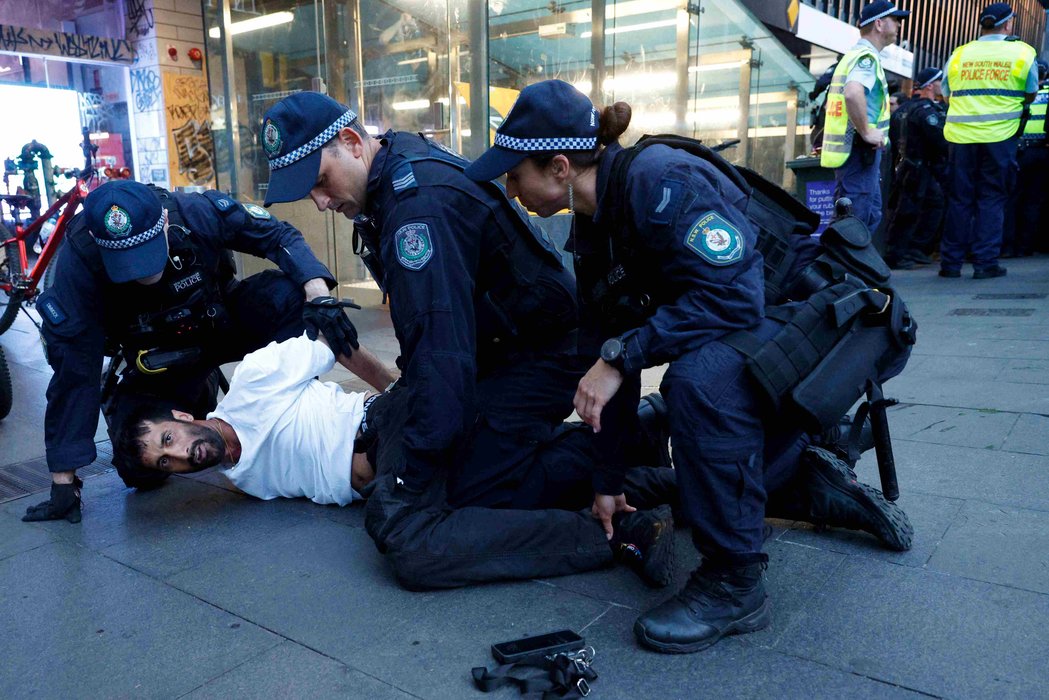
New South Wales police used excessive force against people protesting Israeli President Isaac Herzog’s visit to Australia in February 2026. At least 27 people were arrested, and many suffered from and were subjected to extreme and unnecessary police violence.
According to Human Rights Watch, video footage of a rally in Sydney on 9th February 2026, shows police punching protesters lying on the ground, violently dispersing people kneeling in prayer, and charging at and pepper spraying protesters.
President Herzog was officially visiting Australia after being invited by the Australian government following the December 2025 attack on Jewish holiday celebrants at Sydney’s Bondi Beach. Around 10,000 people gathered in Sydney to protest Herzog’s visit and to demand justice and accountability for the Israeli President, who the International Court of Justice and the UN Independent Commission of Enquiry have determined has overseen and directly incited genocide against Palestinians in Gaza.
The NSW government had granted police additional powers in response to planned protests over Herzog’s visit, including increased authority to issue “move-on” orders. According to HRLC, the NSW Police Commissioner also made the extraordinary decision to extend protest restrictions around Sydney ahead of Herzog’s visit, using new rushed powers under recent amendments to the Terrorism (Police Powers) Act 2002.
According to HRW, two journalists who covered the event said that while the crowd was angry that police were restricting them from marching, they did not observe any protesters committing violence. Rebecca Payne, a legal observer, said police had pepper sprayed her and others before they charged the crowd near Sydney Town Hall. She said she had been videoing the protest when police sprayed the crowd and “started punching, shoving, pushing, and charging” at protesters.
The NSW government contends that its new laws are necessary for public safety. However, the UN special rapporteur on human rights and counterterrorism, Ben Saul, has warned that the laws “clearly violate international law” by indiscriminately restricting the rights of law-abiding protesters.
NSW police arrest climate protesters
Who are the Australians trying to shut down the world’s biggest coal port?
— ECIU (@ECIU_UK) December 1, 2025
Climate activists from the Rising Tide organisation have stopped coal ships from reaching Newcastle port – for a day or two. What’s their real objective? @jordynbeazley https://t.co/s5mpIzVabl pic.twitter.com/Y61lD7wVTU
Police arrested 141 individuals after thousands of people gathered at Rising Tide’s annual climate protest to block coal ships from entering the Port of Newcastle, the world’s largest coal port, on 30th November 2025.
Of those arrested, 121 adults were charged with various offences under the Crimes Act and the Marine Safety Act. Eighteen juveniles were dealt with under the Young Offenders Act, police said.
The Human Rights Law Centre called for an independent review of the policing of the Rising Tide protest. It said it was particularly concerned by reports that 18 young people – one as young as 15 – were arrested and processed under the Young Offenders Act. Children have the right to participate in public life and to speak out about decisions that will shape the world they inherit. Arresting children for exercising their democratic right to protest in a democracy is a serious overreach by NSW Police.
David Mejia-Canales, Senior Lawyer, Human Rights Law Centre, said: “Protest is essential to our democracy, yet NSW has the harshest anti-protest regime in the country. It is deeply troubling that NSW Police move so quickly to criminalise people, including children, just for speaking out”
Authorities conduct police raids against pro-Palestine protesters
The authorities in Victoria and New South Wales (NSW) conducted intimidating police raids to arrest protesters against the ongoing US-Israeli genocide in Gaza and the complicity of the federal government.
Early on the morning of 27th March 2026, Victoria Police Public Order Response Team (PORT) officers in full combat gear conducted eight raids upon homes around Melbourne to detain eight women who had taken part in a 6th March 2026 protest outside the Victorian Trades Hall building. The Melbourne raids targeted women who draped a statue of 1960s and 1970s feminist equal pay activist Zelda D’Aprano at the Victorian Trades Hall in an apron.
Just a day before the eight raids, on 26th March 2026, heavily-armed NSW police commandos stormed the home of a woman who had joined the large demonstration at Sydney Town Hall on 9th February against the visit by Israeli President Isaac Herzog. She was dragged out of bed and handcuffed after the police smashed open her front door. At least four similar raids were mounted across Sydney.
Aged between 34 and 71, the eight women were then taken to various police stations, where they were held for hours before being released on bail. The charges include criminal damage to property, behaving in a riotous manner in a public place, marking graffiti on a residence without consent, recklessly damaging part of a registered place without a permit and refusing to leave a scheduled public place after a warning.
Greenpeace activists arrested after disrupting gas conference in Sydney
On 31st March 2026, two Greenpeace Australia Pacific activists were arrested following a peaceful protest at the Australian Domestic Gas Outlook conference in Sydney, where they dropped a banner that said — “Gas Execs Profit. We Pay The Price” and held banners saying “Tax Gas Profits”. The two activists were arrested by police and taken to Day Street Police Station.
Solaye Snider, Campaigner at Greenpeace Australia Pacific, said: “Greenpeace activists have taken a strong stand today against profit hungry gas corporations and lobbyists, who see horrific global wars as an opportunity to price gouge and profiteer, while everyday people pay the price. Change requires showing up and speaking out, and that’s what these activists have done today.”
Protesters win case against police expanded powers in Victoria
In January 2026, Tarneen Onus Browne, Benny Zable and David Hack, represented by the Human Rights Law Centre, partially won their case against Victoria Police, challenging extraordinary police powers in designated areas, following the declaration of the entire Melbourne CBD to be a designated area for six months in November 2025.
The Federal Court found that the six-month declaration of the Melbourne CBD was unlawful and invalid. The judgment means that it will be much more difficult for Victoria Police to declare designated areas and exercise extraordinary warrantless powers under the Control of Weapons Act. Judge Bennett found that police can only do so where the designation is necessary to address the risk of weapons-related offences in the area.
Judge Bennett found that the Assistant Commissioner of Victoria Police who made this decision did so on the basis of an incorrect interpretation of the law, did not properly consider the legislative criteria for designated areas, and did not properly consider human rights under the Victorian Charter of Human Rights and Responsibilities, in particular the right to privacy.
However, Judge Bennett found that Victoria Police’s power to request a person to remove a face covering in designated areas was constitutional, but only if a valid declaration of a designated area has been made.
Tarneen Onus Browne, a community organiser who brought the challenge, said: “This decision is a significant win, though we didn’t get everything we wanted. This is a win for First Peoples and allies coming to the Invasion Day rally, and every person who come into the CBD and designated areas, who want to be treated with dignity and respect and not subject to intrusive police powers.”
Expression
Queensland government rushes hate speech law
On 5th March 2026, a sweeping new hate speech law banning certain expressions in a way that makes a member of the public feel menaced, harassed or offended, passed in the Queensland Parliament.
The Crisafulli Government made last-minute changes to the Fighting Antisemitism and Keeping Guns Out of the Hands of Terrorists and Criminals Amendment Bill 2026 (Bill) to specifically ban the phrases “from the river to the sea” and “globalise the intifada”. The new laws include both written and spoken use of phrases, such as chants or placards at a protest, with penalties of up to two years in prison.
The changes to the Bill were rushed through with only seven days provided for consultation, followed by further last‑minute amendments.
The Human Rights Law Centre (HRLC) called the law ‘divisive and discriminatory’, threatening freedom of expression. It risks conflating peaceful political expression with antisemitism and undermining freedom of expression in Queensland.
HRLC added that the “selective prohibition of two Arabic and Palestinian political phrases, both associated with the Palestinian rights movement, undermines the rights to freedom from discrimination, freedom of expression, and equality before the law. It is inconsistent with international human rights law and may also raise concerns in relation to the constitutionally implied freedom of political communication.’
The organisation stated that there is no evidence that criminalising specific expressions - without accompanying preventative measures - reduces racism, antisemitism, hatred, or radicalisation.
Two protesters charged under new Queensland law
Liam Parry has appeared in court charged under Qld Premier David Crisafulli's speech criminalisation. He will contest & the matter was adjourned until 29 April. Outside 70yo Mark Gillespie was warned by police over a variant of the banned phrase. #qldpol https://t.co/C8ODOAe7qt
— David Marler (@Qldaah) April 8, 2026
On 11th March 2026, two pro-Palestinian protesters were charged with violating contentious new Queensland hate-speech laws, with one of them allegedly saying the banned phrase “from the river to the sea”.
The arrests occurred at a small protest march which started outside the state parliament building, just hours after the new laws, passed by parliament, went into effect (see above section).
One of those arrested was Liam Parry from the Students for Palestine group who had led the protest. He went on to deny that the phrase was terroristic or antisemitic, saying it was instead a call for freedom and dignity of the people between the Jordan River and Mediterranean Sea.
Parry was released from the Brisbane watch house later that evening. He has been issued with a notice to appear in Brisbane magistrate’s court on 8th April for the offence of recital, distribution, publication or display of prohibited expressions, the spokesperson said.
Witnesses said a second person was later arrested at the end of the march to King George Square, who they described as wearing a shirt which said, “from the river to the sea”. A spokesperson for the police said both protesters had been charged.
Justice for Palestine Magan-djin (JFP) said that it stands in solidarity with those people who were arrested. They added: “The laws weren’t designed to make our streets safer; they were designed to silence Palestinian voices and protect a foreign government from being criticised by Australians.”
Climate protesters win groundbreaking class action against Victoria police
In December 2025, climate protesters won a class action against Victoria police over their use of capsicum spray during an anti-mining demonstration in Melbourne. The first class action against Victoria police in relation to alleged excessive use of oleoresin capsicum (OC) spray was heard in the state’s supreme court, and a decision was handed down on 12th December 2025.
The trial before Justice Claire Harris was led by protester Jordan Brown, who was twice hit with OC spray while protesting outside the international mining and resources conference in October 2019. Harris found that Brown had been subject to an unlawful battery by police, and awarded him $AUD 54,000 (USD 37,995) in damages. She said these injuries were caused intentionally by police.
Brown’s lawyers argued the spraying was in breach of Victoria police’s internal policies and procedures, Victoria’s Crimes Act and the state’s charter of human rights, and that it was “an unreasonable, unlawful and disproportionate use of force constituting battery and assault”.
Social media ban threatens free expression
In December 2025, the government formally barred users under the age of 16 from accessing major social media platforms. The ban targets 10 major services, including YouTube, Meta, Instagram, ByteDance’s TikTok, Reddit, Snapchat and X.
The Online Safety Amendment (Social Media Minimum Age) Bill 2024 requires these platforms to take “reasonable steps” to prevent underage access, using age-verification methods such as inference from online activity, facial estimation via selfies, uploaded IDs, or linked bank details. All targeted platforms had agreed to comply with the policy to some extent
When Australia passed a world-first social media ban for teens, there was a display of national pride from the prime minister, and even the Sydney Harbour Bridge was lit up in the country’s national colours, green and gold, to celebrate the historic achievement.
A barrage of civil society groups and others have all criticised or opposed the ban.
Index on Censorship said “any such ban on platforms curtails the user’s ability to navigate the open web and access public-interest information. As a result, it is a disproportionate threat to free expression as outlined in Australian and international law.”
Tom Sulston, head of policy at Australian charity Digital Rights Watch, said it was disproportionate to remove that right of access to a group of people in order to protect their safety, or under the guise of protecting their safety. He added that there were alternative measures that many organisations were asking for, such as regulation and investment in digital literacy, which could have been put in place instead of an outright ban.
In submissions to Australia’s Senate Standing Committees on Environment and Communications , before it became law, the Australian Human Rights Commission said that it had “serious reservations” about the legislation. While it said that it understood the significance of protecting young people from online harm and the negative consequences of social media, the ban would affect some human rights outlined in international human rights treaties including the International Covenant on Civil and Political Rights and the UN Committee on the Rights of the Child.
Government commits to landmark secrecy reform
On 1st April 2026, the Attorney-General introduced the Secrecy Provisions Amendment (Repealing Offences) Bill 2026 into the House of Representatives. According to the Human Rights Law Centre, these reforms, if passed, will wind back hundreds of federal secrecy offences so that whistleblowers can speak out safely on wrongdoing in Australia.
The Bill repeals over 300 secrecy offences, which is more than a third of the secrecy offences on the federal statute book, to strike a better balance between secrecy and transparency. The Bill also sets a higher bar for the prosecution of journalists under secrecy law, by requiring the Attorney-General to consent to any prosecution. The Bill implements numerous recommendations from two reviews of federal secrecy laws in recent years.
Kieran Pender, Associate Legal Director at the Human Rights Law Centre, said: “The Human Rights Law Centre welcomes the Albanese Government’s landmark reform to federal secrecy laws. Transparency is the bedrock of democracy, but in recent decades we have seen the proliferation of sweeping secrecy offences. “The repealing of more than 300 secrecy offences is a historic step towards greater transparency.”