Freedom of association
Youth policies in the spotlight of Ukrainian authorities
On 5th June 2025, the Verkhovna Rada adopted Law № 4229-IX, “On the Fundamental Principles of Youth Policy”, revising the framework for financing youth organisations in the country. The act introduces a far more diverse range of funding sources: not only state budgets and international support, but also voluntary contributions from individuals, companies (including foreign ones) and other legal sources. This is a crucial step towards reducing dependence on public resources and creating space for stronger civic initiatives, according to the CSO Meter project.
The importance of the reform also lies in the fact that the Ukrainian Youth Fund will, for the first time, be able to provide not only project-based grants but also institutional support: funding for teams, workspaces and administrative capacity, enabling long-term planning. The law also strengthens transparency by mandating the publication of all funded projects, introduces key terms such as mobile youth centres, the “Youth Guarantee” mechanism (aligned with EU standards), rent reductions for youth CSOs, and measures to stimulate inter-institutional cooperation.
This legislative change is considered a genuine turning point for the youth organisation sector, especially for regional and grassroots organisations, which, until now, have faced precarious and unstable funding.
Anti-corruption activist faces raids and criminal charges after criticising defence procurement
On 11th July 2025, Ukraine’s State Bureau of Investigation conducted searches targeting Vitaliy Shabunin, a prominent anti-corruption activist, after he publicly criticised the Ministry of Defence and the President’s Office over weapons procurement. Investigators raided his family home in Kyiv, and his military posting in Kharkiv region a day after his transfer there, and opened a criminal case alleging evasion of military service and fraud, offences carrying up to 10 years in prison. On 15th July, the court prohibited Shabunin from leaving his unit’s location.
According to the Anti-Corruption Action Centre, an organisation Shabunin co-founded, the searches were carried out without a warrant, before lawyers could be present, and included the seizure of devices belonging to Shabunin’s wife and children. The case follows a year-long smear campaign, threats and earlier attacks on his family.
Human Rights Watch called on Ukrainian authorities to end retaliation against anti-corruption activists, uphold due process and protect freedom of expression as essential to the rule of law.
Freedom of peaceful assembly
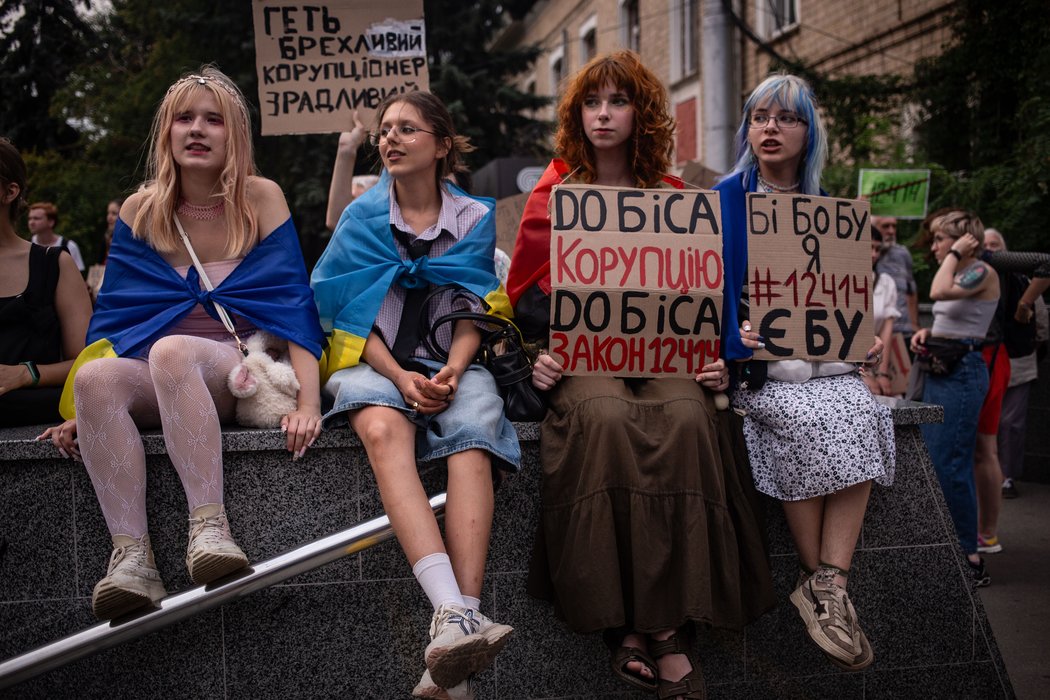
Stand-off between anti-corruption institutions and the President sparks mass protests
In July 2025, Ukraine was shaken by an open conflict between President Volodymyr Zelenskyy and the country’s main anti-corruption bodies, the National Anti-Corruption Bureau (NABU) and the Anti-Corruption Prosecutor’s Office (SAP). The crisis was triggered by the arrest in Kyiv of a NABU employee alleged to be a FSB agent, after the Security Service of Ukraine (SBU) and NABU publicly contradicted each other over their respective competences and the credibility of the investigation. Instead of defusing the dispute, President Volodymyr Zelenskyy backed the passage of a bill in the Verkhovna Rada aimed at curbing the powers of NABU and SAP, a move widely interpreted as a direct attack on their independence.
The adoption of the law, and its swift signing by President Zelenskyy, triggered mass protests in Kyiv, Lviv, Odessa and other cities, where thousands rallied under the slogan “Hands off NABU”. NGOs, journalists and anti-corruption activists accused the Zelenskyy administration of seeking to subordinate institutions created under European Union pressure and regarded as guarantors of transparency.
https://www.youtube.com/watch?v=pgRf_oN3ZZo
Ukraine’s Western partners, including the European Union and the United States, voiced serious concern over the new restrictions on NABU and SAP. Brussels reminded Kyiv that the independence of these bodies is a key condition for EU accession talks and continued international financial support.
The decision to curtail the powers of NABU and SAP prompted speculation about the president’s true motives, with critics accusing him of intending to interfere in sensitive investigations into his inner circle and attempting to consolidate power in the context of possible elections. Under mounting pressure from protesters and Western allies, Zelenskyy reversed course, submitting his own bill to the Verkhovna Rada to repeal the contested provisions, which deputies subsequently approved.
Freedom of expression
Concerns raised about legislation impacting press freedom
On 16th July 2025, the Ukrainian parliament approved in second reading a bill that would fine journalists and others who “publicly identify an attorney with their client”. According to the Institute of Mass Information (IMI), the law would impose fines of 1,700 to 3,400 hryvnias (approximately €35–€70) for naming a lawyer by reference to a client, rising to 6,800–10,200 hryvnias (€140–€210) for repeat offences within a year. MP Anastasia Radina warned that the measure would undermine accurate reporting on links to powerful and controversial figures, by banning formulations such as “Serdiuk, lawyer to Viktor Yanukovych” — a reference to a lawyer who represented Ukraine’s former president, who fled to Russia after the deadly crackdown on the Euromaidan protests. The bill’s authors argued it would strengthen protections for lawyers and guarantee access to legal assistance.
On 21st August 2025, parliament also adopted a law restricting access to some data in state registers, notably the locations of real estate and cadastral numbers held by legal entities. In March, journalists and anti-corruption groups warned the measure was overly broad and would hinder corruption investigations.
While Bihus.Info editor-in-chief Maksym Opanasenko said the impact would be limited, MEZHA head Martyna Bohuslavets cautioned that the changes could facilitate investigations into journalists and activists. Lawmakers from the ruling party said the restrictions were needed to protect defence industry confidentiality during wartime.
Severe impact of full-scale invasion on journalists continues
The situation of Ukrainian journalists in the context of the war remains severe. According to the National Union of Journalists of Ukraine and the International Federation of Journalists, 127 journalists have died since the start of the large-scale invasion. Of these, 18 were killed while practising journalism, 10 were civilian victims of shelling, and 99 died on the front after being mobilised into the Defence Forces of Ukraine. Currently, at least 30 journalists are detained in Russia, most of whom were abducted or arrested after February 2022, including Irina Levchenko from Melitopol and Gennady Osimak from Henichesk. The Union of Journalists continues advocacy efforts for their release.
In recent weeks, a prisoner exchange led to the release of Ukrainian journalist Dmytro Khilyuk, who had been held in Russia for over two years. His case was closely monitored by international organisations and colleagues, and his release demonstrates that international pressure can yield tangible outcomes.
In contrast, the journalistic community confirmed a fatality on the front line: Bohdan Zaiats, an officer and reporter for the Novyi Chernihiv station, was killed on 30th January during an attack on Ukrainian positions.
The Mapping Media Freedom project also continued to record attacks on journalists and media offices in Ukraine by Russian forces.
On 10th July 2025, the Kyiv office of Channel 5 (5 Kanal) sustained substantial damage during a new Russian attack on the city. Video published by the broadcaster showed damage to walls, doors and windows, as well as to computers and other equipment. Channel 5 reported that no one was injured. However, television broadcasts were suspended for several hours due to damage to operational systems and were temporarily available only via YouTube.
On 28th July 2025, the office of the newspaper Ridny Kray in Buryn, Sumy region, was damaged during a Russian attack on the town, according to the National Union of Journalists of Ukraine (NUJU). Editor-in-chief Lyudmyla Maznova said windows were shattered and technical equipment destroyed. No one was injured, as no staff were present at the office at the time of the attack.
The National Union of Journalists of Ukraine (NUJU) reported that the office of Mezhivsky Meridian in Mezhova, Dnipropetrovsk region, was damaged in a Russian drone strike on 28th August 2025. Windows and panes were broken in the attack. Editor-in-chief Yevhen Khrypun said the newspaper continues to be published despite Mezhova’s proximity to the front line—just 10 kilometres from Russian positions—and ongoing challenges including shelling, power outages, water shortages, and limited mobile network access.
On the night of 28th August 2025, the offices of Ukrainska Pravda and Radio Free Europe/Radio Liberty (RFE/RL) in Kyiv were damaged during a large-scale Russian drone and missile strike. Ukrainska Pravda’s building sustained structural harm, while at RFE/RL’s bureau, windows were shattered and some equipment destroyed. No staff were injured at either outlet. Surveillance footage showed two Russian rockets striking the area, causing explosions that damaged surrounding civilian buildings. Both media organisations reported continuing operations despite the attack.
Journalists detained, intimidated, discredited
On 1st July 2025, police in Kyiv detained journalist Maksym Kotsiubynskiy, a reporter for online outlet Hromadske, for several hours after he filmed Deputy Prime Minister and Justice Minister Olha Stefanishyna leaving an apartment not listed in her asset declarations. Despite presenting his press accreditation, officers searched Kotsiubynskiy, took him to a police station and requested access to his phone, while repeatedly denying that he was detained. Police claimed they had received a complaint from an unnamed individual who became suspicious after seeing the journalist filming in the area. He was released after his lawyer arrived. Stefanishyna later confirmed she was staying at the apartment and announced she would include it in her upcoming asset declaration.
On 16th July 2025, Cherkasy-based online outlet 18000 reported intimidation by a local judge and police, apparently linked to an investigation from 2024 carried out by their journalist Iryna Maliukova. The outlet said Cherkasy police requested information about Maliukova and later interrogated her on 15th July. Police had reportedly opened a criminal case regarding “interference with the work of a judge aiming to obstruct their professional duties or obtaining an unjust [court] decision”. 18000 said the case stemmed from Maliukova’s article in which she reported that the judge in question, Vladyslav Konstantyn, had built a large house near Cherkasy, registered in his wife’s name, despite her lack of sufficient income, which raised questions about the origin of the funds used.
On 7th August 2025, online outlet Chetverta Vlada reported that Serhii Vynnychenko, an official at the State Tax Service in Rivne region, verbally attacked journalist Valentyna Panyuk while she sought comment on his parents’ property holdings near Kyiv. According to the outlet, Vynnychenko accused Panyuk of carrying out “dirty assignments” and refused to answer her questions, demanding an official information request instead. The exchange followed Panyuk’s analysis of his asset declarations. Vynnychenko did not publicly confirm or deny the account.
Press freedom violations in the digital space
Between 14th and 20th July 2025, journalist Olena Mudra faced a series of discreditation attacks. On 14th July, a video falsely accused her of sabotaging an activist’s work and embezzling US$53,000, reportedly using AI. Two days later, a Facebook account published another AI-generated video depicting her son repeating the same unfounded claims. On 20th July 2025, the discreditation attempts continued with the publication of a video on the YouTube channel Novyny Ukrainy. The video repeated claims that Mudra’s criticism of a wind farm project in Ukraine’s Zakarpattya region was made on orders from Russia.
On 17th July 2025, online outlet RBC Ukraine reported being targeted in a discreditation campaign against the publication and its management. Anonymous Telegram channels and websites circulated false claims about CEO and majority shareholder Yosyp Pintus, following RBC Ukraine’s reporting on activist Nazariy Husakov and alleged schemes involving gambling companies. The outlet said the attacks appeared designed to pressure and interfere with independent journalism. RBC Ukraine filed a complaint with the national police, who later confirmed a criminal case had been opened. The editorial board stressed the reporting was based on reliable documents and law enforcement data.
On 21st July 2025, Ukraine’s Institute of Mass Information (IMI) reported a discreditation campaign against journalists from online outlet Dzerkalo Tyzhnia (Zn.ua) by the Telegram channel Joker, which is reportedly linked to the Office of the President. The campaign targeted domestic politics editor Inna Vedernikova and editor-in-chief Yulia Mostova, including doctored images and insults. IMI said Joker published at least 30 intimidating posts between 15th and 18th July. Vedernikova suggested the attacks may be linked to a recent Zn.ua op-ed supporting anti-corruption activist Vitaliy Shabunin (see above).
On 29th July 2025, Ukraine’s Institute of Mass Information (IMI) reported that two journalists from Khmelnitskiy were targeted in an SMS-bombing attack following their coverage of recent anti-corruption protests. Journalists Alona Bereza and Kateryna Vovk received a large volume of SMS messages containing access codes for online services within a short period. IMI said the identical nature of the messages suggested a single, unknown source. The journalists linked the incident to their reporting on protests against legislation weakening the independence of anti-corruption bodies.
On 4th August 2025, the website of Detector Media was targeted in a DDoS attack, according to a statement by the outlet. The attack began at around 15.30 local time and partially restricted user access to the site. At the time of reporting, it was unclear how quickly Detector Media’s technical team resolved the disruption or who was responsible for the attack.