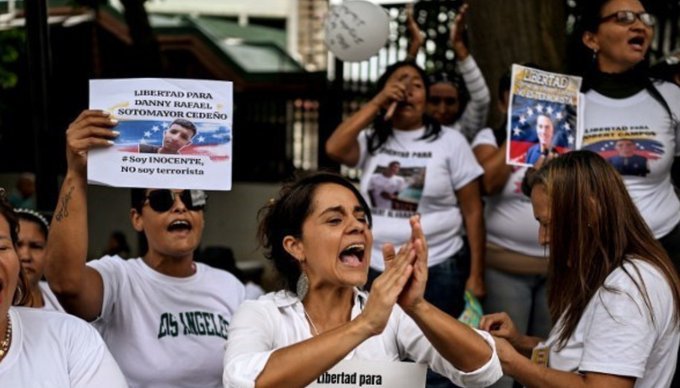
This update covers developments relating to the freedoms of expression, association and peaceful assembly in Venezuela from June to October 2025.
General
Venezuela’s ruling coalition sweeps municipal elections amid low turnout and opposition absence
According to official results, on 27th July 2025, the Great Patriotic Pole, led by the ruling Socialist Party, won 280 of 304 mayoral races, expanding on its gains from four years ago. The National Electoral Council (CNE) reported that around 6.27 million people voted, representing just under a third of the electorate. While authorities pointed to stability in turnout compared with May’s regional elections, participation remained well below previous municipal contests.
Despite the formal conduct of voting, the electoral process unfolded within a context marked by serious restrictions on political participation and pluralism. As documented by the Venezuelan civil society organisation Acceso a la Justicia, the elections were convened through an expedited process without institutional justification, despite the mandates of mayors and councillors expiring only in November 2025. Campaign periods were sharply reduced, voter registration was frozen on the day the election was announced, and independent observation was largely absent. The main opposition coalition did not participate, while other parties were sidelined by court rulings, administrative bans and arbitrary detentions.
Announced state of external emergency lacks legal effect
On 29th September 2025, the Executive Vice-President, Delcy Rodríguez, announced that the country’s president had signed a decree declaring a state of external emergency (state of external commotion) to be activated in the event of a military attack. This followed a period of heightened tensions with the United States, including reported U.S. military strikes on vessels allegedly transporting illegal drugs in the southern Caribbean Sea and the eastern Pacific Ocean. On 16th September, three UN experts have indicated that dozens of people have died in circumstances described as extrajudicial killings.
The announcement prompted immediate legal scrutiny, as states of exception in Venezuela do not enter into force automatically and must comply with constitutional and statutory procedures. Authorities had not published the decree in the Official Gazette, nor confirmed that the Supreme Tribunal of Justice of Venezuela (TSJ) had reviewed its constitutionality or that the National Assembly of Venezuela had approved it, as required under the Constitution and the Organic Law on States of Emergency. Legal experts have stated that, in the absence of publication, judicial review and legislative approval, the announced measure has no legal effect.
The declaration of a state of external emergency without transparent procedural compliance raises broader concerns about legal certainty and access to public information. As reported by the European Union System for an Enabling Environment (EU SEE), civil society organisations have warned that invoking a state of external commotion could lead to further militarisation and facilitate additional abuses and restrictions on fundamental freedoms.
#AlertaLegal A través de redes sociales se conoció que el #28sep el Presidente de la República suscribió el Decreto de Estado de Conmoción Exterior, previsto en el artículo 338 de la Constitución.
— Acceso a la Justicia (@AccesoaJusticia) September 29, 2025
Ante ese escenario es importante recordar que el artículo 22 de la Ley Orgánica de… pic.twitter.com/kwItMj388W
UN Fact-Finding Mission reports persistent patterns of rights abuses in Venezuela
In October 2025, the Independent International Fact-Finding Mission on the Bolivarian Republic of Venezuela published an update on its investigation into serious human rights violations committed between the eve of the 2024 presidential election and 31st August 2025. The investigators concluded that grave abuses and international crimes had taken place. They found that the authorities continue to apply a state policy aimed at silencing and discouraging opposition voices.
According to the report, events throughout 2025 show how this policy has been adapted and sustained, using different forms of repression during moments of political tension. The report confirms earlier findings that abuses documented before and after the 2024 election, including arbitrary detention, torture and sexual violence, together amount to persecution on political grounds. Investigators say these violations have continued against people critical of the government, as well as those seen as political opponents.
The mission further found reasonable grounds to believe that justice system authorities have played an essential role in implementing this state policy. Through deliberate actions, these authorities facilitated both the commission and concealment of serious violations, failing to meet their constitutional and international obligations.
Association
Venezuelan human rights defender and analyst injured in targeted attack
On 13th October 2025, unidentified assailants shot and injured Yendri Omar Velásquez Rodríguez and Luis Alejandro Peche Arteaga in Bogotá, Colombia. The attack happened as the two men were leaving a building in the north of the city. Velásquez, a Venezuelan national, LGBTQI+ activist and asylum seeker who leads the Venezuelan Observatory of LGBTQI+ Violence, was hit several times and was taken into intensive care after surgery. Peche, a Colombian-Venezuelan political consultant and analyst, was shot in the legs and elsewhere. Both men were living in exile in Colombia after fleeing Venezuela following the post-election crackdown in 2024.
The attack came after reprisals linked to Velásquez’s engagement with international human rights mechanisms. In August 2024, Venezuelan authorities arbitrarily detained him at Maiquetía International Airport as he attempted to travel to Geneva to travel to Geneva to take part in Venezuela’s review before the UN Committee on the Elimination of Racial Discrimination (CERD). During his detention, Velásquez reported torture and cruel treatment during prolonged interrogations.
CERD publicly condemned the detention and urged Venezuela to take effective measures to prevent harassment, intimidation and threats against human rights defenders and civil society representatives. UN Special Procedures, including Special Rapporteurs on human rights defenders, freedom of expression, and freedom of peaceful assembly and association, also raised concerns about his arbitrary detention and the annulment of his passport.
The case points to a broader pattern of transnational repression affecting activists. Venezuelan authorities have employed different tactics, including systematically obstructing activists’ and journalists’ movement and human rights work by arbitrarily annulling or retaining passports. By May 2025, authorities had unlawfully revoked at least 40 people’s passports. Human rights organisations have raised alarm over the lack of protection for Venezuelan activists and opposition figures who fled after contested elections in 2024, driven out by political persecution.
🇨🇴🇻🇪 Condenamos enérgicamente el atentado ocurrido ayer en Bogotá contra dos ciudadanos venezolanos, entre ellos Yendri Velásquez, defensor de DDHH, activista LGBTIQ+ y solicitante de refugio.
— World Organisation Against Torture (OMCT) (@omctorg) October 14, 2025
Urgimos al Estado colombiano a reforzar la protección de las personas venezolanas en… pic.twitter.com/4jPE3n9C4B
Woman human rights lawyer arbitrarily detained after protest outside UN Office
On 8th August 2025, Venezuelan lawyer and woman human rights defender Martha Lía Grajales was in Caracas after participating in a peaceful protest outside the UN Human Rights Office. Mothers of political detainees and human rights activists organised the protest to denounce reported attacks against relatives of political prisoners and human rights defenders.
As Grajales left the area, officers of the Bolivarian National Police (PNB) stopped her at a checkpoint and requested her identity documents. Grajales explained that unknown armed individuals had stolen her identity card days earlier, on 5th August, during a separate vigil. While officers questioned her, a grey van without licence plates arrived at the checkpoint. Officers forced Grajales into the vehicle and took her away.
Following the arbitrary detention, Antonio González, Grajales’s partner, and representatives of the human rights organisation PROVEA searched multiple PNB detention facilities. Authorities at each location refused to provide information on her whereabouts. On 9th August, a criminal court in Caracas declined to examine a habeas corpus petition filed on her behalf, leaving the detention without judicial review. For nearly three days, authorities withheld information on her fate and location, raising concerns of enforced disappearance.
On 11th August 2025, the Public Prosecutor’s Office publicly acknowledged Grajales’s detention and stated that a court had issued an arrest warrant for alleged acts “against Venezuelan institutions and public order”. Authorities charged her with incitement to hatred, conspiracy with a foreign government, and association, and ordered her pre-trial detention at the PNB’s Criminal Investigation Directorate in Maripérez, a neighbourhood of Caracas.
This confirmation came after her partner and more than 100 human rights organisations had repeatedly searched the same facility without receiving information. Authorities assigned Grajales a public defender despite her request for legal counsel of her choice and held her incommunicado, preventing contact with her family and lawyers.
In response, human rights organisations, including IM-Defensoras and Front Line Defenders, expressed concern and urged the authorities to respect due process guarantees. They highlighted the risks associated with arbitrary detention, incommunicado detention and the failure to provide prompt information on a detainee’s fate and whereabouts.
Sustained national and international mobilisation led to her release under alternative measures the following day. These include a requirement to report monthly to the control court, a ban on leaving the country and restrictions on speaking in mass media and on social networks.
Between January and August 2025, at least 44 arbitrary detentions were documented by the Independent International Fact-Finding Mission on the Bolivarian Republic of Venezuela, evidence of a wider pattern of repression and the systematic criminalisation of independent civil society in the aftermath of the 2024 election crisis.
📣⚠️🚨#AlertaDefensoras VENEZUELA / Presuntos policías secuestran a la defensora de izquierda Martha Lía Grajales; se desconoce su paradero.
— IM-Defensoras (@IM_Defensoras) August 12, 2025
📌Más información➡️ https://t.co/JNmoaYa2nT pic.twitter.com/T49DRaWdkj
Targeting of labour leaders
Between June and August 2025, authorities arbitrarily detained multiple trade unionists, professional association leaders and social advocates across several states. According to documentation by the National Press Workers Union (SNTP), at least 15 trade union and professional leaders from different sectors remain arbitrarily detained. Many have experienced temporary enforced disappearance, denial of access to legal counsel of their choice, remote hearings lacking procedural guarantees, and, in several cases, the absence of formal notification of charges.
Below are summaries of selected cases:
- On 19th June, security forces arbitrarily detained Ángel Rivas, a retired health worker in Bolívar state and a representative of retired workers. Authorities detained him at his home after failing to locate the president of the College of Nurses of Caroní municipality. Since the arrest, authorities have not disclosed his whereabouts. Trade union sources linked the detention to Rivas’s public denunciations of the hospital crisis in the Guayana region.
- On 18th July, police in Bolívar arbitrarily detained Fernando Serrano, a long-standing union leader at the state-owned aluminium company CVG-Venalum. Union representatives reported that authorities have not disclosed his place of detention or health status. Serrano has publicly advocated for wage increases, industrial reactivation and adequate living conditions for workers in state-run enterprises.
- On 22nd July, 15 officials arbitrarily detained Yanny Esther González Terán, president of the College of Nursing Professionals of Barinas, as she left the union’s headquarters. Authorities held her for 13 days without a court hearing and later charged her, in a remote proceeding, with incitement to hatred and association to commit crimes. Despite living with hypertension and diabetes, she remains detained in cells of the Forensic Criminal Investigations Police (CICPC).
- On the same day in Puerto Ordaz, security forces raided the home of Fidel Brito, president of the Federation of Workers of Bolívar state (FetraBolívar) and detained him. Authorities have not disclosed his whereabouts. His detention has raised concern given that he lives with Parkinson’s disease and had previously denounced the criminalisation of trade union protest.
- On 14th August, security forces arbitrarily detained Roberto Antonio Campero, a teacher and union leader of Sitraenseñanza, at his home in Turmero, Aragua state, and seized mobile phones and computers. Authorities initially held him at a SEBIN facility in Maracay and later transferred him to El Helicoide in Caracas, where authorities have denied family members and lawyers access to him.
- On 30th August, security forces arbitrarily detained José Eustorgio Osorio Torres, a civil engineer and former president of both the College of Engineers of Barinas and the Association of University Employees of UNELLEZ, in Ciudad de Nutrias, Barinas state. His detention followed his participation in an activity supporting families affected by flooding. Authorities held him incommunicado for several days, later presented him before a court and subsequently transferred him to Caracas without officially notifying his relatives.
SIPPENHAFT | Angel Rivas fue detenido cuando allanaron su casa el #18Julio. Buscaban a su esposa @1maritzamoreno, Pdte. del Colegio de Enfermeras del estado Bolívar. No encontraron a Maritza y se llevaron a su esposo, utilizando una práctica nazi. #LiberenAAngelRivas. pic.twitter.com/JbeZdyEpMA
— Comité por la Libertad de los Luchadores Sociales (@LibertadLuchSoc) July 20, 2025
Human rights defender and relatives forcibly disappeared in Yaracuy
On 16th September 2025, hooded individuals forcibly disappeared rural rights activist Pedro Hernández outside his home in Aroa, Yaracuy state. According to information received by civil society organisations, the individuals arrived on a motorcycle and in a patrol vehicle, intercepted Hernández and identified themselves as members of the Bolivarian National Police (PNB), without presenting official identification. Since the incident, authorities have not confirmed his detention, reported any transfer to a detention facility or provided information on his whereabouts.
The following day, the same pattern affected Hernández’s father, Pedro Hernández Serrano, and his wife, Natalia Álvarez, when individuals forcibly disappeared them while they visited detention centres in Yaracuy state to search for him. Authorities have provided no official clarification on the fate or location of any of the three individuals.
Hernández co-founded the Human Rights Centre at Yacambú University, directs Campo, an organisation that defends the rights of rural workers, and coordinates activities of Movimiento Vinotinto in Lara state, a civic movement that promotes citizen participation and support for victims of human rights violations.
Human rights organisations reported previous reprisals linked to his work. For example, in 2016, authorities detained Hernández after he shared information on looting in Aroa and kept him in custody despite judicial orders granting precautionary measures, following public statements by President Nicolás Maduro that blamed activists for unrest. In 2020, Hernández reported judicial harassment and threats by local officials.
Intimidation of activist linked to advocacy for political prisoners
On 18th September 2025, human rights activist and journalist Andreína Baduel reported that an unidentified individual on a motorcycle followed and harassed her after she attended the Second Global Route for Justice and Freedom in Caracas. The event, held at the French Embassy, formed part of a broader advocacy initiative that brings together relatives of political prisoners, human rights defenders, workers and civil society organisations to call for the release of detainees and improved detention conditions.
Baduel stated that, as she left the event, the motorcyclist followed the vehicle she was travelling in. She described the incident as an attempt to extend intimidation beyond the public setting. She further reported that this episode fits a broader pattern of surveillance and harassment that has continued for several months. This pattern includes what she described as a regular police presence outside her home in Caracas, with sirens and flashing lights activated in a manner she says has sought to intimidate her and her family.
Baduel has publicly advocated against torture and due process violations in Venezuela, particularly in relation to her brother, Josnars Adolfo Baduel. Through her work with the Comité por la Libertad de los Presos Políticos en Venezuela (CLIPPVE), she has repeatedly denounced his treatment and conditions of detention.
Expression
TikTok influencer killed during livestream
On 22nd June 2025, unknown armed men shot dead TikTok influencer Gabriel Jesús Sarmiento Rodríguez, known online as @unleacks, during a live TikTok broadcast from his home in the El Piñonal neighbourhood of Maracay, Aragua state. While livestreaming, Sarmiento called for help and repeatedly stated his address. The video captured his calls for assistance moments before gunfire and ended abruptly. His mother, who was present and can be heard asking for help, reportedly sustained a gunshot wound to the abdomen.
Sarmiento had thousands of followers on TikTok, where he regularly denounced alleged corruption and collusion between criminal groups and some law enforcement officials. His content frequently referenced criminal organisations, including Tren de Aragua and Tren del Llano, and accused local police forces of extortion and other abuses. In one of his final posts, he warned that his public criticism had generated threats to his safety.
Following widespread public attention, authorities assigned the 69th Prosecutor’s Office Against Organised Crime to investigate the killing. The Attorney General’s Office announced the investigation and stated that it would seek to identify and prosecute those responsible, describing the case as linked to organised violent crime.
Exiled journalist reports threats against family linked to his human rights work
On 8th September 2025, journalist and activist Melanio Escobar reported receiving serious threats directed at his family. The messages explicitly referred to kidnapping and enforced disappearance. Escobar shared screenshots of the threats on social media. The messages called for individuals to “locate his family” to compel him to return to Venezuela and offered a “reward for information”. Escobar stated that the threats came from individuals he identifies as government-aligned militants and criminal networks.
Escobar founded RedesAyuda, a civil society organisation, and has documented human rights violations in Venezuela for more than 15 years. He also works on digital security and protection for activists and supports international advocacy efforts.
The threats followed a pattern of sustained harassment. In August 2023, the organisation Cazadores de Fake News documented a coordinated online campaign that sought to discredit and criminalise Escobar’s work. Anonymous accounts accused him of “treason” and “incitement to hatred” and publicly called on senior officials to investigate him and scrutinise his assets.
Absolutamente todos ellos son de alta peligrosidad demostrado en todo el continente. Y esto es lo que uno tiene que a diario recibir por parte de los esbirros del Cartel de Los Soles. pic.twitter.com/alXF2etlBb
— Melanio Escobar (@MelanioBar) September 7, 2025
Court hands long prison terms to two women under Anti-Hatred Law
On 18th July 2025, a criminal court sentenced Génesis Gabriela Pabón Paredes and Rocío Del Mar Rodríguez Guillen, two young entrepreneurs, to 10 years’ imprisonment for printing T-shirts depicting the toppling of a statue of former president Hugo Chávez. The court convicted them under Venezuela’s Law against Hatred (Ley contra el Odio) on charges of incitement to hatred, treason and terrorism.
On 16th August 2024, authorities arbitrarily detained Pabón and Rodríguez. Shortly before the detention, the women had opened a small screen-printing business in Mérida. An individual contacted them via WhatsApp and requested T-shirts featuring an image of a demonstrator toppling a Chávez statue. The person paid for the order in US dollars and described it as urgent. When the women arrived to deliver the printed shirts on 16th August, officials of the PNB seized the T-shirts, printing equipment and materials and detained both women. Authorities did not explain the detention or provide independent procedural guarantees at that stage.
During the proceedings, the women told the court that financial necessity motivated their decision to accept the order and stated that they had not promoted the images on their business’s social media accounts.
Mexican reporters held incommunicado and deported upon arrival in Venezuela
On 25th August 2025, authorities detained and later deported two Mexican journalists, Israel Navarro and Gerardo Torres, as they attempted to enter the country to report on the political crisis and rising tensions between the government of Nicolás Maduro and the United States. Both journalists worked as special correspondents for the Mexican news outlet Milenio and sought to cover recent political developments in Venezuela.
Authorities held the journalists for nearly 24 hours at Simón Bolívar International Airport in La Guaira, near Caracas. Media reports indicated that officials from migration and counterintelligence bodies held them incommunicado, seized their passports, mobile phones and work equipment, and prevented any communication with their employer. After this period, authorities declared both journalists “inadmissible” and ordered their deportation to Mexico via Panama, citing the lack of authorisation for journalistic activities in Venezuela.
UK film crew held for hours in Barinas
On 2nd September 2025, heavily-armed members of the Bolivarian Militia restrained for seven hours British actor and documentary maker Michael Palin and his film crew in Sabaneta, in Barinas state, western Venezuela. The team was working on a documentary for UK broadcaster Channel 5 and was filming near a statue of former president Hugo Chávez when armed militiamen approached them.
The militiamen seized the crew’s passports, cameras and filming equipment and subjected them to questioning without presenting a warrant or formal charges. Militiamen released Palin and his crew later that day after identifying him as a well-known public figure associated with the comedy group Monty Python.
Journalistic coverage limited during local elections
The freedom of expression organisation Espacio Público recorded at least 10 incidents restricting journalistic work during Venezuela’s municipal elections in July 2025 (see General), affecting coverage in at least seven states. Despite holding formal accreditation from the National Electoral Council (CNE), journalists who attempted to cover voting processes faced obstruction and intimidation by members of Plan República, the military-led operation responsible for election security, and the Bolivarian National Guard (GNB).
Security personnel blocked journalists from entering polling centres, forced them to delete photographs and videos, and photographed reporters as a form of intimidation. In several cases, officers refused to recognise official CNE press credentials and instead demanded national identity documents. Journalist Pilar Guerra reported this practice in Cojedes, as did reporters from El Impulso in Lara state.
In Bolívar state, security forces prevented journalists Félix Requena and Edwin Rosal from documenting candidates casting ballots and applied restrictive criteria that lacked a basis in electoral law. In Barquisimeto (Lara state), authorities curtailed coverage of opposition candidate Henri Falcón while he voted. Officers briefly allowed photographers to enter the polling centre but barred them from recording statements or providing contextual reporting.
In Nueva Esparta, a soldier stopped a reporter filming outside the Madre Guadalupe polling centre, photographed his identity documents and demanded authorisation to record, despite the absence of any legal requirement for such permission.
These incidents illustrate a pattern of institutional obstruction and intimidation of the press during an electoral process. They occurred within a broader context of restrictions on media freedom in Venezuela, including outlet closures, journalist detentions and other measures documented during previous elections.
#DenunciaEP | Un funcionario de la GNB impidió que una periodista del medio El Impulso hiciera su cobertura informativa este domingo #27jul en el centro electoral La Salle, en la ciudad de Barquisimeto, estado #Lara.
— Espacio Público (@espaciopublico) July 28, 2025
El uniformado la obligó a borrar el material grabado.
Concerns over expanded surveillance after new VenApp reporting function announced
On 21st October 2025, President Nicolás Maduro announced during a televised address on state media that he had instructed authorities to create a new reporting function within VenApp, a government-run mobile application. He urged citizens to report “everything they see and everything they hear” and said the feature would involve the Bolivarian National Armed Forces (FANB), Communal Militia Units, and Popular Bases of Integral Defence, which operate as local civil-military structures. He presented the initiative as a measure to strengthen the “defence of the people”.
The announcement extends the state’s increasing use of digital platforms such as VenApp and VePatria, a separate government portal, both of which collect extensive personal data with limited transparency and weak safeguards. Civil society technical assessments have identified high security and privacy risks associated with VenApp, including broad permission requests and tracking functions. These assessments also note the absence of clear guarantees on data confidentiality, access, rectification, deletion and proportionate retention periods. Amnesty International has previously warned that, following Maduro’s re-election in 2024, authorities adapted VenApp to enable users to report protesters.
Human rights organisations warned that encouraging citizens to monitor and denounce others would expand state surveillance and social control. They situate this risk within a context in which authorities have linked harassment, criminalisation and arbitrary detention to online expression. They also cautioned that the measure could deepen self-censorship among journalists, activists and the wider public and further stigmatise dissent by framing it as a matter for citizen-led supervision.
Regional broadcaster closed
On 3rd July 2025, the National Telecommunications Commission (CONATEL), Venezuela’s telecommunications regulator, ordered the closure of Telecolor, a private television station based in Zulia state. A joint contingent of military personnel and CONATEL officials entered the station’s premises and instructed staff to halt broadcasts immediately. As a result, dozens of journalists and media workers lost their jobs, and authorities removed a long-standing regional broadcaster from the airwaves. CONATEL issued no public explanation for the decision.
Telecolor provided news, cultural and entertainment programming to audiences in Zulia and western Venezuela. The closure aligns with a broader pattern of media restrictions in the country’s north-west, where regional outlets play a central role in delivering local information. According to media reports, authorities have shut down at least 332 media outlets in Zulia since 2003, including radio stations, print newspapers, television channels and digital platforms. In the past year alone, authorities closed 13 radio stations in the state. At the national level, more than 400 media outlets have ceased operations over the past two decades, a trend that organisations widely describe as a systematic policy to restrict media pluralism.
In a separate case, on 29th August 2025, Televisora Regional del Táchira (TRT) announced a partial shutdown of its broadcasts, citing economic constraints. The regional television channel said it would continue operating only through independent productions and effectively end its in-house news output. Founded in 1989, TRT served western Venezuela, including Táchira, southern Zulia, Barinas and northern and north-western Apure, and its signal previously reached Norte de Santander, Colombia, making it a key source of local and cross-border information.
Journalist Luzfrandy Contreras, speaking to the freedom of expression organisation Espacio Público, said TRT had already dismissed at least 20 workers a year earlier. The channel later rehired nine staff through a subcontracted production company under worsened labour conditions. Those rehired reportedly faced salary reductions, lacked social security contributions and did not receive year-end bonuses, while workloads increased.
Several workers learned in late August that their contracts would end. As of 1st September, TRT’s newsroom ceased operations, with management framing the changes as a rebrand rather than a shutdown. Management attributed the decision to its inability to sustain payroll costs.
Peaceful Assembly
Protests fall sharply amid repression
The Venezuelan Observatory of Social Conflict (OVCS) recorded 1,249 protests during the first half of 2025, an average of seven demonstrations per day. This figure represents a 48 per cent decrease compared with the same period in 2024, when OVCS documented 2,383 protests. OVCS cautioned that the decline does not reflect improved living conditions but rather points to growing social fatigue, fear of repression and tightened restrictions on civic space.
Between January and June 2025, OVCS documented 638 social rights-related protests (51 per cent), driven primarily by demands for living wages, pensions, healthcare, housing and access to basic services. It also recorded 611 protests (49 per cent) linked to political rights, justice and democratic guarantees, particularly in the post-electoral context.
Monthly trends show shifting mobilisation patterns. In January (401 protests), demonstrations centred on political demands following the contested 2024 elections. That month, OVCS recorded 36 repressed protests across 16 states, resulting in two injuries and 15 detentions. From February to June, social-related protests predominated, led mainly by workers, pensioners and educators calling for salary increases, labour rights and improved public services. OVCS also reported protests in March opposing the deportation of Venezuelans abroad, alongside continued mobilisations by families seeking justice and due process for detainees.
Geographically, protests concentrated in Anzoátegui (122), Distrito Capital (117), Bolívar (110) and Táchira (110), while Yaracuy, Amazonas and Apure registered the lowest numbers. Over the six-month period, OVCS documented 50 repressed protests in 18 states, as well as 26 demonstrations that explicitly denounced abuses by security forces.
Other developments
Judgment reopens Inter-American system to victims of violations in Venezuela
On 21st August 2025, the Inter-American Court of Human Rights delivered its judgment on preliminary objections in Chirinos Salamanca and Others v. Venezuela. The case concerns the torture and unlawful detention of 14 police officers and represents the first Inter-American Court proceeding addressing alleged human rights violations in Venezuela after 2013.
The principal question before the Court was whether Venezuela remains bound by the American Convention on Human Rights (ACHR) after the Venezuelan government’s denunciation of the treaty in 2012, which became effective in 2013, and a 2019 instrument of re-accession that the interim government of Juan Guaidó deposited with the Organisation of American States (OAS). Venezuela’s authorities argued that its withdrawal from the ACHR nullified the Court’s jurisdiction over violations that occurred after the denunciation took effect.
The Court unanimously rejected the preliminary objections and held that the ACHR remains in force in Venezuela and that the Venezuelan state continues to fall under the Court’s contentious jurisdiction. It found that the 2019 instrument of re-accession met the formal requirements of international law because the OAS Secretary-General received and accepted it. The Court emphasised that internal disputes over governmental legitimacy cannot disrupt the continuity of human rights protection and applied the pro persona principle in Article 29 of the ACHR, which requires interpreting human rights treaties to offer the strongest protection to people.
According to legal experts, by confirming that Venezuela cannot unilaterally evade its international human rights obligations and that victims retain access to the Inter-American human rights system, the Court preserved a key avenue for international scrutiny and accountability of alleged violations committed after 2013. The decision reinforces the principle that human rights obligations endure even amid contested authority and political fragmentation, ensuring that such allegations remain within the remit of regional human rights mechanisms.
En el caso Chirinos Salamanca y otros vs. #Venezuela, la @CorteIDH afirmó que, si un Estado busca salir de un tratado de #DerechosHumanos durante una crisis democrática, el acto de denuncia puede carecer de legitimidad pues va en contra de la protección de las personas.
— CIDH - IACHR (@CIDH) September 18, 2025
Por… pic.twitter.com/S4dUM4iJ79