Introduction
In March 2025, the US government ceased funding Prague-based Radio Free Europe/Radio Liberty (RFE/RL) as part of its agenda to reduce bureaucracy and sever ties with what it described as “radical propaganda”. Founded during the Cold War to counter Soviet propaganda, the organisation operates 21 bureaus, broadcasting in 27 languages to 23 countries. In response to these developments, Czech Foreign Minister Jan Lipavský called for a wider European discussion on supporting the broadcaster, pledging to raise the issue at a meeting of European foreign ministers and stressing that the broadcaster remains one of the few credible sources accessible in authoritarian states such as Iran, Belarus, and Afghanistan.
The funding cuts had immediate consequences. On 1st April, the Belarusian service of RFE/RL announced that it had been forced to place part of its editorial staff on leave. The outlet continues to operate, but the volume of published content will be significantly reduced. The editorial board emphasised that the current limitations are due to insufficient funds for full-scale operations. The outlet, based in Lithuania and staffed by exiled Belarusian journalists, remains an important source of news on the country, despite the dissemination of its content being a criminal offence in Belarus since authorities declared the broadcaster an “extremist organisation” in 2021. In a speech to the Lithuanian parliament, exiled Belarusian opposition leader Svetlana Tikhanovskaya urged RFE/RL to continue broadcasting despite its uncertain future, stating, “Free media are our link between the truth, between the people in exile and the people in the country.”
International observers continued to highlight the dire civic space situation in Belarus. In February 2025, the Group of Independent Experts on the Human Rights Situation in Belarus established by the UN Human Rights Council the previous year, published a report finding that the Belarusian government has committed widespread human rights violations against civilians in a brutal effort to suppress opposition to President Alexander Lukashenko. The report described these abuses as mass and systematic, targeting critics of the government, and concluded that some violations may constitute crimes against humanity. Furthermore, in its concluding observations on Belarus’s ninth periodic report reviewed on 6th February 2025, the UN Committee on the Elimination of Discrimination against Women expressed concern over the shrinking space for civil society and the government’s active role in suppressing human rights activities.
In February, the International Accountability Platform for Belarus (IAPB), a consortium of Belarusian and international non-governmental organisations, announced that it had submitted evidence and legal analyses to the International Criminal Court (ICC) to support its preliminary examination of alleged crimes against humanity committed by senior Belarusian officials since May 2020, during the run-up to the 2020 presidential election and its aftermath. This submission follows Lithuania’s 2024 referral of the situation to the ICC. Drawing on a database of over 29,000 documents and 2,600 witness interviews, the IAPB’s evidence covers persecution, deportation, and other abuses linked to the post-election crackdown. The platform urged continued action through both ICC and national investigations to ensure accountability for victims of human rights violations.
Freedom of association
The Belarusian government continued its repression of civil society organisations (CSOs) and activists. As of February 2025, Law Trend reported that over a hundred CSO representatives remained imprisoned. Authorities routinely invoked charges such as facilitating extremist activities, creating or participating in extremist formations, and financing extremism to impose lengthy sentences on critics. Pressure on activists abroad also persisted, with criminal cases initiated and processed in absentia against Belarusians who had fled the country. On 17th February 2025, Law No. 61-Z was adopted, expanding the list of criminal acts for which convictions can be handed down in absentia to include a wide range of additional politically motivated offences, such as “discrediting the state”, insulting officials, and terrorism-related acts, signalling a likely surge in cross-border prosecutions against dissenters and regime opponents.
Arbitrary detention for exercising civil rights remained widespread. In February 2025, the Viasna Centre recorded at least 656 cases of politically motivated repression, including detentions and searches linked to criminal and administrative prosecutions. At least 352 individuals faced rulings in administrative cases. By 28th February 2025, Viasna reported 1,234 political prisoners in Belarus, including 155 women. Political prisoners continued to face harsh conditions, such as isolation in punishment cells, incommunicado detention, and arbitrary extensions of their sentences for alleged disobedience to prison authorities.
Forcible and self-liquidation of CSOs continues; Minor positive changes to tax framework
According to Law Trend, the campaign to forcibly liquidate non-governmental organisations (NGOs) became increasingly selective, as a large number of organisations had already been dissolved or shut down under pressure by the end of 2024. Consequently, the number of new liquidation cases declined. The re-registration campaign for religious organisations also continued. According to the Ministry of Justice, the number of public associations in Belarus fell by 576 during 2024.
In February 2025 alone, three lawsuits were filed seeking the forced liquidation of public associations, while at least eight NGOs opted for self-liquidation. Since the post-election crackdown in 2020, Belarus has lost no fewer than 1,905 institutionalised forms of civil society, including public associations, professional unions, political parties, foundations, non-governmental institutions, and associations. By the end of February, at least 1,188 NGOs had been forcibly liquidated and 717 had voluntarily dissolved.
While minor positive changes in the legal environment for CSOs have been recorded, it is clear they do not substantially improve the situation for civil society, which operates in an increasingly restrictive atmosphere and faces unrelenting state persecution. CSO Meter noted that legislation introduced in December 2024 granted a two-year moratorium for all CSOs on the mandatory electronic form of tax reporting, which was introduced in 2024 and mandated tax declarations to be filed using specialised software, requiring the procurement of electronic keys and certified cryptographic protection mechanisms and significantly increasing administrative and financial burdens.
Opposition and civic activist released after multiple sentence extensions
Opposition, civic and trade union activist Palina Sharenda-Panasiuk was released from custody on 1st February 2025. Arrested in January 2021, she was sentenced to 24 months of imprisonment in a general-security penal colony in June of the same year. In letters to her husband, she had complained about mistreatment by prison authorities, including being placed in isolation in a “punishment cell” and denied access to parcels. Her sentence was subsequently arbitrarily extended three times under Article 411 of the Criminal Code for “persistent disobedience to the demands of the prison administration”, a provision UN experts have warned is consistently abused by Belarusian authorities to extend the detention of political prisoners indefinitely.
Freedom of peaceful assembly
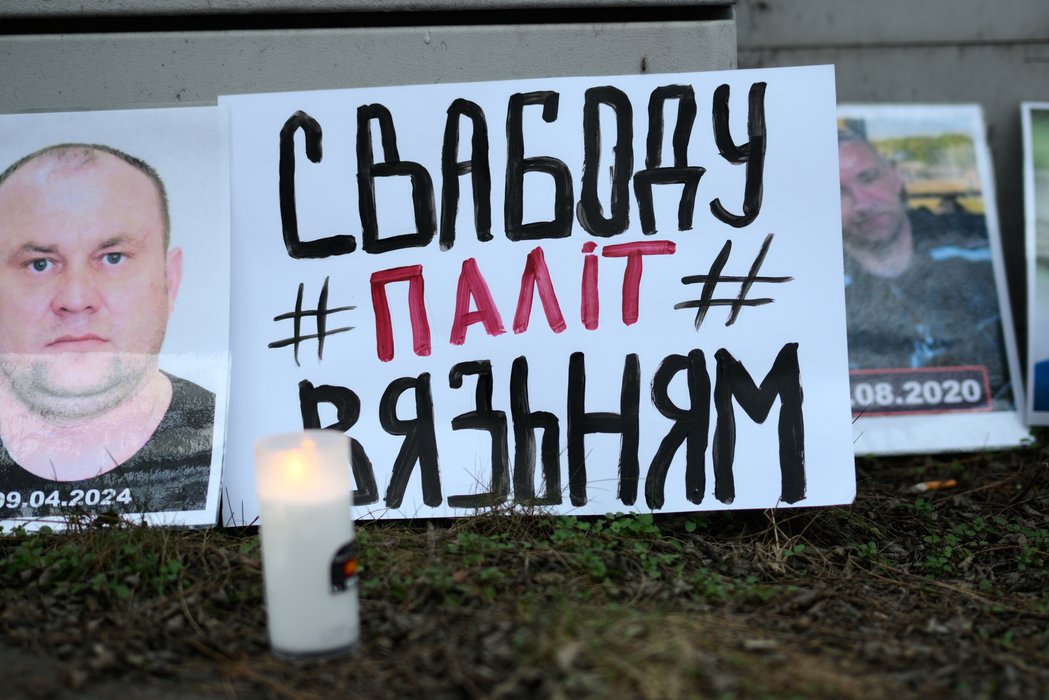
The Belarusian authorities continue to suppress the rights to peaceful assembly and freedom of expression, particularly in response to the mass protests following the disputed August 2020 presidential election. Arbitrary detention and imprisonment for expressing dissent remain widespread, with many individuals facing politically motivated charges.
According to the Viasna Centre, at least 15 people were convicted in February 2025 under Article 342 of the Criminal Code, which penalises the organisation, preparation, or active participation in actions that “grossly disrupt public order.” This provision continues to be widely used to criminalise peaceful protest.
Married couple convicted on charges criminalising protests
A particularly troubling trend is the prosecution of entire families for their involvement in protests or dissent. Authorities have increasingly invoked Article 342 and related charges to silence groups of relatives. For example, on 24th February 2024, the Hrodna Regional Court convicted Leanid and Antanina Tserabei on multiple counts, including insulting President Alexander Lukashenko, participating in actions disrupting public order, inciting social discord, slander, and misuse of state symbols. Following their arrest, pro-government media claimed that Antanina would likely receive a non-custodial sentence while “the head of the family will end up in jail.”
In the February verdict, Antanina received a two-year home confinement sentence, while Leanid was sentenced to three years in prison. The case exemplifies Belarus’s lack of judicial independence, where verdicts appear predetermined and politically driven.
Political prisoners released in US-facilitated deal include one convicted on protest-related charges
On 12th February, Alena Maushuk was released from detention in Belarus and transferred to Lithuania as part of a US-facilitated operation. Chris Smith, the US Deputy Assistant Secretary of State for Eastern European Affairs, told CNN that the release was part of a special operation in which he and other US officials crossed the Belarusian border and travelled to Minsk to meet Belarusian counterparts, who handed three detainees over to them. The group was then taken out of Belarus through Lithuania. On the eve of her release, Maushuk was transferred from Penal Colony No. 24 to the KGB detention centre, from where she was taken to the Lithuanian border the next day with a mask over her eyes.
Detained in Pinsk on 10th August 2020 and later sentenced to six years in prison for alleged participation in mass riots, Maushuk had reported being subjected to physical and psychological abuse and was stripped of her parental rights. Her release, alongside journalist Andrei Kuznechyk (see under Freedom of expression) and an unnamed US citizen, followed a pardon by President Alexander Lukashenko. US officials described the move as a unilateral gesture by Belarus to improve relations with Washington.
Freedom of expression
Radio Free Europe journalist released
Radio Free Europe/Radio Liberty (RFE/RL) journalist Andrei Kuznechyk was released from a Belarusian prison on 12th February 2025 after more than three years of imprisonment. He was arrested on 25th November 2021, when unidentified individuals detained him and escorted him home for a search. Initially sentenced to ten days of administrative arrest on a charge of hooliganism, Kuznechyk was not released after serving that term but was instead charged with creating or participating in an extremist organisation.
In June 2022, a court in Mahiliou found him guilty and sentenced him to six years in prison. Human rights organisations recognised him as a political prisoner, viewing his case as part of a broader campaign of repression against independent journalists and media outlets in Belarus. As noted above, Radio Liberty’s Belarusian service was designated an “extremist organisation” in December 2021, which severely restricted journalists’ work and limited public access to independent information.
His release resulted from international efforts, including mediation by the US administration and support from the Lithuanian government.
Journalist re-arrested after being released on parole
In January, the Belarusian Association of Journalists reported that videographer and political prisoner Andrei Tolchyn, released on parole in September 2024, had been detained again and had not been heard from for three months. Tolchyn, sentenced in March 2024 to two and a half years in prison for “facilitating extremist activity” and “defaming the president”, was pardoned by President Alexander Lukashenko before his re-arrest on 31st October. His home was searched, and his name later appeared in court records for “distributing extremist materials.” His current whereabouts remain unknown.
Security services gain access to Telegram channel tracking military movements, detentions follow
On 5th February, the Belaruski Hajun monitoring project reported that its Telegram channel had been infiltrated, prompting its closure two days later. Founder Anton Motolko said unauthorised access had been gained to a chat linked to the Hajun bot, which collected information from users, raising concerns that data may have been downloaded.
Established by Motolko before Russia’s invasion of Ukraine, Belaruski Hajun was an open-source monitoring project tracking the movements of Russian and Belarusian troops. Following the breach, a pro-government Telegram channel linked to the security services urged the project’s shutdown and appeared to threaten prosecutions based on the user data obtained. The message read: “Food for thought: there’s a 100% chance that the courts will impose a shorter sentence for assisting an ALREADY CLOSED extremist project than for one that’s still active. You know what to do…”
The first reported detention connected to the project occurred on 7th February, when 42-year-old oil refinery worker Maksim Nikitenko was reportedly arrested in relation to the case.