The state of civic space in Taiwan is rated as ‘open’ by the CIVICUS Monitor. This means the state has created an enabling environment for people to enjoy their civic freedoms. Civil society is able to operate and undertake their work without harassment or undue interference. People are free to hold protests in public places and form associations. There is also a relatively free media, and journalists are able to do their work without any major restrictions.
In July 2025, Taiwan held a recall vote which allows voters to remove their elected representatives before the end of their term through a legal process. All 24 legislators from the opposition Chinese Nationalist Party (KMT) who were up for recall survived the vote.
In recent months, opposition protesters have been summoned for questioning as part of investigations while a pro-Palestine protest was disrupted. There are concerns around the ban of a social media platform and deportation of foreigners for their online expression. A union of migrant workers also faced suppression.
Peaceful Assembly
Most protests in Taiwan occurred peacefully. In recent months, there were protests on migrant workers’ rights, by teachers against what they describe as an abusive school incident management system and by those pushing for democracy in Myanmar, among others.
TPP political party protesters facing investigation
TPP supporters clash with police at rally over Ko Wen-je's legal casehttps://t.co/kCAEcx3KBY#Taiwan pic.twitter.com/yNSFlMpuh4
— Taiwan News 247 (@TaiwanNews247) August 30, 2025
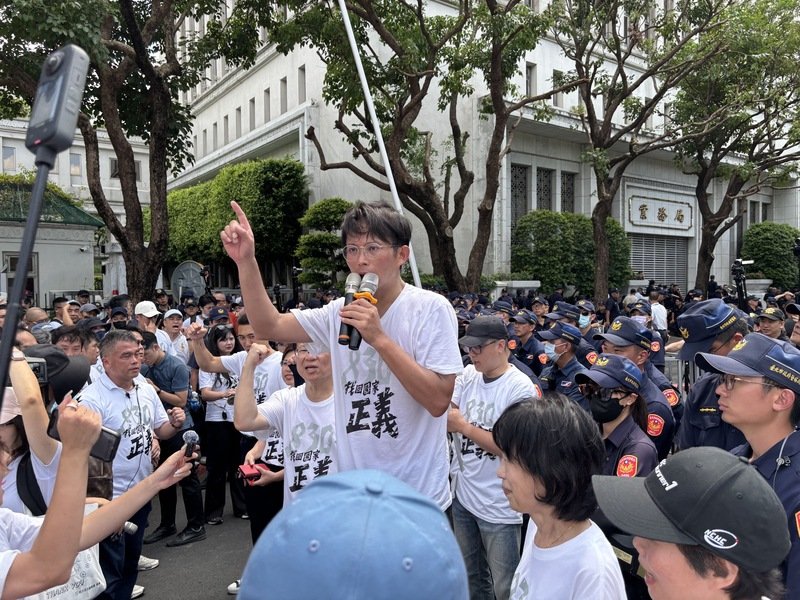
On the morning of 30th August 2025, nearly 1,000 supporters of the Taiwan People's Party (TPP) organised a rally to mark the one-year anniversary of a sweeping raid by Taipei prosecutors targeting former TPP chair and Taipei mayor Ko Wen-je. Police ordered the protesters to stop and disperse as the crowd attempted to cross the intersection of Aiguo West Road and Zhongshan South Road on their way to the President's residence.
Police said the rally violated the Assembly and Parade Act because no permit had been applied for or granted. Despite this, the protest continued and ended after its arrival at the Presidential residence.
On 2nd September 2025, the Ministry of the Interior, which oversees the National Police Agency, said that some protesters from the TPP rally would be referred to prosecutors for investigation. Police added that they had collected evidence of obstruction of public officials and coercion by “disorderly” demonstrators”, as well as contraventions of the Assembly and Parade Act. They said that amid the “severe pushing and jostling” by some demonstrators, eight police officers were injured.
The police said they would soon summon TPP Chairman Huang Kuo-chang, who led the rally, and that other accomplices would also be questioned and held accountable.
Prosecutors question KMT party leaders over protest
In December 2025, Taipei prosecutors summoned former Chinese Nationalist Party (KMT) chairman Eric Chu, former KMT spokeswoman Yang Chih-yu and KMT Legislator Hsieh Lung-chieh for questioning for allegedly holding an illegal assembly in April 2025.
It was the first time that the Taipei District Prosecutors' Office had summoned them for questioning in the case, and they were later released.
Chu, Yang and Hsieh are suspected of contravening the Assembly and Parade Act by holding a protest on 17th April 2025 outside the Taipei District Prosecutors' Office, a restricted area where public assembly is not allowed.
Chu had called on party members to protest after Huang Lu Chin-ju, director of the KMT's Taipei chapter, and several other KMT staffers were questioned over the alleged forgery of signatures in recall campaigns targeting Democratic Progressive Party (DPP) legislators.
Police said that they did not comply with repeated orders to disperse, in accordance with the Assembly and Parade Act.
Pro-Palestine protest disrupts Taiwanese defence expo
Activists in September 2025 staged a demonstration outside the Taipei Aerospace & Defence Technology Exhibition, accusing dozens of participating companies of profiting from Israel’s ongoing military campaign in Gaza and urging the government to block arms-related exports linked to alleged war crimes.
The rally, organised by the Taiwan Alliance for a Free Palestine, coincided with the final day of the three-day defence industry expo at Nangang Exhibition Centre, where 490 companies from 15 countries showcased military hardware, robotics and aerospace technology.
According to New Bloom Magazine, protestors briefly disrupted the event by carrying mock corpses around the venue representing dead babies in Palestine and passing out fliers to expo participants about the report regarding Taiwan’s alleged complicity. They were briskly escorted out by police. Meanwhile, one person was arrested in the vicinity and held by police.
According to Taiwan Association for Human Rights (TAHR), protesters were arrested and questioned by police under the Social Order Maintenance Act. ICNL has pointed out how that law contains vague and overly broad provisions that could be used to restrict assembly.
Expression
Social media platform banned for a year
Taiwan to ban Chinese app RedNote over fraud concerns https://t.co/kCJJGeOt2W
— BBC News (World) (@BBCWorld) December 5, 2025
On 4th December 2025, Taiwan’s Ministry of the Interior imposed a one-year ban on Xiaohongshu (Rednote), a Chinese social media platform, which has become an important source of everyday information, particularly for younger users in Taiwan.
The government cited several reasons: cybersecurity risks, the platform’s alleged role in facilitating scams, and — most importantly — its refusal to comply with Taiwan’s legal requirements by appointing a local legal representative to handle disputes, complaints and regulatory communication.
The Ministry instructed the Taiwan Network Information Centre to implement DNS Response Policy Zone blocking, which prevents the resolution of Xiaohongshu’s domain name. Taiwan’s approximately three million Xiaohongshu users can now access the platform only through VPNs, alternative DNS providers, or other circumvention methods.
Opposition politicians have accused the Democratic Progressive Party (DPP) government of curbing freedom of expression and selectively targeting platforms of Chinese origin. Analysts also argue that the ban may be a barrier to the right to access information and the blanket prohibition prevents all Taiwanese users from accessing any content on Xiaohongshu—including the vast majority of legitimate, non-fraudulent material.
Japanese influencer deported for filming video
Taiwan's National Immigration Agency on Monday deported a Japanese social media influencer for claiming that "Taiwan belongs to China" in a TikTok video made in Taipei.https://t.co/7nKKmxefAk
— Focus Taiwan (CNA English News) (@Focus_Taiwan) August 25, 2025
A Japanese influencer was deported in September 2025 over filming a video by Ximending’s Rainbow Crosswalk in Taipei in which he and another Japanese man raised the flag of the People’s Republic of China and declared that Taiwan was part of China. The man in question, referred to as Aira Todomi on his social media presence, carried out the act along with another man referred to as Hiroyuki Tanaka on social media.
According to New Bloom Magazine, the National Immigration Agency banned both men from re-entering Taiwan. Todomi is reportedly married to a Taiwanese person. Both spoke Mandarin in the video, emphasising that they were Japanese nationals who loved China, and singing the Chinese national anthem. Nevertheless, Todomi has also referred to himself as Chinese in other videos. Tanaka was not deported, as he had already left Taiwan
Todomi and Tanaka likely came to the attention of the National Immigration Agency through angry Taiwanese netizens who reported their actions. This took place on the basis of Item 13 of Article 18 of the Immigration Act, which allows the National Immigration Agency to prohibit a foreign national from entering Taiwan if he or she is “believed to endanger national interests, public security, public order, or the good customs of the State.”
This was not the first case of such deportations. As previously documented, at least three Chinese influencers were deported in March and April 2025.
The deportations have created a debate in Taiwan on free speech and national security. Those who support the government’s decision cite the solid legal basis and process on which the deportation took place, including appeals and procedures for handling a clear breach of laws. However, some argue that these deportations are a violation of Taiwan’s spirit of free speech in that speech deemed offensive to the government is silenced.
Association
Company retaliates against formation of union
TaiDoc Union protests strict migrant worker rules, union suppression - Focus Taiwan https://t.co/EdO2DkHaYp
— Lennon Ying-Da Wang (汪英達) (@lennon_ydwong) November 7, 2025
In response to ongoing grievances at TaiDoc Technology, a well-known local medical device manufacturer, a group of migrant workers organised a labour union in August 2025 and filed a formal labour dispute against the company.
However, according to the union, TaiDoc allegedly retaliated by summoning union leaders and pressuring them to turn over member rolls and dissolve the union. The company also held closed-door meetings with migrant workers to pressure them not to join the union, confiscating phones during the meetings. In these meetings, workers were told that they were being influenced by “outside forces” and could lose privileges regarding overtime and bonuses. It was also alleged that forming a union was only for the purpose of receiving a 100,000 NT (USD 3,170) subsidy from the government.
In November 2025, a group of Filipino migrant workers, joined by Taiwanese labour rights organisations, staged a protest in front of Taiwan’s Ministry of Labour calling for an investigation into alleged forced labour practices at TaiDoc Technology. The protesters submitted a formal petition urging the government to look into what they described as unfair and exploitative labour management policies. Another protest was held on 9th February 2026.