Freedom of peaceful assembly
On 18th November, former technical workers of the Kosovo Assembly protested demanding reinstatement after being dismissed by “Schafberger”, the company contracted for the Assembly’s maintenance, in retaliation for striking. The workers had been on strike for over two months, calling for higher salaries. Following the renewal of the company’s contract, wages were raised from €270 to €400 gross, yet the dismissed strikers were not allowed to return to work. The Private Sector Independent Union filed a complaint with the Labour Inspectorate, which ruled that the company had acted unlawfully by dismissing 15 workers. However, despite this decision, the workers have not been reinstated, prompting the Union to announce plans to take the case to court.
On the same day, actors of the National Theatre launched a general strike, demanding a review and increase of salary coefficients, which brought all artistic activities to a halt. The strike followed earlier union actions such as delaying rehearsals. On 27th November, several actors symbolically threw portraits of their faces at the entrance of the Ministry of Culture, denouncing what they described as the crushing of their dignity through low pay. On 5th December, dozens of actors staged a protest performance entitled “The Minister’s Monologue”, featuring a puppet with the face of the Minister of Culture performing a scene from George Orwell’s 1984 that mocked the striking actors. They vowed to continue the strike until their demands are met.
Growing discontent over wages and working conditions was also reflected in the healthcare sector. On 14th November and again on 5th December, healthcare workers led by the Federation of Health Unions protested to demand the signing of a collective agreement and to express dissatisfaction with the Government’s proposal to increase the salary coefficient by only 0.5 units. Chanting slogans such as “We want a collective agreement” and “Patience has run out, sign the agreement, Minister!”, they called on the Ministry to resume social dialogue and warned of further protests and a possible general strike if their demands remain unmet.
Similar frustrations were echoed in the education sector. On 4th December, hundreds of teachers, led by the United Union of Education, Science and Technology, marched from the National Library to the Ministry of Education and then to the Government, demanding salary increases and a new collective agreement. Under the slogan “Government, fulfil our demands, prevent further union actions”, they criticised the authorities—particularly the Minister of Education—for failing to communicate with unions. The Union also warned of a general strike if their demands are ignored.
Labour-related protests extended beyond education and healthcare. On 9th December, workers of the public enterprise “Tregu” and three associations providing services to people with disabilities held a joint protest in front of the Municipality of Gjilan, demanding salary increases and municipal subsidies. Representatives of the associations warned that without continued subsidies they would be unable to maintain their services in 2025. The approval of the 2025 municipal budget has been delayed due to the local authorities’ lack of a governing majority, preventing subsidy allocations. The protesters warned of a strike if the issue remains unresolved.
Concerns about job security also drove workers of the public enterprise “Pastrimi” in Prishtina to protest on 22nd November and 4th December. They opposed the outsourcing of waste collection services to private companies, warning that it could lead to the enterprise’s bankruptcy and the loss of their jobs. The workers urged the Municipality to cancel the tender for private operators.
Protests were not limited to labour issues. On 14th November, employees of the Ministry of Culture, Youth and Sports demonstrated against violence in public institutions following the physical assault of a ministry official by the deputy secretary. Wearing masks and holding slogans such as “Today I wear a mask because I work in a toxic environment” and “I am not sure if I dare to participate because there might be retaliation”, they condemned the culture of intimidation and lack of accountability within the Ministry.
Public outrage also surfaced around justice and professional ethics. On 21st November, activists from the Centre for Information and Social Improvement, joined by the Patients’ Rights Association, protested outside the Appeals Court after speech therapist Iljasa Fazliu was acquitted of charges of mistreating a three-year-old girl with autism. Fazliu had been arrested in 2022 after a video showed him addressing the child with offensive and derogatory language. Protesters carried slogans reading “Where is the professional ethics?” and “Abusers in prison”, demanding justice and the revocation of Fazliu’s professional licence.
Calls for accountability extended into the political sphere as well. On 13th December, activists from the Youth Initiative for Human Rights gathered outside the headquarters of Kosovo’s four largest political parties, urging them to adopt an “inclusive, respectful, and human rights-based” discourse during the election campaign. Through slogans referencing party messages, they denounced femicide, violence, and discrimination.
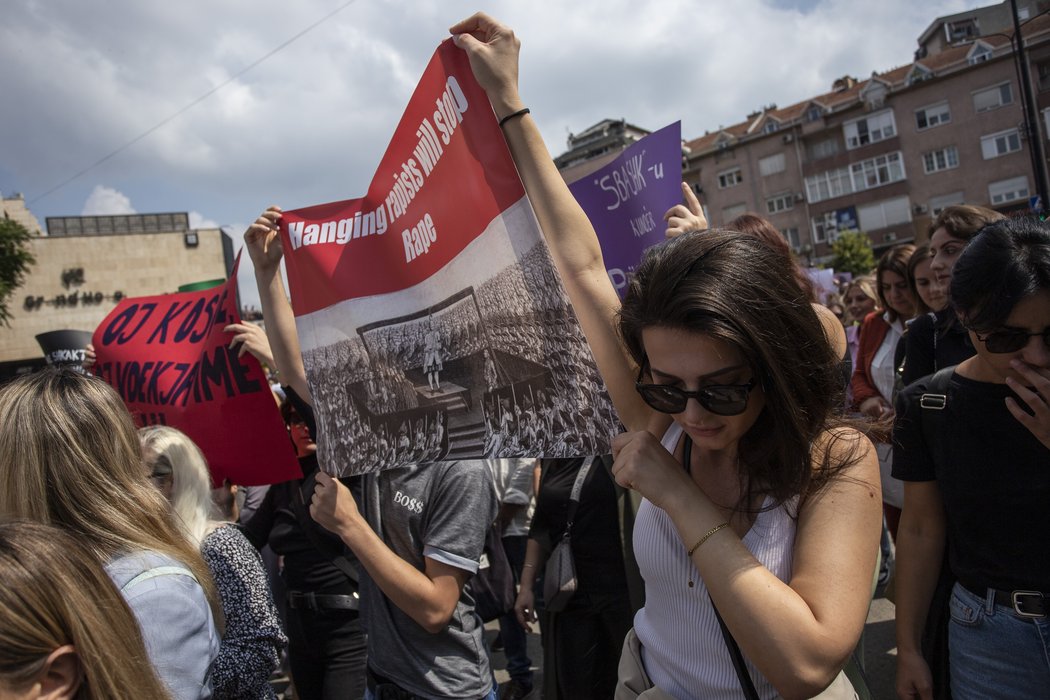
Civil society mobilisation also continued around gender-based violence. On 25th November, dozens of activists marked the start of the “16 Days of Activism Against Gender-Based Violence” campaign in Mitrovica, highlighting that 58 women and girls have been killed in Kosovo as victims of domestic violence. They condemned the failure of law enforcement to properly sanction offenders, who often later commit femicide.
Local grievances over public services and infrastructure also triggered protests. On 18th November, residents of Prishtina’s Dardania neighbourhood demonstrated against the continuation of an infrastructure project that, they said, closed off the basement windows of their flats due to terraces built by ground-floor businesses. They had previously protested on 4th November, reporting that the blocked windows caused suffocation, foul odours, and made their basements unusable. Similarly, in December, residents of Bibaj village in Ferizaj and Bardhosh village in Prishtina held separate protests over frequent power outages, which disrupted heating and caused financial losses to local businesses.
In December, residents of several villages in Lipjan initiated a petition against the construction of a waste landfill in their area. They complain about the environmental damage the landfill would cause and criticise the Ministry of Environment for deciding to build the landfill without prior public consultation. The residents have warned of protests if their petition is not addressed by the competent authorities.
On 14th November, activists from the Social Democratic Party staged a symbolic protest along the Prishtina–Gjilan highway, criticising the Minister of Infrastructure, Liburn Aliu, for delays in completing the project. They placed signs reading “I am too reluctant to talk about the highway” alongside photos of the Minister, mocking his refusal to answer journalists’ questions about the delays.
On the same day, Aleksandar Arsenijević, leader of the political party Serbian Democracy, and several members staged a protest in North Mitrovica against the Kosovo Police, who were distributing awareness leaflets to encourage public cooperation. The protesters displayed a banner featuring social media photos of police officers making what they viewed as nationalist gestures, such as the two-headed eagle symbol. Arsenijević told KALLXO.com, which had reporters at the scene, that citizens want a multiethnic police force, not a nationalist Albanian police, criticising the Kosovo Police for what he described as unprofessional behaviour.
Freedom of expression
On 20th November, the Association of Journalists of Kosovo (AJK) reported receiving information about a lawsuit filed by rapper Trim Ademi against journalist Robert Bojaj, which it described as a SLAPP case. Ademi claims that Bojaj damaged his reputation by pressing a guest on his TV show to reveal the amount of money Ademi had requested for a music project. The rapper is seeking unspecified financial compensation. The AJK has organised legal defence for Bojaj and submitted a response to the lawsuit before the Basic Court of Prishtina. It characterised the case as an attempt to intimidate and silence journalists in exercising their right to ask questions, urging the court to handle it in line with the Council of Europe’s recommendations against SLAPPs and to set a precedent against such cases in Kosovo.
Threats and intimidation against journalists continued. Berat Buzhala, a journalist with the online portal Nacionale, received a death threat from a Facebook profile, which he later published. The message read: “I give you the Albanian’s oath that I will kill you and others like you.” On 2nd December, the AJK condemned the threat as a serious risk to the journalist’s personal safety and called on the police to act urgently and hold the perpetrator accountable. Similarly, on 18th December, Periskopi journalist Ilir Mirena received a threat from a Facebook user who commented under a news article about him, writing: “This one, he only deserves the bullet.”
Journalists also faced obstruction while performing their duties. On 21st November, the TV crew of Kanal 10 was physically prevented from reporting by the director of a public school in Fushë Kosova, while covering the lack of heating in the institution. Earlier, on 13th November, the AJK condemned sexist language and obstruction against journalist Qliresa Hasani by officials of the Kosovo Energy Distribution Services during her coverage of a protest outside the corporation’s building. One of the officials told her, “Filming the institution’s building is not allowed, unless you want to take a photo with me.” The AJK described this as a gender-based attack on the journalist’s personal and professional dignity.
On 4th December, the AJK condemned the use of inflammatory language by the director of the public enterprise Ibër-Lepenci, Faruk Mujka, towards journalist Mimoza Koprani Muçaj and the media outlet Kohavision. In a Facebook post, Mujka accused Koprani Muçaj of lying about his statement concerning the €1 million required to repair damage from an explosion in Ibër-Lepenc. He denied making the comment, alleging that the journalist aimed to damage his reputation for the benefit of certain groups, and compared KTV to Russian state outlets such as Sputnik and Russia Today.
Politicians’ attacks on the media also drew condemnation. On 9th January, the AJK criticised the spokesperson of the Lëvizja Vetëvendosje party, Arlind Manxhuka, who referred to several media outlets as Serbian “parallel institutions” in a Facebook post. The AJK called his remarks unacceptable and said they undermine the environment for free journalism in Kosovo. On 8th December, it also condemned Prime Minister Albin Kurti’s comments during a party meeting, in which he accused the media of siding with Serbia, saying: “Those who, for every attack and aggression of Serbia against our state, always found the culprit in our government, but never in Serbia, do not deserve your attention.”
Concerns about political pressure on the media persisted. On 9th January, the AJK expressed alarm over reports that Lëvizja Vetëvendosje planned to boycott several media outlets—including Klan Kosova, TV Dukagjini and TV7—during the electoral campaign. The AJK urged the party to reconsider, stressing that such a move would undermine media pluralism, equality and transparency by preventing the press from holding the ruling party accountable.
In December, media representatives also criticised the draft regulation of the Independent Media Commission on electoral coverage, calling it restrictive and inconsistent with the Electoral Law. They objected to the 120-second limit for political advertisements, describing it as an obstacle to comprehensive campaign coverage, and opposed limits on extended reporting of political events, which hinder the presentation of party programmes and gatherings. Additional concern was raised over the proposed restriction of advertisement airtime to just four hours per day, which journalists said would further constrain media freedom during elections.