Introduction
Babiš to be appointed PM despite conflict-of-interest concerns
Right-wing populist Andrej Babiš and his party, ANO, won 34.51% of the vote in parliamentary elections held on 3rd and 4th October 2025, significantly outperforming the pro-Western conservative coalition led by outgoing Prime Minister Petr Fiala. Babiš signed a coalition deal with two far-right parties: the Motorists party, which is climate-change sceptic, and the SPD (Freedom and Direct Democracy), which opposes the EU and NATO. Babiš announced that he intends to form a government by mid-December.
Czech President Petr Pavel is set to appoint election winner Babiš as prime minister on 9th December 2025, after Babiš pledged to permanently relinquish ownership and control of his Agrofert conglomerate. Agrofert has long been criticised for receiving public subsidies while Babiš was previously in office from 2017 to 2021. Ministerial vetting continued at Prague Castle, with Pavel raising minor reservations but signalling no intention to block ANO’s nominees. Tensions have centred on the far-right SPD and Motorists, ANO’s coalition partners, whose proposed ministers include controversial former MEP Filip Turek. Pavel has blocked Turek’s appointment for weeks over mounting scandals involving racist, sexist and homophobic Facebook posts.
Following the election victory, Babiš’s populist ANO party and its right-wing allies announced plans to keep budget deficits within EU limits, cap the retirement age and lower energy costs as part of a joint government agenda. Political analysts warn that the coalition could tighten immigration rules, slow progress on environmental targets, and reshape aspects of Czechia’s relationship with the EU.
Investigation reveals Russian disinformation ahead of elections
An investigation published on 25th August 2025 by Czech news outlet Voxpot, in collaboration with the IT team Druit, mapped and analysed the scale of Russian disinformation by examining more than a dozen of the largest Czech disinformation websites, covering some 360,000 articles published over the past 25 years. “Disinformation platforms in the Czech Republic are now churning out more articles every day than the largest Czech media houses,” Voxpot warned in an accompanying report. The findings raise serious concerns about the widespread dissemination of Russian narratives and accuse the government of failing to respond adequately. The analysis also highlights close, and at times direct, ties between some of these platforms and Czech politicians, including figures within the inner circles of former presidents Miloš Zeman and Václav Klaus. Russian disinformation is reportedly amplified en masse by actors linked to the SPD movement, among others.
Freedom of Association
NGOs warn of Russian-style restrictions on civil society planned by incoming government
In October, it was reported that Andrej Babiš’s incoming government is preparing legislation to tighten controls on non-profit organisations, prompting strong criticism from civil society groups. The planned law would introduce a public register of all subsidies, prohibit the use of public funds for “political activism”, and require organisations receiving foreign funding to label themselves as such. It would also allow subsidies to be withdrawn from groups deemed to be blocking development or investment, potentially affecting environmental organisations. The NGO People in Need warned that the proposal mirrors Russian “foreign agent” legislation, arguing that Czech non-profits already operate under robust transparency rules and that similar laws elsewhere in Europe have been overturned or sparked mass protests.
Freedom of Assembly
Protesters rally against cabinet picks
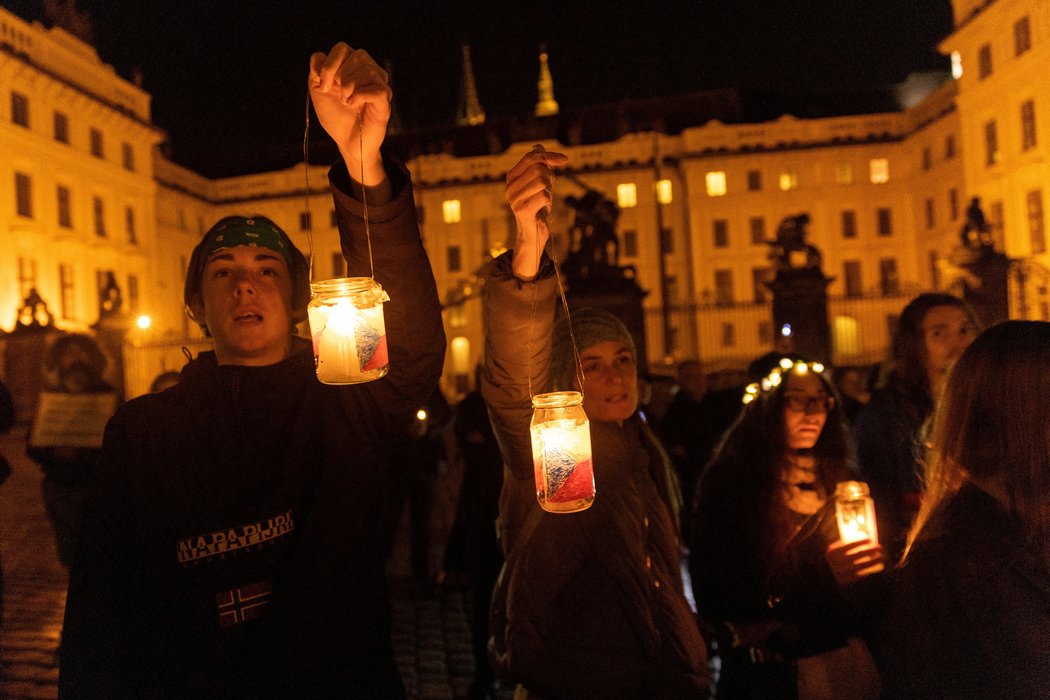
On 29th October 2025, protesters in Prague rallied against the participation of Tomio Okamura’s far-right SPD party in the next Czech government. The protest was organised by the civic initiatives Štít demokracie (Shield of Democracy) and Občanský rozcestník (Civic Signpost). Organisers reported submitting a petition to President Petr Pavel opposing the approval of a government coalition involving the SPD, signed by more than 45,000 people. “At a time when a major war is raging in Europe, it is highly risky for a party like the SPD to have access to the most sensitive security documents and negotiations,” the organisers said.
The petition, titled “NE vládě s účastí SPD” (NO to a government with SPD participation), calls on the president and parliamentary party leaders to reject the SPD’s inclusion in the new government. It argues that the SPD failed to secure even 8% of the vote in the elections and therefore lacks the legitimacy to influence government security or foreign policy.
On 6th November, Okamura was elected as Speaker of the Chamber of Deputies, the lower house of the Czech parliament.
Earlier, on 19th October 2025, around 2,000 people protested in Prague against the nomination of Petr Macinka, chairman of the Motorists party, as Minister of the Environment. Protesters warned that his appointment would undermine environmental protection in the Czech Republic. Speakers from a coalition of environmental movements and organisations highlighted Macinka’s record of denying the climate crisis, as well as his ties to oligarchs and the fossil fuel industry. According to Rozálie Husáková, co-spokesperson of the Young Greens, this was one of the largest environmental demonstrations in the country since independence. On 22nd October 2025, around 1,000 people gathered in Brno to protest against the same nomination.
Freedom of Expression
Press freedom at risk, RSF and journalists warn
In a joint statement released on 10th November 2025, Reporters Without Borders (RSF) and the Czech Syndicate of Journalists warned that the newly forming government’s plans to abolish the licence fee would “lead to a rollback of freedoms and financial instability for public service media” and “may also conflict with the European Media Freedom Act (EMFA)”.
Since August 2025, the EMFA has required EU member states to guarantee the “editorial and operational independence” of public service media and to support them with “adequate, sustainable and predictable financial resources”. However, the post-election coalition intends to abolish the licence fee that underpins the independence of Czech Television (ČT) and Czech Radio (ČRo), citing a desire to “reduce the burden on citizens and businesses”, while failing to propose any alternative financing model compliant with EU law.
The coalition has also pledged to eliminate “duplicate costs” in public media, echoing pre-election threats to merge ČT and ČRo. Such a move would enable changes to the leadership of these outlets, which coalition figures have baselessly accused of being “corrupted” by the outgoing government.
Already on 4th September 2025, Czech and international press freedom organisations urged democratic parties to commit to a 10-point plan to protect independent journalism ahead of October’s parliamentary elections. The recommendations, inspired by the EU’s Media Freedom Act, called for stronger safeguards against attacks on journalists, swift implementation of anti-SLAPP measures, and stricter controls on state surveillance tools such as spyware.
The groups warned against legislative initiatives that could chill investigative reporting, urging parties to respect media self-regulation, avoid politicising accreditation or defining who qualifies as a journalist, and ensure transparent allocation of state advertising. They also called for stronger guarantees of public service media independence, fair competition in the private media market, and continued protection for exiled journalists operating from Czechia.
Czechia currently ranks 10th globally for press freedom, but the signatories stressed that maintaining this position requires sustained cross-party commitment, particularly as political tensions intensified ahead of the vote.
The incoming government has also announced plans to impose new obligations and restrictions on private and exile media registered as non-profit organisations. Outlets that “engage in political activity and receive foreign funding” would be required to “label this transparently”.
“Unprecedented” gendered harassment campaign against women investigative journalists
Following their investigative reporting, journalists Zdislava Pokorná of Deník N and Apolena Rychlíková of Page Not Found faced an avalanche of threats, insults and hate speech. “The attacks directed at Apolena Rychlíková and Zdislava Pokorná in recent days represent an unprecedented new low,” the industry association Ženy v médiích (Women in Media) stated in mid-July 2025.
At the end of May 2025, investigative journalist Zdislava Pokorná revealed that the Ministry of Justice had received around one billion Czech crowns (approximately €40 million) in bitcoin from a convicted drug trafficker. The revelation led to the resignation of Justice Minister Pavel Blažek, a close ally of Prime Minister Petr Fiala.
In two articles published in late June and early July 2025, Apolena Rychlíková, a prominent reporter, documentary filmmaker and editor-in-chief of Page Not Found, reported that MEP and honorary president of the Motorists party Filip Turek was facing a criminal complaint from his former partner, who alleged years of sexual abuse, harassment and rape.
In both cases, the reporting was followed by coordinated online threats, abuse and ridicule, often targeting the journalists’ personal lives or physical appearance in an attempt to undermine their credibility and divert attention from the allegations. Senior figures within the ruling conservative Civic Democratic Party (ODS) called for a boycott of Deník N, while largely remaining silent about the hate campaign against Rychlíková. The Motorists, meanwhile, dismissed the reporting as “an outrageous campaign by a left-wing extremist” aimed at smearing Turek ahead of the October 2025 elections.
In mid-October 2025, Deník N journalist Zdislava Pokorná again faced a wave of online abuse and threats after publishing archived Facebook posts containing racist, sexist and homophobic comments by Filip Turek. Supporters of the Motorists party targeted her with insults and threats of physical violence. The Czech IPI committee urged party leaders Petr Macinka and Filip Turek to call on their supporters to stop the harassment, while the Czech Syndicate of Journalists expressed solidarity and welcomed police investigations into the threats.
Safe Journalism platform launched
On 4th September 2025, the Safe Journalism platform was launched by the Czech branch of the International Press Institute, introducing a new system for documenting attacks on journalists and alerting law enforcement to potential criminal cases. The platform supports journalists under threat by providing legal, psychological and professional support, and serves as a practical guide for responding to coercion and harassment. Journalists can report online threats and intimidation; pressure from political or economic actors; legal harassment, including SLAPP lawsuits; internal pressure from management or media owners; physical intimidation, attacks and stalking; and invasions of privacy or surveillance, among other abuses.
Criminalisation of communist propaganda
In late July 2025, the Czech Republic amended its criminal code to criminalise the promotion of communist ideology as from 2026, placing it on the same legal footing as Nazi propaganda. Supporters argued that the change closed a 30-year gap by recognising both as “totalitarian movements” responsible for human rights violations. Critics, including the Communist Party of Bohemia and Moravia (KSČM), denounced the move as a political tactic by Prime Minister Petr Fiala’s government to weaken opponents ahead of the October elections.
Local ODS member condemned over threats
On 10th November 2025, the Czech branch of the International Press Institute condemned Tomáš Homola, a South Bohemian member of the ruling ODS party, for violent online insults targeting journalists Vojtěch Berger and Břetislav Tureček. The abuse followed Tureček’s participation in a university debate on Israel–Palestine and intensified after Berger reported on the incident. Homola referred to them as “brown filth” and “psychopaths”, and hinted at physical violence, writing that he had “missed” Tureček’s lecture because his “baseball bat was damaged”. Local ODS officials only partially distanced themselves, prompting IPI to urge the party leadership to take a clear stance and ensure respectful conduct towards journalists.
Babiš targets investigative editor while promoting foreign-agent law
On 3rd November 2025, incoming prime minister Andrej Babiš used a press conference to promote a planned law requiring “politically active” NGOs receiving foreign funding to disclose it, singling out Investigace.cz editor-in-chief Pavla Holcová. Babiš accused Holcová of running a “political” organisation and claimed her reporting—including the Pandora Papers revelations about his offshore property dealings—cost him the 2021 election. He reiterated earlier claims linking Holcová to George Soros and suggested that her USAID-funded work constituted foreign interference. Press freedom organisations condemned the remarks as intimidation and warned that the proposed law could be weaponised against independent media.
Investigation uncovers paid smear ads targeting Czech journalists and public media
A cross-border investigation has identified 47 paid political ads on Meta platforms that smeared Czech public service media and individual journalists between July 2024 and June 2025. The ads, linked mainly to the far-right SPD and far-left STAČILO! blocs, portrayed Czech Television as corrupt, biased and akin to “Goebbels-style propaganda.” Private outlets including Seznam Zprávy and Forum 24 were also attacked, with journalists labelled “hyenas” and “idiots.” Media groups warn the coordinated campaigns risk chilling reporting and undermining trust in independent journalism.
Czech Television condemns violent hate against drag-themed talk show
Czech public broadcaster ČT condemned a surge of hateful and threatening comments directed at its new drag-themed talk show Chi Chi na gauči and those involved in its production. The programme, launched in late July 2025, addresses LGBTQI+ rights, childhood experiences, discrimination and everyday life in drag.
ČT stressed that criticism is legitimate but incitement and intimidation are not, and pledged to protect the programme’s creators. The broadcaster said the show reflects its public service mandate and international trends promoting diversity and minority representation.
Artists oppose Motorists’ culture ministry pick
An open letter opposing the Motorists party’s planned nominations for the Ministry of Culture has been signed by nearly 1,000 cultural workers and artists as of 25th October 2025. The signatories warn of proposed cuts to an already underfunded ministry and argue that the cultural sector requires political trust to uphold its autonomy and democratic values.