Freedom of association
Between 2023 and mid-2024, Bosnia and Herzegovina faced political and economic challenges that diverted leaders’ attention from implementing the reforms required to advance EU integration and align with the region. Despite the European Council’s decision in March 2024 to open accession negotiations, several key priorities remain unfulfilled. The country still needs to address the 14 essential priorities outlined in the European Commission’s 2019 Opinion, which focus on democracy, the rule of law, fundamental rights, and public administration. A report by the Sarajevo Open Centre published in October 2024 highlights significant gaps in these areas that, if resolved, could accelerate Bosnia and Herzegovina’s path towards EU membership.
Workers in the non-governmental (NGO) sector are increasingly calling for greater unionisation and recognition of their labour rights, challenging the widespread perception that NGO work is purely activism. In an article published on 7th November 2024, activist Svjetlana Nedimović argues that equating NGO work with activism obscures the fact that NGO employees are entitled to fair wages, benefits, and legal protections such as sick leave and pensions, a point often overlooked, particularly by those in expert or managerial positions. Union organisers point to the complex relationship between NGO staff and their organisations, where decisions are often controlled by boards or presidents accountable primarily to donors rather than to workers. Despite these structural barriers, advocates stress the urgent need for stronger union representation in the NGO sector, emphasising that broad-based unions are crucial for both democracy and workers’ rights.
A publication released in December 2024 by the Sarajevo Open Centre examines the anti-abortion movement in Bosnia and Herzegovina, focusing on individuals, formal and informal groups, organisations and foundations seeking to ban or restrict abortion through legislation, public campaigns, protests, or social media. It reveals how these actors, often funded by public or international sources, present themselves as “pro-life” initiatives while in reality aiming to curtail women’s legal rights and reproductive choices.
Freedom of peaceful assembly
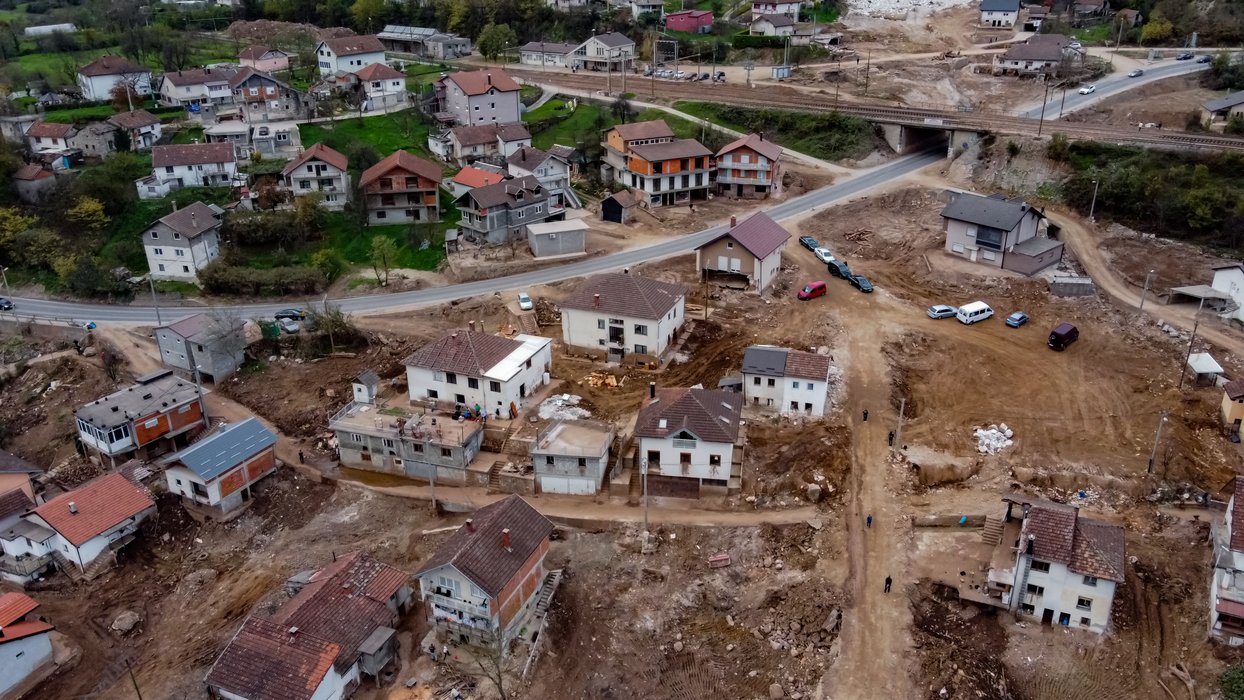
Several dozen residents of Donja Jablanica, a village in southern Bosnia and Herzegovina severely affected by floods and landslides in early October, gathered on 9th November to protest the slow pace of recovery efforts and the delayed arrival of aid. The peaceful protest began at the local railway station, which has remained out of service since the disaster. Residents demanded that all levels of government act more efficiently and conduct safety assessments for those remaining in the area. They also called for an investigation into the quarry above the village, believed to have contributed to the landslide that buried parts of the settlement and claimed 19 lives.
On 11th November, union representatives from the Clinical Center in Sarajevo held protests to highlight the institution’s lack of a general director and permanent management board for over a year. Edin Kulovac, president of the Basic Trade Union Organization of the University Clinical Center Sarajevo, stated that the unions are demanding the appointment of new management bodies and the full implementation of the collective agreement, rather than relying on the institution’s internal regulations, which are not aligned with it. Sebija Izetbegović, who had led the Clinical Center since 2016, was dismissed in late November 2023 after the University of Sarajevo revoked her postgraduate academic titles. Her tenure was marked by controversies, including the departure of numerous doctors. Since May 2024, Hajrija Maksić has been serving as acting director.
Donja Jablanica residents and employees of the state owned railway company of the Federation of Bosnia and Herzegovina (ŽFBH) and the “Gikil” company held another peaceful protest on 21st November to demand faster repair of the railway line damaged by October’s floods and landslides. The village remains without a functioning railway, a key economic link to Europe via the Port of Ploče in Croatia. Protesters warned they might take matters into their own hands if authorities continue to delay repairs. The day before, the Federation of BiH government dismissed the director of ŽFBH due to the slow restoration of infrastructure.
On 26th November, more than 2,500 members from four unions representing employees in primary and secondary education in the Herzegovina-Neretva Canton (HNK) went on a general strike, demanding better working conditions and higher salaries. Teachers marched through the streets of Mostar calling for salary increases, one-time financial aid, regular medical check-ups, and support for employees working under difficult conditions. Union leaders criticised the long-term use of fixed-term contracts, some lasting over a decade. Government offers of 2.5% and later 5% salary increases were rejected as insufficient to cover inflation and rising living costs. The unions consistently demand a 15% increase and one-time financial aid, rejecting the cantonal government’s latest offer of an 8% raise starting 1st January 2025.
On 30th November, journalists in Sarajevo staged a protest on International Day of Solidarity with Palestine to draw attention to the dangers faced by reporters covering conflicts in Gaza and Lebanon. Citizens joined the event, paying tribute to the casualties in Gaza and highlighting the high number of journalists and medical workers killed. According to the Committee to Protect Journalists (CPJ), 2023 was the deadliest year for journalists since records began in 1992, with nearly 140 killed in Gaza, the West Bank, Israel, and Lebanon since 7th October 2023, most of them Palestinians killed by Israeli forces. The event included a humanitarian bazaar and an exhibition attended by several hundred people, with all funds raised earmarked to purchase tents for the Jabalia camp in Gaza.
Residents of Sarajevo’s Stari Grad municipality protested on Trebević mountain on 1st December to demand urgent action to protect the Širokača neighbourhood from a landslide threatening hundreds of homes. The landslide, located 200 metres above the houses, was triggered by the construction of the “Trebević Hills” apartment complex. Remediation work began on 11th October after the landslide endangered approximately 250 households. The Stari Grad municipality had adopted nine urgent measures on 10th October, including preparing an evacuation plan, requesting higher-level assistance, and halting construction activities contributing to the landslide.
Also on 1st December, residents blocked the main highway near Donja Jablanica for 19 minutes to commemorate the 19 lives lost during the October floods. Nearly two months after the disaster, residents remain uncertain about the reconstruction of their property and the collection of waste. Previous protests took place on 24th November, joined by workers from companies affected by halted railway traffic connecting northern and southern Bosnia to Croatia’s Port of Ploče.
On 4th December, a protest march against violence towards women was held in Mostar, organised by the citizens’ association “Novi put.” The event called for zero tolerance for all forms of violence—physical, psychological, economic, sexual, and digital—and aimed to support women facing abuse. The association reported that nine women had been killed in Bosnia and Herzegovina in 2024. According to the High Judicial and Prosecutorial Council (VSTV), 19 women were murdered between 2021 and 2022, and the OSCE notes that nearly half of the women in the country have experienced some form of violence since the age of 15.
Protests against femicide under the slogan “Not One More” took place on 10th December in several cities, including Mostar, Banja Luka, Zenica, Trebinje, Sarajevo, and Bijeljina. In Mostar, residents criticised institutions for failing to strengthen criminal policies and enforce protective measures. The Mostar Citizens’ Initiative reported that over 80% of domestic violence cases go unreported due to women’s distrust in the judicial system. The protest followed the shooting of a 39-year-old woman in Mostar eight days earlier; the suspect, a 45-year-old man, was arrested and placed in pre-trial detention. Protests under the slogan “Not One More” were initially sparked by the murder of Nizama Hećimović in Gradačac, northeastern Bosnia. Nizama was killed by a former partner in August 2023, prompting authorities to announce plans to amend laws to better protect victims of domestic violence and increase penalties for femicide.
Several thousand education workers from the Herzegovina-Neretva Canton participated in another protest march in Mostar on 10th December, reiterating demands for a 15% salary increase. Teachers have been on general strike since 26th November, rejecting the cantonal government’s offer of an 8% raise starting 1st January 2025, citing insufficient financial support and highlighting that salaries in the canton remain among the lowest in the Federation of Bosnia and Herzegovina. Union representatives emphasised that this was the sixth time they had taken to the streets to press their demands, insisting they will not give up.
Freedom of expression
On 28th October 2024, investigative journalist Nataša Miljanović Zubac, employed by Radio Television of Republika Srpska (RTRS), reported being physically attacked on the street in Trebinje. Zubac informed the European Federation of Journalists (EFJ) that a woman approached her and deliberately struck her. She identified the alleged assailant as the sister of Dražen Milović, a fugitive wanted by Montenegrin authorities for organised crime linked to the Kavač clan. Zubac said she managed to deflect the blow and subsequently filed a report with the Trebinje police. Authorities confirmed the incident and stated they would submit a request to the competent court to open a misdemeanour case against a person with the initials “V.P.” for violating Article 11 of the Law on Public Order and Peace of the Republic of Srpska.
In November 2024, journalist Vladimir Kovačević announced that he had submitted a petition to the European Court of Human Rights in Strasbourg with legal support from the BH Journalists Association (BHJA) and the Free Media Helpline (FMHL), seeking protection of his reputational rights and his right to freedom of expression. The petition follows a decision by the Constitutional Court of Bosnia and Herzegovina in July 2024, which the FMHL legal team has criticised as unjust and inconsistent with European Court standards. They also condemned the Constitutional Court for taking three years to issue a decision, describing the delay as excessive for an institution tasked with promptly protecting human rights. The case concerns the republication of defamatory content by the portals of RTRS and Alternative Television (ATV) in Banja Luka, originally published by the Serbian tabloid Informer. The article stated that the journalist Kovačević is a “mercenary” who writes “as his financiers dictate” and that he participated in preparing a coup d’état in Republika Srpska.
On 6th December, the portal Istraga.ba reported that Dino Muzaferović, a suspect in multiple murders and other serious crimes, had planned to kill their editor Avdo Avdić. Muzaferović was arrested in Ljubljana, Slovenia, during an international investigation into drug trafficking and violent offences. Authorities discovered his plan to target Avdić during the operation and immediately informed police, security agencies, and prosecutor’s offices in Bosnia and Herzegovina. Following this, Avdić was placed under police protection. Following these reports, journalists’ associations called for special protective measures for Avdić. The BH Journalists’ Association and the Free Media Helpline demanded urgent security for Avdić and his family after Muzaferović’s arrest. They urged Bosnia’s State Investigation and Protection Agency (SIPA), the Intelligence and Security Agency (OSA), and the Ministry of Interior of Sarajevo Canton to provide Avdić and his family with constant police protection and special surveillance. The association highlighted that Avdić has long reported on international criminal networks linked to drug cartels, making him a target of serious threats and ongoing pressure.