Introduction
Amnesty International: Freedom of expression and the right to protest in Armenia in 2024
Amnesty International documented challenges to human rights in Armenia in its 2024 report. These included threats to freedom of expression, exacerbated by societal polarisation over the Nagorno-Karabakh conflict. Despite improvements such as the decriminalisation of defamation, journalists continued to face harassment, pressure, and threats, including from government officials. Online intimidation and the lack of effective investigations into such threats negatively impacted critical media. The right to peaceful assembly was also affected by instances of excessive police force during protests in the reporting period.
Freedom of Association
Law on youth Policy adopted
On 5th March 2025, the Armenian parliament adopted the Law on Youth Policy, which provides legal mechanisms for cooperation between state institutions and private entities, including non-governmental organisations (NGOs), on youth-related issues. The law aims to identify young people’s needs and develop solutions to help them overcome challenges. It also facilitates effective cooperation between central and local governance institutions. According to Hasmik Aleksanyan, UNICEF Adolescent Development Officer, the law will “regulate the legal relationships between state bodies, local self-government entities, youth organisations, and youth centres.” It includes provisions for the participation of young people in public life and policy debates, recognising their input in decision-making and giving them a legal mechanism to promote their rights and interests.
Freedom of Peaceful Assembly
Protesters demand release of prisoners held by Azerbaijan
Following the forcible military takeover of the Nagorno-Karabakh region (known as Artsakh in Armenia) by Azerbaijan in 2023, several Armenian politicians from the unrecognised Republic of Artsakh were detained. Azerbaijani authorities filed cases against them, accusing them of violating Azerbaijan’s territorial integrity. Armenian press reports indicate that at least 23 political and military leaders were detained in Baku, awaiting trial at the time of writing.
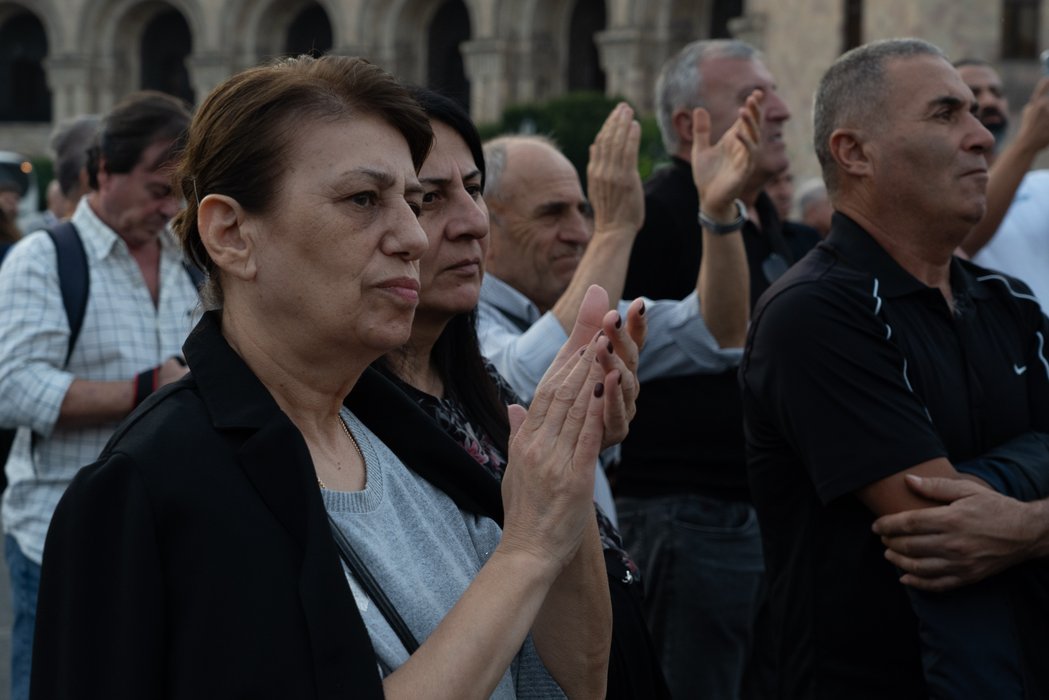
These developments sparked protests in Yerevan, starting on 28th February 2025. Demonstrators called on the Armenian authorities and the international community to secure the release of the detainees or ensure their right to a fair trial. Protest organisers claimed the detainees were subjected to inhumane treatment and denied legal counsel. NGOs and civic activists in Armenia expressed concern that Azerbaijan’s deteriorating human rights situation would negatively affect the imprisoned Armenian leaders. In March 2025, the UN High Commissioner for Human Rights, Volker Türk, called for the release of persons deemed to have been arbitrarily detained by Azerbaijani authorities.
Protest over alleged police abuse of Nagorno-Karabakh refugee
Tigran Ulubabyan, a refugee from Artsakh, claimed to have experienced inhumane treatment from police when reporting a theft. He believes the response was linked to his status and origin as a refugee from the disputed region. The police reportedly denied the claims.
As Ulubyan’s case became public, protesters gathered in front of the Investigative Committee building on 19th March, blocking traffic, and then continued to the Ministry of Internal Affairs (MIA). Approximately 200 people reportedly participated, demanding an investigation into the alleged abuse. CivilNet noted that Ulubyan’s case is not unique, with around 180 cases of law enforcement abuse reported annually in Armenia.
Freedom of Expression
Politicians’ smear campaign against the press
Azatutyun, the Armenian service of Radio Free Europe, was subjected to a harassment campaign in February 2025 after high-ranking government officials, including Prime Minister Nikol Pashinian’s chief of staff, Arayik Harutiunian, Deputy Parliament Speaker Ruben Rubinian and senior lawmaker Artur Hovannisian publicly criticised Azatutyun’s news coverage on social media and accused the journalists of spreading false information. CivilNet reported that the campaign to discredit the press was further amplified by supporters of the ruling party, resulting in insults and threats against the media outlet and its journalists.
As this smear campaign targeted independent media in Armenia receiving U.S. funding, concerns have arisen that public officials are increasingly seeking to discredit the press that criticises or does not reflect the positions of the government and ruling party.