Introduction
Portugal has held three national elections in the past three years, preventing any government from establishing a consistent legal framework to support civil society participation in decision-making. In March 2025, the centre-right minority government led by the Democratic Alliance (AD) coalition was removed by a vote of no confidence. During its tenure, the far-right Chega party, although in opposition, continued to rise dramatically in support and exert significant influence on policy debates. In the subsequent election, which took place on 18th May 2025, AD took first place again and increased its vote share, but still did not achieve a majority. Meanwhile, Chega disrupted the longstanding two-party dominance to become the biggest opposition party in parliament, ahead of the Socialist Party (PS). According to human rights expert Mariana Rodrigues, Chega’s rise has contributed to growing political polarisation in areas such as immigration, education, and civil liberties. While civil society organisations continue to operate and have their existence respected, they report that their activities are not actively supported or promoted.
Civic space in Portugal remains rated as “open” by the CIVICUS Monitor. However, the absence of a stable central government since 2023 has had tangible consequences for civic space. The Portuguese Platform of Development Non-Governmental Organisations (ONGD) reports that key framework documents intended to guide the work of Portuguese civil society have been delayed since 2023. Among them, the operational roadmap for the 2030 Agenda for Sustainable Development remains unfinished, and the annual Development Cooperation Forum has not been held since 2023. Although the government maintains an openness to dialogue with NGOs, there is no coherent strategy to translate these discussions into concrete policies.
Freedom of association
In Portugal, strong legal protections guarantee citizens’ right to freedom of association under both the constitution and a decree-law, and civil society organisations (CSOs) report no new legislation restricting their operations or access to funding, nor any increased oversight or interference. However, despite these solid legal safeguards, activists and civil society groups have increasingly been targeted by far-right parties and extremist groups, creating a climate of intimidation that undermines their work.
The groups most frequently attacked by far-right actors are those advocating for Palestinian rights and climate action. Worryingly, in April 2025, the Annual Internal Security Report (RASI) included environmental CSOs such as Clímaximo and Student Climate Strike (Greve Climática Estudantil - GCE) under its chapter on “terrorism crime and counterterrorism coordination”, framing their activities as reinforcing “left-wing extremism.” Both organisations are known in Portugal for organising non-violent demonstrations urging government action on climate change. The conflation of non-violent activism with extremism represents a troubling reversal: instead of protecting those targeted by right-wing violence, the state increasingly treats them as security threats, thus legitimising far-right narratives.
Watchdog organisations have reported an increase in hate speech against activists, minorities, and immigrants. Much of it has been fuelled by the far-right Chega party, which regularly vilifies civil society and marginalised groups. In July 2025, a Chega MP published on social media the names of migrant children attending a public school, claiming that immigrant students were “taking places” from Portuguese children, and branding activists supporting them as “extremists”. Such actions illustrate how rhetoric used by elected officials reinforces the hostile environment facing CSOs and activists.
Incidents of violence against activists and civil society volunteers by far-right actors have also been reported. In June 2025, in Porto, Nazi supporters verbally harassed volunteers from an NGO distributing food to the homeless, making Nazi salutes and blaming them for the presence of immigrants in the country. That same month in Guimarães, a neo-Nazi group physically attacked an anti-fascist activist, who had previously been targeted and claims he has had to change his address to avoid further attacks. According to Academia Cidadã, activists and civil society organisations often have limited means to pursue legal action against threats and intimidation due to economic fragility.
LGBTQI+ rights and women’s rights activists have faced particular setbacks in their advocacy. While many rights are long-established, far-right parties have pledged to remove certain protections. In July 2025, a public consultation on the new Citizenship and Development curriculum—intended to allow civil society participation online—excluded topics on gender equality and sexual health. Parents’ and educators’ associations, as well as opposition parties criticised the omission for depriving youth of essential information. Although civil society participation in the public consultation was anticipated, the submission links did not function, preventing them from contributing to the debate. The Ministry of Education, responsible for the consultation, failed to provide explanations or a timeline for resolving the issue. Far-right interference also targeted LGBTQI+ events: in May, members of the extremist group Habeas Corpus interrupted a reading group organised by Lisbon Libraries and ILGA Portugal, protesting a book discussing diverse forms of love.
Freedom of peaceful assembly
The right to peaceful assembly in Portugal is generally respected, although incidents of repression or reprisals have occurred, often involving far-right groups. The Constitution guarantees the right to peaceful assembly without prior authorisation; however, a decree-law requires organisers to give authorities advance notification. Protest bans are rare and are mostly directed at far-right groups attempting to stage counter-protests.
According to ONGD, violence at protests is uncommon, and police intervention typically targets actions that exceed pre-authorised limits, such as unexpectedly blocking traffic. For example, they note that groups such as Clímaximo, which organise civil disobedience and confrontational demonstrations, are more likely to face police action. The organisation also reports that far-right tendencies within segments of the police force have contributed to a more confrontational approach to protest management. It further observes that governmental inaction on sensitive issues such as housing shortages or the Palestinian conflict has heightened public frustration, with clashes between activists and far-right counter-protesters, particularly over migration and Palestine, being increasingly frequent.
In 2025, major protests centred on housing, Palestinian solidarity, and climate action. Climate activists continued their non-violent civil disobedience actions, sometimes facing sanctions. In May 2025, activists from Fim ao Fóssil threw green powder at Iniciativa Liberal leader Rui Rocha during a campaign event, demanding a ban on fossil fuels by 2030. The activists were immediately removed from the event, and Rocha announced he had filed a criminal complaint against them. In June, four Clímaximo activists were arrested for civil disobedience after blocking traffic near Lisbon Airport during a march involving around 50 participants. In March 2025, a teenage Greve Climática activist who had thrown washable green ink at prime ministerial candidate Vicente Fernandes the previous year to protest government inaction on climate change was fined for property damage but acquitted of assaulting a police officer.
Earlier, in April, up to 100 immigrants demonstrated in Lisbon for faster processing by the Agency for Integration, Migration and Asylum (AIMA), while a peaceful protest in front of the agency’s office in Porto that same month was disrupted by an anti-immigration agitator, who was later removed by police. On 25th April 2025, the anniversary of Portugal’s liberation from fascism, far-right groups sought violent confrontations with police, resulting in the arrest of two extremist party leaders. Counter-protests by nationalist parties had been banned by both the Public Security Police (PSP) and Lisbon municipality, but these bans were ignored.
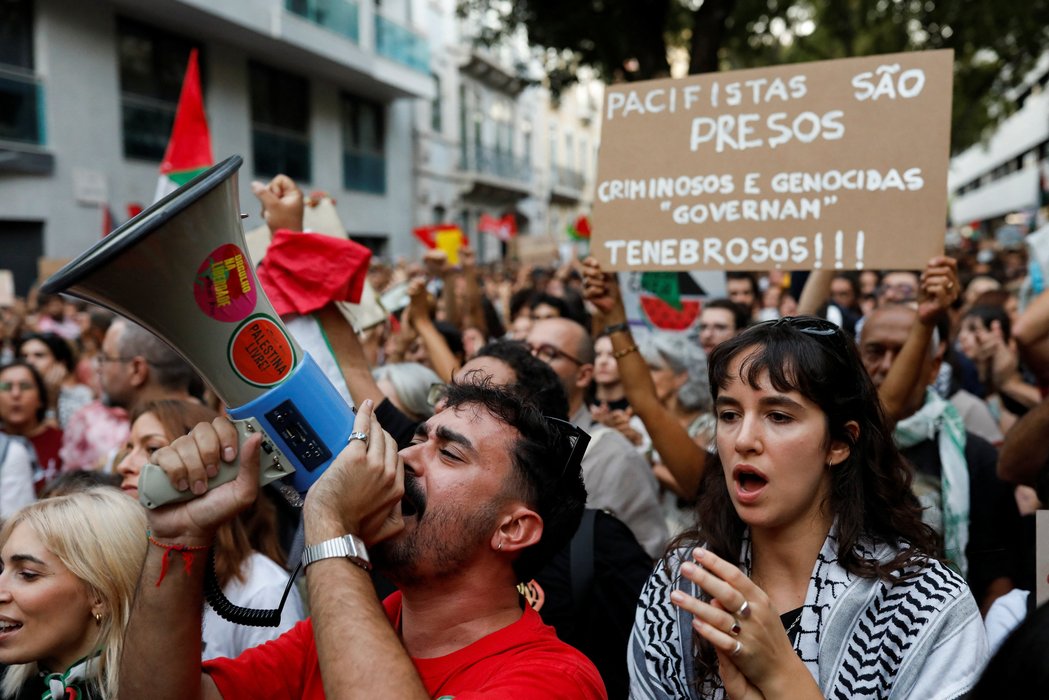
Members of the Palestinian solidarity movement have also faced scrutiny and repression. In a violation of activists’ right to privacy, the group Algarve pela Palestina provided personal data of its organisers to the police and municipality in compliance with Decree-Law no. 406/74 ahead of a protest on 31st July 2025. These details were subsequently shared by the municipality with around 30 legal entities, including churches and hotels. Algarve pela Palestina has announced that it will file a complaint with the National Committee for Data Protection.
Police repression was also reported during the Tour of Portugal cycling race on 16th August 2025. In several towns, including Nazaré, Caldas da Rainha, and Lisbon, spectators carried Palestinian flags and signs condemning Israeli government actions and to protest the participation of the Israel Premier Tech team amid Israel’s genocide in Gaza. According to the outlet Guilhotina.info, police responded with intimidation and excessive force.
In Nazaré, Guilhotina.info documented cases of police harassment and physical abuse against spectators carrying flags or banners related to Israel and Palestine. Officers demanded identification from those present, accused them of holding an unauthorised demonstration, and confiscated posters before eventually allowing flags to be displayed. A woman was reportedly threatened for filming police conduct.
In Caldas da Rainha, plainclothes and uniformed officers were seen violently detaining a young man who briefly ran alongside cyclists while holding a Palestinian flag. According to eyewitness testimony, he was tackled and handcuffed despite not interrupting the race. His relatives reported that, while in custody, he was denied access to a lawyer and was allegedly kicked and filmed by police before being released without charge later that day.
In Lisbon, a protester identified as Patrícia reported that officers blocked about a dozen people carrying Palestinian flags from crossing a pedestrian bridge, while others without flags were allowed through. The group was followed throughout the event by rapid response police, who repeatedly ordered them to move away from visible areas and threatened them with removal to prevent Palestinian flags from appearing on camera. Officers justified their actions as “following orders” without citing any legal basis.
Another case reported by Guilhotina.info concerned a woman named Carla Gonçalves, who said she was violently detained on 12th July and held incommunicado for nearly 48 hours after a solo protest in front of a Starbucks outlet, where she accused the company of complicity in the Israel-Palestine conflict. She alleged that she was beaten in custody and denied access to a lawyer during her detention.
Freedom of expression
In principle, civil society notes that the government does not directly restrict freedom of expression. However, media freedom watchdogs report that journalists face attacks and discreditation from right-wing politicians and their supporters. In 2025, a representative of the ruling coalition called for an investigation into a media outlet over its reporting on Prime Minister Luís Montenegro’s business activities. Additionally, Portugal’s public broadcaster RTP is severely underfunded, with funding among the lowest in Europe, and faces further strain due to plans to cut advertising revenue without a clear compensation plan. More broadly, experts highlight the financial viability of Portugal’s media sector as a central threat to press freedom, with only three of 13 privately held media companies reporting positive results in 2023. The Media Freedom Rapid Response (MFRR) monitoring platform has documented a series of media freedom violations across the country.
RTP Information Director dismissed without explanation
On 24th June 2025, the Board of Directors of Portugal’s public broadcaster RTP dismissed Information Director António José Teixeira without providing an explanation. The decision, part of a broader restructuring of the broadcaster’s operations, ended Teixeira’s five-year tenure despite his defence of the newsroom’s performance and his insistence that the reasons for his removal remain unclear. The Portuguese Journalists' Union condemned RTP’s dismissal of its news director without consulting the Editorial Board, warning that the move violates the broadcaster’s legal obligations and undermines the editorial independence of public media.
Pressure to reveal sources behind reporting on PM’s business dealings
On 1st May 2025, Hugo Carneiro, an MP from the ruling Social Democratic Party (PSD), called on the Transparency Authority to reveal the sources behind a media leak concerning Prime Minister Luís Montenegro’s family business, the consulting firm Spinumviva. Carneiro suggested checking journalists’ telephone records and claimed the leak was criminal. Journalist unions criticised the MP’s demands as an attempt to pressure the press and undermine the protection of sources. The controversy followed reporting by Expresso on 30th April, which disclosed previously unknown clients of the firm, some of whom later secured state contracts, raising concerns about conflicts of interest. Earlier reporting on Spinumviva was at the centre of the scandal that led to a successful no-confidence vote in Montenegro’s government in March.
Assault on CMTV crew
On 1st May 2025, a CMTV reporting team was assaulted while covering festivities in Samora Correia, Benavente. The incident involved both physical and verbal attacks, as well as damage to the crew’s equipment. The local journalists’ union confirmed that a complaint had been lodged and that police had identified those responsible. Video recordings from the scene show a woman shouting at and striking a camera operator, while another clip shows a man pursuing one of the operators.
Harassment of journalist at far-right rally
On 25th April 2025, CMTV journalist Francisca Laranjo was harassed during a live broadcast of a far-right rally in Lisbon by neo-Nazi leader Mário Machado, who verbally threatened her and tried to snatch her microphone. Police quickly intervened, arresting Machado, and Laranjo filed a complaint. The journalists’ union condemned the assault and warned against normalising threats to the press. The rally, organised by far-right groups during the 51st anniversary of the Carnation Revolution, targeted immigration ahead of upcoming elections.
Media banned from public interest trial
On 14th April 2025, the Aveiro District Court ruled that the trial over the 2023 murder of a pregnant woman in Murtosa would be held behind closed doors, barring both the public and media on grounds of privacy and witness protection. The Portuguese Journalists’ Union condemned the decision as an unacceptable restriction on press freedom and the public’s right to information.
Ransomware attack on media
On 30th March 2025, a ransomware attack hit publishers Notícias Ilimitadas and the Global Media Group, disrupting several outlets including Jornal de Notícias, Diário de Notícias, TSF, O Jogo and others. The cyberattack temporarily took websites offline and even interfered with TSF’s broadcasting, with authorities later confirming it stemmed from a phishing email.
Portuguese Communist Party files complaints against public broadcaster
On 25th March 2025, Portuguese broadcaster RTP faced three complaints from the Portuguese Communist Party (PCP) following an interview on RTP1’s Telejornal between journalist José Rodrigues dos Santos and PCP general secretary Paulo Raimundo. The complaints were filed with the Regulatory Authority for Social Communication (ERC), the National Elections Commission (CNE) and the Professional Journalist’s Card Commission (CCPJ). The PCP accused the broadcaster and journalist of using the interview to promote “propaganda and fascism” over questions on Ukraine, announcing plans to take legal action.
Threats against media by Chega Party official
On 22nd January 2025, José Pacheco, president of the right-wing Chega party in the Azores, used a media interview to attack and threaten the press after reports emerged about Chega deputy Miguel Arruda, who was under investigation for allegedly stealing passengers’ luggage at Lisbon airport. Defending Arruda, Pacheco dismissed the accusations, claimed the case was a “cabal against Chega”, and accused journalists of mishandling the matter. He went further by calling for new legislation that would “severely and violently penalise” reporters who publish negative stories.
Former footballer attempts to prevent reporting on alleged illegal activity
On 16th January 2025, former Portuguese footballer Fábio Coentrão threatened a SIC television crew while they were filming outside a warehouse at the port of Póvoa de Varzim, Porto, where authorities had just seized illegally kept live seafood and ordered the premises closed for lacking the required licences. Although the journalists were authorised to report from the site, Coentrão reacted aggressively, warning them not to film and threatening to destroy their equipment, saying on camera: “Don’t make the same mistake that Jornal de Notícias made.” The incident occurred while the crew was covering a matter of clear public interest involving the footballer’s alleged illegal activity.