The state of civic space in the Philippines is rated as ‘repressed’ by the CIVICUS Monitor. Concerns documented in recent years include the arrest and detention of activists, often on fabricated charges. Human rights defenders have also been ‘red-tagged’, putting them at risk of arrest or even being killed. Civil society has also documented the harassment and attacks against journalists.
On 11th March 2025, former Philippine President Rodrigo Duterte was arrested by police on the basis of an arrest warrant issued against him by the International Criminal Court (ICC) for crimes against humanity, including murders in relation to the “war on drugs”. From 2016 to 2022, thousands of people, mostly from poor and marginalised communities, were unlawfully killed by the police – or by armed individuals suspected to have links to the police. On 12th March, Duterte was moved to The Hague, Netherlands, where he will face trial.
On 23rd June 2025, ICC prosecutors opposed Duterte’s appeal for an interim release. Deputy Prosecutor Mame Mandiaye Niang argued that the continued detention of Duterte remains necessary.
In June 2025, the UN Special Rapporteur on Freedom of Expression, Irene Khan, presented her final report on the Philippines to the United Nations Human Rights Council. She expressed serious concerns about ongoing red-tagging, sluggish judicial processes, extended pretrial detentions, and the alarming trend of impunity surrounding journalist killings.
A final report of the International Observer Mission (IOM) - a group of international poll observers - concluded that the 12th May 2025, Philippine midterm elections were neither free, nor fair. Among the concerns were widespread cases of red-tagging of candidates, vote-buying and harassment, and barring of international poll observers.
Since January 2025, there have been reports of arbitrary arrests and disappearances of activists and baseless terrorism financing charges filed against civil society groups and activists. At least 227 activists have been charged under anti-terror laws. There has also been red-tagging of four Cordillera activists, harassment of families of the Bloody Sunday massacre and online harassment of youth activists. A trans rights activist was killed, there were concerns around censorship after a film was pulled from a festival, while a political candidate accused Meta of censorship. At least ten indigenous activists were arrested for blocking off their land in Southern Palawan.
Association
Arbitrary arrests and disappearances of activists
LOOK: Groups hold press conference on the arrest and detention of political activist Lejun dela Cruz pic.twitter.com/qJzewYo3ml
— iDEFEND (@iDEFENDhr) February 18, 2025
On 2nd February 2025, activist Lejun dela Cruz, was reported missing by the Magsasaka Party List, citing possible abduction after individuals in a car and on two motorcycles allegedly opened fire on his vehicle.
Hours later dela Cruz was found to be in the custody of Pasig Police after being served with a warrant of arrest for a 1998 murder charge. He is a former guerilla and was also one of Magsasaka Party List’s nominees for the 2025 Philippine mid-term elections. Dela Cruz is also a former board member of Amnesty International Philippines. He was set free on 25th March after the Las Piñas Regional Trial Court Branch effectively dismissed the murder charges against him.
“Until Enriquez is surfaced and Campos is granted immediate access to her family and lawyers, their rights and safety remain at risk,” said the fact-finding mission team in a statement.
— Bulatlat (@bulatlat) March 11, 2025
Read: https://t.co/7E4MoLLYql pic.twitter.com/EKxseMdOxr
The fate of indigenous Lumad leader, Genasque Enriquez, who was reportedly arrested on 2nd March 2025, remains unknown. Enriquez is from the Manobo tribe in Lianga, Surigao del Sur who led campaigns to defend their ancestral lands from the encroachment of big mining and logging companies. Enriquez served as secretary-general of Kahugpungan sa mga Lumadnong Organisasyon (KASALO).
On 5th March 2025, indigenous activist and Lumad leader Michelle Campos and three others were arrested in Agusan del Sur and held under heavy military guard. Campos faces at least seven trumped-up charges ranging from frustrated murder to murder. The warrants for these cases were served on Campos after she had been in hospital for five days, where she and the others were receiving treatment for injuries sustained before or during their detention. She was transferred to Butuan City Jail in May 2025 and has faced intimidation while in detention.
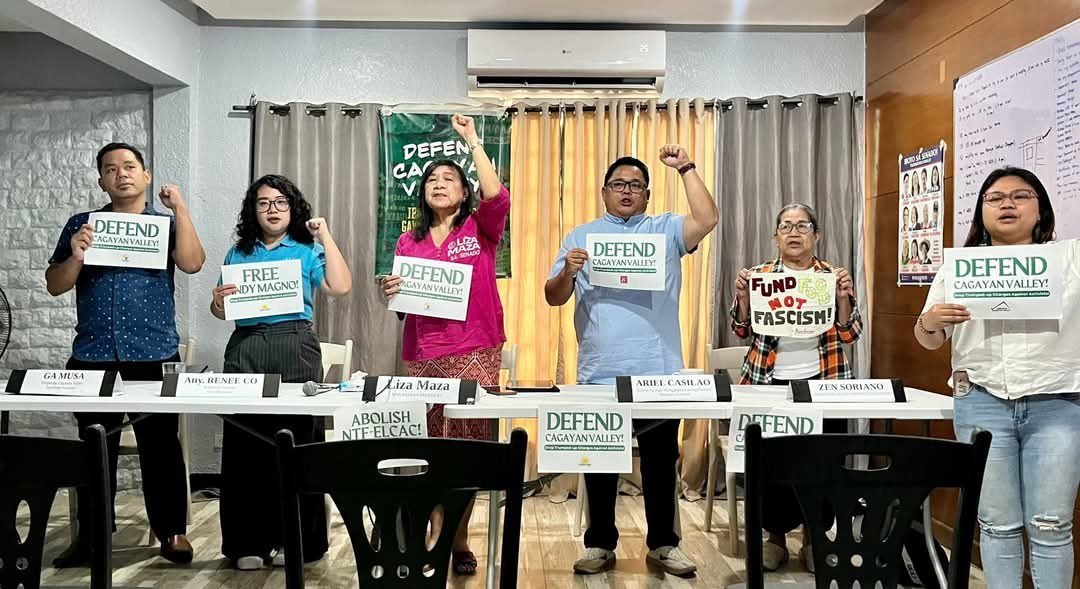
In April 2025, six prominent Cagayan Valley activists were charged on cases of financing terrorism under the Terrorism Financing Prevention and Suppression Act of 2012. They include Jackie Valencia, former Karapatan national council member; Isabelo Adviento, regional coordinator and former 4th nominee of Anakpawis Partylist; Cita Managuelod, Kilusang Magbubukid ng Pilipinas national council member; Agnes Mesina, Makabayan-Cagayan Valley regional coordinator; Walter Villegas, Kabataan Partylist Regional Coordinator; and Deo Montesclaros, environmental activist and journalist.
Human rights groups say the charges were trumped-up and meant to derail the campaign for the May 2025 elections of Makabayan candidates and two party list groups.
ANG SINING AY HINDI KRIMEN!
— Katipunan ng mga Samahang Magbubukid sa TK (@kasama_tk) June 28, 2025
PALAYAIN ANG IMUS 5!
Mariing kinukundena TEKAMUNA at KASAMA TK, ang iligal na pag-aresto sa IMUS 5 noong alas dose ng madaling araw ng Hunyo 28, 2025 sa Pasong Buaya, Imus, Cavite.
BUONG POST:https://t.co/7rX1fMAZYa#FreeImus5 pic.twitter.com/by9mXEiEq2
On 28th June 2025, five cultural activists were arrested in Cavite. The activists - Shenice Wacan, Ronaldo Valderrama, Andrew Peña, Denn Martizano and Christine Quillosa - collectively called the Imus 5, were arrested in Pasong Buaya, Imus City as they were about to create protest art against the widespread land-use conversion and demolitions in Cavite province. The cultural workers were later transferred to the custody of the Philippine National Police in Barangay Malagasang in the same city, where they were charged with malicious mischief.
Baseless terrorism financing charges filed against civil society groups and activists
According to Human Rights Watch (HRW) on 11th February 2025, the Philippine authorities are filing baseless terrorism-financing charges against civil society groups and activists, apparently in order to be removed from the “grey list” of a global terrorism financing and money laundering watchdog.
Philippine authorities have been exploiting the organisation’s grey-listing to harass organisations and activists in a surge of terrorism financing cases. Many charges have been based on scant evidence that the courts have dismissed. The authorities appear to be increasing prosecutions so that the task force would remove the Philippines from its grey list, while disregarding its guidance that aims to protect nonprofit organisations.
The Financial Action Task Force, an intergovernmental body established in 1989, works with regional bodies and member countries to tackle money laundering, terrorist financing, and other threats to the global financial system through monitoring and by issuing recommendations.
In 2021, FATF put the Philippines on its “grey list” for deficiencies in its money laundering and terrorism financing measures. To be removed from the “grey list” Philippine authorities need to implement an action plan of key reforms. On 22nd February 2025 it was removed from the list.
At least 227 individuals charged under anti-terror laws
In June 2025, Karapatan reported that at least 227 individuals have already been charged with violating the Anti-Terrorism Act (ATA) of 2020 and the Terrorism Financing Prevention and Supression Act (TFPSA), using vague or patently baseless accusations. Thirty-four activists have been arbitrarily designated as “terrorists.” Thirty are behind bars, including community journalist Frenchie Mae Cumpio, development workers Marielle Domequil and Emilio Gabales, church worker Aldeem Yañez, and environmental activist Miguela Peniero. The cases, affecting a broad spectrum of society, reveal a sinister pattern of instilling fear and suppressing dissent.
Red-tagging of four Cordillera activists
In March 2025, four Cordilleran activists were red-tagged by the Joint Task Unit (JTU) “Panagkaykaysa” under the 5th Infantry Division of the Philippine Army. According to Karapatan, the activists continue to be red-tagged despite the passage of a Baguio City ordinance prohibiting red-tagging and in spite of a Supreme Court ruling that red-tagging constitutes a threat to one’s life, liberty and security.
The latest red-tagging case involved a four-minute video purportedly reporting on the “threat situation” in the region in February 2025. Accused in the video as CPP-NPA personalities are Cordillera People’s Alliance (CPA) leaders Jennifer Awingan, Windel Bolinget, Steve Tauli and Joanna Cariño, who is also a national council member at large of Karapatan. Also red-tagged in the video as “sectoral front organisations” were groups such as the CPA, Anakbayan-Cordillera and Cordillera Human Rights Alliance (CHRA), an affiliate of Karapatan.
The Cordillera activists have faced ongoing intimidation from the authorities, including being arbitrarily designated as “terrorists” by the Anti-Terror Council (ATC). Aside from the arbitrary designation, trumped-up criminal charges have also been filed against these Cordilleran activists.
Harassment of families of the Bloody Sunday massacre
According to Karapatan, relatives of victims of the Bloody Sunday massacre reported that they had received unwanted calls and visits from state agents pressuring them against filing cases against the assailants or to withdraw any cases they have already filed.
As previously documented, nine community-based activists were killed in coordinated raids, known as the ‘Bloody Sunday’ killings, which took place across four provinces in the Calabarzon region on 7th March 2021 by members of the national police and the military.
Relatives of slain activists Melvin Dasigao and Mark Lee Bacasno, both residents of Kasiglahan Village in Montalban, Rizal, reported receiving such unwanted visits from agents of the National Bureau of Investigation (NBI).
The family of Randy and Puroy dela Cruz, also killed, likewise received an unwelcome visit on 16th June 2025 from elements of the Philippine National Police in Tanay, Rizal, to force them to stop any legal actions they may be planning against the perpetrators.
In both cases, the police and NBI agents offered “cash assistance” to buy the families’ silence.
Karapatan secretary general Cristina Palabay said: “These attempts by State elements to obstruct the course of justice is truly deplorable. Four years have passed since the Bloody Sunday Massacre and not a single perpetrator has been punished”, she added. “Instead, the bereaved families are being threatened, harassed and intimidated.”
Youth activists face online harassment
In April 2025, Amnesty International’s first ever youth-led report revealed that online harassment by the Philippine authorities, including the practice of “red-tagging” or labelling individuals as communists, creates a climate of fear that is deterring young human rights defenders from engaging in activism and expressing themselves freely.
In the report, “Left to their own devices: The chilling effects of online harassment among young human rights defenders (YHRDs) in the Philippines”, young activists aged 18 to 24 shared experiences of being red-tagged, doxed with personal information published online without their consent, and trolled. They describe how online harassment has led to self-censorship, infringed their rights to freedom of expression and association and, in some cases, forced them to abandon their work as activists or journalists.
The report highlights how young activists’ age, sexual orientation, student status and institutional affiliations magnify the risks and impact of online harassment that they experience.
Despite these challenges, YHRDs have found ways to adapt their approach to ensure they can continue their human rights advocacy. These include establishing internal well-being committees, enforcing safety protocols, and accessing mental health services.
Trans rights activist killed
Chilling. In General Santos City in the southern Philippines, a hooded gunman carried out an apparent targeted killing of a transgender rights activist Ali Jejhon Macalintal who worked as a radio commentator. https://t.co/VnwrBPBBXz
— Elaine Pearson (@PearsonElaine) June 30, 2025
On 23rd June 2025, a hooded gunman in General Santos City in the southern Philippines carried out an apparent targeted killing of a transgender rights activist who worked as a radio commentator.
According to Human Rights Watch, an unidentified man shot Ali Jejhon Macalintal several times at the acupuncture clinic she owned in General Santos City, and fled on a motorcycle. Police said they were investigating whether Macalintal's history of activism, as well as her recent business ventures, were possible motives for the attack.
Macalintal, a 39-year-old trans woman, was an activist for the rights of lesbian, gay, bisexual, and transgender (LGBT) people on the southern Philippine island of Mindanao, where she also advocated for the rights of Muslim Filipinos, known as Moros, and Indigenous peoples. She was the deputy-secretary general of the human rights group Karapatan in General Santos City until 2018. She also worked as media liaison for the leftist activist group Bagong Alyansang Makabayan.
Expression
Concerns around censorship after film pulled from festival
Voyage Studios dedicates the Baby Ruth Villarama-directed documentary's win to 'every Filipino defending the West Philippine Sea' https://t.co/MkNJRVRX5X
— Rappler (@rapplerdotcom) July 3, 2025
In March 2025, a documentary was pulled from a film festival at the last minute, raising concerns around censorship.
Baby Ruth Villarama’s documentary Food Delivery was suddenly removed from the CinePanalo Film Festival. The documentary, which depicts the harassment faced by Filipino fishermen in the West Philippine Sea, was pulled just two days before its scheduled premiere — raising concerns that political pressure may have played a role. Food Delivery explores encounters between Filipino fisherfolk and the Chinese Coast Guard in the Philippines’ Exclusive Economic Zone (EEZ), as defined by the United Nations Convention on the Law of the Sea (UNCLOS).
Villarama noted that she had not received a clear explanation for the withdrawal.
The Directors’ Guild of the Philippines, Inc. (DGPI) condemned the withdrawal. It said: "It is deeply disturbing that multiple documentary films...have either been given initially an X-rating or pulled from public view, with some of their audiences even facing threats."
Food Delivery is the latest in a string of documentaries — including Alipato at Muog and Lost Sabungeros — to face either content restrictions or removal in under a year.
Political candidate accuses Meta of censorship
Kinondena ni ACT Teachers party-list Rep. France Castro ang META sa pag-unpublishing ng kaniyang official Facebook pages at paglimita sa personal accounts ng mga page administrator nito.
— Abante News Online (@AbanteNews) March 17, 2025
BASAHIN:https://t.co/aEoS45fYO5 pic.twitter.com/D9RCaXBY5C
Makabayan senatorial candidate and ACT Teachers Party-list Rep. France Castro, who was running for senator, reported that her first official Facebook page was unpublished on 16th February 2025 while a second page was unpublished on 15th March. Facebook also restricted the personal accounts of page administrators.
On 19th March 2025, she received a sudden 180-day suspension imposed by Meta, which it flagged as an “impersonation.”
She said that she had appealed the matter with Meta to no avail. She also pointed out that Meta did not provide any “substantial explanation” as to why her pages were unpublished.
Castro said: “This is a clear case of digital harassment and censorship. Meta is systematically silencing progressive voices that speak truth to power.”
Peaceful Assembly
Indigenous defenders arrested for peacefully blocking their territory
NEWS | The Molbog indigenous communities of Sitio Marihangin, Bugsuk, Palawan face intensified threats, including the forced entry of 80 armed guards from JMV Services, (1/3)
— UPLB Perspective (@uplbperspective) June 17, 2025
READ: https://t.co/hsRC3nR4i0#StopTheAttacks#DefendAncestralLands#DefendSouthernTagalog pic.twitter.com/3u0cx3krTq
On 15th May 2025, ten indigenous defenders from the Molbog and Palaw’an communities in Southern Palawan and non-indigenous human rights defenders - now known as the “Mariahangin 10” - were arrested and charged with grave coercion for peacefully blocking their territory to prevent the entry of the former Executive Director of the National Commission on Indigenous Peoples (NCIP) and personnel from the Department of Agrarian Reform (DAR) in June 2024. The blockade was carried out in response to concerns in the community that the NCIP-DAR group was attempting to bribe residents into relinquishing their ancestral lands for a proposed eco-luxury tourism project.
For over a year, the Molbog Bugsuk community have faced armed intimidation, legal harassment, and systemic repression. Since April 2024, more than 80 armed personnel from JMV Security Services, allegedly contracted by Bricktree Properties ( a subsidiary of the Philippine multinational conglomerate San Miguel Corporation), have been repeatedly deployed to the area.
Following the incident, the community has reported continuing harassment, armed surveillance, and restricted access to their fishing grounds, violations that strike at the heart of indigenous self-determination and food security.