The state of civic space in Pakistan is rated as ‘repressed’ by the CIVICUS Monitor. Ongoing concerns include the repression against the opposition, the censorship of journalists and attacks on peaceful protests held by the opposition and human rights movements. Other ongoing concerns include the criminalisation, threats and harassment of human rights defenders and the failure to hold perpetrators to account. There have also been violations documented against ethnic Pashtun, Sindh and Baloch minorities and women’s rights activists.
In October 2025, Pakistan was elected to the UN Human Rights Council (HRC) for a three-year term beginning January 2026, after securing 178 votes in the UN General Assembly. In a scorecard prior to the elections, human rights groups noted concerns that Pakistan has not accepted all country visit requests from the UN or sent substantive replies to all communications sent by Special Procedures. The state has also failed to resolve reprisals highlighted in Secretary-General reports (2014 – 2024).
On 13th November 2025, the International Commission of Jurists (ICJ) said that the 27th amendment to the Constitution of Pakistan is a ‘flagrant attack on the independence of the judiciary and the rule of law’ and ‘will significantly impair the judiciary’s ability to hold the executive accountable and protect the fundamental human rights of the people of Pakistan.’
In recent months, the authorities have cracked down on a human rights group, and targeted and criminalised Baloch and Pashtun activists. There have been reports of unlawful mass surveillance and censorship, failure to address enforced disappearance and concerning amendments to the Anti-Terrorism Act. There has been ongoing targeting of journalists and a raid on a press club. There was also crackdown on protests by the opposition in Jammu & Kashmir and criminalisation of protesters.
Association
Crackdown on human rights group
On 19th August 2025, the EU SEE published an alert about a systematic clampdown on the Human Rights Commission of Pakistan (HRCP), the country’s foremost independent rights watchdog, by state authorities during the months of June and July 2025.
HRCP described a series of “arbitrary, illegal, and unjustified actions” that have hindered its ability to function freely, marking what it termed the most serious interference in its 38-year history. The Commission highlighted that, for the first time, its meetings and public consultations - particularly in Gilgit-Baltistan and Islamabad - were forcibly cancelled after hotels, under state pressure, demanded official “No Objection Certificates (NOCs)” to proceed. HRCP clarified that such NOC requirements had never been imposed on their programming before, indicating a shift in bureaucratic tactics to suppress civil society discourse.
The Commission’s operations in Lahore also faced disruption, beginning with the sealing of its office by local authorities in late 2024 on vague municipal grounds. The electricity meter was removed, and a fine was levied, while the organisation’s bank account was frozen, allegedly on the instructions of the State Bank of Pakistan, which later denied such directives in court.
Baloch activists added to terrorist watchlist
Pakistan: Inclusion of Baloch activists on terrorist watchlist an affront to human rights
— Amnesty International South Asia, Regional Office (@amnestysasia) October 23, 2025
“The arbitrary manner in which these individuals, including peaceful Baloch activists, have been put on a terrorist watchlist without being given an opportunity to challenge the decision is…
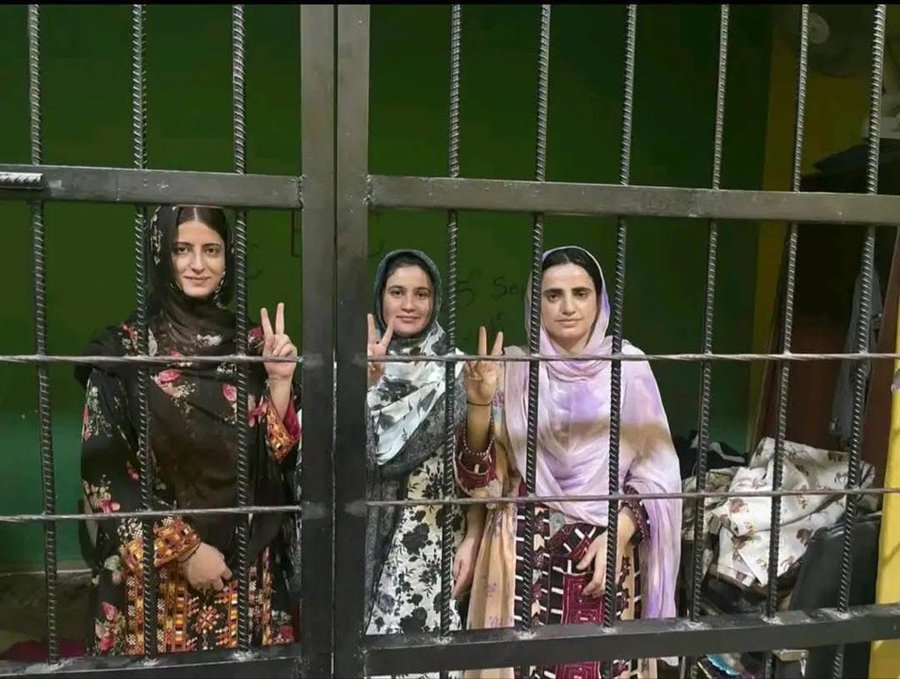
The Balochistan authorities, through notifications issued on 2nd and 16th October 2025, designated 32 individuals from Khuzdar, Kech and Chagai districts in Balochistan province as “proscribed individuals” under the Fourth Schedule of the Anti-Terrorism Act. These include women activists such as Dr. Sabiha Baloch, Sammi Deen Baloch, Naz Gul and Syed Babi Sharif and Shalee Assa.
According to Amnesty International, the designation under section 11-EE of the Anti-Terrorism Act 1997 places the individuals under heavy surveillance and severely restricts their freedom of movement and ability to take part in public life. Proscribed individuals cannot travel outside designated areas without express permission from their local police station. It also grants powers to the authorities to investigate and freeze financial assets of the person or their immediate family members.
Hearing of Baloch activists held in prison
On 12th October 2025, the Baloch Yakjehti Committee (BYC) criticised the authorities for holding the hearing of Baloch leaders Mahrang Baloch, Beebow Baloch, Gulzadi Baloch, Beebarg Baloch and Sibghatullah Shahjee in prison, terming it a "grave and deliberate attempt to suppress transparency, exclude public scrutiny, and further institutionalise the criminalisation of peaceful political dissent in Balochistan".
They added: "By moving the proceedings behind prison walls, the state effectively bars families, journalists, and neutral observers from witnessing the process which is a direct violation of Pakistan’s own constitution and international standards on fair trial and due process.”
As previously documented, the BYC activists, since their arrest in March 2025, have been subjected to continuous unjustified extensions of remand and repeated denial of access to their legal representatives. Mahrang Baloch and other BYC members were arrested on 22nd March on allegations of "attacking" the Quetta Civil Hospital and "inciting people to violence". Mahrang Baloch was arrested under Section 3 of the Maintenance of Public Order (MPO) — a law that enables authorities to arrest and detain people suspected of posing a threat to public order. After their arrest under the MPO, cases were also lodged against Mahrang Baloch and other BYC leaders under different sections of the Anti-Terrorism Act and the Pakistan Penal Code.
Anti-terrorism courts reissue non-bailable warrants for Pashtun activists
🚨🚨#BREAKING: An anti terrorism court of #Islamabad issues non bailable warrants of @PashtunTM_Offi chief @ManzoorPashteen. pic.twitter.com/ZnHDYsoTJr
— Asad Ali Toor (@AsadAToor) October 20, 2025
On 11th November 2025, an anti-terrorism court reissued non-bailable arrest warrants for Pashtun Tahaffuz Movement (PTM) chief Manzoor Pashteen and National Assembly member Mohsin Dawar in a four-year-old sedition case.
The two were booked for allegedly committing sedition, rioting, holding an unlawful assembly and delivering speeches defaming the state in Shah Latif Town, Karachi, in 2018.
The PTM chief and the lawmaker have been booked at the Shah Latif Town police station in a case lodged under the Sections 124-A (sedition), 148 (rioting with deadly arms), 149 (every member of unlawful assembly guilty of offence committed in prosecution of common object), 153-A (promoting enmity between different groups), 500 (defamation) and 505 (statements conducing to public mischief) of the Pakistan Penal Code read with Section 7 (punishment for acts of terrorism) of the Anti-Terrorism Act, 1997.
As previously documented, in October 2024 the government banned the PTM, listing it as a “proscribed organisation”. The movement, founded in 2014, advocates for the rights of ethnic Pashtuns. The PTM is known for its strident criticism of Pakistan’s powerful military for its role in alleged enforced disappearances and extrajudicial killings of rights activists and ethnic leaders.
UN raises concerns about extra-judicial killing and arrest of activists
The UN Special Rapporteur on Human Rights Defenders and other UN experts wrote to the government of Pakistan on 13th August 2025 about the extra-judicial killing of journalist and human rights defender Abdul Latif Baloch as well as the arrest of human rights defender Gulzar Dost.
Abdul Latif Baloch worked for many years as a journalist at The Daily Intekhab, an Urdu-language newspaper based in Balochistan, and regularly wrote about human rights violations occurring in the region. This included reporting on alleged enforced disappearances, extra-judicial killings and restrictions on freedom of movement due to military operations. On 24th May 2025 Baloch was shot dead in his home in Mashkay town, Awaran district in Balochistan after four unidentified masked and armed men broke into his house at around 4 a.m. He was struck by four bullets.
On 6th July 2025, Gulzar Dost was reportedly detained at his home in Turbat, Kech District, by plainclothes officers from the Counter-Terrorism Department (CTD). The arresting officials reportedly did not show a warrant for his arrest, nor did they provide Mr. Dost with information on the charges he was facing. He was held incommunicado for a number of hours before the CTD confirmed that Dost was in their custody at the CTD Headquarters in Turbat. Charges filed against Dost include terrorism-related offences. He was reportedly released on bail on 1st August 2025.
Student activist abducted
Ghani Aman, A Progressive Student Politics and Human Rights Activist from Sindh has been abducted. Peaceful Student Activist are not criminals... They are the voice of people. We demand the safe recovery of Ghani Aman.#ReleaseGhaniAman pic.twitter.com/hnpuTc5l4E
— Daadlo 🍉 (@DaadloSain) October 28, 2025
On 28th October 2025, plain-clothed men abducted student activist Ghani Aman from the Memona Hospital in Karachi, where his daughter was receiving treatment. The men were accompanied by Rangers’ personnel.
Ghani, a student leader and the Chief Organiser of the Sindhian National Students Federation, has been speaking out on issues of state oppression and social injustice for years. He has been an active part of organising the protests on Cholistan Canals and has consistently spoken up about extra-judicial killings in Sindh.
According to Amnesty International, Ghani had previously been named in a criminal case on charges of “anti-state” slogans during a protest and had delivered a lecture at the local university on student politics the day before his abduction.
Report highlights unlawful mass surveillance and censorship
Pakistan is running a huge unlawful surveillance and censorship system.
— Amnesty Tech (@AmnestyTech) September 9, 2025
It is built with foreign tech and carried out without warrants and safeguards, this is enabling human rights abuses on a massive scale. #BreakTheFirewall pic.twitter.com/YyFkzzjq1m
A new report by Amnesty International published in September 2025 found that Pakistan’s unlawful mass surveillance and censorship expansion is powered by a nexus of companies based in Germany, France, United Arab Emirates (UAE), China, Canada, and the United States.
The investigation exposed how Pakistani authorities have obtained technology from foreign companies, through a covert global supply chain of sophisticated surveillance and censorship tools, particularly the new firewall (the Web Monitoring System [WMS 2.0]) and a Lawful Intercept Management System (LIMS).
The systems “operate like watchtowers, constantly snooping on the lives of ordinary citizens. In Pakistan, your texts, emails, calls and internet access are all under scrutiny.”
WMS 2.0 can block both internet access and specific content, with virtually no transparency. LIMS is mandated by the Pakistan Telecommunications Authority (PTA) to be installed across telecommunications networks, by private companies, allowing the Armed Forces and the Inter-Services Intelligence (ISI) to tap into and access consumer data, such as phone calls, text messages, and even which websites people visit.
Failure to address enforced disappearance
On 30th August 2025, International Day of the Victims of Enforced Disappearances, eight human rights and civil society organisations highlighted the systematic failure of the authorities to stop enforced disappearance and provide truth, justice and reparations to victims and families of the disappeared in Pakistan.
Enforced disappearances continue to be routinely used by the Pakistani authorities as a tool to target dissidents and human rights defenders, with thousands of cases having been documented by local civil society organisations.
Over 15 years since its establishment, the Commission has consistently failed to provide meaningful remedy to victims and their families. Although over 700 production orders have been issued to date, only a handful have been complied with. As of August 2025, 1,837 cases remain unresolved, with 140 new cases reported to the commission this year alone. This lack of compliance and accountability not only renders the commission ineffective but further traumatises the families, who are left with written orders but no justice.
Pakistan has not yet ratified the International Convention for the Protection of All Persons from Enforced Disappearance (CPED). Further, families and activists campaigning and protesting for the return of their loved ones have been subject to surveillance, harassment and threats by the Pakistani authorities. Peaceful protests organised by families of the disappeared are often subject to state repression and have resulted in arbitrary arrests and unlawful use of force.
Amendments to Anti-Terrorism Act raise concerns
On 13th August 2025, the National Assembly passed amendments to the Anti-Terrorism Act, 1997, restoring preventive detention powers for security agencies.
According to an alert by EU SEE, the amendments allow the police, armed forces, and civil armed forces to detain individuals suspected of terrorism or serious offences for up to three months on the basis of “reasonable suspicion” or “credible information.” While the law requires detainees to be presented before a magistrate within 24 hours, custody of up to 90 days is permitted for investigation under Joint Investigation Teams (JITs) composed of police and intelligence agencies. A three-year “sunset clause” means the preventive detention powers will lapse unless renewed by Parliament.
Civil society groups and opposition parties warn it risks normalising arbitrary detention and eroding due process. Critics highlight that vague standards like “reasonable suspicion” undermine constitutional guarantees of liberty and fair trial, and could be weaponised against political opponents, journalists, and human rights defenders. In conflict-affected regions such as Balochistan, the law may legitimise special detention centres and entrench practices that are unlawful under international human rights law.
Expression
Ongoing targeting of journalists
Pakistan’s ranking in the Press Freedom Index declined from 152nd to 158th place, according to the latest report released by Reporters without Borders (RSF), which assessed press freedom across 180 countries. The report attributed Pakistan's decline primarily to tightening restrictions on journalistic freedom, highlighting growing censorship and limitations imposed on the media landscape. This has persisted in recent months.
Journalist Muhammad Akbar Notezai was summoned on 4th August 2025 to the Federal Investigation Agency (FIA) Cyber Crimes Wing office in Quetta, where he was questioned for 30 minutes about an August 2024 investigative report on corruption in the construction of the Turbat-Buleda road in Balochistan,. The FIA alleged the report was defamatory, the journalist said.
#Pakistan: The Committee to Protect Journalists calls on Pakistani authorities to drop all travel restrictions against independent journalist Asad Ali Toor, who was blocked from traveling to the United States at the Islamabad airport on August 8. https://t.co/1SXVHma9Z0
— CPJ Asia (@CPJAsia) August 12, 2025
According to the Committee to Protect Journalists (CPJ) independent journalist Asad Ali Toor, was blocked from traveling to the United States at the Islamabad airport on 8th August 2025. Toor, who had been arrested and beaten previously, said he was on his way to participate in a 12-day International Visitor Leadership Program arranged by the U.S. State Department when immigration authorities prevented him from boarding his flight, stating that his name had been added to a FIA list that imposes temporary travel restrictions on Pakistan citizens.
The trial of senior journalist Matiullah Jan in an alleged drug smuggling and terrorism case began on 31st October 2025. As previously documented, Jan was taken into custody by Islamabad Police in November 2024. Jan, who is known for his criticism of the country’s powerful institutions, including its military, vehemently denied the charges against him. The International Federation of Journalists (IFJ) and the Pakistan Federal Union of Journalists (PFUJ) condemned the baseless charges.
#Pakistan: CPJ urges authorities in Pakistan to swiftly investigate and prosecute the suspected killers of journalist Imtiaz Mir, who was allegedly murdered by a banned militant group in connection to his reporting on Israel. #PressFreedomhttps://t.co/MF39kPlBXR
— CPJ Asia (@CPJAsia) October 31, 2025
Journalist Imtiaz Mir was allegedly murdered by a militant group in connection with his reporting on Israel. According to CPJ, Mir, who hosted “Aaj Ki Baat with Imtiaz Mir” on the independent Metro 1 News channel, was returning home on 21st September 2025 when gunmen on two motorcycles pulled alongside his vehicle and opened fire in Karachi’s Malir district. The journalist sustained multiple gunshot wounds and died eight days later.
Police in Islamabad raid the press club
#Pakistan🇵🇰: Police allegedly assaulted multiple journalists and destroyed their equipment at the National Press Club in Islamabad on 2 Oct. We call for a thorough investigation to ensure journalists can perform their duties without fear of intimidation. https://t.co/17IYQxrdlC
— IFJ (@IFJGlobal) October 10, 2025
On 2nd October 2025, police conducted a violent raid of the National Press Club in Islamabad and assaulted journalists at the press club premises.
According to the Pakistan Press Foundation (PPF), footage shared on social media and by media outlets showed police manhandling, pushing, and shoving journalists inside the press club premises.
Journalists were documenting the events, and the police tried to stop them by snatching their cameras and phones. When some journalists asked the police to stop manhandling journalists, the police forced open the press club doors, including climbing the walls to enter. The police continued attacking them, including throwing cameras to the ground and assaulting media professionals.
Police also entered the press club’s kitchen, breaking crockery and detaining two press club employees for a short period. Two photographers and three press club staff members were injured.
The Pakistan Federal Union of Journalists (PFUJ) issued a statement stating that the Islamabad Police’s action of violating the sanctity of the press club was akin to an attack on all journalists in Pakistan. In a joint press release, the Council of Pakistan Newspaper Editors (CPNE), PFUJ, and the Association of Electronic Media Editors and News Directors (AEMEND) strongly condemned the incident.
Lawyer hauled up for sharing ‘anti-state’ content on social media
In September 2025, the National Cyber Crime Investigation Agency (NCCIA), Peshawar circle, issued a call-up notice to a prominent lawyer, Tariq Afghan, for an inquiry about his alleged sharing of ‘anti-state’ content on social media.
The notice, issued by the inquiry officer/investigation officer at NCCIA Peshawar, called upon Tariq Afghan, who is also a central leader of the lawyers’ wing of the Awami National Party (ANP), to appear in person to record his version in his defence on 8th September 2025. The notice stated that the inquiry has been initiated under the provisions of Section 11 of the Prevention of Electronic Crimes Act (PECA), 2016.
Afghan, who is also an environmentalist, is an active member of the Peshawar High Court Bar Association and has a visible presence on different social media platforms. The Peshawar High Court suspended the call-up notice on 9th September 2025.
Peaceful Assembly
Arrests and convictions of members of the PTI party
Pakistan court sentences 108 opposition figures to 10 years in prison via @FT
— Humza Jilani (@humza_jilani) August 1, 2025
https://t.co/zr4KYxiVZa
On 31st July 2025, 108 members of Imran Khan’s Pakistan Tehreek-e-Insaf (PTI) party were convicted by an anti-terrorism court in Faisalabad These individuals were found guilty in connection with the 9th May 2023 protests which broke out nationwide after Khan was arrested on corruption charges.
While the protests began as peaceful demonstrations, they quickly escalated into violence, with attacks on military and government buildings, including the Lahore Corps Commander House, triggering a massive security response. The state accused PTI of orchestrating the violence and used anti-terrorism laws to pursue hundreds of its members. The court’s decision handed 10-year sentences to top leaders, while others received sentences ranging from one to three years.
According to EU SEE, human rights organisations have raised serious concerns about the fairness of the trial process against the 108 PTI members, citing closed hearings, limited access to legal counsel, and the use of military and anti-terror courts to try civilians. The application of anti-terrorism laws to political protests is being condemned as a dangerous precedent that criminalises dissent and could be used against other opposition voices in the future.
On 5th August 2025, protests by the PTI party around the second anniversary of former Pakistani Prime Minister Imran Khan’s imprisonment were also met with arrests. The rallies were held despite the government’s order barring “illegal” gatherings and large assemblies. At least 200 activists were arrested from Lahore, said PTI spokesperson Zulfikar Bukhari.
Excessive force and communications blackout amid Jammu & Kashmir protests
With at least nine people reportedly dead amid a communications blackout, authorities must prioritize ensuring no further injuries or loss of life.https://t.co/BKjEN1SsaO
— Amnesty International USA (@amnestyusa) October 2, 2025
According to Amnesty International, in September 2025, protests were organised by the Jammu Kashmir Joint Awami Action Committee (JKJAAC), an alliance demanding civil liberties and political rights in the region, an end to special privileges for government officials, restoration of student unions, and access to free and quality healthcare and education, among others. The JKJAAC had engaged in talks with the government before calling for a region-wide strike on 29th September. In the lead up to the strike, the government shut down all mobile, landline and internet services in the region from 28th September.
Nearly 172 police personnel and 50 protesters were injured in the protests. Protest organisers claimed that over 100 protesters were injured following police use of lethal force. There were also reports of the deaths of at least nine people, including six protesters and three police officers.
HRCP condemned the use of “excessive force and the deaths of civilians and law enforcers alike as well as communication blackouts.” They added that “the right to peaceful protest must be upheld and grievances addressed transparently. We urge both the federal and AJK governments to avoid further escalation, respect people's fundamental rights and commit to genuine, inclusive negotiations.”
Crackdown on protests by Islamist party
On 9th October 2025 members of the Islamist political party Tehreek-i-Labbaik Pakistan (TLP) marched from the eastern Punjab city of Lahore toward the capital Islamabad to protest a US-brokered ceasefire between Israel and Hamas. Lahore police had placed numerous containers on the main highway and dug trenches to break the party’s momentum. However, despite clashes with police, TLP workers managed to break free and reach Muridke.
On 13th October, police launched a pre-dawn operation in Muridke to dismantle the TLP protest camp along GT Road, triggering widespread chaos and confrontations that lasted nearly six hours. The operation, involving around 1,500 police personnel with armoured vehicles and water cannon, left several people dead.
According to the Human Rights Research Center (HRRC), official sources described the protesters as “armed and violent mobs” who attacked officers with sticks, stones, and petrol bombs, prompting what police called a “limited defensive response.” The First Information Report (FIR) invoked multiple sections of the Anti-Terrorism Act (ATA) and the Pakistan Penal Code against TLP members.
As the unrest spread to other cities, authorities imposed Section 144 across Punjab, suspended mobile internet, and sealed entry routes to major cities to prevent further mobilisation.
In the aftermath, the Punjab government moved to formally ban the TLP and place its leadership under the Fourth Schedule of the Anti-Terrorism Act.
Activists briefly detained after rally against 27th Amendment
On 11th November 2025, activists of different nationalist parties and groups staged a protest outside the local press club in Hyderabad to condemn the passage of the 27th amendment. The call for the protest was made by the Sindh Action Committee (SAC).
Protesters chanted against the 27th Amendment and described it as “dangerous for integrity of provinces.” They also said the amendment was “an attack on the judiciary” and “would only make undemocratic forces more powerful”.
During the protest, a heavy contingent of Cantonment police arrived at the venue and rounded up at least 15 activists for violating Section 144 of the Criminal Procedure Code. They were released later that day.