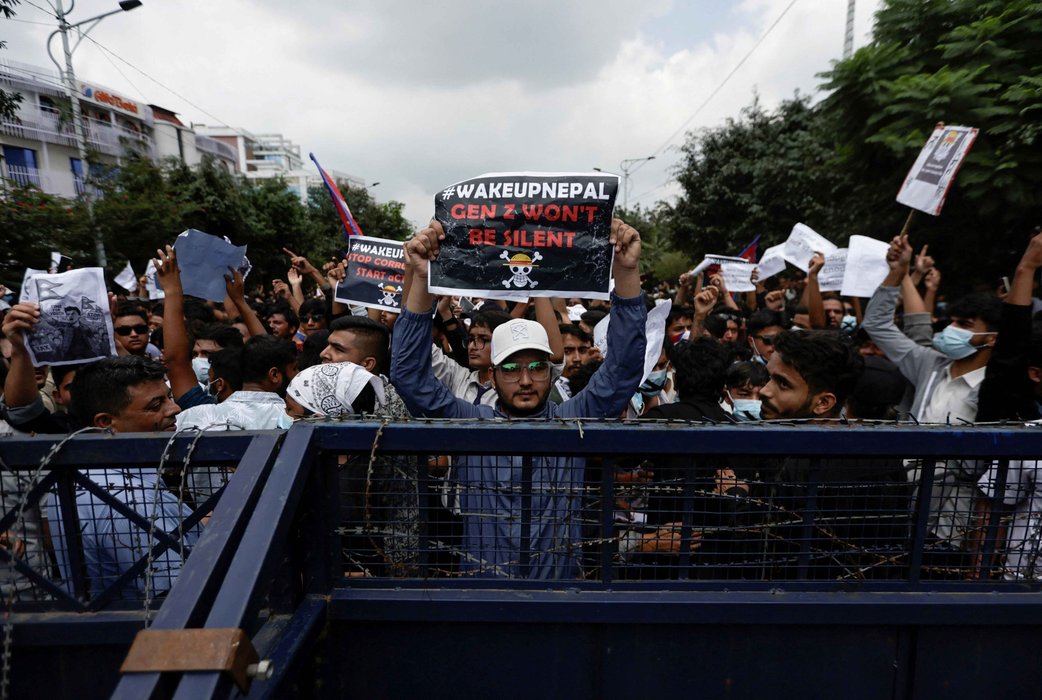
The state of civic space in Nepal is rated as ‘obstructed’ by the CIVICUS Monitor. Documented violations of fundamental freedoms include arbitrary arrests and the use of excessive force with impunity during protests, as well as the ongoing targeting of journalists, including through harassment, attacks and criminalisation.
In July 2025, CIVICUS together with the Asia Human Rights Commission (AHRC) made a submission to the UN ahead of Nepal’s Universal Periodic Review (UPR) in 2026. The report highlighted civic space concerns including incidents of attacks and threats against journalists and media workers in retaliation for their work, as well as restrictions to the right to peaceful assembly and the use of excessive and disproportionate force against protesters, including the repeated use of teargas and water cannon.
As of July 2025, the government had failed to finalise a bill to enhance the National Human Rights Commission’s effectiveness and independence. The Global Alliance of National Human Rights Institutions’ subcommittee on accreditation (SCA) had called for the law to ensure that the selection and appointment process complies with the Paris Principles by being broad, transparent and participatory, while preventing conflict of interest. The law must also ensure the commission’s financial autonomy.
In September 2025, police cracked down violently on mass protests against a ban on social media platforms and corruption leading to killings and injuries with no one yet held to account. Journalists and media outlets were attacked during the mass protests, which eventually led to a lifting of the social media ban and a new interim government.
Prior to the protests, there were efforts to restrict freedoms, including a ban on Telegram, removal of critical news articles and the criminalisation and harassment of journalists. There are continued concerns around a social media bill and a draft NGO law has raised concerns about increasing controls and burdensome requirements for civil society.
Peaceful Assembly
Violent crackdown by security forces on mass protests
Police in Nepal have used lethal force to suppress youth protests, killing at least 19 people and injuring over 300.
— Human Rights Watch (@hrw) September 9, 2025
The “Gen Z”-led protests were organized following a widespread social media ban, with many also expressing anger about pervasive political corruption and nepotism… pic.twitter.com/0SQ4CBnwu3
On 8th September 2025, mostly ‘Gen Z’ protestors took to the streets across Nepal - including Kathmandu, Pokhara, Butwal, and other major city centres - demanding an end to corruption and the lifting of the government’s sweeping ban on 26 social media platforms imposed on 4th September.
The situation escalated after some of the protesters breached the “restricted zone” and entered the Parliament premises. Police responded with water cannon, tear gas, rubber bullets and live ammunition, leaving at least nineteen dead and hundreds injured. Hospitals were overwhelmed with critically wounded protesters, including victims with gunshot wounds to the head and chest. According to human rights groups, many victims were young, including children.
Civil society organisations condemned the government’s violent crackdown and called for accountability.
#Nepal: We are shocked by the killings and injury of protesters today and urge a prompt and transparent investigation.
— UN Human Rights (@UNHumanRights) September 8, 2025
We have received several deeply worrying allegations of unnecessary or disproportionate use of force by security forces during protests organized by youth… pic.twitter.com/KstvW4La92
On the same day, UN Human Rights Office spokesperson Ravina Shamdasani said: “We are shocked by the killings and injury of protesters in Nepal today and urge a prompt and transparent investigation. She added: ‘We have received several deeply worrying allegations of unnecessary or disproportionate use of force by security forces during protests organised by youth groups demonstrating against corruption and the recent Government ban on social media platforms.”
🗣️ "The police were shooting and killing people."
— The Observers (@Observers) September 15, 2025
🇳🇵 The Nepalese police used lethal weapons against demonstrators gathered on September 8 to protest government corruption.
➡️ The @Observers team spoke to young Nepalese who were at the protest.https://t.co/28RWk5R3BS
A report by France 24 after the protests found the use of lethal munitions used in lightweight 7.62x51mm automatic rifles. According to an arms expert, “using this ammunition to maintain public order will result in ‘disproportionate’ risk because this is military-grade ammunition."
Despite curfews, protests intensified on 9th September 2025, following the resignation of the Prime Minister K.P. Sharma Oli, who fled his residence, and the lifting of the social media ban. It was reported that crowds attacked police officials, politicians and their property, and set fire to government buildings both in the provinces and in Kathmandu, the capital city, including parliament and the Supreme Court.
Reports suggest that some of those involved in violence, arson, and looting were “infiltrators” acting for a variety of reasons. For instance, places of detention were attacked and prisoners released, and digital records in the Attorney General’s office were deliberately targeted.
The Nepal army announced on 10th September that it had assumed command of security operations and enforced a nationwide curfew.
By 12th September 2025, officials said the number of fatalities caused by two days of violence had reached 51. On the same day, an agreement was reached to dissolve parliament and swear in former Chief Justice Sushila Karki - the first woman to hold the position - as head of an interim government that would conduct fresh elections announced for 5th March 2026. On 17th September, there were reports that at least 73 people had been killed. Karki announced that monetary compensation of one million rupees (USD 11,330) would be given to families of protesters who died during the demonstrations.
Human rights groups have called on the interim government to “conduct a prompt, thorough, independent, credible, time-bound, transparent, and effective investigation into the police’s use of force, as well as attacks by violent protesters, and to appropriately discipline or prosecute all those suspected to be responsible for abuses or criminal acts”.
On 19th September 2025, the interim prime minister pledged to undertake reforms to fight corruption, create jobs and raise living standards.
On 22nd September 2025, Nepal's interim government announced it had set up a panel to investigate the violence during the anti-corruption protests. The three-member panel headed by retired judge Gauri Bahadur Karki had been given three months to complete the probe.
Expression
Ban on major social media platforms lifted
On 4th September 2025, the government ordered the Nepal Telecommunications Authority to block 26 unregistered social media platforms, including Facebook, X (formerly Twitter), YouTube, and Instagram. The decision followed repeated deadlines under the 2023 Social Media Operation Directive, which requires platforms to register locally, appoint liaison officers, and designate grievance handlers. While TikTok and Viber complied earlier, most global platforms refused, triggering the suspension order.
Officials justified the ban as a measure to enhance accountability and curb online harms, with the Supreme Court ruling in August 2025 that social media platforms should be mandatorily listed and subjected to the monitoring and supervision of a competent authority. However, critics warn that the move undermines freedom of expression, access to information, and economic activity. Civil society actors argue that the ban is part of a broader trend of shrinking civic space.
Following the mass protests that were sparked following the ban, the government lifted the ban.
Media outlets attacked and journalists injured around mass protests
#Nepal: The Committee to Protect Journalists calls on Nepali authorities to ensure the safety of journalists covering protests in the Himalayan nation, following reports the offices of at least two media outlets were set on fire and four journalists were injured in the unrest.… pic.twitter.com/7l5vzaBpNh
— CPJ Asia (@CPJAsia) September 10, 2025
Media outlets and journalists were targeted during the protests. According to the Committee to Protect Journalists (CPJ), broadcasters were forced off air during the anti-government protests, including Kantipur TV, Avenues TV, ABC Television, and ITV Nepal.
On 9th September 2025, protestors set fire to the offices of the privately owned Kantipur Media Group — which houses its print, television, and radio divisions — and the daily newspaper Annapurna Post.
The offices of Public Service Broadcasting Nepal (PSBN), the public broadcaster that owns Radio Nepal and Nepal Television and which is housed at the seat of the Nepalese government, Singha Durbar, were also vandalised.
At least four journalists were injured while covering the protests. Dipendra Dhungana, a photojournalist with news website Naya Patrika, was hit in the neck with a rubber bullet fired by police. Nepal Press photographer Umesh Karki and video journalist Shyam Shrestha, from Kantipur TV, were also hit by rubber bullets. Barsha Shaha, photojournalist with news website Deshsanchar, was injured after being hit by stones.
CPJ Regional Director Beh Lih Yi said: “The increasingly violent unrest in Nepal, which has damaged at least two media offices, is a reminder of the danger facing journalists covering events of national importance. Authorities should hold both security forces and demonstrators to account for all assaults on the media and ensure the press can work safely.”
#Nepal 🇳🇵: Amid an escalation of violence against journalists and media outlets during Nepal’s mass ‘Gen-Z’ anti-corruption protests, the IFJ has documented at least 42 media rights violations since 8 Septemberhttps://t.co/eUY69NFglS
— IFJ (@IFJGlobal) September 18, 2025
Multiple attacks on regional media also took place on 9th-10th September 2025. According to the International Federation of Journalists (IFJ), in Butwal, a News24 vehicle was torched, and Radio Jagaran had its office ‘demolished’. In Kaski, a Radio Dhorbarahi motorcycle was destroyed, and the camera of online news editor Govinda Subedi was damaged. In Chitwan, the offices of Safal Khabar and Chure Sandesh were looted and torched, Kalika FM had equipment destroyed, and the home of journalist Santosh Deuja, of Kapurbot Media, was looted and burned. In Ilam, media outlets Nepalwani FM and Ilam Express Daily were vandalised. In Saptari, the district office of the FNJ was vandalised, and in Sarlahi, Mero Shaan TV journalist Rajeev Sah was assaulted while reporting on the torching of a police station.
Authorities impose nationwide Telegram ban
Prior to the protests, on 18th July 2025, the Nepal Telecommunications Authority, in a notice on its official website, instructed service providers to block Telegram, claiming the decision was aimed at combating online fraud and money laundering.
According to Access Now, Telegram is used widely across Nepal for daily communication, education, work, advocacy, and community coordination. The sudden, unlawful disruption has severely impacted journalists, human rights defenders, students, small businesses, and others who depend on the platform for essential day-to-day communication. Instead of targeting those allegedly responsible for fraud or misuse, this measure indiscriminately punishes the general public.
The Government of Nepal did not make public any legal orders, evidence, or regulatory framework underpinning this decision. Nor has it provided information on the scope of the restriction, the duration, or the process by which users might seek redress.
Digital Rights Nepal (DRN) and 28 civil society organizations jointly condemned the directive to block Telegram, calling it “a serious violation of constitutional freedoms”. In their statement they argued that the move lacked transparency, legal basis, and undermines Articles 17 and 19 of Nepal’s constitution, which protect freedom of expression and the right to communication.
Court issues order to remove news content
In June 2025, the Kathmandu District Court issued an Interlocutory interim order directing two online news websites, Nepal Khabar and Bizmandu, to immediately remove articles published about Santosh Narayan Shrestha, chair of the Securities Board of Nepal.
Judge Pitambar Sharma issued the order in response to two separate petitions filed by Shrestha seeking the removal of the articles. He claimed the publications had defamed him, caused reputational harm, and published content without verification.
The Federation of Nepali Journalists (FNJ) expressed serious concern over the court order and called on the court to reconsider it. In a statement, the FNJ argued that the interim injunction violates the spirit of the constitution and global principles on media freedom.
Journalists remain at risk for undertaking their work
Journalists in Nepal remain a risk of criminalisation, harassment or attacks for undertaking their work.
On 6th June 2025, Hadis Khuddar, a bureau chief for Naya Patrika National Daily was assaulted and briefly detained by police while covering a protest at a police station in southern Dhanusha District. Despite identifying himself as a journalist, officers seized his phone, grabbed him by the neck, beat him with a baton, and detained him. He was released after an hour following pressure from other journalists, he said, adding that he believed the attack was in retaliation for his recent reporting on police misconduct.
Editor at Pradeshtimesdainik.com Ram Pukar Yadav received death threats over a news story on 19th July 2025 in Siraha, Madhesh Province. According to Yadav, news published had highlighted irregularities in payments made at the end of fiscal year at Bishnupur Rural Municipality in Siraha. The news reports quoted complaints from municipality staff and clients that payments for completed projects were being withheld while those for incomplete projects were being released.
In August 2025, journalist Dil Bhusan Pathak was charged for alleging on his YouTube channel that Jaiveer Singh Deuba, the son of two powerful Nepalese politicians, was linked to questionable deals involving the new Hilton Kathmandu. He was charged with publishing “illegal material” under the 2008 Electronic Transactions Act, which is regularly used to stifle online commentary and prosecute journalists.
Reporter to Krishna Daily, Basanta Lama, was attacked on 16th September 2025 in Bara district after he had reported about massive deforestation of the national forest in Rautahat, Madhesh Province, the day before.
Ward chair arrested for social media post linked to protests
Police in Parbat arrested Achyut Tiwari, Ward Chairperson, Falewas Municipality-4, on 14th September 2025 on charges of inciting violence during the Gen-Z potests. Tiwari allegedly posted on Facebook urging protesters to act against local sand smugglers, their protectors and the district police chief. Chairperson Tiwari had been writing on exploitation of Kali Gandaki River and alleged negligence of security in controlling it.
Authorities claim his post violated Section 47 of the Electronic Transactions Act, accusing him of fueling unrest as protesters vandalied government and private property. Nepal Congress leaders, however, argue the arrest is politically motivated, citing revenge after Tiwari mentioned the police chief by name.
Concerns around social media bill
According to Digital Rights Nepal, a discussion on the Social Media (Use and Regulation) Bill, 2081, was held on 17th August 2025 in the National Assembly. Lawmakers from both ruling and opposition parties warned that the bill is overly controlling and risks curbing citizens’ freedom of expression. They criticised provisions imposing heavy fines and long prison terms for simple actions like liking, commenting, or sharing content on social media platforms.
As previously documented, On 9th February 2025, the bill, was introduced in Nepal’s National Assembly, designed to regulate social media platforms and users through increased registration, penalisation, and content moderation. The bill would require social media platforms to register with the government to operate in Nepal, enforce strict content moderation policies, and target harmful activities online, including extortion, cyberbullying, phishing, scams, and hacking, specifically defining and determining digital crimes.
Critics argued that its vague provisions could suppress political dissent and contradict constitutionally protected rights. Human rights groups have also raised concerns that the bill could allow a government department to undertake surveillance of journalists and severely undermine press freedom and digital expression.
Association
Draft NGO law raises concerns
In August 2025, Nepal’s Ministry of Home Affairs published a draft NGO Registration, Regulation and Management Bill, consolidating three existing laws governing CSOs: the Associations Registration Act (1977), the National Guidance Act (1961), and the Social Welfare Act (1992).
The draft proposes to dissolve the Social Welfare Council and create a new department under direct ministerial control. Critically, regulatory authority would shift from the Ministry of Women, Children, and Senior Citizens to the Ministry of Home Affairs, signaling a move from a welfare-oriented to a security-oriented approach.
The NGO Federation of Nepal (NFN), after urgent consultations, denounced the draft as regressive, restricting freedom of association and shrinking civic space. NFN’s press release highlights problematic provisions on registration, renewal, and oversight.
Arjun Bhattarai, chair of NFN expressed serious objection to the bill, saying, “It is motivated not by the objective of facilitating and empowering associations but rather of further restricting them, tightening control, and curtailing the role of citizen participation. In doing so, the draft also undermines the shared values of civil liberties, inclusivity, and transparency.”