General
Disputed general elections
On 9th October 2024, 17 million Mozambicans were called to the polls to elect a new president, 250 members of the unicameral National Assembly and members of the ten provincial assemblies. The vote occurred amidst political killings, widespread irregularities and restrictions on the freedoms of peaceful assembly and expression.
Electoral observers, including the EU observer mission and the US-based International Republican Institute, highlighted widespread irregularities, including vote buying, intimidation and inflation of voter rolls
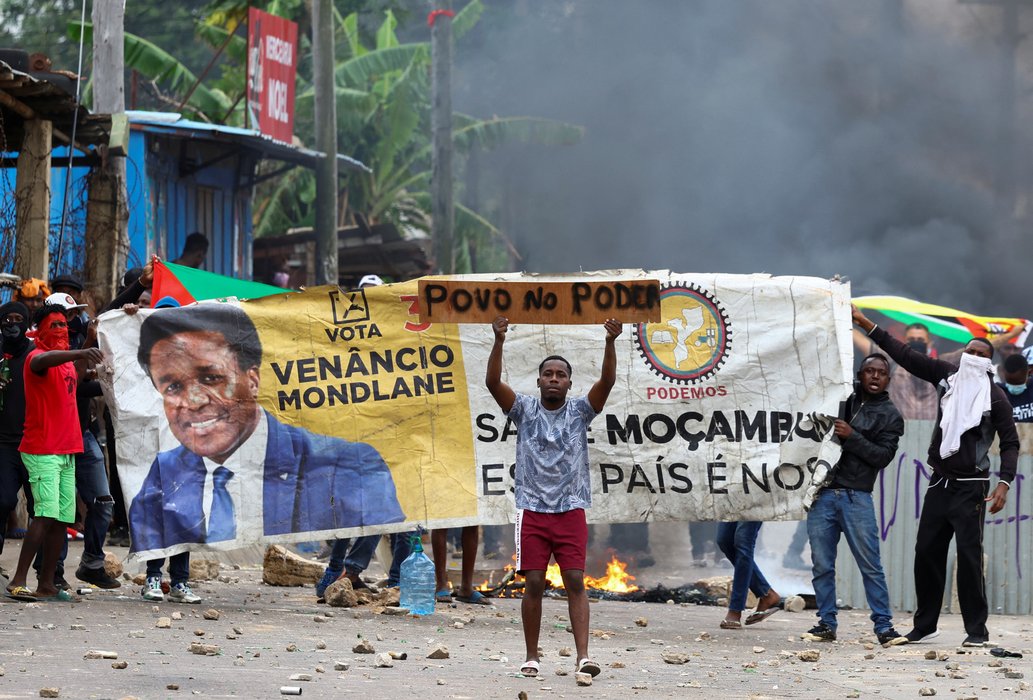
Independent candidate Venâncio Mondlane, supported by leading opposition party Podemos (Partido Optimista pelo Desenvolvimento de Moçambique) contested provisional results, pointing to FRELIMO’s electoral victory, and called on 16th October 2024 for a nationwide strike from 21st October. On 19th October 2024, unidentified attackers shot and killed Podemos lawyer Elvino Dias and Podemos representative Paulo Guambe while they were travelling in a car in Maputo.
In the days and weeks that followed, thousands protested across the country. In a report on violations during protests between 21st October 2024 and 24th January 2025, Amnesty International said security forces used excessive and unlawful force, including through firearms and less lethal weapons, killing and injuring protesters and bystanders, in violation of international norms and standards. According to local civil society groups, over 300 deaths and over 4,200 arrests were recorded between 21st October 2024 and 16th January 2025 (see Peaceful Assembly).
On 24th October 2024, the National Electoral Commission (CNE) declared Daniel Chapo of the ruling party Frente de Libertação de Moçambique (FRELIMO) as the winner of the presidential elections, with FRELIMO winning a majority of seats, 195 out of 250, in the National Assembly. In December 2024, the Constitutional Council upheld the electoral results, with Daniel Chapo receiving 65% of votes.
Peaceful Assembly
Crackdown on post-election protests: at least 315 killed, over 4,200 arrested according to local civil society group
In a report published on 16th April 2025, Amnesty International outlined violations during the protests that occurred between 21st October 2024 and 24th January 2025, including excessive unlawful force, killing and injuring protesters and bystanders in mostly peaceful protests.
The Plataforma Decide (Platform Decide) hosted a hotline during the post-electoral period, in which citizens could report illegal arrests, killings, disappearances and other violations during the protests. According to their preliminary data - based both on cases registered by DECIDE and other channels such as social media, and other organisations such as the Mozambican Bar Association - over 315 deaths were recorded between 21st October 2024 and 16th January 2025, with 91% of those deaths were caused by firearms and approximately 9% by causes such as being run over, physical assaults and inhalation of tear gas. 6% of those deaths were of minors, according to the organisation.
DECIDE also recorded during 4,236 arrests during the period, with a majority later released due to legal intervention from organisations such as the Mozambican Bar Association (OAM, Ordem dos Advogados de Moçambique) and Instituto de Patrocíonio e Assistência Jurídica (IPAJ).
As of April 2025, authorities had failed to conduct a credible investigation into political killings during the electoral period. According to Human Rights Watch (HRW), at least 10 key opposition party officials were killed between October 2024 to March 2025, the majority of whom had been involved in organising street protests contesting the electoral results.
Expression
Blogger killed while covering post-election protests
On 12th December 2024, blogger and musician Albino Sibia, also known as Mano Shottas, was shot in the back by police officers while he was livestreaming police action in protests in Ressano Garcia, Maputo province. During the livestream, the blogger was heard saying “Help. I got shot and they keep shooting… I am dying”. He died hours later.
During the funeral of Albino Sibia, on 14th December 2024, members of the Rapid Intervention Unit (UIR) shot and killed two people. The funeral of the blogger was attended by hundreds of people.
Post-election protests: journalists assaulted, detained
According to the Committee to Protect Journalists (CPJ) and MISA Moçambique, several press freedom violations took place in the context of the post-electoral protests and crisis, including arbitrary arrests and physical assaults of journalists, confiscation of material and expulsion of foreign correspondents:
- On 14th November 2024, police in Maputo detained South African journalists Bongani Siziba and Sbonelo Mkhasibe, who report for Nigerian media outlet News Central, together with local Radio Moçambique journalist Charles Mangwiro. The journalists told CPJ that they were taken to a police station and later taken to another location which “looked like barracks”. They were reportedly blindfolded, questioned several times and accused of being spies. The journalists were released the following day.
- Nuno Alberto, journalist for community radio Radio Monte Gilé, was assaulted and briefly detained by police officers on 25th October 2024 in Gilé, Zambézia province. He was kicked, beaten and threatened before being taken to a police station where he was again beaten and forced to wear a mask and hold a placard while police officers were taking pictures. The journalist was released after two hours.
- In Nampula province, police chased and shot at Radio TV Encontro journalists Cesar Rafael and Valdimiro Amisse on 13th November 2024, reportedly after they refused to delete footage of a protest. While they initially escaped, they were beaten when they later ran into the same police officers.
- On 21st October 2024, police fired tear gas at a group of 15 journalists during a press conference by opposition candidate Venâncio Mondlane, injuring five journalsts. Tear gas was also fired at a group of journalists who were covering protests on the same day in Maputo, including TV Gloria camera operator Bruno Marrengula.
- On 4th November 2024, police fired a rubber bullet at Paulo Julião of news agency Lusa, hitting him in the head.
- On 26th October 2024, intelligence officers consfiscated the phones of three journalists, including TV Amaramba reporters Nhampulo and Jaime Joaquim and Radio Esperança journalist Nunes Rafael.
2024 report on press freedom
Press freedom group MISA Moçambique, in its annual report of 2024, noted that it had documented 32 cases of press freedom violations in 2024. Nearly 70% of those violations occurred in the context of the elections of 9th October 2024. Violations occurred in all 10 provinces.
10 out of the 32 press freedom violations concerned physical assaults of journalists. Other violations included verbal threats and assaults (6 incidents), prevention of coverage (6 incidents), restrictions imposed on the adequate functioning of media houses (2 incidents) and arbitrary arrests of journalists (one incident involving three journalists).
Internet shutdowns, disruptions to quell protests
Access to the internet and social media was disrupted in the post-electoral period. Several instances of “curfew style mobile internet shutdowns” occurred between 25th October and 10th November 2024. According to Internet Outage Detection & Analysis (IODA), abnormal drops in internet connectivity were seen on 20th, 21st .and 23rd October 2024, while daily outages were seen between 5th and 10th November 2024.
Journalist missing in Cabo Delgado
Journalist Arlindo Chissale, editor of the online outlet Pinnacle News, went missing on 7th January 2025 in Silva Macua, in the northern province of Cabo Delgado. Witnesses told Chissale’s family that they saw him being removed from a public minibus, being beaten and driven away by alleged security force members. As reported previously on the Monitor, Chissale was detained in October 2022. Another journalist, Ibraimo Mbaruco, went missing in Cabo Delgado in April 2020.