Introduction
Xenophobia continues to put migrants at risk
Anti-migrant groups such as Operation Dudula have intensified campaigns of intimidation and exclusion against illegal foreign nationals, targeting not only informal traders but also restricting access to healthcare and education for migrants and refugees. Numerous reports emerged of migrants being denied healthcare in public hospitals by Operation Dudula if they fail to present a South African Identity Document (ID), despite Section 27 of the South African Constitution guaranteeing the right of everyone to access healthcare services, including reproductive healthcare.
On 31st May 2025, Parliament’s Joint Constitutional Review Committee received over 250 submissions proposing amendments to the Constitution. Among these, ActionSA called for amendments to Sections 26, 27, and 29, arguing that illegal foreign nationals should not benefit from universal rights to housing, healthcare and education due to the strain on public resources. Civil society and legal experts expressed deep concern, warning that such proposals could undermine the universality of the Bill of Rights, weaken constitutional equality protections, and erode South Africa’s human rights commitments.
The South African Human Rights Commission (SAHRC) reaffirmed this constitutional guarantee, emphasising that access to healthcare applies to all persons within the country’s borders, irrespective of nationality or legal status. However, the SAHRC’s intervention sparked fierce backlash from Operation Dudula, who accused the Commission of “putting foreigners first” and neglecting the needs of South African citizens.
Amid these tensions, on 7th October 2025, the Department of Home Affairs announced an 18-month extension for the Zimbabwe and Lesotho Exemption Permits, providing temporary protection to thousands of migrants and refugees from arrest, detention or deportation.
Association
CSOs advocating for migrant rights threatened
On 17th July 2025, Operation Dudula marched to the offices of SERI and the SAHRC in Braamfontein, to deliver a “memorandum of demands” and labelling both institutions “unpatriotic” for defending the rights of migrants and refugees. The march to SERI, however, fell flat when Operation Dudula were confronted by several CSOs that had gathered outside SERI’s office in solidarity with the rights group. SERI condemned the demonstration as an act of intimidation, while the Kopanang Africa Against Xenophobia (KAAX) coalition and allied organisations denounced it as part of a wider campaign of harassment and scapegoating of human rights defenders.
Anti-corruption activist receives death threats
On 13th June 2025, Archbishop Nkosinathi Ngesi, chairperson of the Concerned Makhanda Residents (CMR), reported receiving a death threat allegedly from senior officials of the Makana Local Municipality, who described him as the “only stumbling block” to their interests and claimed he “had to be removed.” Ngesi, a prominent critic of corruption and poor service delivery failures that have plagued Makhanda for years, opened a police case after an informant warned him of the plot.
On 17th June 2025, the CMR condemned the threats in a public statement, accusing municipal officials of using intimidation and political violence to silence dissent. The group vowed to pursue legal action and urged the community to stand in solidarity with Ngesi and other activists. The threats reflect a broader pattern of intimidation in Makhanda, where whistle-blowers such as Jeff Budaza were previously killed, and activists like the late Ayanda Kota faced similar harassment for exposing corruption within the municipality. Despite the risks, Ngesi vowed to continue his fight for justice and accountability.
Alexandra community leader gunned down
On 6th October 2025, Alexandra community leader and businessman Vincent “Vinny” Ndima was shot dead by unknown gunmen in a brutal ambush that shocked residents of the township. The attack occurred. He was shot multiple times and died at the scene, while his friend sustained serious injuries and was rushed to hospital. Police recovered over forty spent cartridges from the site and opened cases of murder and attempted murder. Though no arrests have been made, the motive for his assassination remains unclear, but many fear it may have been linked to his outspoken stance against crime and his leadership in grassroots safety efforts.
Ndima, was widely respected as a community leader and President of the Alexandra Parliament. He had been actively involved in anti-crime initiatives, including joint patrols with residents and local police, and was known for his philanthropy providing food parcels, supporting disadvantaged families, and helping organise youth empowerment projects.
Peaceful Assembly
Residents protest delayed electricity meter installations
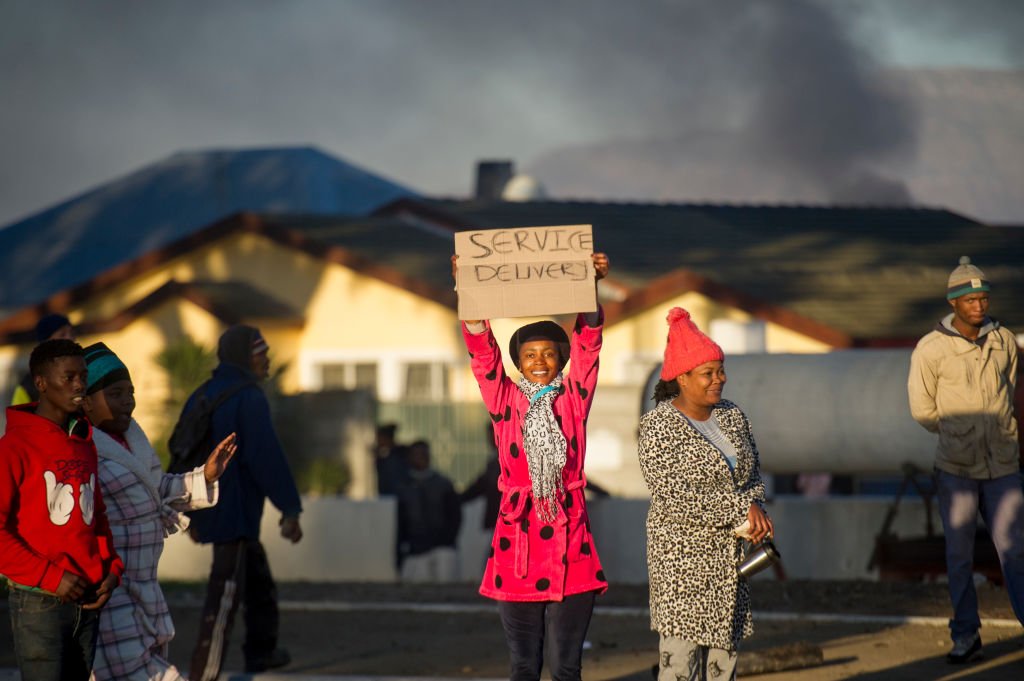
On 14th July 2025, residents of the Wells Estate community in Rabie Village, Gqeberha, Eastern Cape, took to the streets in a violent two-day service delivery protest. The protests erupted over persistent power outages and delays in the installation of electricity meters promised by the Nelson Mandela Bay Municipality.
Frustrated by what they described as years of municipal neglect, protesters dumped human waste outside the homes of ward committee members and at the local clinic before escalating their actions on 15th July 2025. Roads were blocked, tyres burned, and both a bus and a panel van were set alight. Demonstrators also attempted to torch the local councillor’s office in retaliation for perceived government inaction. Police responded with rubber bullets and stun grenades to disperse the crowd, arresting one woman, aged 48, who was charged with public violence, arson, malicious damage to property, and obstruction of traffic.
Residents protest taxi operations and lack of access to electricity
On 13th August 2025, a service delivery protest in Ritchie, Northern Cape, initially peaceful turned tense after police allegedly fired rubber bullets, tear gas and stun grenades. Taxi and bus operators joined the demonstration, disrupting transport on the N8 and N12 highways, closing schools and clinics and preventing residents from commuting. Protesters expressed frustration over illegal taxi operations and what they described as unequal access to electricity in informal settlements like Rietvale and Motswedimosa. Police arrested 19 people who were reportedly transported to Kimberley, as the local holding cells were unable to accommodate all of them and were charged with public violence.
Coronationville residents protest prolonged water shortages
On 10th September 2025, residents of Coronationville, Johannesburg, who have endured years of unreliable water supply, took to the streets to demand urgent intervention from the City of Johannesburg’s water utility company, Joburg Water. The protest was sparked by irregular water supply that had persisted for more than three weeks, with residents experiencing outages lasting up to two days at a time. Frustrated by dependence on water tankers which they accused of contributing to infrastructure sabotage, residents barricaded roads with burning tyres, garbage, and rocks. Police responded with rubber bullets, tear gas, and stun grenades, injuring several, including Daily Maverick journalist Julia Evans, who was shot in the leg while covering the protest. Gauteng police arrested one person during water protests in Coronationville.
City officials acknowledged the crisis, citing strain on the “Commando System,” which supplies the area, due to weak infrastructure, high demand, and low reservoir levels. In response, the city allocated R800 million (USD 46,475,520) for system upgrades and deployed water tankers as a temporary measure. Despite Mayor Dada Morero’s promise that water supply would be restored within seven days, residents continued to report outages weeks later, expressing deep frustration over what they called years of government neglect and empty assurances.
Expression
Law suits threaten press freedom
Several journalists faced attempts to silence them through gag orders, lawsuits, and defamation-related interdicts highlighting a growing trend of using legal instruments to restrict media freedom.
In March 2025, journalist Bongani Hans of Independent Newspapers was served with an order preventing him from publishing allegations that ARTsolar, a Durban-based solar energy company, was importing rather than locally manufacturing its solar panels. On 29th July 2025, ARTsolar withdrew its court case to uphold the gag order against Hans, businessman Brett Latimer, and two former employees, following widespread criticism that the company was attempting to silence whistle-blowers. Under new legal representation, ARTsolar dropped the case and agreed to pay all legal costs. Investigative journalism organisation amaBhungane described the withdrawal as a “bittersweet victory” for press freedom.
Separately but in a similar vein, after nearly eight months, on 9th July 2025, the court dismissed a harassment lawsuit against Carte Blanche journalist Lourensa Eckard. The case had been filed by surgeon Soraya Patel in November 2024, after Eckard’s team approached her at a hospital in Gauteng Province hospital to comment on alleged malpractice following coverage of two episodes that aired on 1st September 2024 and 8th December 2024 on DSTV. The first episode focused on surgical complications, while the second examined patient complaints and the complainant’s billing practices. Patel provided written responses to address the allegations but claimed the programme lacked balance and infringed on her privacy and dignity. The court rejected her complaint, noting her responses had been aired alongside the allegations. While dismissing the case, the court also affirmed that Eckard acted in the public interest, reinforcing protections for investigative journalism in South Africa.