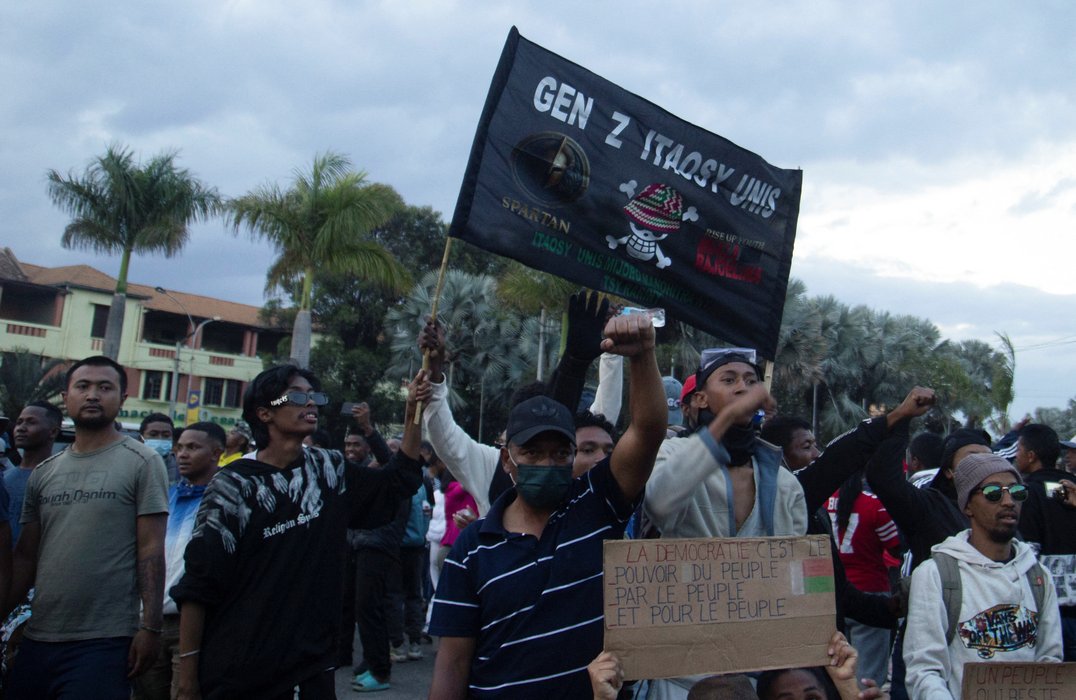
#UPDATE An elite military unit that backed youth-led anti-government street protests said on Tuesday it had taken power in Madagascar after the national assembly voted to impeach President Andry Rajoelina ➡️ https://t.co/OemB8QBQWW pic.twitter.com/JPa4oq1pgy
— AFP News Agency (@AFP) October 14, 2025
Peaceful Assembly
Military seizes power following sustained deadly youth-led protests; at least 22 killed in first days of Gen Z protests
On 17th October 2025, Colonel Michael Randrianirina was sworn in as the President of “the Refoundation of the Republic of Madagascar”, after he had earlier dissolved institutions, except the National Assembly. The latter voted to impeach President Andry Rajoelina on 14th October 2025, after he fled the country when the military, most notably the CAPSAT military unit, backed the protests by announcing they would not follow orders to shoot at protesters.
This follows weeks of sustained, youth-led anti-government protests, mobilised since 25th September 2025 under the Gen Z Madagascar movement, protests which were repressed by security forces, using excessive use of force, including lethal force, against protesters.
On 25th September 2025, a peaceful protest was organised against prolonged and repeated power and water outages, mobilised through social media, in Antananarivo and other cities in Madagascar. The protest, organised by mainly university and high school students, mobilised under what is dubbed the Gen Z Madagascar movement, was banned by the prefect of Antananarivo the previous day, using grounds of ‘risk of disturbance of public order’, who also requisitioned the police. Despite the ban, people gathered in Antananarivo to protest, and were met with security forces firing tear gas and rubber bullets and arresting and beating protesters. Violence and clashes ensued later on 25th September, including looting and setting fire to symbols of power, such as the residences of a senator and a Member of Parliament.
Observers from France 24 said the repression of the protests was violent and disproportionate, including the launching of tear gas at close range, cars ploughing into crowds, injuries and widespread panic. According to media, who spoke with hospital sources, five people were killed. The International Federation for Human Rights (FIDH) said three protesters, including two HRDs, were arrested, beaten and denied access to a lawyer, while other protesters were threatened with arrest. Dozens of people, including journalists, were injured.
Authorities issued a curfew in the capital from 7PM to 5 AM. Curfews were reportedly also installed in Antsiranana, Majunga, Toliara and Antsirabé. Protests reportedly also took place in Antsirabé, Fianarantsoa, Diego Suarez (Antsiranana) and Tamatave.
Ahead of the protest on 25th September, tensions had been building up after the arrest of two municipal councillors, Clémence Raharinirina and Faniry Alban Rakotoarisoa, on 19th September 2025 in relation to a protest in front of the State Palace in Anosikely, designated as a red zone. The two were arrested after they had submitted an application for a protest permit at City Hall, planned for 25th September to denounce the water shortages and power outages. The two were released but placed under judicial control. They are being prosecuted for having violated a red zone.
The following day, on 26th September 2025, in an attempt to quell the protests, President Andry Rajoelina announced the dismissal of the Minister of Energy, Olivier Jean-Baptiste. Despite the announcement, the Gen Z Madagascar movement called for another protest on 27th September starting from the University of Antananarivo to the Ambohijatovo neighbourhood. That day, hundreds of people heeded the call and protested, despite security forces pushing back the protesters with tear gas. In Tamatavé, Diego-Suarez and Majunga, clashes were reported. The following days and weeks, protests continued. In a statement published on 29th September 2025, the UN Human Rights Office of the High Commissioner said that at least 22 people were killed and more than 100 injured in the first few days of the protests. Victims include protesters and bystanders, with some killed by security forces and others in widespread violence and looting by individuals and gangs not related to the protesters. Among those killed was an infant of one month, as a result of tear gas. Authorities have disputed the UN number of deaths, saying 12 people had died during the protests.
Despite President Rajoelina’s announcement to dismiss the government on 29th September, the Gen Z movement continued to mobilise and protest almost daily, joined by trade union platform Solidarité syndicale de Madagascar, demanding Rajoelina step down. There have been frequent reports of the use of tear gas, stun grenades and rubber bullets by security forces during these protests.
- On 4th October 2025, hundreds of pro-Rajoelina supporters gathered at the Coliseum in Antananarivo to show support for the president, after a call for mobilisation by the latter. Meanwhile, Gen Z protesters, who tried to reach Ambohijatovo Gardens, also called the ‘Square of Democracy’, were met with security forces, who used tear gas to disperse groups of protesters.
- On 6th October 2025, President Rajoelina appointed an army general, Ruphin Fortunat Dimbisoa Zafisambo, as the Prime Minister and called for a national dialogue.
- On 8th October, police dispersed about 200 medical students after they attempted to march after a peaceful sit-in at the main government hospital. The Gen Z movement reportedly said they would not have talks with the government as long as the security forces use force against protesters, instead issuing a 48-hour ultimatum for President Rajoelina to agree with their demands, or face a national strike.
- On 9th October 2025, violent clashes reportedly erupted after security forces deployed armoured vehicles and used tear gas and rubber bullets to disperse a group of a thousand protesters attempting to reach the Ambohijatovo Gardens. Street violence ensued, with protesters throwing stones at security forces. At least six people were injured and 28 protesters were reportedly referred to the prosecutor’s office for formal charges.
Several arrested during protest against mining project Base Toliara
On 27th April 2025, security forces arrested six protesters during a protest against mining project Base Toliare in Benetse. According to a statement by CSO CRAAD-OI, security officers came to Ankilimalinike to arrest an opponent of the mining project, Mr. Relaso, and when they did not find him they proceeded to seize a herd of Zebu cattle and the motorcycle of the opponent. After security officers reportedly announced the arrest of other opponents of Base Toliara, a protest erupted, including by erecting a roadblock in Benetse. During clashes, which lasted nearly eight hours, six protesters were arrested, two of whom were injured.
On 25th March 2025, colonel Rodney Rehosy Fanampera was arrested in Tuléar, and transferred to Antananarivo for participation in a non-authorised protest against the Base Toliara. On 1st April 2025, he was sentenced to a suspended three years in prison.
Similar protests have taken place in the area against the mining project. In a statement issued on 21st July 2025, CSOs, including Réseau des Jeunes pour le Développement Durable (Youth Network for Sustainable Development) and Femmes en Action Rurale de Madagascar (Women In Rural Action Madagascar) condemned the use of excessive force and violence by security forces during protests since early April and the detention of protesters.
Expression
Journalists injured during Gen Z protests
According to Reporters without Borders (RSF), several journalists were injured by security forces in the first few days of the protests. Hardi Juvaniah Reny, a journalist for radio station Aina Fahazavana, despite wearing a clear press vest, was hit by a bullet in the lower abdomen while covering the Gen Z protests on 26th September in Antsiranana, northern Madagascar. The same day in Antananarivo, officers of the Special Security and Intervention Group (GSIS), a specialised gendarme unit, hit Alain Rakotondrainabe, photojournalist for L’express de Madagascar, including twice on his head. Real TV journalist Leonard Jo Andriamparany was broadcasting live when a GSIS officer punched his phone, knocking him to the ground. On 30th September 2025, while Andriamparany was testifying in front of cameras of an earlier incident of security forces hitting him in the face, the group of journalists was targeted by a tear gas canister. In Antsiranana, Kolo TV correspondent Stanio Bezara was targeted by a tear gas canister and stones on 26th September 2025.
Two journalists were injured as a result of being hit by stones thrown by protesters: Kolo TV journalist Elysée Bonhomme in Toliara, southern Madagascar, and Isaac Hubert Ratefilaza, reporter for Radio Télé Nakay, in Mahajanga, northern Madagascar.
In a response to RSF’s report, Minister of Culture and Communication Volamiranty Donna Mara told the press freedom group on 2nd October 2025 that an internal administrative investigation was launched on the “deliberate attack on journalists” by security forces.
Two journalists threatened with criminal sanctions
In August 2025, the Ministry of Culture and Communication wrote to French media outlets TV 5 Monde and Radio France Internationale (RFI) to request the replacement of their two correspondents in Madagascar – freelance journalist Gaëlle Borgia and Pauline Le Troquier - accusing both journalists of undermining public safety in relation to their reporting on the death of at least 32 people at a June birthday party in Ambohimalaza, east of the capital Antananarivo. The two journalists had questioned the official explanation that the deaths were caused by intentional poisoning, instead suggesting the deaths might have been caused by botulism, as a result of improperly handled or stored food.
According Borgia, who spoke with the Committee to Protect Journalists (CPJ, authorities accused her of having breached a section of Madagascar’s media law on the publication of false news, punishable by a fine up to 2,260 USD. Additionally, authorities threatened to prosecute her under article 91 of the Penal Code, which proscribes a prison sentence of one to five years for the dissemination of information that compromises public safety or causes serious political unrest.
Journalist detained, charged with spreading false news
On 29th January 2025, gendarmes arrested investigative journalist Ferdinand Avimana, popularly known as Ferdinand Cello, at his home while visiting his family. According to CPJ, a judge charged the journalist on 30th January 2025 with spreading false news and undermining national security, and placed him in pretrial detention.
An arrest warrant was issued against the journalist by the senior investigating judge of the Anosy Court of First Instance on 5th October 2023 for a social media post in which Cello alleged that the president, together with the Minster of Communication and the president of the High Constitutional Court had fled to France. The journalist later retracted the statement and issued an apology. According to RSF, before his arrest Cello had criticised Madagascar in relation to its Universal Periodic Review (UPR), a process at the UN Human Rights Council that assesses the human rights record of countries, and had raised concerns about the misappropriation of EU funds intended for the construction of a highway.
Cello has been subjected to judicial harassment in the past. In 2017, Cello was detained for four months and was later sentenced to a suspended two year prison sentence. He was acquitted by the Fianarantsoa Court of Appeal in 2019.