Civic space in Laos is rated as ‘closed’ by the CIVICUS Monitor. The fundamental freedoms of association, expression and peaceful assembly remain severely restricted while impunity persists in cases of enforced disappearance, attacks and extrajudicial killings of human rights defenders and activists. Additionally, laws criminalising expression and media freedom create a climate of fear and self-censorship.
In early January 2026, the 12th National Congress of the Lao People’s Revolutionary Party (LPRP) was held. During the congress Laos’ communist party reappointed Thongloun Sisoulith for a second term as party chief. Elections for members of the 10th National Assembly (NA) and the 5th Provincial People’s Assemblies (PPA) will be held on 22nd February 2026.
On 29th September 2025, CIVICUS, FORUM-ASIA, and Amnesty International delivered a statement at the 60th session of the UN Human Rights Council, noting that Laos received 24 recommendations on civic space. The government supported seven but rejected 17, including calls to review laws restricting fundamental freedoms, investigate enforced disappearances, and prevent intimidation of human rights defenders and journalists. The statement urged the repeal or amendment of the Decree on Associations, Decree No. 327 (Cybercrime Law), and Article 117 of the Penal Code to align with the ICCPR, halt transnational repression, and conduct full, independent investigations into all unresolved enforced disappearance cases.
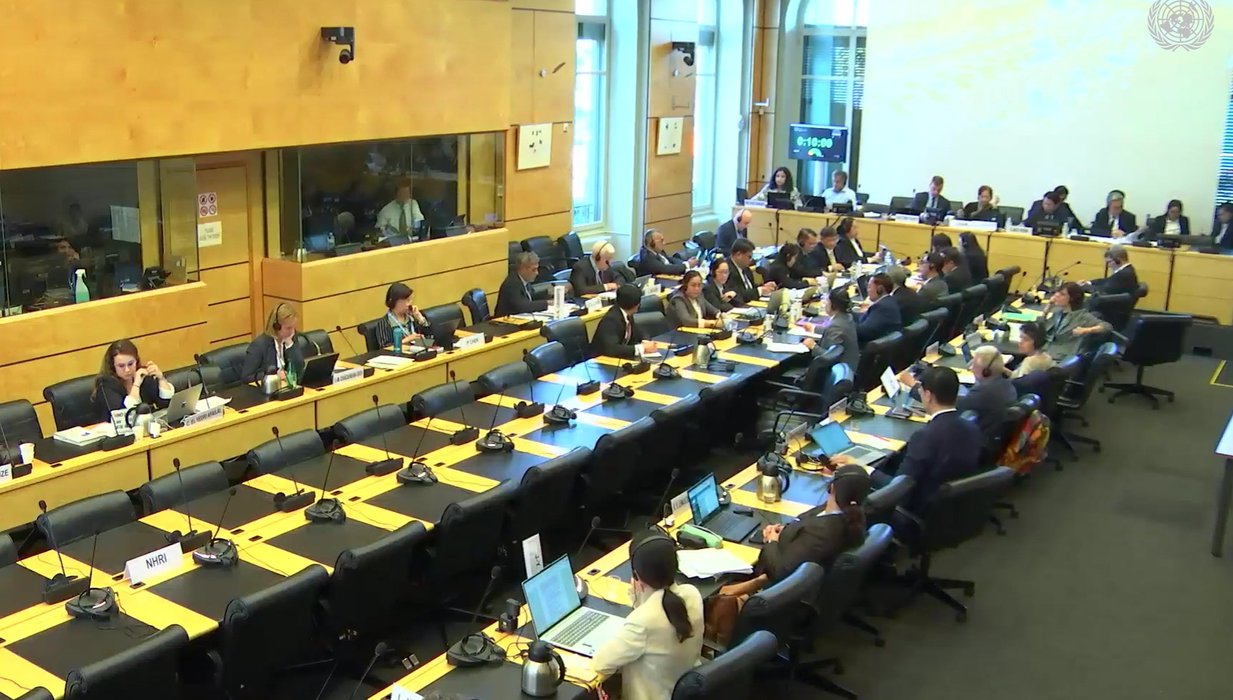
The UN Committee on Economic, Social and Cultural Rights (UN CESCR) reviewed Laos’ record in September 2025 and issued its Concluding Observations in October 2025. The Committee recommended that Laos establish a national human rights institution, or restructure an existing body, with a broad mandate to promote and protect human rights.
In recent months, the UN has raised concerns on the lack of protection for human rights defenders and civil society activists and restrictions on trade union rights. Civil society has also highlighted concerns around transnational repression, the lack of justice for Sombath Somphone and violations against the Hmong people.
Association
Lack of protection for human rights defenders and civil society activists
A report submitted by Manushya Foundation in September 2025 to the UN CESCR noted that Laos does not recognise the status of human rights defenders (HRDs) and lacks a legal framework to support or protect them and their work. HRDs are often viewed by the state as enemies and threats. Courageous HRDs who dare to speak out, especially those raising concerns about the environmental and social impacts of development projects, are often subject to serious retaliation, including threats, intimidation, arbitrary arrest and detention, and even enforced disappearances, all aimed at silencing them.
In October 2025, the UN CESCR expressed its deep concern about reports that human rights defenders and representatives of civil society working on economic, social and cultural rights - including defenders of Indigenous and tribal people’s rights and the environment, trade union leaders, leaders of peasant movements and anti-corruption activists - have been subjected to intimidation, threats, harassment, arbitrary arrest and detention, cases of unjustified criminal prosecution, violations of fair trial guarantees, enforced disappearance, extrajudicial killing and transnational repression.
It called on the state to strengthen the protection of human rights defenders, journalists and activists working on economic, social and cultural rights, and of their families, in order to prevent impunity and ensure that all violations are promptly, effectively and impartially investigated, prosecuted, sanctioned and remedied.
The Committee also called on the government to ensure that legislation is not used to unduly limit and repress activities of government critics, human rights defenders and activists, who are indispensable for the realisation of economic, social and cultural rights.
Restrictions on trade union rights
The CESCR was also concerned about reports that the right to form and join trade unions remains severely restricted in law and in practice, that most unions are affiliated with the Lao Federation of Trade Unions, and that there is no genuine possibility to form independent trade unions.
It was also concerned that the Labour Law does not explicitly prohibit anti-union discrimination or recognise the right to strike, and that, in practice, restrictive conditions continue to impede the exercise of the rights to strike and to collective bargaining.
Furthermore, it was concerned by reports of trade union leaders and workers being subjected to reprisals, including disciplinary sanctions and dismissals, for exercising their union rights.
Activists targeted in cases of transnational repression
In November 2025, Human Rights Watch made a submission to the Australian Department of Foreign Affairs and Trade (DFAT) ahead of the 9th Australia-Laos Human Rights Dialogue that took place in November 2025 in Vientiane.
In the submission, the human rights groups said it had documented several cases over the past decade that suggest the Lao government has engaged in quid-pro-quo agreements with neighbouring countries, colloquially known in the region as “swap mart” arrangements, to target dissidents and critics.
Targets of transnational repression are often Lao dissidents who have sought safety in neighboring Thailand. Thai dissidents and critics who fled to Laos have also been targets of transnational repression.
Renewed calls for justice for Sombath Somphone
🇱🇦Laos: On 15/12/2012, Sombath Somphone was last seen at a police checkpoint. #13years after his enforced disappearance, only 1 country called for a credible investigation during last April’s 4th #UPR.
— The Observatory (@OBS_defenders) December 15, 2025
📣We demand justice!#WhereIsSombath
👉https://t.co/85RbwQLy2b pic.twitter.com/E2Lxp6o8Mu
On 15th December 2025, marking the 13th anniversary of Lao civil society leader Sombath Somphone's enforced disappearance, civil society organisations and individuals worldwide urged UN member states and Laos’ development partners to press the Lao government to resolve his case and provide justice, remedies, and reparations to his family. They also called on the government to ratify the International Convention for the Protection of All Persons from Enforced Disappearance, signed in 2008, and fully implement it into national law and practice.
In its September 2025 report, the UN Working Group on Enforced or Involuntary Disappearances noted that Sombath’s disappearance weakened community ties, deprived groups of leadership, increased vulnerability to cultural and environmental harm, and instilled fear that discouraged public participation.
Violations against the Hmong people
The #Hmong people in Lao PDR continue to face violence, forced displacement, and cultural erasure. At the 60th UN HRC session, UNPO, together with the CWHP and GDH, called for urgent action to protect their rights and ensure recognition of their Indigenous identity. pic.twitter.com/hj4bthXw2Y
— Unrepresented Nations and Peoples Organization (@UNPOintl) September 30, 2025
On 20th August 2025 it was reported that the Unrepresented Nations and Peoples Organization (UNPO) and Congress of the World Hmong People (CWHP) submitted two critical reports to United Nations bodies documenting severe human rights violations against the Hmong people in the Lao People's Democratic Republic.
The Hmong are Indigenous Peoples to the Xaysomboun region of Laos. The ChaoFa Hmong have endured decades of systematic discrimination including uncompensated land confiscation, arbitrary arrests, enforced disappearances, suppression of freedom of expression, and severe restrictions on their economic, social, and cultural rights. Since the 1970s, military campaigns have killed thousands and displaced approximately 300,000 individuals to neighboring Thailand. Many of those remaining were forced to retreat to the forests, and face ongoing attacks, arbitrary arrests, enforced disappearances, and extrajudicial killings.
The systemic displacement of Hmong communities remains a significant concern. Reports show the use of heavy artillery and starvation tactics to displace the Hmong villagers, with resources being destroyed and civilians being subjected to (gender-based) violence and forced labour, and Hmong communities being forcibly relocated to military-controlled villages, stripped of land rights and impoverished.