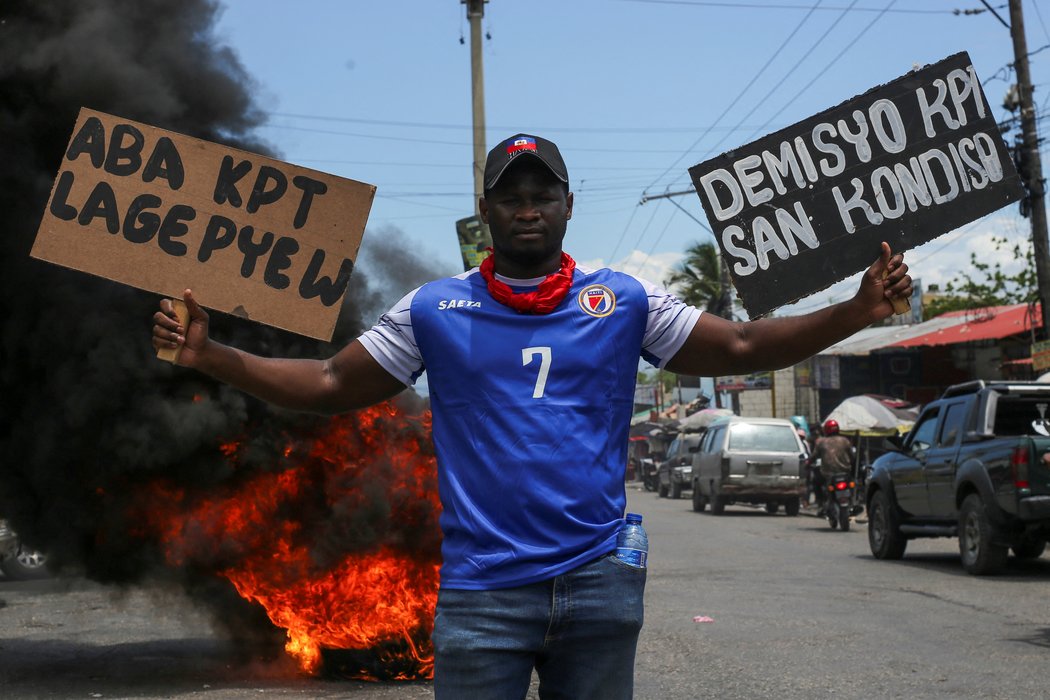
This update covers developments relating to the freedoms of expression, association and peaceful assembly in Haiti from 31st March 2025 to 18th September 2025.
GENERAL
The political, security, and humanitarian crisis endure in Haiti. It has been a year and a half since the transitional presidential council was installed at the head of the country, a collegial governing body tasked with restoring the authority of the State and organising elections in 2025.
On 10th September 2025, the National Identification Office announced that 6.3 million Haitians of voting age now have an ID card, meaning that approximately 85% of potentially eligible voters are registered and ready to vote in the upcoming elections. Voter registration has been severely compromised by population displacement and the destruction or closure of civil registry offices in gang-controlled areas.
As of 12th September 2025, no date has been set for the elections or for the controversial constitutional referendum. Security remains the main challenge, with more than 1.3 million people displaced and gangs controlling key areas. A decade without national elections has fostered a profound democratic deficit. Albert Ramdin, Assistant Secretary General of the Organization of American States (OAS), also warned of the risk of a political vacuum in Haiti if no agreement is reached before the end of the Presidential Transition Council’s mandate in February 2026, and the Forum of Former Prime Ministers of Haiti is alarmed about “an imminent political crisis”.
UN sounds alarm but no concrete plan is yet in sight
On 21st April 2025, during the United Nations Security Council meeting on Haiti, the Secretary-General’s special representative for Haiti said that the country is “approaching a point of no return”, and that increased funding and support is needed to avoid “total chaos”.
As gang violence continues to spread to new areas of the country, Haitians experience growing levels of vulnerability and increasing skepticism about the ability of the state to respond to their needs”
- Special Representative of the Secretary-General for Haiti María Isabel Salvador
On 4th June 2025, the UN Special Representative of the Secretary-General on Sexual Violence in Conflict, Ms. Pramila Patten, issued a statement expressing grave concerns over the escalating levels of sexual violence being inflicted upon women and girls amid the worsening gang violence in Haiti.
In a 19th June 2025 letter from Kenya to the Security Council, Kenya requested “expeditious consideration” by the Council of the Secretary-General’s proposals to strengthen political stability and security in Haiti, deploring that the mission it leads remains underequipped and without adequate operational support to effectively carry out its tasks. The Multinational Security Support mission indeed faces many political, structural and operational challenges.
On 14th July 2025, the UN Security Council adopted Resolution 2785 (2025) to extend the mandate of the BINUH until 31st January 2026.
On 28th August 2025, during a briefing of the United Nations Security Council on the Haitian crisis, the United States and Panama called for the establishment of a new force called the “Gang Suppression Force” to replace the Multinational Security Support Mission (MMSM) in Haiti. Despite these calls, international engagement remains stalled, with ambitious plans but no consensus or implementation. The UN Secretary General lamented the level of international neglect.
More than 1500 people killed in three months
According to the United Nations Integrated Office in Haiti (BINUH), between 1st April 2025 and 30th June 2025, at least 1,520 people were killed and more than 600 injured in armed violence, primarily in the Port-au-Prince metropolitan area, followed by Artibonite and Centre, and there were at least 185 kidnappings and 628 victims of sexual violence. Abuses by criminal groups caused more than 24 percent of those killed or injured during the quarter and 64 percent of those killed or injured were killed during security force operations against criminal groups, many during strikes using explosive drones.
Gang attacks in the Artibonite and Centre departments, and in the capital, continue to cause serious human rights violations and exacerbate an already dire humanitarian crisis, leading to massive population displacement with dramatic consequences for women and children in particular
- Ulrika Richardson, Acting Head of BINUH and United Nations Resident and Humanitarian Coordinator
On 10th July 2025, the United Nations Integrated Office in Haiti (BINUH) and the United Nations High Commissioner for Human Rights published a report on the intensification of gang violence observed since March 2025 in different regions.
On 11th and 12th September, armed gangs killed at least 40 people, including women, children and elderly persons, in Labodrie, north of Port-au-Prince. According to AlterPresse, the attackers stormed several houses, shooting entire families. The attack was condemned by the UN Secretary General, the Organisation of American States, the European Union delegation in Haiti and the French and Spanish embassies. Amnesty denounced the Haitian state's inability to protect its population.
The Global Initiative Against Transnational Organized Crime’s Observatory of Violence and Resilience in Haiti observed that since early 2025, vigilante groups (‘brigades’) have become central actors in Haiti’s security landscape. While initially formed for community protection, many brigades are now pursuing territorial and political expansion and could themselves evolve into criminal groups.
On 2nd May 2025, the Office of Foreign Assets Control (OFAC) of the U.S. Department of the Treasury officially designated the armed groups Gran Grif and Viv Ansanm as transnational terrorist organisations. Under these sanctions, the groups’ assets under U.S. jurisdiction are frozen and financial transactions with them are prohibited.
Opaque agreement with U.S private military company
Since March 2025, the private security firm Vectus Global started operating in Haiti, deploying drones, helicopters and international fighters to target gang-controlled areas. The firm also plans to manage tax collection at the Haitian–Dominican border. The company Vectus Global is run by Erik Prince, founder of the controversial security firm Blackwater. The fact that the interim and non-elected government entered a decade-long fiscal agreement and that it did not communicate on the agreement and on the numbers raised concerns. Critics have warned of various risks and said that the allocation of resources was more needed for national forces than for foreign mercenaries. U.S. senators questioned the legality of these activities under the Leahy Law that prohibits providing security assistance to a foreign security force when there is credible information that it has committed a gross violation of human rights.
@SecRubio and @Sec_Noem can’t have it both ways. If Haiti is stable enough to end TPS, why are US private military contractors preparing for combat operations in Port-au-Prince?@SenatorWarnock and I are demanding answers by August 15. You can’t deport people into a war zone. pic.twitter.com/J3wPas6Rac
— Ed Markey (@SenMarkey) July 28, 2025
EXPRESSION
Special Rapporteur for Freedom of Expression points to the existence of “silenced zones”
In May 2025, the Office of the Special Rapporteur for Freedom of Expression of the Inter-American Commission on Human Rights (IACHR) released a report on the situation of press freedom in Haiti. The last report dated from 2022. The report aims at analysing the evolution of the guarantees and conditions to practise journalism in the country and underlines the need to overcome the multidimensional crisis that the State is going through. According to the report, the addition of the myriad patterns of violence against the press in Haiti, compounded by the impunity against perpetrators resulted in “silenced zones”, especially in the areas where the State has lost its monopoly of force. The concept of “silenced zones” describes the violence exercised against the physical and psychological integrity of journalists and media workers with or without the acquiescence of the State, resulting in the inhibition of journalists to carry out their work and self-censorship on security issues, corruption or influence peddling. According to AP, Haiti’s Online Media Collective has advised that journalists not cover incidents involving gangs.
Gang takes over community radio station
On 20th April 2025, a gang operating in the town of Mirebalais, in the department of Centro, seized the community radio station Panik FM 97.5. It then renamed it Taliban FM and use it to broadcast propaganda.
Order must be restored, not least so that media outlets such as Radio Panic FM can provide news to Haitians and the world, rather than being hijacked to become mouthpieces for gangs.
- Committee to Protect Journalists, U.S., Canada, and Caribbean Program Coordinator Katherine Jacobsen
Journalists kidnapped and threatened
At the beginning of April 2025, journalist Roger Claudy Israël and his brother Marco Israël were kidnapped by the gang members active in Mirebalais. The kidnappers issued a video in which they clearly threatened to execute the hostages. Following the mediation of the group SOS Journalistes, both were released after a few days.
Journalist missing after his house was burned down
On 31st March 2025, the house of Jean-Christophe Collègue, who worked for Voice of America until it went off air in March and was also a former correspondent for Radio Kiskeya, was burned down during a large scale gang attack. He then went missing and as of 4th July 2025 has not been found. According to AlterPresse, the house of his son, Anderson Collègue, a correspondent for Radio Caraïbes, was also set on fire.
Threats against a journalist who advocated for independent radio stations
On 11th September in Miami, the Committee to Protect Journalists called on Haitian authorities to end their harassment of Guy Delva, leader of Haitian press freedom group SOS Journalistes, and to ensure the journalist can work safely without fear of threats. Delva conducted advocacy work on behalf of independent radio stations Radio Caraibes and Radio Mega. After that, he reported having been threatened at least twice by unidentified men, and he believes the police intend to arrest him. The Committee to Protect Journalists contacted the deputy police spokesman Lionel Lazarre about the police investigation against Delva but the spokesman declined to comment.
ASSOCIATION
USAID funding cut effects on CSOs
Six months after the USAID funding cuts decided by the U.S. administration, several associations in Haiti are pointing to its devastating effects, for example on the HIV prevention programmes and LGBTQ+ associations, such as the CHAAPES collective, which has been forced to halt its prevention activities due to a lack of funds. In May 2025, a representative of Haiti’s Federation of Associations of HIV, said that at least five clinics, including one that served 2,500 patients, were forced to close after the USAID funding cuts. The executive director of Caring for Haitian Orphans with AIDS, a CSO operating in Cap-Haitien, explained that their medical supplies would last them only until the end of July 2025.
According to UNAIDS, civil society organisations have been significantly impacted, particularly those providing services for key, priority, and vulnerable populations. The loss of key population-focused interventions has increased vulnerability to stigma and discrimination and weakened responses to sexual and gender-based violence. Furthermore, access to healthcare, education, nutrition, shelter, psychosocial support, economic empowerment programmes for caregivers, and comprehensive sexual and reproductive health and GBV education has been directly affected.
ASSEMBLY
Protests denouncing lack of responses to urgent needs are often met with tear gas
- On 1st March 2025, at the call of the EDE (Engagés pour le Développement) political party, thousands of people demonstrated against insecurity, poverty, hunger and the failure of the transitional government in Port-au Prince. A Haitian National Police vehicle tear gassed demonstrators as they walked along Delmas 40 B.
- On 19th March 2025, thousands of residents of Canapé-Vert took to the streets of Port-au-Prince to denounce the new wave of violence orchestrated by criminal groups. They wanted the authorities to take measures to curb the abuses committed by criminals and claim the right to live in safety. Police fired tear gas to scatter protesters. On 27th March 2025, hundreds of protesters gathered again in Canapé-Vert to demand authorities restore security.
- On 16th September 2025, protesters blocked the national highway connecting the north and closed access to the town hall. They criticise the municipal authorities for their inability to respond to urgent problems and accuse the acting mayor, who has been at the head of the municipal council for more than ten years, of administering the municipality from abroad. The protesters demand that the municipal administration be replaced by a new team.
Protesters demanding justice for victims of police officers’ actions
- On 23rd May 2025, teachers and students protested to demand justice for Williamson Saint-Fleur, a teacher who police officers assaulted in Cap-Haïtien on 18th May 2025 during the Flag Day and University Day celebrations. Williamson Saint-Fleur was demonstrating with other educators for better pay and was slapped and shoved by police officers. The Ministry of National Education and Vocational Training condemned the attack perpetrated by police officers. Although the officers have reportedly faced internal discipline, demonstrators argued that it is insufficient. In addition to denouncing the assault, the protesters called for overdue reforms in Haiti’s education system and salary arrears.
- On 17th September 2025, relatives and thousands of people demonstrated for three consecutive days in Gonaïves (Artibonite) to demand justice for the leader of the Artibonite Resistance Front, Wilfort Ferdinand, known as “Ti Will” and another man shot dead in unclear circumstances the day before in the Kannal Bwa area. A spokesman for Haiti’s National Police said that officers killed former rebel leader Wilfort Ferdinand after they accused him of opening fire at a police checkpoint. The protesters also demand the resignation of the police chief in the Artibonite department.
Bystanders shot during protests
- On 12th May 2025, in Petit-Goave Ouest, residents protested to demand financial accountability from the local authorities due to unsatisfying local security conditions. They marched near the home of the director of the city hall’s council, where the director’s security personnel fired gunshots to disperse the crowd, injuring two people who were not involved in the protest. It is unclear whether the private security or police officers injured the victims.
- On 18th August 2025, a dozen trainee teachers held a sit-in protest in front of the Ministry of National Education and Vocational Training in Port-au-Prince to demand their inclusion in the educational system. An agent from the ministry’s security personnel fired shots to disperse the crowd, hitting and killing 19 year-old Zamy Wanderson, who was not related to the protest and who was passing through on the back of a motorcycle. A security guard from the Ministry was arrested in connection with the incident. On 21st August 2025, three days later, hundreds of people, mostly young people, marched in front of the Ministry of National Education building to demand justice for Zamy Wanderson, who was shot dead on 18th August 2025. Following this peaceful march, the Ministry of Education announced disciplinary measures. Fifteen security guards who were present on 18th August 2025 were disarmed, suspended, and placed under investigation.
Pour réclamer justice pour Zamy Wanderson, tué d’une balle le 18 août 2025, des centaines de personnes majoritairement des jeunes ont marché dans les rues ce jeudi 21 août devant les locaux du Ministère de l'Education Nationale à Delmas 83. Ils réclament justice. Selon des… pic.twitter.com/CEGEjMxUSO
— Gazette Haiti (@GazetteHaiti) August 21, 2025
Teachers occupy the Ministry offices
Between 21st and 28th April 2025, nearly 100 public school teachers occupied the Ministry of National Education and Vocational Training offices to demand payment of unpaid wages, employment regularisation, and improved working conditions. This occupation follows three months of fruitless dialogue with education officials, during which teachers accused the Ministry of not respecting an earlier agreement that had promised to address longstanding grievances.