Introduction
Introduced in January 2025, the Border Security, Asylum and Immigration Bill has remained a contentious issue. While a shift in approach was expected following the 2024 change in government, its passage through Parliament has raised concerns over a missed opportunity to adopt a more constructive and humane tone on migration.
The Bill repeals the Safety of Rwanda (Asylum and Immigration) Act 2024 and parts of the Illegal Migration Act 2023. However, several civil society organisations argue that it does not go far enough. The UN Refugee Agency (UNHCR) has expressed concern about certain remaining provisions, particularly those concerning detention periods and the inadmissibility of asylum and human rights claims from people of specific nationalities. The UNHCR has also warned that the Bill fails to provide adequate protections for asylum seekers.
Further developments on the issue of migration and human rights have caused concern about the government’s changing position. In February, the Government amended the Home Office ‘Good Character’ guidance without consulting civil society organisations. The changes seek to permanently bar individuals who entered the UK irregularly, including asylum seekers, from obtaining British citizenship, in violation of international human rights standards. The Immigration Law Practitioners’ Association sent a letter to Home Secretary Yvette Cooper, urging the government to “take immediate action to amend the Guidance to ensure its compliance with the UK’s international obligations, by upholding the rights of refugees, stateless persons, children, and victims of trafficking.”
In April, Prime Minister Keir Starmer stated that “we all pay the price for insecure borders—from the cost of accommodating migrants to the strain on our public services.” Following this, 136 organisations urged the Prime Minister to stop using demonising language that stirs up anti-migrant sentiment and social division. In May, at a press conference to announce an immigration White Paper entitled Restoring Control over the Immigration System, PM Starmer described the UK as an “island of strangers”, again drawing condemnation for the use of right-wing anti-migrant rhetoric.
Further attempts to restrict immigration protections followed. In June 2025, the Government launched a review of Article 8 of the European Convention on Human Rights (ECHR), the right to private and family life, in immigration cases. Ministers argued that the current interpretation has unjustly hampered deportation, particularly of offenders who are foreign nationals, and suggested tightening the definition of “family life” to limit the cases in which protections offered by the article can be invoked. Civil society organisations have warned that such changes could undermine vital protections and risk separating families.
Protections for trans people have also been rolled back. In April 2025, the UK Supreme Court upheld the right of service providers to restrict access to single-sex spaces where “proportionate” in a case concerning transgender rights. The decision was criticised for potentially reinforcing exclusionary practices. The Equality and Human Rights Commission (EHRC) also issued guidance that many civil society organisations view as weakening protections for trans people under the Equality Act 2010. The Good Law Project and Liberty have since launched legal action against the EHRC over this guidance.
The Assisted Dying Bill, which seeks to legalise assisted dying for terminally ill adults under strict safeguards, has passed the House of Commons and is now before the House of Lords. The proposals have reignited debate over autonomy and Article 8 rights, with the Joint Committee on Human Rights examining the Bill’s human rights implications. Although some disability and faith groups remain opposed, public support continues to grow, with 73% of respondents expressing support in recent polling.
The Assisted Dying Bill was passed in the Commons in June 2025 and moved on to the House of Lords, aiming to legalise assisted dying for terminally ill adults under strict safeguards. The proposals have triggered renewed debate over autonomy and Article 8 rights, with a Joint Committee on Human Rights currently reviewing its human rights implications. While concerns remain from some disability and faith groups, public support continues to grow—with 73% in favour according to recent polling.
In the May 2025 local elections, the far-right populist party Reform UK gained control of its first local councils and has been steadily rising in national polls since the 2024 general election. Concerns persist over the party’s pre-election pledges to withdraw from the European Court of Human Rights, dismantle climate initiatives, and pursue an anti-migration agenda. Following the party’s local election victories, leader Nigel Farage publicly told council staff working on diversity and climate issues to “find alternative careers.”
Freedom of association
Civil Society Covenant in development
In 2024, the Government announced a Civil Society Covenant to rebuild trust with civil society. After publishing principles of engagement in October, a consultation ran through December and the full document is expected in mid-2025. Civil society organisations have expressed hope the Covenant will lead to more inclusive and collaborative policymaking, though its impact remains to be seen.
In May 2025, the National Council for Voluntary Organisations (NCVO) and Association of Chief Executives of Voluntary Organisations (ACEVO) published a report outlining the finding of the consultation and engagement exercise their organisations ran in collaboration with the Government’s Department for Culture Media and Sport in order to inform the development of the Covenant. The report found civil society organisations in the UK currently experience barriers to working with government, including bureaucratic ways of operating, poor understanding of civil society, and lack of trust. Funding arrangements have been described as predominantly short term, competitive, and one-size-fits-all, preventing organisations from responding flexibly to the needs of communities. Drawing on these findings, NCVO and ACEVO outlined a number of recommendations to ensure the Covenant is effective in improving the relationship between civil society and government.
Proscription of Palestine Action
In June, Home Secretary Yvette Cooper announced her intention to proscribe the direct action group Palestine Action under anti-terror legislation, following a break-in at RAF Brize Norton in Oxfordshire in which two military aircraft were spray-painted red. The order would classify the group as a terrorist organisation, making membership or expressing support for the group, or even just publicly wearing clothing or carrying articles associated with it, a criminal offence punishable by up to 14 years in prison under the Terrorism Act.
In reference to PA’s non-violent civil disobedience protest actions, Cooper said the group has a “long history” of criminal damage targeting “financial firms, charities, universities and government buildings”, with incidents since 2024 increasing in frequency and severity. She stressed the measures would not affect lawful protest groups or peaceful demonstrations.
On 1st July, a group of five UN Special Rapporteurs called on the UK Government not to misuse counter-terrorism legislation by proceeding with the ban, describing the labelling of PA as “terrorist” as unjustified and warning of a chilling effect on fundamental freedoms in the country. “Individuals could be prosecuted for peacefully exercising their rights to freedom of expression and opinion, assembly, association, and participation in political life. This would have a chilling effect on political protest and advocacy generally in relation to defending human rights in Palestine”, the experts said.
Despite this, the next day, Members of Parliament voted in favour of legislation to proscribe PA as a terrorist organisation, with the measure passing by 385 votes to 26. Following unsuccessful attempts by PA to temporarily block the order’s application, it officially came into effect on 5th July 2025.
On 30th July, a court ruled to allow Palestine Action to challenge its designation as a terrorist organisation, with a decision expected in November.
Raid on Youth Demand activist group
On 28th March, police raided a meeting of the group Youth Demand at a London Quaker meeting house, arresting dozens of activists planning non-violent action on suspicion of conspiracy to commit public nuisance. According to the group, at least 20 officers, some armed with tasers, forced open the door without warning. Despite not having a warrant, they searched the premises and arrested six women on charges of conspiracy to cause public nuisance. The women were taken to two separate police stations, denied communication, and questioned overnight.
Using keys confiscated from those arrested, police subsequently conducted 12 home raids on supporters of the group, arresting five more people. The Guardian reported that one of those arrested was 23-year-old autistic activist Joe Booth, taken during a pre-dawn raid at his supported accommodation in north London. Seven officers entered Booth’s flat while he was in bed, arresting him on suspicion of conspiracy to cause public nuisance. Booth, a London Underground cleaner, said the experience has left him traumatised and suffering from PTSD. He denies any involvement in disruptive protests, stating he only attended peaceful meetings and distributed leaflets opposing arms sales to Israel and the use of fossil fuels. Booth was questioned for seven hours before being released on bail with conditions, including a ban on entering Westminster.
Youth Demand is a non-violent civil disobedience group advocating for “an immediate end to all arms sales enabling violence in Gaza, genuine climate crisis action, and the repeal of authoritarian protest laws that criminalise dissent.” According to them, the meeting targeted by police was an introductory session for new members on Gaza and climate issues, providing guidance on how to take part in peaceful protest actions. The Metropolitan Police stated that the arrests were made amid concerns that the group was planning to “shut down” London the following month by blocking roads as part of a planned protest.
Thousands of young people are horrified by the UK’s complicity in Gaza and betrayed by continued fossil fuel expansion that destroys their future. Aggressive police tactics only strengthen our resolve. They prove we’re on the right path and non-violent disruptive actions are what it takes to make our government pay attention.
- Youth Demand
Freedom of peaceful assembly
Liberty wins another court case challenging government’s restriction on protests
In a positive development, Liberty has twice won its legal challenge against the government’s protest restrictions. As previously reported, on 21st May 2024, the High Court ruled that the former Home Secretary, Suella Braverman, had exceeded her powers when she passed the anti-protest legislation in June 2023. The Court found that the law had broadened the definition of “serious disruption” to the point that the police were able to restrict peaceful protests causing minimal disruption.
Following the change in government, the new administration continued the appeal initiated by its predecessors. On 2nd May 2025, Liberty won the appeal, with the Court of Appeal upholding the High Court’s earlier judgement.
Liberty described the ruling as a landmark victory and called for an urgent review of all arrests and prosecutions conducted under the legislation. The organisation also urged a comprehensive review of all protest laws enacted in recent years to ensure that the right to peaceful protest is fully protected.
Crime and Policing Bill 2025
The Crime and Policing Bill 2025 was introduced to Parliament in February and passed its third reading in June. It represents the third major piece of legislation in recent years to restrict the right to protest. Civil society has raised serious concerns about several of its measures. The Bill criminalises the use of face coverings at specific protests, with vague thresholds that could allow the police to impose pre-emptive bans and even in cases where identity concealment was not the intention. It also restricts protests near places of worship and creates an offence relating to climbing war memorials, raising questions about the protection of freedom of assembly and expression. In addition, the Bill enables post-arrest conditional cautions that could require people with limited leave to remain in the UK to leave the country. It also introduces Respect Orders, modelled on infamous anti-social behaviour orders (ASBOs), which were scrapped in 2010. Liberty has warned these are likely to be applied to behaviours linked to poverty, such as rough sleeping or non-aggressive begging.
Civil society organisations warn that these powers risk chilling peaceful protest and disproportionately affect marginalised communities, including Muslim women, climate activists, and people experiencing homelessness. They have called for amendments to remove or limit these provisions.
Study shows UK leads the world in cracking down on climate protests
A study published in December 2024 by the University of Bristol shows the UK are among global leaders in cracking down on climate activism, with research showing UK police arrest environmental and climate protesters at three times the average global rate, with 17% of such protests leading to arrests.
As previously reported, in July 2024, five climate activists from the group Just Stop Oil (JSO)—Roger Hallam, Daniel Shaw, Louise Lancaster, Lucia Whittaker De Abreu, and Cressida Gethin—received significant prison sentences for “conspiracy to cause a public nuisance” by planning a peaceful protest disrupting traffic on London’s M25 motorway in November 2022. Hallam, regarded as the lead organiser, was sentenced to five years, while the others received four-year terms each. According to the Guardian, these are thought to be the longest sentences ever given in the UK for non-violent protest actions.
In March 2025, the Court of Appeal heard the appeals of 16 JSO protesters jailed in 2024, including the above five. Ruling that the sentencing judge had not taken into account the protesters’ conscientious motivation, the Court ruled to reduce each of their sentences, with Hallam’s reduced to four years, Shaw's and Lancaster's reduced to three years, and Whittaker De Abreu's and Gethin's reduced to 30 months.
Another participant in JSO protests, 75-year-old Gaie Delap, had her prison sentence reduced from 20 months to 18, citing onerous bail conditions she had faced while awaiting trial. According to the BBC, in 2024, she was briefly returned to jail, having been released on licence, because the authorities could not find a monitoring tag small enough to fit her.
The other ten protesters’ appeals were dismissed.
Repression of pro-Palestine protests
Mass mobilisations in solidarity with Palestine continued in 2025, with authorities responding with arrests and obstruction.
In central London on 18th January 2025, more than 70 pro-Palestinian demonstrators were arrested on suspicion of breaching protest conditions after some allegedly broke through a police line while marching from a rally in Whitehall. The demonstration, attended by thousands, called for an end to Israel’s 15-month war in Gaza, a day after a ceasefire was agreed, with placards reading “Stop arming Israel” and “Free Palestine.”
Police blocked access to Trafalgar Square and the surrounding areas, with footage showing former Labour leader Jeremy Corbyn and former shadow chancellor John McDonnell among the crowd. Arrests included individuals charged with public order offences and breaching conditions prohibiting entry to specific areas. MPs Jeremy Corbyn and John McDonnell agreed to be interviewed under caution by police. The Metropolitan Police said the arrests responded to what they described as “a coordinated breach” of conditions, while organisers and civil society groups condemned the intervention as an assault on civil liberties and the right to peaceful protest.
In February 2025, the Network for Police Monitoring (Netpol) reported that Greenwich Council was using anti-social behaviour powers to suppress pro-Palestine demonstrations. Since October 2023, a borough-wide Public Space Protection Order (PSPO) has prohibited the “anti-social use of amplification”, effectively preventing protesters from using loudspeakers or PA systems without prior permission. Local Palestine solidarity groups have criticised the measure, saying it has repeatedly disrupted peaceful protests. They report that police and council enforcement officers have threatened demonstrators with arrest under the PSPO for using sound equipment, forcing organisers to turn down or abandon their systems.
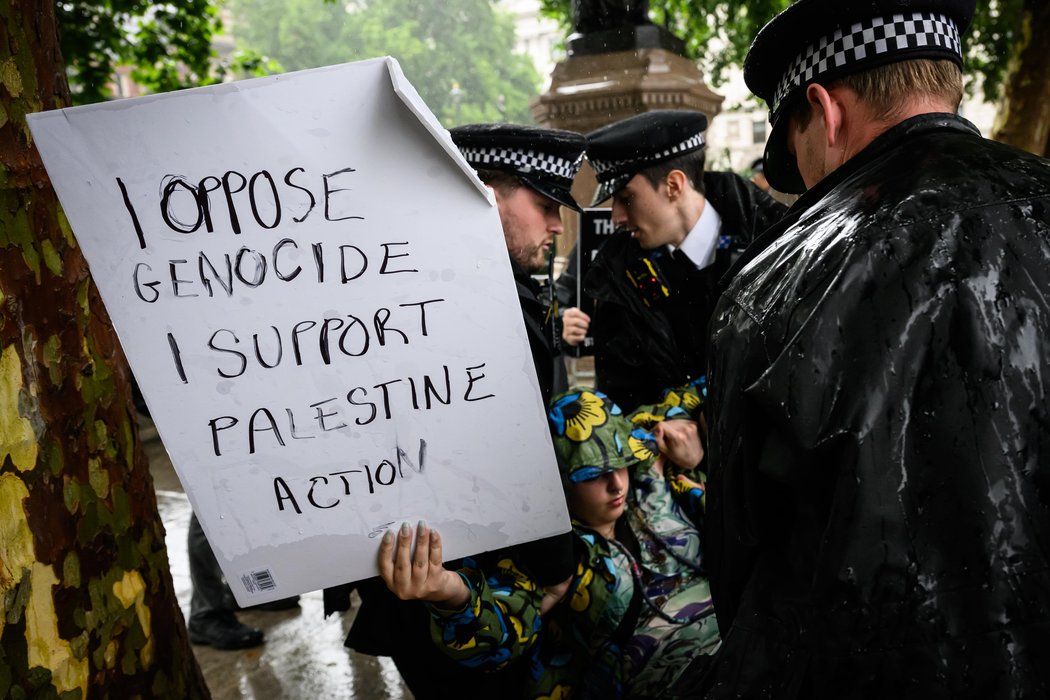
From June 2025, as people mobilised to oppose the government’s plan to proscribe Palestine Action (PA) as a terrorist organisation, police responded with unprecedented arrests, targeting completely peaceful protesters simply for holding placards reading “I support Palestine Action.” With the ban set to take effect on 5th July, making any expression of support for PA an offence under terrorism law, the group Defend Our Juries informed the Metropolitan Police that they intended to stage a demonstration with placards that same day. Protesters holding homemade cardboard signs gathered near the Mahatma Gandhi statue in Parliament Square, where police surrounded the group and detained individuals, including an 83-year old priest and a human rights lawyer. Police later stated that 29 people were arrested and were being investigated for offences under the Terrorism Act.
According to Defend Our Juries, on 12th July, one week after the London arrests, dozens of activists replicated the action in cities across the UK, resulting in 76 arrests in London, Manchester, Cardiff and Leeds, with additional participants in Derry and Kendal not arrested. Police responses varied widely, with South Wales Police reportedly raiding homes and holding those arrested in cells for over 30 hours.
On 9th August, over 500 people were arrested in London’s Parliament Square for peacefully holding signs with the same slogan. This is believed to be the largest number of arrests at a single event in living memory by the Metropolitan Police, far surpassing the arrests made during the 1990 Poll Tax riots.
Freedom of expression
Report warns of rising threats and declining trust in UK media freedom
In April 2025, a report by the Reuters Institute for the Study of Journalism and the University of Oxford titled UK Journalists in the 2020s found increasing threats to media freedom and declining trust in the UK’s journalistic landscape. Published in April 2025, the report found that nearly half of journalists believe the truth is “inevitably shaped by those in power”, reflecting growing scepticism within the profession.
Based on a survey of 1,130 journalists, the report found that 43% view media freedom in the UK as limited. It highlights a climate of growing hostility, with only 18% of journalists reporting they had not faced safety threats in the past five years. Nearly half had experienced demeaning or hateful speech, while more than one in five women reported incidents of sexual violence.
Amnesty: Northern Ireland ‘most dangerous place in UK’ for journalists
Northern Ireland is the most dangerous place in the UK to work as a journalist, according to a new Amnesty International report published in July 2025. The report, titled Occupational Hazard? Threats and Attacks Against Journalists in Northern Ireland, documented at least 71 incidents of threats or attacks on journalists since 2019, including death and rape threats, petrol bomb attacks, and shootings.
The report found that most threats originate from paramilitary and organised crime groups, with some journalists forced to install bulletproof windows and alarms connected to police stations. Despite the severity of the situation, no prosecutions have been brought in cases related to paramilitary threats. Amnesty warned that inadequate police responses and a lack of accountability are eroding press freedom and endangering lives. Many journalists, it said, now regard violence and intimidation as an “occupational hazard”.
Freedom of Expression and Academic Freedom
In May 2025, the High Court granted Cambridge University a protest injunction, effective until 26th July, restricting demonstrations on sites associated with Palestine and Israel. Liberty, which intervened in the case, warned that the ruling risks silencing student voices and sets a dangerous precedent.
The Higher Education (Freedom of Speech) Act 2023 came into force on 1st August 2025. The law, which is designed to stop universities from censoring controversial or unpopular ideas, gives the Office for Students (OfS) responsibility for ensuring institutions comply with its provisions. Previously in June, the OfS issued a “sweeping” guidance urging universities to adopt a “very strong” approach to permitting lawful speech on campus. According to The Guardian, the detailed regulations set out for the first time how universities should handle inflammatory disputes. Institutions are advised not to impose prolonged bans on protest encampments, as Cambridge did, but must prevent “frequent, vociferous and intrusive” protests that could intimidate Jewish students.
CSOs challenge government’s secret surveillance orders
In February 2025, it was reported that the UK Government had used a Technical Capability Notice (TCN) to pressure Apple into creating a backdoor in iCloud services, thereby weakening encryption. In response, Apple withdrew its Advanced Data Protection feature from UK users.
TCNs, issued under the Investigatory Powers Act, which Privacy International describes as one of the most intrusive surveillance laws in the world, are secret orders compelling technology companies with connections to the UK to alter their systems to facilitate the UK's use of its investigatory powers, for example, by removing encryption. These notices are issued under strict confidentiality, and it would be illegal for a company that has received them to disclose any details.
On 14th March, Liberty and Privacy International initiated legal action against the Government, filing a complaint with the Investigatory Powers Tribunal (IPT), a body tasked with reviewing certain surveillance measures. In July, the IPT announced it would hold a seven-day hearing in the case in early 2026.
UK’s new age verification law sparks concern over privacy and access to information
In July 2025, the UK began implementing the Online Safety Act, aimed at protecting minors from harmful online content, including pornography, content that encourages, promotes, or provides instructions for violence, promotion of self-harm and eating disorders.
Under threat of significant fines, social media and other platforms are obliged to implement invasive age-verification methods, including facial recognition, credit card checks, photo ID scans as well as sweeping artificial intelligence scans of, for example, one’s email communication, before allowing the user to access sensitive content.
Worryingly, BBC Verify has found that the new regulations are preventing users from accessing a wide range of public interest and politically sensitive content without giving up their biometric data or access to their communications. According to their report, social media companies including X (formerly Twitter) and Reddit have blocked content including footage of the wars in Ukraine and Gaza as well as UK parliamentary debates and classical art under the new rules.