Association
In November 2025, the Moroccan General Secretariat of the Government (SGG) announced an institutional restructuring affecting the governance of associations, merging previously separate administrative units into a single directorate responsible for overseeing associations, regulated professions, and professional organisations. Presented by SGG Secretary-General Mohamed Hajoui, the reform was framed as a move toward greater administrative efficiency, legal support, and improved coordination with civil society. The restructuring also included plans to revise procedures for granting public-utility status, tighten oversight of public fundraising and foreign funding, and introduce a centralised digital system for registration and reporting. While authorities described the reform as supportive and modernising, civil society actors warned that the centralisation of oversight and increased reporting requirements could reinforce administrative control, slow registration and funding approvals, and negatively affect the practical exercise of their rights.
Peaceful Assembly
Ongoing solidarity with Palestinians against the war in Gaza and normalisation with Israel continued to be demonstrated in recent protests in the country. On 29th November 2025, more than 20 professional, associative and civil‑society organisations staged a sit‑in in front of the Moroccan Parliament in Rabat on the International Day of Solidarity with the Palestinian People. On 22nd December 2025, on the fifth anniversary of Morocco’s normalisation agreement with Israel, dozens of Moroccans participated in a demonstration in Rabat demanding an end to the normalisation. A month later, on 9th January 2026, hundreds of pro‑Palestinian activists marched in Rabat, opposing Morocco’s normalisation with Israel and demanding its reversal, while expressing solidarity with Palestinians amid ongoing Israeli military offensives in Gaza and the West Bank.
Separately, journalists in Morocco too to the streets to express strong discontent over increasing restrictions on press freedom and the controversial draft law 026.25 that seeks to reorganise the National Press Council, which they fear could undermine media independence. On 28th November 2025, around 200 journalists gathered in a public demonstration in Rabat, in front of the Ministry of Communication, to protest these restrictions. They carried signs reading “Journalism is not a crime,” “Dissolve the National Press Council,” and “Withdraw Draft Law 026.25,” highlighting concerns over the media reform bill. The protest was largely triggered by a video leaked by independent journalist Hamid El Mahdaoui on his YouTube channel, showing members of the National Press Council’s disciplinary commission allegedly insulting and humiliating him, which journalists said revealed deeper issues in the regulation of their profession.
While the government said the proposed law would strengthen journalists’ independence and professional self regulation, CSOs called for strengthening of the draft law to reflect stronger protections for journalists, fair representation, pluralism, independence, and transparency in the Council's structure (see more in expression section below).
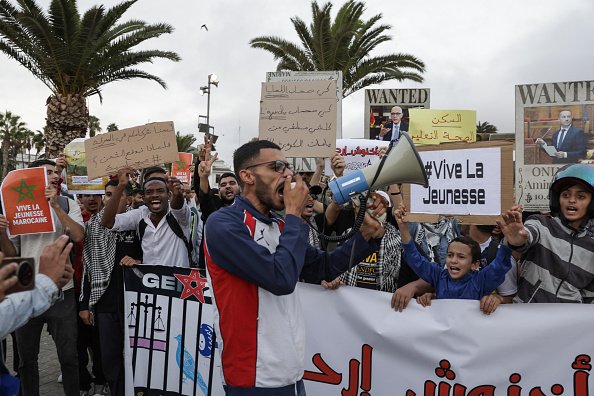
In other developments, following the GenZ212 protests in Morocco in September and October 2025, which saw massive mobilisation of young people around social, economic, and living condition-related demands, the movement issued a new statement reaffirming its call for the immediate release of all individuals detained during these demonstrations. Specifically, it called for a peaceful sit-in on 4th November 2025, at Bab Doukkala Square to demand the release of the protesters still in custody. A report presented in October 2025 by the Moroccan Association for Human Rights (AMDH) revealed that 2,068 people, including 330 minors, had been arrested and prosecuted following the protests. Among them, 1,088 were still in detention at the time of the report’s publication, 596 had been released, and 233 had been sentenced following rushed trials, some to very severe terms of up to 15 years in prison. As of today, no precise information is available regarding the current situation of those still detained. One month earlier, the UN Secretary‑General Antonio Guterres had called on Moroccan authorities to uphold the rule of law and ensure that the rights of protesters were respected, urging the release of those detained and stressing the importance of allowing peaceful demonstrations.
Expression
Worrying sanctions were adopted on 19th October 2025, by the Council of Ministers under Organic Law Project No. 04.21, providing for two to five years of imprisonment as well as substantial fines for anyone spreading false information intended to cast doubt on the credibility of elections. Article 2 of the draft law which introduces this provision was publicly defended by the Minister of the Interior, Abdelouafi Laftit, on 12th November 2025, who stated that the measure aims to protect the integrity of the electoral process against disinformation. However, the provision has sparked considerable controversy in Morocco, with some political figures calling for the article’s withdrawal, arguing that it could restrict freedom of expression and prevent legitimate criticism of election results.
Separately, in December 2025, despite strong criticism from opposition parties and international NGOs, the Parliament adopted the controversial Organic Law Project No. 026.25, reforming the National Press Council and granting it new powers over journalists and media outlets. CSOs warned it could limit freedom of expression, reduce media pluralism, and give the government excessive influence over the press. In January 2026 however, the Constitutional Court invalidated several provisions, ruling that they violated constitutional guarantees of press freedom and pluralism, highlighting ongoing concerns about the protection of independent journalism in Morocco.
Western Sahara
On 3rd November 2025, following the adoption of UN Security Council Resolution 2797 on 31st October 2025, the Organisation Marocaine des Droits Humains (OMDH) issued a statement emphasising the centrality of human rights in the Western Sahara context. OMDH highlighted that any political process, including the autonomy framework endorsed by the UN, must fully respect the civil, political, economic, social, and cultural rights of the Sahrawi population. The organisation also stressed the importance of including human rights actors and Sahrawi voices in shaping governance mechanisms