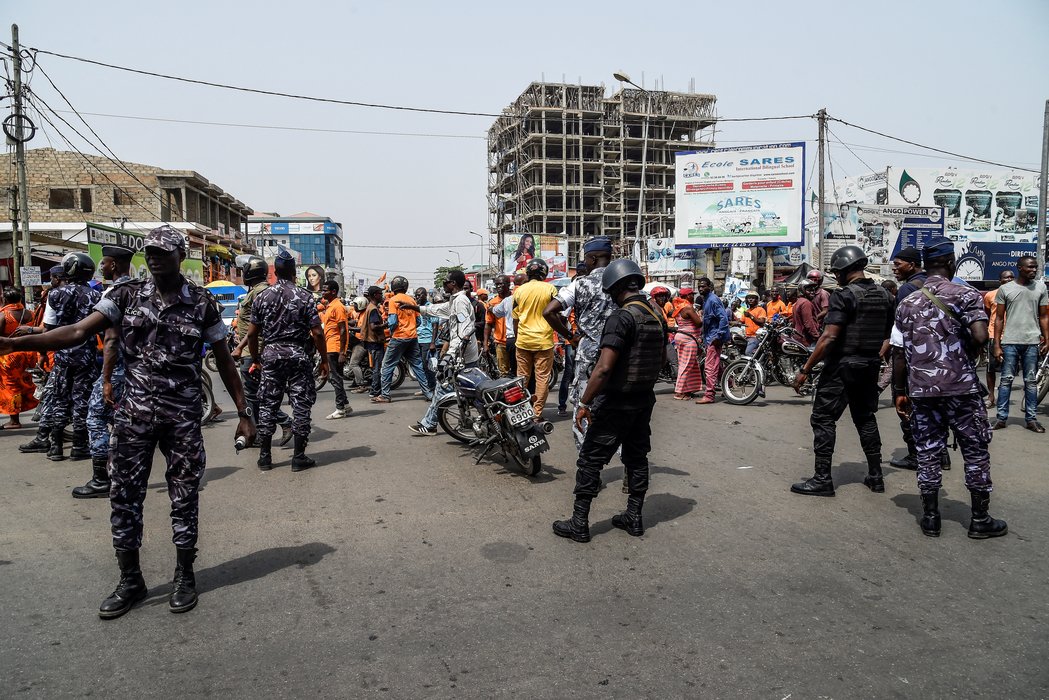
GENERAL: CONSTITUTIONAL REVISION REMAINS CONTENTIOUS
The May 2024 controversial constitutional revision continues to spark significant backlash, including from civil society actors. The new Constitution fundamentally alters the political landscape by abolishing direct presidential elections and instituting a parliamentary system, meaning that Members of Parliament will nominate the President of the Council of Ministers. As previously reported by the CIVICUS Monitor, authorities banned several meetings, sit-ins, and protests against the newly adopted Constitution.
The constitutional revision has not ceased to ignite widespread opposition, as critics argue that it paves the way for the incumbent President, Faure Gnassingbé, who has held power since 2005, to extend his rule indefinitely. For example, on 23rd March 2025 hundreds of activists gathered at Place Akassimé in Lomé’s city centre to voice their dissent.
ASSEMBLY
AUTHORITIES BAN COMMUNITY GROUP’S ACTIVITIES
On 23rd and 24th December 2024, the Golfe prefecture banned Club Nubuéké, a community organisation in Togo, from conducting planned activities, citing the organisation’s failure to obtain prior authorisation. The ban affected events such as tree watering, youth reading competitions, and soccer galas. Club Nubuéké is known for its local development initiatives, focusing on environmental conservation, youth education, and sports promotion. The banned decision raised controversy, as the organisation had previously freely conducted such events to contribute to community development.
GOVERNMENT BANS SOLIDARITY EVENT FOR POLITICAL PRISONERS [Bureaucratic restriction]
On 17th September 2024, the Minister of Territorial Administration, Decentralisation and Chieftaincy, Col Awaté Hodabalo, banned a day of prayer and solidarity for political prisoners planned for 20th September 2024 in Sokodé in solidarity with political prisoners. The event was organised by ‘Touche Pas à Ma Constitution’, a coalition of opposition parties and civil society organisations dedicated to protecting the constitution. The minister reportedly cited concerns about preserving public order as grounds for banning the day of prayer.
In response to the ban, on 18th November 2024, key members of the coalition, including the Ligue Togolaise des Droits de l’Homme (LTDH; Togolese Human Rights League) and political parties ‘Démocrates’, and the Parti des Togolais (PDT), filed an appeal with the Administrative Chamber of the Togo Supreme Court. The appeal alleges government abuse of power, arguing that the ministerial ban violates the constitutional right to peaceful assembly. It contends that vague justifications of public order concerns are insufficient, especially given the event’s humanitarian aim of supporting the families of political prisoners through the distribution of school supplies. The appeal also referred to a peaceful prior demonstration to underscore the non-disruptive nature of the meetings.
VIOLENT ATTACK AND DISRUPTION OF POLITICAL GATHERING INJURES SENEGALESE MP GUY MARIUS SAGNA AND OTHERS
On 29th September 2024 in Lomé, unidentified assailants attacked and injured Member of Parliament of the Economic Community of West African States (ECOWAS) and Senegalese politician Guy Marius Sagna, and other people, including politicians and journalists, during a meeting organised by the Convention Démocratique des Peuples Africains (African Peoples’ Democratic Convention – CDPA). Guy Marius Sagna, attending the 3rd session of the ECOWAS Parliament in Lomé, participated in a meeting at the CDPA headquarters to promote dialogue with citizens. During the meeting, unknown individuals infiltrated the building and started throwing stones and projectiles at the audience at the podium, and injuring seven people, including Brigitte Kafui Adjamagbo-Johnson, a Togolese Member of Parliament. The assailants also destroyed property, such as vehicles, during the incident. There were allegations that security personnel failed to intervene during the incident.
To clarify the incident, the Directorate General of the National Police (DGPN) issued a press statement indicating that they had not been properly notified of the meeting, which impeded their ability to establish adequate security measures for the gathering. Civil society activists have criticised these attacks.
ASSOCIATION
ENFORCEMENT OF STRINGENT NGO ACCREDITATION RULES
On 7th October 2024, the Togolese Ministers for Development Planning and Territorial Administration issued a letter demanding strict compliance with Articles 9 and 10 of Decree No. 2022-002/PR regulating the conditions of cooperation between non-governmental organisations (NGOs) and the Government, adopted on 5th January 2022, mandates all NGOs, including new, existing, and international NGOs, to seek partnership agreements or align their activities to governmental development priorities to obtain official accreditation of their NGO status before conducting any operations. The Togolese ministers granted existing organisations a one-year grace period from October 2024 to comply with the new regulations, while unapproved entities were given six months to comply.
POET ACTIVIST ARRESTED, CHARGED
On 12th January 2025, plainclothes police officers arrested poet and activist Honoré Sitsopé Sokpor, also known as ‘Affectio’, in Adidogomé, Lomé. The arrest – described by human rights groups as violent and “amounting to kidnapping” - follows the poet’s publication of his poem ‘Fais ta part’ (Do your part), in which he condemns arbitrariness and governmental oppression. On 14th January 2025, an investigating judge at the High Court of Lomé charged Sokpor with ‘undermining the internal security of the state’. On 26th February 2025, the Lomé Court of Appeal rejected the request made by Sokpor’s lawyers to provisionally release the poet.
EXPRESSION
PREFECT INTERRUPTS RADIO BROADCAST
On 22nd October 2024, the prefect of Tône divisional district, Yendoukoua Douti Chaminda, interrupted a live broadcast of the ‘sept jours ici’ program on radio station Radio Courtoisie after the latter accused the program’s host, Mohammed Koudoungou, of disseminating false information. During the broadcast, the host brought up the contentious issue of the delay in the election for the chief town of Pana. In reaction, Prefect Yendoukoua swiftly called the Radio station’s Manager, ordering the immediate termination of the live broadcast, while simultaneously sending law enforcement officers who arrived during the broadcast, effectively bringing it to an end.
On 27th November 2024, Awaté Hodabalo, the Minister for Territorial Administration, Decentralisation and Customary Chieftaincy, sent a memo to all prefects. This memo emphasised the importance of administrative authorities to comply with Togo’s media regulation laws and clarified that only the media regulator, the Haute Autorité de l’Audiovisuel et de la Communication (HAAC), has the power to halt or oversee media operations. This authority is established by Law No. 2020-001 dated 7th January 2020, concerning the Press and Communication Code, and Organic Law No. 221-031 of 6th December 2021, regarding the HAAC.
MEDIA REGULATOR SUSPENDS MEDIA OUTLET TAMPA EXPRESS
On 4th April 2024 in Lome, the news outlet Tampa Express was suspended for three months by the Haute Autorité de l’Audiovisuel et de la Communication (HAAC) for breaching the ethics and deontology of journalism. This decision was based on a HAAC ruling of 31st October 2024, which accused the outlet of making defamatory statements and alleging maladministration by Sandra Ablamba Johnson, the Secretary General at the Presidency of Togo. These accusations were made in a publication titled ‘Dr Sandra Ablamba Johnson, l’étoile montante des “putains” de la république dans ses œuvres,’ published on 30th October 2024.