This update covers developments relating to the freedoms of expression, association and peaceful assembly in Canada from July 2025 to October 2025.
General
The notwithstanding clause at the Supreme Court
As previously reported, dozens of civil society organisations and law professors observed that the notwithstanding clause was being used increasingly and called for a national conversation on it. The notwithstanding clause can be invoked when a legislator wants to pass legislation that violates rights and freedoms protected by several sections of the Canadian Charter of Rights and Freedoms.
Many legal questions surround the use of this clause, such as when it should be invoked and what extent of judicial review is left to the courts when it has been invoked. Two cases are currently in the court system. The first is a challenge to Quebec's Bill 21, which bans public sector workers such as teachers, lawyers, and police officers from wearing religious symbols.
Quebec has invoked the Charter override to avoid the courts’ scrutiny. In 2021, the Québec Superior Court found that Bill 21 has a cruel and dehumanising impact on Muslim women, but the law continues to stand because courts have interpreted Section 33 to have no substantive limits. The Court of Appeal confirmed that the notwithstanding clause is enshrined in the Constitution and governments cannot be criticised for using it.
In January 2025, the Supreme Court agreed to hear a challenge to this law. The English Montreal School Board, the Canadian Civil Liberties Association and the National Council of Canadian Muslims are among the plaintiffs, and there are many interveners. In September 2025, the federal government intervened, requesting the Supreme Court of Canada to set limits on how the notwithstanding clause can be used. It argues that in cases in which the clause is invoked, courts have the responsibility of examining whether the use of the clause would result in an irreparable impairment of a right or freedom and that the prolonged impossibility of exercising a right is tantamount, in practice to deny its very existence, which can be done only through a constitutional amendment.
The Premiers of five provinces then asked the federal government to withdraw this submission, that would threaten the original bargain and national unity. The federal government has rejected these calls. This ruling is awaited as it will also have an impact on current legislative proposals and other cases, such as the Saskatchewan Bill 137, which introduced parental-rights provisions relating to students’ preferred names and pronouns and explicitly invoked the notwithstanding clause (see Peaceful Assembly).
The constitutionality of this bill is also challenged. On 11th August 2025, the Court of Appeal for Saskatchewan allowed the challenge of the University of Regina (UR) Pride Centre for Sexuality and Gender Diversity to move on despite the provincial government’s use of the notwithstanding clause to shield the bill. The UR Pride Centre’s challenge seeks a court declaration stating that the pronoun policy violates the students’ Charter rights to equality; life, liberty and security of the person; and not be subjected to cruel and unusual treatment or punishment. Amnesty International Canada called the ruling a “meaningful victory” as it decided that courts can still determine whether a law violates the Charter of Rights and Freedoms, and issue a declaration saying so. The human rights organisation had participated as an intervenor in the Saskatchewan appeal. In its written submission to the court, Amnesty argued that the use of the notwithstanding clause must align with Canada’s obligations under international law to uphold the right to an effective remedy. The application for leave to appeal before the Supreme Court was submitted in September 2025.
Leader of the opposition returns to the House of Commons after losing his seat
In April 2025, when the Liberal Party won the federal election, beating the Conservative Party, Pierre Poilievre, the leader of the opposition, lost the seat he had held for more than 20 years. An MP from Alberta, Damien Kurek, decided to step aside to let Poilievre rerun. A special election was called in June, and on 19th August 2025 Pierre Poilievre won the by-election organised in the district of Battle River—Crowfoot and returned to the House of Commons. This by-election saw the active involvement of the Longest Ballot Committee, a group calling for electoral reform.
Heavily criticised border-security bill is revised but not abandoned
On 3rd June 2025, Bill C-2 was introduced in the House of Commons (see our previous update). The announced aim of the bill is to equip law enforcement to keep the borders secure, combat transnational organised crime and fentanyl and crack down on money laundering.
This legislation would change asylum claim processing and introduce new ineligibility rules for asylum claimants, but also introduce new federal agency and law enforcement powers. The proposed omnibus legislation saw a flurry of opposition, and over 300 civil society organisations demanded the complete withdrawal of Bill C-2, as several provisions could undermine Canada’s international protection obligations, in particular regarding refugees’ rights and privacy rights.
On 8th October 2025, following this pressure from various groups and the refusal of the Conservatives to support Bill C-2 unless the police search powers were removed, the government tabled a new version of the bill, now called Bill C-12, the “Strengthening Canada’s Immigration System and Borders Act”. It removes the controversial proposal to make it easier for police to access Canadians’ internet data without a warrant. Regarding border control, Bill C-12 otherwise replicates most of Bill C-2. According to media reports, Public Safety Minister Gary Anandasangaree seeks to prioritise C-12 but still wants the original bill to be considered, even the parts that raised privacy concerns.
Pressure from informed citizens can help protect constitutional rights.
- Canadian Constitution Foundation Executive Director Joanna Baron.
Report of the UN Working Group on Arbitrary Detention
On 4th August 2025, the UN Working Group on Arbitrary Detention released its report following a visit to Canada in May 2024. The identified positive developments are: the respect of arrest procedures in most cases, a low incidence of excessive use of force during arrests, a significant decrease in incarceration rates and the adoption of regulatory reforms that prioritise non-carceral alternatives to detention.
The challenges that remain are: inefficiencies and systemic issues in the bail process that disproportionately affect marginalised groups, police interrogations without the presence of a lawyer, and poor detention conditions.
The Working Group also underlined the overrepresentation of Indigenous Peoples and people of African descent in the criminal justice system. The report concludes with a series of recommendations, such as a re-evaluation of bail practices to end cycles of rearrest and more stringent regulations in plea-bargaining practices.
First Nations’ complaints about failure to ensure adequate emergency services
On 31st July 2025, after the deaths of two teenagers, the Kitchenuhmaykoosib Inninuwug First Nation declared a state of emergency over a lack of health services. The Independent First Nations Alliance, a group of five First Nations then decided to file human rights complaints before the Canadian Human Rights Tribunal and the Human Rights Tribunal of Ontario against Ontario, claiming the Ministry of Health “has persistently failed to provide adequate funding and resources”, leaving these communities with inadequate emergency medical services. The complaints allege a pattern of discriminatory conduct by both levels of government, showing a disparity in service between similarly situated communities.
Economic priorities at the expense of human rights
In September 2025, the Prime Minister announced that Canada should “prepare for austerity measures” as the government attempts to balance high defence expenditures, reductions in public programmes, and ongoing trade tensions with the United States of America.
While economic recovery is clearly a priority for Carney’s government, the human rights organisation Amnesty International Canada warned that it should not be pursued at the expense of human rights. In September 2025, it issued a press release calling on the federal government to change course in three priority areas: Indigenous rights, refugee rights, and upholding international law. Amnesty International observed that during the first 100 days of Canada’s 45th Parliament, the direction taken in the adopted legislation did not uphold rights in these areas and lessened the protection for the most vulnerable.
Those warnings gained urgency in early November 2025, when Finance Minister François-Philippe Champagne presented the first federal budget of the Carney government. The budget arrived amid economic turbulence driven by new US tariffs and growing uncertainty at home. For example, proposals included reducing foreign aid to pre-pandemic levels and cutting specific social and environmental programmes.
Peaceful Assembly
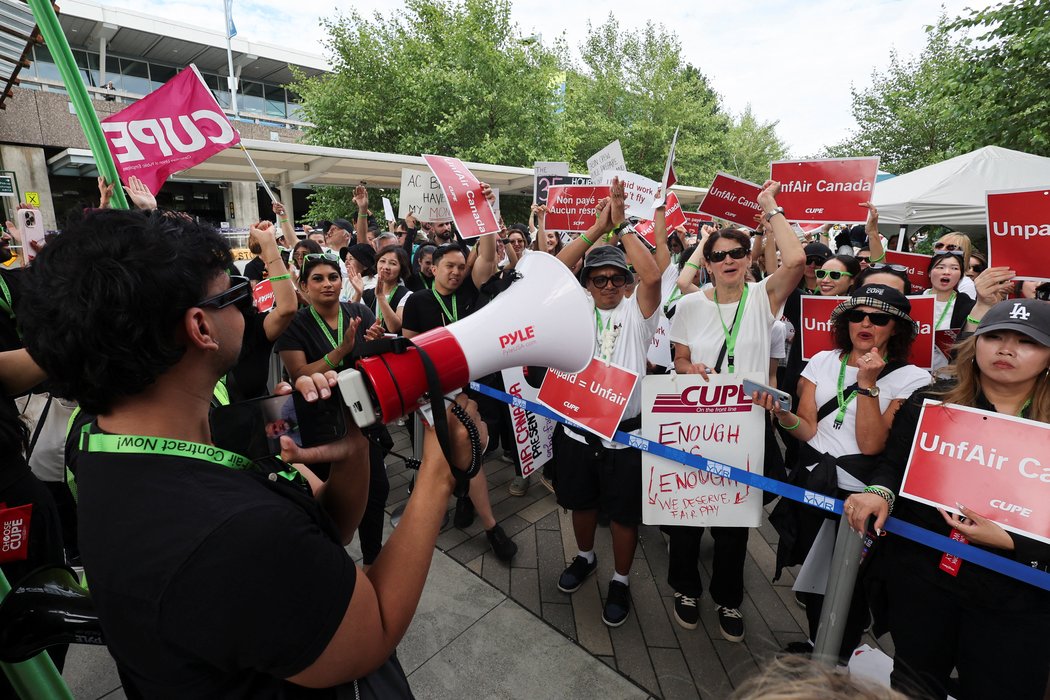
Air Canada flight attendants strike: Government asks Industrial Relations Board to impose binding arbitration, Union defies order
On 13th August 2025, the Air Canada component of the Canadian Union of Public Employees (CUPE) issued a 72-hour strike notice to Air Canada. The employees demanded a wage increase and “ground pay”, that is, compensation for the work done on the ground by flight attendants before boarding and after deplaning.
The strike began on 16th August 2025, involving some 10,000 flight attendants. The same day, the Canadian federal government, through its Minister of Jobs and Families, Patty Hajdu, invoked powers under section 107 of the Canada Labour Code to ask the industrial relations board to impose binding arbitration. On 18th August 2025, the Canada Industrial Relations Board (CIRB) declared the strike activity unlawful and ordered the CUPE to direct its members to return to work. The union defied the order from the CIRB, saying its members would remain on strike until Air Canada returned to the table to continue negotiating.
This provision of the Labour Code is being increasingly used to pre-empt strikes. According to the President of the Air Canada component of CUPE, “Section 107 has had a corrosive effect on the bargaining environment in recent years, and creates a fundamental imbalance in labour relations. Employers have stopped negotiating fairly because they know the federal government will intervene on their behalf”. The union asked a Federal Court judge to quash the minister’s decision and declare the power she invoked unconstitutional.
On 19th August 2025, a “tentative” deal was reached between the flight attendants and the airline and the strike ended. On 6th September 2025, flight attendants overwhelmingly rejected the company’s wage offer, saying that even with the proposed increase, they would still earn less than the federal minimum wage. Both parties also agreed that no labour disruption would be initiated.
Unions clash with government over labour rights
Canada’s labour movement entered September 2025 in confrontation with the federal government, as workers across multiple sectors took strike action and accused authorities of undermining their rights.
On 1st September 2025, thousands of workers from dozens of unions took part in Labour Day celebrations in Toronto and Ottawa. The unions denounced the repeated use of labour code to end strikes by the federal government that hurt their bargaining efforts.
On 2nd September 2025, public servant members of the British Columbia General Employees’ Union (BCGEU) went on strike. Pay remains the main issue of discord after months of negotiation. The strike lasted eight weeks, and throughout it, BCGEU members maintained essential services. On 18th September, members of the BCGEU said they were attacked with bear spray while picketing outside the Royal British Columbia Museum. A police investigation was opened. On 26th October 2025 a tentative agreement was reached with the help of mediators.
On 25th September, postal workers went on strike throughout Canada after the Canadian government announced widespread reforms to Canada Post that would shut some post offices and end door-to-door deliveries for many. On 10th October, the Canadian Union of Postal Workers (CUPW) shifted from a full national strike to rotating strikes, allowing limited services to resume while job action continued.
The strike occurred against the backdrop of a prolonged labour dispute over pay, benefits and job security. Postal workers had staged a weeks-long strike in late 2024, which ended after the government legislated employees back to work. Negotiations since then have failed to produce a new collective agreement. CUPW rejected a revised offer from Canada Post in early October 2025, citing proposed job cuts, weakened job security and workforce restructuring.
Strike Action Update: Shift to Rotating Strikeshttps://t.co/eETpZAI6R7#SupportCUPW #canlab #cdnpoli @CanadianLabour pic.twitter.com/jAt98gUAaU
— CUPW (@cupw) October 10, 2025
In late October 2025, approximately 51,000 teachers in Alberta remained on strike, entering a third week of industrial action after walking off the job on 6th October. The strike followed a June 2025 strike-authorisation vote, in which around 95 per cent of members of the Alberta Teachers’ Association (ATA)—the province’s main teachers’ union—supported job action. The walkout disrupted schooling for an estimated 750,000 students across roughly 2,500 public, Catholic and francophone schools.
Teachers have called for improved working conditions, including smaller class sizes, increased support for students with additional needs, and higher salaries. Their collective agreement with the provincial government expired in August 2024, after which teachers continued working under the previous contract for more than a year. Between 2019 and 2025, teachers’ salaries increased by 3.8 per cent, while inflation exceeded 20 per cent, resulting in a sustained decline in real wages.
The dispute has unfolded amid rising workloads and staff shortages. Student enrolment in Alberta increased by nearly 89,000 between 2019 and 2024, while the number of teachers remained largely unchanged. The provincial government, led by United Conservative Party (UCP) Premier Danielle Smith, rejected binding commitments on class-size limits and warned it could introduce back-to-work legislation if no agreement is reached before the provincial legislature reconvenes by the end of the month. In previous labour disputes, including a teachers’ strike in 2002, government intervention brought industrial action to an end.
On 27th October 2025, the Alberta teachers’ strike suddenly ended when the Legislative Assembly of Alberta passed the Back to School Act (Bill 2), ordering teachers back to work and imposing a collective agreement. The Act invoked the notwithstanding clause of the Canadian Charter of Rights and Freedoms (see General). The legislation also prohibited strike action until August 2028. The bill completed all legislative stages in a single evening, from first reading to final passage.
Pro-Palestinian protests met with arrests and heavy police presence
Across Canada, pro-Palestinian protesters demanding action on arms sales and accountability for Israel’s genocide in Gaza are facing arrests and aggressive policing. On 21st October 2025, around 100 pro-Palestinian protesters gathered in London, Ontario, a mid-sized city in south-western Canada, to protest outside a venue hosting a defence industry conference. Protesters surrounded the building and called on the Canadian government to suspend arms exports to Israel and other countries. The protest coincided with the opening of the Best Defence Conference.
In response, police deployed approximately 25 vehicles to the site. During the operation, officers forcibly restrained several protesters, with some reportedly wrestled to the ground. Police confirmed one arrest for alleged property damage. Authorities had not announced additional charges at the time of reporting.
“We are here to demand an arms embargo on Israel […], and it’s just unacceptable for these companies, these military programmes and these government [representatives] to think that they can continue to sell and profit from war crimes,” one protester said.
Earlier that month, on 9th October 2025, Toronto police arrested eight people following a pro-Palestinian protest at the constituency office of Liberal Member of Parliament Karim Bardeesy in the High Park area of Toronto, Canada’s largest city. Videos shared on social media showed protesters wearing keffiyehs and chanting slogans including “No justice, no peace.” Protesters called on the Liberal government to impose sanctions on Israel, introduce an arms embargo, and intensify efforts to secure the release of six Canadian nationals detained by Israeli authorities after participating in a recent aid flotilla to Gaza.
A staff member who was alone in the office moved to a separate room and contacted emergency services. Police escorted the staff member from the premises and instructed dozens of protesters to vacate the office. According to a police statement issued the following day, eight protesters did not comply and were arrested. Those arrested face four charges each: forcible entry, unlawful assembly, mischief and obstructing police. They are scheduled to appear in court in November 2025.
In a public statement, Bardeesy’s office said it recognised the right to peaceful protest, while stating that the incident disrupted constituency services and caused fear among staff. Foreign Affairs Minister Anita Anand said Canadian consular officials were engaged and could assist in facilitating processes with Israeli authorities.
In a separate incident, on 19th July 2025, more than a thousand people gathered for a pro-Palestinian protest organised by the Palestinian Youth Movement in Toronto, to demand the Canadian government act in defence of Palestinians. Toronto police alleged that officers issued several lawful orders for protesters to clear the roadway and remain on the sidewalk and that they intervened when protesters allegedly refused to comply. When officers attempted to disperse the crowd, tensions escalated and some protesters became aggressive. Eleven protesters were arrested and charged with various offences, such as obstructing or assaulting a peace officer.
Peaceful protests without disruptions were also recorded. For example, on 12th September 2025, around 400 people gathered near Citadel Hill National Historic Site in Halifax, Nova Scotia, for a rally organised by Palestine Solidarity Halifax, a local advocacy group. Organisers stated that nearly 1,000 people had signed a petition calling for Israel’s suspension from the Davis Cup. Following the rally, protesters marched peacefully through downtown Halifax, stopped outside the Scotiabank Centre, and later held speeches at Halifax City Hall. Organisers announced further demonstrations for the following day.
The protest coincided with Canada’s Davis Cup tennis tie against Israel, which took place at the Scotiabank Centre under closed-door conditions. Tennis Canada, the national governing body for the sport, announced that spectators and media would be excluded, citing safety concerns identified by local authorities and security agencies. The matches were held in an empty arena, attended only by players, team staff and officials. The decision departed from standard practice for international sporting events and followed heightened public attention surrounding Israel’s participation in the tournament.
During the march, participants carried Palestinian flags and placards bearing slogans including “Don’t Play Ball” and “No Sportswashing Israel,” a term used by activists to criticise the use of sporting events to enhance a state’s international image. Police monitored the demonstration, which caused traffic disruptions but was reported as peaceful.
Irritant gas sprayed at Rad Pride participants
On 9th August 2025, a “Rad Pride” was organised in Montreal to celebrate the LGBTQI+ community and to express opposition to corporations and police involvement in Pride events. During the march, demonstrators threw fireworks and other unspecified objects at police officers. The police used irritant gas on demonstrators. There were no arrests by the police and no reported injuries.
Pride Parade shortly cancelled
On 24th August 2025, pro-Palestinian protesters, including members of the Queers for Palestine, rallied and tried to block the route of the Capital Pride Parade in Ottawa to call on Capital Pride to be transparent about its pro-Palestine support. They demanded that the Capital Pride recommit to a boycott of Israel as well as apologies from the mayor and authorities who had boycotted the Pride the year before. The protest caused the cancellation of the entire Capital Pride Parade.
Solidarity rally with Muslim woman victim of Islamophobia
On 15th August 2025, a rally took place at the OC Transpo Innovation Drive Park & Ride in Ottawa to show solidarity with a Muslim woman who was attacked on a bus the week before. A man approached a Muslim teenager wearing a hijab, uttered Islamophobic slurs, and slapped the teenager while they were on board.
“Draw the Line” protests across multiple cities
On 20th September 2025, tens of thousands of people participated in the “Draw the Line” protest, organised by a coalition of organisations representing movements for migrant justice, economic justice, Indigenous rights, anti-war activism, and climate justice. They took place in Toronto, Saint John, Calgary, and many other cities. The protests demanded the Liberal government prioritise the climate, Indigenous rights, migrants and workers ahead of the fall budget and to show their opposition to Prime Minister Carney’s current agenda.
Encampment in front of Hamilton City Hall to demand housing solutions
On 3rd September 2025, law enforcement officers in Hamilton, Ontario, followed up on earlier trespass notices and instructed protesters to clear their belongings from City Hall Peace Park, a public space adjacent to Hamilton City Hall. The action targeted unhoused people and their supporters who had been occupying the site for 100 days.
The occupation began on 26th May 2025, when unhoused residents and their supporters protested outside City Hall to demand that the municipal council meet with them to discuss the clearing of encampments and the lack of adequate housing alternatives. Protesters installed tents in the park and maintained a continuous presence at the site.
On 4th July 2025, a city spokesperson stated that authorities had issued approximately 60 trespass notices and that police officers asked protesters to leave the area. Despite these measures, the encampment remained in place until the renewed enforcement action in September. The dispute followed a policy shift in March 2025, when the City of Hamilton began clearing encampments from public property after repealing a protocol that had previously allowed them under certain conditions.
Association
First Nations and environmental groups are challenging restrictive laws Bill C-5 and Bill 5
In June 2025, the Ontario Parliament and the federal Parliament both adopted legislation trampling on Indigenous groups’ rights. On 4th June 2025, after being fast-tracked and disregarding the free, prior and informed consent of Indigenous peoples, Ontario adopted Bill 5, an omnibus legislation intended to reduce regulatory processes across major infrastructure, mining, and resource projects. On 26th June 2025, the Parliament of Canada adopted Bill C-5, which contains the Building Canada Act. The Act allows the government to bypass several pieces of environmental and municipal legislation in “special economic zones” designated by the province. It had met strong opposition from Indigenous organisations, who accused the government of “bulldozing” their rights, and from environmental organisations.
On 15th July 2025, nine First Nations in Ontario launched a legal action against Bill 5 and Bill C-5. The constitutional challenge filed in the Ontario Superior Court of Justice seeks an injunction prohibiting Ottawa from selecting national interest projects under Bill C-5 and barring Ontario from implementing special economic zones under Bill 5. The First Nations allege that unchecked, fast-tracked development which is not subject to laws and regulations, and which excludes consultation with First Nations violates the Canadian Constitution. On 11th September, the Québec Centre for the Environment filed an application with the Superior Court of Québec to challenge the validity of Bill C-5, arguing that it grants excessive powers to the federal government and circumvents environment laws.
On 19th July 2025, during a meeting with Prime Minister Mark Carney, a group of First Nations youth staged a protest and several First Nations leaders walked out. Carney promised hundreds of assembled First Nations delegates that the communities would be consulted and that the new infrastructure would enrich them. Some expressed cautious optimism while others expressed disappointment.
On 10th September 2025, CBC News revealed that Prime Minister Carney had unveiled a list of five "nation-building" projects sent to the newly-created Major Projects Office (MPO). The first project on the list is the second phase of LNG Canada in Kitimat, British Columbia, to double the production of liquefied natural gas. LNG Canada is a joint venture between Shell, Petronas, PetroChina, Mitsubishi Corporation and KOGAS. Environmental rights defenders denounced this prioritisation and demand that the health and environmental trade-offs be assessed before pushing for further development. Amnesty International Canada notes that the promotion of this project was made without obtaining the free, prior and informed consent of multiple Indigenous Nations affected by the plan.
CSOs complain that investigation into surveillance and differential treatment of pro-Palestinian protests by the Vancouver Police Department is flawed
On 18th September 2025, several civil society organisations expressed concern over the handling of complaints against the Vancouver Police Department (VPD) related to the policing of Palestine solidarity protests. Pivot Legal Society, the British Columbia Civil Liberties Association (BCCLA), West Coast LEAF, and the South Asian Law Clinic of British Columbia criticised a review that found no wrongdoing by police, arguing that it failed to adequately address patterns of surveillance and “systemic racism embedded in BC’s policing and oversight”.
The complaints were reviewed by a former VPD Deputy Chief Constable, who concluded that the VPD had not breached its internal regulations and had not applied different criteria when policing protests in support of Palestinian human rights compared to other demonstrations.
The civil society organisations stated that the review did not explain why fewer than 5 per cent of Palestine solidarity demonstrations in 2024 resulted in recorded legal violations, while more than 68 per cent of all police surveillance drone deployments at protests in the same year targeted Palestine solidarity actions. They argued that this disparity raised unresolved questions about discriminatory surveillance practices and the proportionality of policing measures.
The complaints were originally filed in September 2024 under the British Columbia Police Act, alleging excessive use of force, as well as the targeting and surveillance of individuals expressing support for Palestinian human rights. The complainants alleged that VPD policing was biased and that protesters were subjected to overt surveillance.
In response to the review’s findings, the organisations called on the Office of the Police Complaint Commissioner, an independent oversight body, to review the decision of the Vancouver Police Board.
Expression
Intimidation of reporter through exposure and spoofing
Journalist Carrie Tait has been reporting on alleged political interference at Alberta Health Services (AHS) and the dismissal lawsuit filed in February by its former CEO, Athana Mentzelopoulos. In July 2025, an X account was launched, promising it would “start exposing Carrie Tait’s sources in the continuing health care saga”. The account started publishing pictures of the reporter in different settings and the other women who appeared in the pictures started receiving threatening text messages.
World Press Freedom Canada condemned the surreptitious campaign of intimidation waged against Globe and Mail reporter Carrie Tait.
Targeting a journalist for simply doing their job is a cowardly act that endangers not only the reporter, but also the vital public interest work that journalism represents. Carrie Tait should be saluted for her work — not spoofed or surveilled.
- Canadian Association of Journalists.
Cancellations of evangelical singer tour
Sean Feucht is a provocative U.S. evangelical singer who has expressed anti-diversity, anti-2SLGBTQ+ and anti-women's rights views. He was supposed to perform in various Canadian cities in the summer of 2025. But eight cities either refused to grant permits or revoked them, citing, for example, complaints from residents and planned protests that raised concerns about public safety. Some cities were pushed by their local LGBTQ communities, who urged the authorities “to consider the broader implications of platforming an individual whose rhetoric has repeatedly targeted the 2SLGBTQIA+ community”.
On 25th July 2025, an evangelical church in Montreal allowed Feucht to perform over the objections of the city administration, and was fined $2,500. The Réseau évangélique du Québec said the event should not have required a permit because it was part of a religious gathering. Some politicians denounced an assault on freedom to worship and experts warned that cancelling shows based on their (future) content violates the right to free expression.
Alberta school libraries book ban
On 4th July 2025, Alberta’s Ministry of Education issued a ministerial order (#030/2025) directing school libraries to remove books that contain “explicit sexual content” (the decree is not available any more on the official webpage of the province). The order is the result of lobbying by socially conservative “parents’ rights” groups in the province.
The order was criticised and many voices asked for it to be rescinded. The executive director at the Canadian Civil Liberties Association described it as book banning and textbook censorship. The Canadian Children’s Book Centre noted that “this sweeping and vague ministerial order risks the removal of many diverse and inclusive books and disproportionately targets 2SLGBTQIA+ stories”.
The Edmonton’s public school board put together a list of more than 200 titles it was going to take out, including many classics like Margaret Atwood’s The Handmaid’s Tale, Maya Angelou’s “I Know Why the Caged Bird Sings” and F. Scott Fitzgerald’s “The Great Gatsby”.
Amid all these criticisms, the ministerial order was put on pause. The Alberta Teachers Association complained about these “playing games” as the deadline for removing the books was approaching and urged the government put a stop to policing school library materials.
On 8th September 2025, the Minister of Education issued a revised decree (#034/2025), repealing the previous one. The new ministerial order removes "written passage" and narrows the scope to focus strictly on explicit visual depictions of a sexual act. Critics such as the director of the Centre for Free Expression still denounced that the appropriateness of books in schools will not be determined by educators using their best professional judgment but by politicians.
Other developments
First Nations win back land in Canada’s courts
On 28th August 2025, the Supreme Court of Canada dismissed an appeal against the judgment of the Court of Appeal, which held that the Saugeen First Nation’s reserve was wrongly surveyed and reduced in size, contrary to commitments made under Treaty 72 of 1854. As a result of the error, the Saugeen First Nation lost approximately 1.4 miles of shoreline along Lake Huron. The municipality of South Bruce Peninsula and several private landowners, who had challenged the ruling, must now return the affected stretch of shoreline to the Saugeen First Nation.
In a separate decision, on 7th August 2025, the Supreme Court of British Columbia delivered its long-awaited judgment in Cowichan Tribes v Canada (Attorney General), 2025 BCSC 1490, recognising that the historical descendants of the Cowichan people, an Indigenous nation on Canada’s west coast, hold Aboriginal title to portions of their traditional village lands, Tl’uqtinus, located on the south shore of Lulu Island within the City of Richmond, near Vancouver.
The Court found that the Cowichan had established sufficient, exclusive and pre-sovereignty occupation as of 1846, in line with the test set out in Delgamuukw and Tsilhqot’in. It also affirmed an Aboriginal right to fish for food in the south arm of the Fraser River. The recognised title lands include areas subject to federal, provincial and municipal fee simple grants, as well as privately held interests. The Court also held that most Crown grants of fee simple interests in the Cowichan Title Lands constituted unjustified infringements of Aboriginal title and were issued without valid statutory or constitutional authority.
It characterised Aboriginal title as a prior and constitutionally protected interest under section 35 of the Constitution Act, 1982, which burdens later-created fee simple estates rather than yielding to them. On this basis, the Court declared the majority of Canada’s and the City of Richmond’s fee simple interests to be defective and legally invalid, while suspending the declaration for 18 months to allow the parties to negotiate an orderly transition consistent with the honour of the Crown.
According to First Peoples Law, a law firm dedicated to defending and advancing the rights of Indigenous Peoples, the judgment addresses a long-standing uncertainty in Canadian law concerning the relationship between Aboriginal title and privately held land:
[…] The decision clarifies the Crown can no longer avoid addressing the messy consequences which flow from the granting of fee simple interests on lands which are subject to Aboriginal title. Instead, the Crown has a duty to honourably negotiate with Indigenous peoples to recognise and implement Aboriginal title, including on lands subject to third-party interests. As the Court recognised in Cowichan Tribes, Indigenous peoples should not be expected to forgo their rights to their homelands in the name of reconciliation. When Indigenous groups have been unlawfully dispossessed of their Aboriginal title lands, justice requires more than compensation and damages. Ultimately, justice – and certainty – may only be achieved through the return of land itself.
-
Shortly after the judgment, both the federal and British Columbia provincial governments appealed the decision. If upheld, the ruling could have significant implications for the Canadian land title system, clarifying that privately held land may remain subject to Aboriginal title. The outcome of the appeals is likely to influence future interpretations of Crown authority, Indigenous land rights, and the legal foundations of land tenure in British Columbia.
In this episode of Canadian Justice, I interview professor Dwight Newman and lawyer Tom Isaac about the recent decisions in Cowichan Tribes v Canada.
— Christine Van Geyn (@cvangeyn) October 27, 2025
The BC trial court issued a groundbreaking decision and found that the Cowichan had successfully proved that they hold… pic.twitter.com/RpwqOUTiS3
Supreme Court rules that offences related to sex work are constitutional
On 24th July 2025, the Supreme Court of Canada unanimously ruled in R. v. Roublakov that two parts of Canada’s sex work criminalisation scheme were constitutional. The case evolved around two men who worked as drivers for sex workers in Calgary. A court found them guilty of benefiting financially from prostitution and being parties to procuring women into the sex trade. They challenged the constitutionality of laws criminalising people who work with sex workers in non-exploitative situations.
The British Columbia Civil Liberties Association was of the opinion that the legislation restricts sex workers from assessing and addressing their protected safety needs and subjects sex workers to an untenable choice: work alone in possible dangerous conditions, or choose to work with others for their own safety and risk criminalisation.
The Supreme Court had rejected the intervention of the Canadian Alliance for Sex Work Law, a national coalition of 23 sex worker organisations, as well as interventions submitted by the Migrant Workers Alliance for Change, the Canadian Association of Refugee Lawyers, and Pivot Legal Society. These organisations expressed their disappointment at the decision.
The decision was purposefully limited as there is an ongoing challenge launched by the Canadian Alliance for Sex Work Law Reform (CASWLR) against the Protection of Communities and Exploited Persons Act provisions before the Ontario Superior Court of Justice. That challenge was on hold pending the Supreme Court’s decision in Kloubakov and is thus expected to resume.
Canada’s largest private sector union endorses call for an arms embargo on Israel
During its Constitutional Convention in August 2025 in Vancouver, UNIFOR, Canada’s largest private sector union, adopted a resolution in support of the Palestinian Trade Unions and Palestinian workers affected by the genocide and endorsing the call by Palestinian trade unions for an arms embargo on Israel.