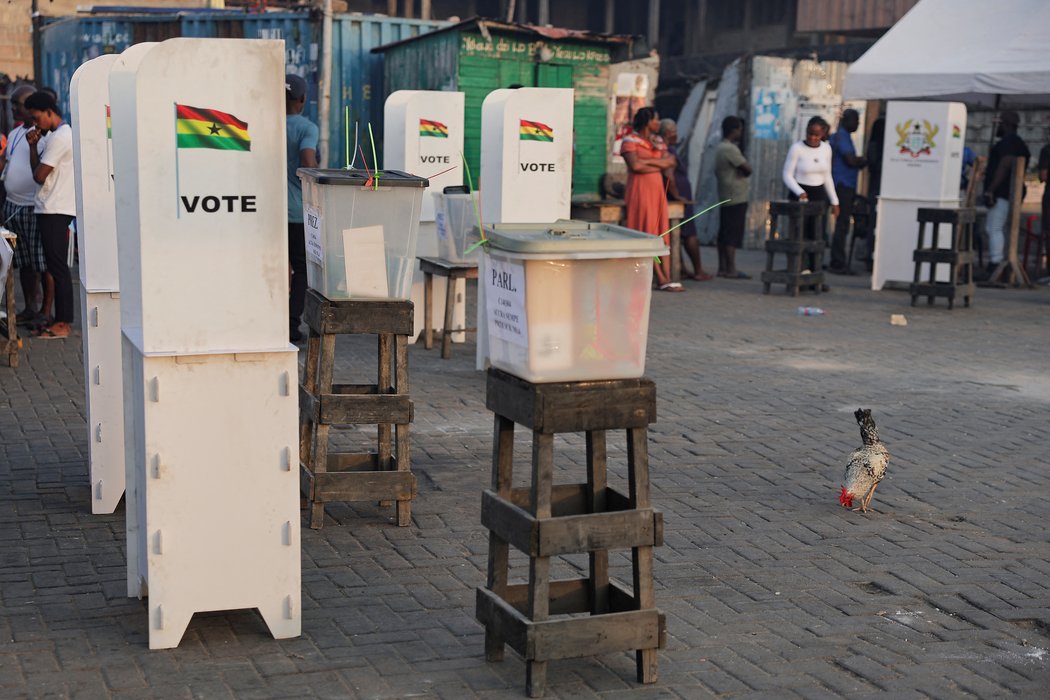
Election day has arrived in Ghana, where close to 19 million voters are registered to cast their ballots.
— BBC News Africa (@BBCAfrica) December 7, 2024
A debt crisis and high living costs mean the economy is uppermost in the minds of many voters.#Election2024 #GhanaPolls2024 #GhanaDecides2024 https://t.co/0LqKj5S5HQ pic.twitter.com/PXkk84hVla
General
Ghanaians go to the polls to elect president and parliamentarians
On 7th December 2024, Ghanaians went to the polls to elect a new president and 276 members of Parliament. The elections took place amid a difficult socioeconomic situation in the country, including high inflation and sovereign debt default, as well as low public trust in institutions and increasing polarisation.
President Nana Akufo-Addo, who ruled for two terms from 2017 to 2024, could not be considered as a candidate in the 7th December elections, as he had already completed a consecutive two-terms, which is the constitutional limit. On 9th December 2024, John Dramani Mahama from the opposition National Democratic Congress (NDC), the country's previous president from 2012 to 2017, was declared the new president, garnering 56,55% of the votes. His main rival, Mahamudu Bawumia of the ruling New Patriotic Party (NPP) conceded defeat a day earlier.
Documented incidents of violence in the post-election period
A number of incidents of violence and voting irregularities were documented during the electoral period. At the Okaikwei North collation centre in the Greater Accra region, for example, supporters of NDC and NPP alleged instances of vote rigging for the parliamentary candidates. Supporters gathered to voice their concerns over the allegations and the police used pepper spray to disperse the crowd. Two electoral officers present at the centre lost consciousness from the pepper spray and were taken to hospital.
There were also a number of documented incidents of looting, violent attacks, and destruction of state properties across the country 72 hours after polls closed. Affected areas of post-election violence included Damongo, Tamale, Sunyani, Ayensuano, Nsawam Adoagyiri and Tepa, among others. The police, in collaboration with the military, worked to restore peace and stability in the affected areas. In total, police arrested 107 suspects in the post-election attacks, and 76 separate incidents were recorded in relation to the elections, including 46 injuries, 24 cases of destruction, vandalism, and invasion of public facilities, and six deaths.
Party supporters disrupt collation process at electoral commission
On 17th January 2025, about 40 individuals, suspected to be affiliated with the NDC, disrupted the Greater Accra regional office of the Electoral Commission (EC) by vandalising office property. According to a statement signed by Samuel Tettey, Deputy Chairman of the EC, the supporters were led by Anthony Nukpenu, the NDC regional organiser. They vandalised the EC's office property and forced staff and media personnel to vacate the premises ahead of the planned re-collection of parliamentary results for the disputed Ablekuma north constituency. The EC halted the collation of the votes due to the disturbances.
On 24th December 2024, the EC had released a statement identifying nine constituencies where the collation of electoral results had been interrupted, preventing the EC from declaring winners. Subsequently, the collation process was moved to Greater Accra, and after a long process, eight out of the nine constituencies were finalised, with Ablekuma being the only one outstanding. Efforts to resume the collation process are on hold until a secure environment is guaranteed.
Expression
Disinformation prevalent in run-up to 7th December elections
The Media Foundation for West Africa conducted monitoring and fact-checking of the information space in Ghana, leading up to the 7th December 2024 presidential and parliamentary elections. The monitors found instances of disinformation circulated on social media, with political actors and state institutions being the most-frequently targeted. Moreover, social media was found to be the most prevalent source of distributing disinformation to the public.
Attacks on journalists covering illegal mining
On 20th December 2024, armed men attacked Joy News journalist Ohemeng Tawiah and camera operator Joseph Kusi, while they were reporting on an illegal mining site in Ashanti region, northern Ghana. In a separate incident on 21st February 2025, Akwasi Agyei Annim, Citi FM’s western regional correspondent, along with Henry Emil Fynn of Angel TV and Jacob Adu-Baah of ABC News GH/Rok FM, were violently attacked while covering illegal mining activities in the Adomanya Forest within the Wassa Amenfi West District of the Western Region. The miners, led by Daniel Baidoo, a member of the family that sold the land for the mining, assaulted the journalists, attempting to confiscate their equipment. Police arrested Baidoo on the same day of the assault, and on 26th March 2025, the Asankragwa District Court convicted and sentenced him to one year in prison with hard labour. He was also fined 300 penalty units, equivalent to Gh¢3,600.00.
The Ghana Journalists Association condemned the attack on the journalists and urged the government to prioritise the safety of journalists and ensure their unrestricted access to report on issues of public interest.
Military officers assault two journalists in Walewale
On 13th February 2025, military personnel assaulted two journalists, Alhassan Dokurugu of Asaase radio and Tahiru Ibrahim of Zaa Multimedia, in Walewale, West Mamprusi Municipality in northeastern Ghana. The journalists were covering an arson attack on a passenger bus. When they arrived at the scene of the incident, they saw military officers violently assaulting civilians, including bystanders and travellers. As they tried to flee the scene, they were stopped and questioned by some of the soldiers. The first and second groups of soldiers who stopped to question them allowed them free passage. However, a third group of military officers at Nalerigu Junction stopped them, and even though the journalists identified themselves as such, they were assaulted, along with other bystanders. The military also brutalised them with cables and hard objects. The two journalists obtained police medical reports and received treatment for their injuries.
The Northern Region branch of the Ghana Journalists Association condemned the assaults on the two journalists at Walewale. And the Media Foundation for West Africa criticised the military officers for attacking journalists while they were attempting to report.