Introduction
Threats to expand lawsuit seeking to ban opposition parties as new alliance formed
As previously reported, the Georgian Dream administration is continuing to act on its pre-election promises to punish the previous United National Movement (UNM) government and all those deemed affiliated with it. To this end, Georgian Dream is using the findings of a controversial parliamentary commission that a number of opposition leaders were jailed for refusing to cooperate with to petition the Constitutional Court to outlaw the UNM and two other parties deemed its satellites. In parallel, a law was passed to ban individuals affiliated with banned parties from standing in elections or holding public office.
On 2nd March 2026, nine opposition parties including UNM announced the formation of a new alliance, agreeing on a common strategy to remove the ruling party from power. On 9th March, Prime Minister Irakli Kobakhidze announced that the ruling party may amend its appeal to the Constitutional Court to include all the parties in the alliance. According to Civil.ge, Kobakhidze said “Some parties may be added [to the appeal], given that they have jointly expressed their position on ongoing developments,” adding “the list in the constitutional lawsuit could be updated, and all relevant parties might be included.”
Aside from the petition to the Constitutional Court, eight opposition leaders face serious criminal charges threatening up to 15 years in prison for alleged crimes against the state.
Opposition leader jailed for vandalising ruling party’s election poster
In March, a Tbilisi court sentenced opposition leader Elene Khoshtaria of the Droa! party to 1.5 years’ imprisonment for property damage.
Khoshtaria was detained on 15th September 2025 for writing “Russian Dream” on campaign banners promoting Georgian Dream candidate for mayor Kakha Kaladze ahead of the local elections. She was subsequently remanded to pre-trial detention and charged with “damaging or destroying another person’s property which has resulted in substantial damage.” Handing down the verdict on 24th March, the court accepted prosecutors’ claims that she was responsible for financial damage amounting to 570 GEL (around 200 USD) after vandalising three campaign banners.
Khoshtaria said her action was a gesture of solidarity with activist Megi Diasamidze, a student facing similar charges for political graffiti who had been detained days earlier. In protest, Khoshtaria chose not to attend the hearings and was represented by a public defender. She was also granted bail but refused to post it.
In November 2025, the state prosecutor’s office announced they would pursue criminal charges against eight opposition leaders over “crimes committed against the state.” Khoshtaria was one of the opposition leaders targeted, and has been charged under articles concerning sabotage, providing material resources for sabotage, and aiding a foreign country in hostile activities, which are punishable by 7 to 15 years in prison.
The case against Khoshtaria has been widely criticised as politically motivated and part of a broader crackdown on dissent. Responding to the verdict, Amnesty International’s Eastern Europe and Central Asia Deputy Director Denis Krivosheev said: “In Elene Khoshtaria’s case, the severity of the punishment appears related not to material damage, but to her political opinions and the symbolic damage she has inflicted on the ruling party. The authorities must immediately release her, review her sentence, in particular by quashing the prison term, and end all politically motivated trials without delay.” The European Parliament described her as a political prisoner and called for her release in a resolution adopted on 12th March.
Freedom of association
Even more restrictive laws adopted
Georgian authorities continue to tighten restrictions on funding for civil society and media, subjecting them to administrative harassment and threatening their survival. As previously reported, after adopting a “foreign agents” law in 2024 in spite of mass outcry, a further such law was passed in April 2025, a direct translation of the US Foreign Agents Registration Act, which extends to individuals and imposes criminal liability for non-compliance. Other new restrictions introduced in 2025 include a ban on broadcasters receiving funding from “foreign powers” and requirements for CSOs to secure government approval before accepting foreign grants.
On 28th January 2026, the ruling Georgian Dream party announced another package of legislative amendments aimed at imposing further restrictions on recipients of foreign funding. The amendments were passed in the third and final reading on 4th March 2026, with the President signing them into law on the same day.
As part of the changes, the definition of “foreign grants” has been radically expanded. A “foreign grant” now encompasses any funding or material support received from abroad deemed intended to “exert influence” over public policy. The definition of “foreign donors” has also been expanded to include private individuals, without setting a minimum threshold, meaning even minor financial contributions from foreign citizens could trigger criminal liability, with failing to obtain approval for foreign grants being punishable by six years in prison.
Other amendments passed in the same session introduced criminal liability for “extremism against the constitutional order”, threatening imprisonment for anyone aiming to “establish the perception” that Georgian authorities are illegitimate—a provision widely understood as targeting criticism of the October 2024 parliamentary elections.
Also included in the legal package were provisions imposing an eight-year ban on political party membership for anyone previously employed by an organisation representing “foreign interests,” essentially excluding anyone with a background in foreign-funded civil society or media from participating in political life.
Human rights watchdogs have warned that the legislative proposals represent an extension of authoritarian practices and an attempt to reduce the independence of civil society, eroding fundamental rights of association and expression. In a statement from February 2026 urging Georgian authorities to abandon the then-draft amendments to the Law on Grants, Amnesty International described them as “highly damaging” and emblematic of “Georgia’s further expansion of authoritarian practices to silence and criminalize dissent and entrench power.” Alongside Georgian civil society organisations, others who have criticised the amendments and warned against their adoption include Human Rights Watch, the Committee to Protect Journalists, the Observatory for the Protection of Human Rights Defenders and the Council of Europe Commissioner for Human Rights.
Former Ombudsman summoned by the security service for contributing to human rights report
On 17th March, Georgia's former Public Defender (Ombudsman) Ucha Nanuashvili reported that he had been summoned by the State Security Service over his communication with an expert involved in the Organisation for Security and Cooperation in Europe’s (OSCE) Moscow Mechanism, days after the publication of a critical report on the country.
Nanuashvili published a post on Facebook revealing he had been contacted by the security service after his name was brought up in a TV interview, and questioned whether engaging with international human rights mechanisms had effectively been criminalised.
The Moscow Mechanism is an OSCE instrument which enables the organisation to address human rights concerns in participating states through deploying expert missions. It allows for the investigation of serious human rights violations, even without the consent of the involved state, to facilitate fact-finding and accountability for violations. The report, drafted by an OSCE expert who undertook a mission to the country in February, was released on 12th March and found “marked democratic backsliding” in Georgia since spring 2024. The conclusions called for the release of political prisoners and the repeal of a series of restrictive laws.
Officials of the ruling Georgian Dream party have dismissed the report as politically motivated and “pre-written,” accusing the rapporteur who authored it of political bias.
Freedom of peaceful assembly
Protests continue in Georgia in the first months of 2026
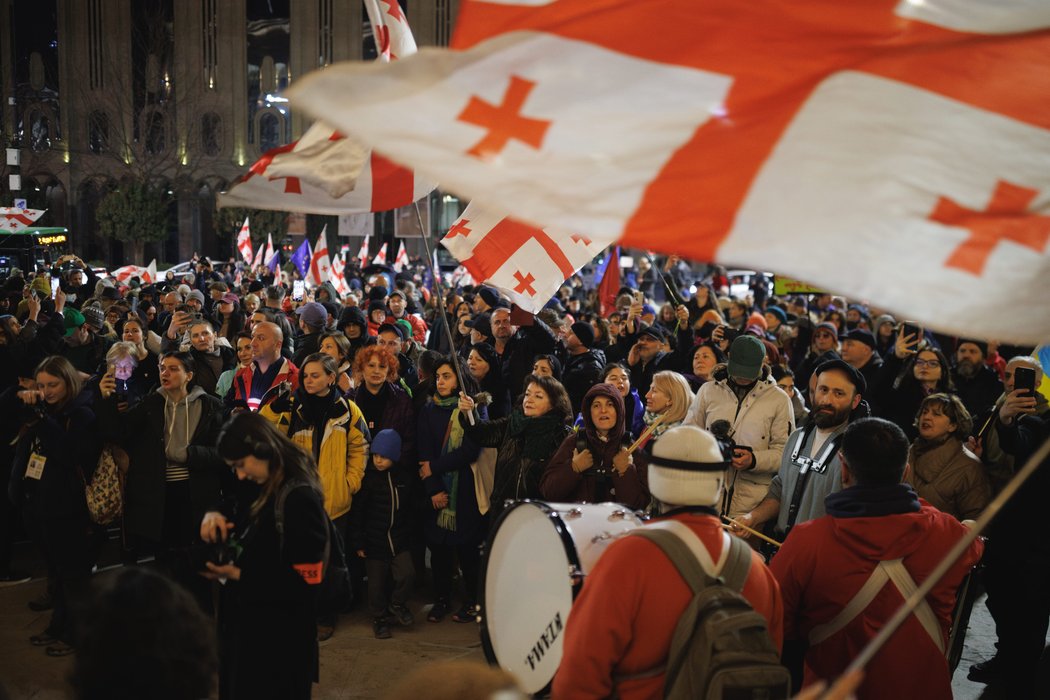
Beginning on 28th November 2024, the Georgian Dream administration’s decision to suspend EU accession negotiations until 2028 sparked mass protests across the country, which were met with violence. Daily protests continue in front of Parliament, with protesters targeted by detentions and fines under increasingly restrictive laws.
On 20th February, which marked the 450th day of continuous protests, the Tbilisi City Court sentenced three activists to administrative arrest, accused by police of blocking a road during a protest near parliament weeks before. Two protesters, Sopo Markozia and Lali Kekua, were sentenced to three days of administrative arrest, and a third, Mariam Chkhaidze, to two days.
Also in February, protests spread to universities, with students at Ilia State University (ISU) organising demonstrations and marches under slogans such as “Education to the End” and “Autonomy for Universities”. The mobilisation followed the publication of a government decree implementing sweeping higher education reforms first announced in October 2025, which introduced a “One City, One Faculty” model that would redistribute programmes across public universities.
Once specific faculty distribution and student quotas were published, it was clear that ISU was disproportionately affected, with student intake cut by 92% and most programmes eliminated. Students and faculty condemned the reforms as rushed and being implemented without adequate consultation, warning that they undermine academic freedom and contradict the government’s stated goals.
Many critics view the measures as politically motivated, citing ISU’s reputation as a centre of dissent and its critical stance towards the authorities, which has further fuelled protests demanding the reforms be reversed.
Public Defender files constitutional lawsuit over protest restrictions
In January 2026, Georgia’s Public Defender filed a lawsuit with the Constitutional Court challenging a series of protest-related restrictions and penalties adopted in 2025 during ongoing anti-government demonstrations.
The complaint targets provisions in the Law on Assemblies and Demonstrations, as well as amendments to the Administrative Offences Code and Criminal Code, arguing that they impose disproportionate limitations on the right to protest. The statement published by the Public Defender’s office emphasised that the lawsuit specifically challenges measures such as the blanket ban on face coverings, the severity of the fines and mandatory detention, and the introduction of criminal liability for repeat administrative offences, which can result in prison sentences of up to one year.
According to the media, the complaint is widely seen as unlikely to result in the repeal of the challenged provisions, as the Constitutional Court is seen as lacking in independence and vulnerable to government influence.
Harsh prison sentences handed down over miners’ protest
On 20th January 2026, four protesters from the mining town of Chiatura were sentenced by the Kutaisi City Court to prison terms on charges linked to a confrontation with the director of the Shukruti mine during labour protests in April 2025. Two defendants, Giorgi Neparidze and Merab Saralidze, were sentenced to six years and three months in prison for “organising group violence”, while two others, Archil Chumburidze and Tengiz Gvelesiani, were sentenced to four years and three months for “participating in group violence”.
The incident occurred amid a major strike in Chiatura with protesters demanding improved working conditions. As other participants of the strike reported at the time, the director of the mine, Tengiz Koberidze, had insulted protest participants, calling them a “herd of cattle”, which triggered a scuffle with the miners.
All four had been held in pretrial detention since their arrest on 29th April. The defence argued that the case relied solely on witness testimony, with no video or photographic evidence, and raised concerns over political interference, citing public statements by Prime Minister Irakli Kobakhidze, who had referred to the defendants as “criminals” before they were sentenced. The defendants and their supporters maintain that the charges are retaliation for their prominent roles in sustained labour protests against the mining company Georgian Manganese, which has faced long-standing criticism over working conditions and the environmental damage caused by its operations.
Bank account freezes over unpaid protest fines
In February 2026, OC Media reported that at least 12 protesters had their bank accounts seized over unpaid fines linked to administrative offences allegedly committed during demonstrations, many of which dated back to early 2025 and had allegedly not been properly communicated.
Several affected individuals said they only became aware of the fines after receiving notifications of account seizures, despite some cases being under appeal or never reaching court. On top of the 5,000 GEL (around 1,800 USD) fine imposed for each, those affected are liable to pay additional 350 GEL (around 130 USD) penalties for late payment.
One demonstrator interviewed by OC Media, Saba Japharidze, reported having received five fines in total dating back to February and March 2025, and claims all were appealed in court but that the trials had never taken place. He announced his intention to file another appeal to halt the seizure of his accounts.
As previously reported, since the outbreak of mass protests in 2024, Georgian authorities have repeatedly increased penalties for protest-related offences, with fines being increased tenfold for common protest actions such as blocking roads or covering one’s face. Amendments introduced in October 2025 further increased sanctions, replacing fines with immediate administrative detention and foreseeing criminal liability for repeat offences.
Second person to face criminal charges for repeat protest offences
In March 2026, it was reported that anti-government protester Shalva Esartia had become the second person to face criminal sanctions of up to one year in prison under new restrictive laws. Arrested on 17th March while on his way to a demonstration, he was initially accused of a minor traffic violation, which was later escalated to “disobeying police orders” following a dispute with officers. Authorities subsequently upgraded the case to a criminal charge, citing his prior administrative penalties for similar offences in 2025, thereby exposing him to a possible one-year prison sentence.
As reported in the previous CIVICUS Monitor update, under amendments fast-tracked in October 2025, a wide range of common protest acts such as blocking the road, covering one’s face or disobeying police orders are now punishable with immediate administrative detention instead of a fine. Repeat offences trigger criminal liability, punishable by up to one year in prison, and subsequent repeat offences by up to two years.
The case follows an earlier prosecution in November 2025 of protester Zurab Menteshashvili, who was criminally charged for repeated offences of “artificially blocking the roadway”.
Opposition calls for accountability for alleged use of WWI chemical against protesters
In February 2026, several Georgian opposition parties announced an initiative to collect data on alleged cases of chemical poisoning among protesters during demonstrations. In a joint statement, parties including the United National Movement and Droa! said they were gathering evidence using a questionnaire developed with Georgian experts and international organisations. They called on protest participants to share their experiences and any health effects linked to suspected chemical exposure. The parties stated that the findings would inform expert conclusions on the alleged use of chemical substances against protesters by security forces.
As previously reported, in December 2025, the BBC World Service published an investigation alleging that the Georgian government had used water cannon laced with a chemical weapon against protesters in November and December 2024. Drawing on a medical study, interviews with protesters as well as police whistleblowers, the BBC investigation found that protesters were likely targeted with “camite”, a chemical agent first used during World War One, leading to long-term health impacts.
On 15th January 2026, Parliament Speaker Shalva Papuashvili announced that Georgian Dream had filed a complaint with the BBC over its investigation. He said the party demanded the removal of the report and “a public and clear apology”, describing the claims asserted in the documentary as “grave and damaging” and alleging the government was not afforded sufficient time to respond. Papuashvili argued the report constituted a “false narrative” aimed at discrediting the government and warned that the complaint could escalate to the UK media regulator Ofcom and potentially the courts.
Freedom of expression
Press freedom continues to deteriorate, media threatened by administrative and economic pressures
A report by the Justice for Journalists Foundation, published in February 2026, recorded and analysed 250 cases of attacks and threats against media workers and editorial offices in Georgia in 2025. The report found that over 85% were carried out or facilitated by representatives of the authorities, while around 68% of incidents were legal or economic in nature (including administrative repression and financial sanctions). While the study found that the number of physical and non-physical attacks had decreased threefold compared to 2024, its findings highlight not only direct violence but also systemic pressure on journalists through legal and administrative mechanisms, warning that media freedom continued to deteriorate due to the adoption of restrictive laws and regulations affecting civic space.
In January 2026, the Centre for Media, Information and Social Research (CMIS) published data on administrative sanctions against journalists linked to reporting on protests since October 2024. As previously reported by the CIVICUS Monitor, authorities in Georgia have increased penalties for common protest-related activities through successive legal amendments since 2024, following the outbreak of mass anti-government protests, raising fines for blocking roads tenfold to up to 5,000 GEL (around 1,800 USD).
CMIS has recorded a number of cases in which provisions prohibiting blocking roads and obstructing traffic have been used to penalise journalists reporting from the scene of the protests, with numerous journalists incurring multiple penalties and thousands of dollars in fines. According to CMIS, between October 2024 and January 2026, 38 administrative penalty reports were issued against journalists: 36 on charges of “artificially blocking the roadway” and two for “violating traffic regulations”. Ten penalty reports have been annulled on appeal, while 19 cases remain pending and one is currently being challenged before the European Court of Human Rights.
As previously reported, these trends are part of a broader pattern of restrictions on media freedom and civil society in Georgia, where restrictions on foreign funding and protests as well as other repressive laws have severely affected the environment for independent journalism and NGOs.
Journalists face 15-day administrative detention for covering protests
Following amendments in October 2025, which increased penalties for protest-related offences by replacing fines with up to 15 days’ administrative detention, there have been reported cases of journalists facing detention for covering protests. Rulings are expected at the end of March 2026 in three cases, involving two journalists and a photographer who are facing charges of “artificially blocking the roadway” and “obstructing the movement of pedestrians”.
Tabula journalist Mariam Kuprava is accused of “artificially blocking the roadway” while covering a protest on 7th February, despite wearing press identification. Authorities argue that, at moments when she was not visibly filming, she acted as a protest participant rather than a journalist, and are seeking up to 15 days’ detention. Her defence counsel has argued that journalistic work includes observing and gathering information, not only recording footage. A ruling in her case is expected on 30th March 2026. Netgazeti journalist Mariam Dzidzaria faces the same charges, with a ruling expected on 27th March. Photographer Giorgi Tarkhnishvili is accused of “obstructing the movement of pedestrians” by standing on a pavement while covering a protest on 18th December 2025. His hearing is scheduled for the same day as Dzidzaria’s.
Broadcaster investigated over single overseas donation
In February 2026, Kavkasia TV, a broadcaster critical of the government, reported that it had been subjected to administrative proceedings after Georgia’s Communications Commission launched a case against it over a single donation received from the United States.
In a Facebook post, Nino Jangirashvili, the channel’s director, published a letter from the media regulator citing Georgia’s Law on Broadcasting, amended in 2025 to prohibit broadcasters from receiving funding from “foreign powers”. Jangirashvili stated that the broadcaster regularly solicits donations publicly and that the donation came from an individual with a Georgian name and surname whom she does not know. She described the regulator’s move as an attempt to intimidate the channel.
UK government sanctions Georgian TV channels
On 24th February 2026, the United Kingdom imposed sanctions on Georgian pro-government broadcasters Imedi TV and POSTV, citing their role in spreading disinformation about Russia’s full-scale invasion of Ukraine. The measures include asset freezes and restrictions on financial services, aimed at blocking any resources of these entities within the UK jurisdiction.
In the statement announcing the sanctions, the UK Government’s Foreign, Commonwealth and Development Office accuses the broadcasters of disseminating misleading narratives undermining Ukraine’s sovereignty, including content alleging “that the Ukrainian Government and President Zelensky are illegitimate, Ukraine is a “puppet” of the West, Ukraine is a corrupt country and that Ukraine and the West are seeking to destabilise Georgia”. The sanctions, part of a wider package targeting nearly 300 entities, were announced on the fourth anniversary of Russia’s full-scale invasion.
Both channels dismissed the sanctions: POSTV responded with a mocking social media post, while Imedi TV issued a statement denouncing the UK government’s assessment as meaningless and reaffirming its commitment to freedom of speech.