GENERAL
On 31st March 2025, Transparency International warned that Switzerland’s ongoing anti-money laundering reform risks leaving major loopholes that could undermine global anti-corruption efforts. The organisation criticised the current draft for not requiring independent verification of company ownership data and for excluding certain trusts from scrutiny, enabling the concealment of illicit funds. Transparency International urged lawmakers to close these gaps, resist lobbying pressure, and align with international standards, stressing that Switzerland’s credibility in combating financial crime depends on meaningful reform.
On 27th May 2025, a new popular initiative to hold businesses liable for human rights violations was formally submitted to the Federal Chancellery with over 287,000 signatures, nearly triple the number required to trigger a nationwide vote. Launched in January by a committee of politicians from all political camps, entrepreneurs and civil society representatives, the Responsible Business Initiative (RBI) seeks to hold Swiss companies and their subsidiaries accountable for human rights and environmental abuses at home and abroad. A similar proposal in 2020 won a popular majority but failed to gain the support of most cantons. Supporters say the initiative’s rapid success reflects strong public demand for stricter corporate accountability in accordance with international standards.
In May, Amnesty International Switzerland warned that a proposed revision of the Ordinance on the Surveillance of Postal and Telecommunications Correspondence (OSCPT) poses an “unprecedented” threat to privacy and fundamental freedoms. The organisation stated that the draft, currently under consultation, would enable mass surveillance by extending data identification and retention obligations to most communication providers, including encrypted platforms. Amnesty argued that the measure violates constitutional and international human rights standards, endangers confidentiality for journalists, lawyers, and activists, and undermines the rule of law. It urged the Federal Council to withdraw the proposal, emphasising that security must not override fundamental rights.
ASSOCIATION
Civil society condemns politicised US NGO questionnaire
In March 2025, Geneva-based international organisations and non-governmental organisations (NGOs) received a questionnaire from the Trump administration assessing the “relevance” of their activities and their future eligibility for US funding. Among other things, the questionnaire asked NGOs to confirm that they did not collaborate with entities espousing “anti-American beliefs”, that their projects were unrelated to climate or environmental justice, and that they “took appropriate measures [...] to defend against gender ideology”.
NGO leaders, including Phil Lynch of the International Service for Human Rights, condemned the questionnaire as coercive and politically motivated. Amnesty International also expressed concern over attempts to pressure organisations into altering principles of cooperation. The move came amid major US aid cuts, with the UN migration agency (IOM) announcing a 20% staff reduction at its Geneva headquarters due to the loss of US funding.
FDFA partially retracts false allegations against a Palestinian NGO
In April 2025, Switzerland’s Federal Department of Foreign Affairs (FDFA) partially retracted its earlier claims that it had terminated its contract with the Palestinian policy network Al-Shabaka as part of its investigation into 11 Israeli and Palestinian CSOs launched after 7th October 2023. According to Al-Shabaka, the organisation was informed in mid-October 2023 that its partnership with the FDFA would not be renewed in 2024, a decision that, they were told, predated the Hamas attacks and was instead related to shifting donor priorities.
Despite this, the FDFA and the Swiss foreign minister issued several public statements in the following months asserting that they had ended their agreement with Al-Shabaka and other Palestinian organisations due to statements allegedly amounting to “apologies for violence”. Al-Shabaka described these accusations as “remarkably dangerous”, warning that they not only damaged the organisation’s institutional reputation but also endangered individual staff members. Although the FDFA reportedly acknowledged in private correspondence that its public statement had misrepresented its decision, it didn’t issue a public correction.
The 2025 clarification followed 16 months of advocacy and legal pressure from Al-Shabaka, supported by the European Legal Support Centre. The organisation criticised the FDFA’s investigation as politically motivated, revealing that internal documents obtained during the process showed the FDFA had targeted groups for referencing Israeli war crimes or failing to condemn Hamas. Legal analyses shared within the department suggested that accusing Switzerland or its allies of complicity in war crimes could justify terminating contracts with NGOs, as well as that FDFA decisions were influenced by pro-Israel lobbying organisations.
Al-Shabaka welcomed the partial correction but stated that it did not undo the reputational harm or address the remaining public misrepresentations.
Defence lawyers allege police surveillance and profiling of activists in Geneva
On 27th April 2025, a collective of 14 Geneva lawyers who defend social, political, and environmental activists published an open letter denouncing what they described as the illegal collection of personal data by Geneva police. They claimed that authorities were profiling activists with no criminal record or ongoing procedures against them—recording their phone numbers, addresses, social media activity, participation in peaceful demonstrations, and contributions to associations such as Greenpeace and Terre des Hommes. This information, they said, was being shared with the Public Prosecutor’s Office, which sometimes used it to obtain search or wiretap warrants.
The lawyers noted that many individuals appeared to be listed in police databases simply for participating in social movements or associations in Geneva. They warned that such practices, lacking any clear legal basis or oversight, amounted to secret surveillance incompatible with human rights protections. The collective called for an urgent revision of Geneva’s law on police intelligence and files (LCBVM) to restore the rule of law.
The lawyers cited several ongoing cases to illustrate what they described as abuses of the law against activists. In one, police allegedly profiled over 100 Extinction Rebellion members following a 2023 action painting cycle lanes to highlight the climate emergency. Reports revealed that investigators traced activists’ income, family ties, donations, and even holidays—despite their non-violent actions resulting in relatively minor property damage. The collective argued that such disproportionate investigations blurred the line between crime prevention and political surveillance, violating the rights to privacy and freedom of expression.
The defence team of the Extinction Rebellion activists is currently contesting the use of this evidence before the Coercive Measures Tribunal. Green Party MP Léo Peterschmitt also raised the issue in a question to the Grand Council in March, but according to Le Tribune de Genève, the Council of State had not yet responded by the end of that month. Another instance of alleged police overreach, known as the “Jérémy case”, concerns a student activist accused of sabotaging construction machinery in 2022. Defence lawyers in that case have also raised issues about police overreach, denouncing illegal phone tapping and invasive surveillance.
ASSEMBLY
Amnesty warns of erosion of the right to protest in Switzerland
A report published by Amnesty International on 29th April 2025 criticises Switzerland for eroding the right to protest, highlighting restrictive laws in several cantons. In 2024, authorities in Geneva proposed banning certain demonstrations in the city centre, while Zurich voters approved legislation requiring prior authorisation and allowing police costs to be charged to organisers.
Amnesty also condemned the targeting of students who protested for Palestine at universities across Geneva, Lausanne and Neuchâtel, some of whom face sanctions and prosecution. The report further denounced Switzerland’s suspension of humanitarian aid to UNRWA during the Gaza conflict and its hesitation to comply with a European Court of Human Rights ruling in favour of the Elders for Climate movement, saying these actions undermine the country’s human rights and humanitarian commitments.
Feminist strike in Neuchâtel challenges protest restrictions
In February 2025, organisers of the Feminist Strike in Neuchâtel announced they had appealed to the Federal Court after local authorities banned their 14th June 2023 demonstration from marching through a central avenue, citing the need to keep the main transport artery open for buses and to avoid traffic disruption. The Cantonal Court upheld the restriction in January 2025, ruling that the city had acted within its discretion to balance transport needs and public order.
Lawyer Olivier Peter argued that the ban lacked legal basis, contradicted European human rights standards, and discriminated against women, as other events had been allowed along the same route. Activists said the decision undermined women’s and minority rights by pushing protests out of public view. Amnesty International also condemned it as part of a broader trend of excessive restrictions on demonstrations in Switzerland.
Court overturns climate activist’s “coercion” conviction for 2021 solo protest
In May 2025, farmer and Extinction Rebellion activist Marion Näder Brahier had her conviction for “coercion” overturned on appeal after a four-year legal battle. In 2021, she participated in a civil disobedience action by sitting alone in a Delémont street holding a placard reading: “I am afraid that the climate crisis will trigger war and violence.” Her protest was part of a wider mobilisation in which hundreds of activists across Switzerland held solitary pickets. She was removed by police after partially blocking traffic for 30 minutes, and was detained for three hours.
Protests in solidarity with Ukraine and against the far-right in Germany
On 22nd February 2025, several thousand people marched through Bern in a national demonstration of solidarity with Ukraine, marking nearly three years since Russia’s full-scale invasion.Organised by the Ukrainian Association in Switzerland, protesters called for stronger Swiss support, stricter sanctions on Russia, and increased aid to Ukraine. Participants carried signs urging the stronger implementation of EU sanctions and the transfer of unused Swiss tanks to Ukraine. The march ended at Federal Square, where Ukrainian and Swiss officials, including Ukraine’s ambassador Iryna Venediktova, addressed the crowd. The event remained peaceful, with no incidents or arrests reported.
That same day, around 250 people demonstrated in Einsiedeln, Schwyz, against the German far right and AfD leader Alice Weidel, who resides in the town. The march, organised by the Alliance Against the Right, was met by counter-protesters shouting pro-Weidel slogans. Police were deployed in large numbers to prevent clashes with counter-demonstrators, whose protest was reportedly banned. In the run-up to the rally, the cantonal police also reportedly conducted numerous identity checks and expelled several counter-demonstrators. A statement from the authorities announced that five people were briefly detained following checks, reportedly for carrying prohibited items or ignoring orders.
International Women’s Day Marches
On 8th March 2025, thousands marched across Switzerland to mark International Women’s Day, denouncing sexism, wage inequality, and the rise of fascism and masculinism. Around 2,300 people joined the march in Lausanne and 2,500 in Geneva, where a symbolic “burning of the patriarchy” closed the rally. Demonstrations remained peaceful in both cities with no reported intervention from police.
In Zurich, however, police intervened in a march organised by left-wing groups seeking to highlight international solidarity and draw attention to the struggles of Kurdish and Iranian women. Several thousand people attended, causing disruption to city traffic services. Police deployed a large contingent, blocked off side streets, and warned that the demonstration was unauthorised. After incidents including paint being thrown at the Italian consulate, police intervened forcibly using pepper spray and briefly detained some participants.
In Lausanne, some Jewish and Israeli groups accused march organisers of anti-Semitism after protesters carrying placards such as “Stop jihadist atrocities against Israeli women” and “Bring back our daughters” were reportedly blocked from joining and called “fascist” by pro-Palestinian demonstrators.
Anti-fascist and feminist mobilisations
On 22nd March 2025, the Anti-Fascist Assembly Geneva called for a protest against the far right at Lausanne’s Place du Château, citing growing activity by neo-fascist groups in the region. The group referenced the attack on the feminist strike on 14th June 2024 in Lausanne, when three participants were injured—two requiring hospital treatment—as well as other incidents in which participants in anti-fascist and anti-racist demonstrations were targeted by far-right violence.
On 4th April 2025, around 300 people gathered at Bern’s Bundesplatz to denounce femicides and demand stronger protections for women. Organised by the Swiss Socialist Youth, the vigil honoured twelve women killed in Switzerland since January—twice as many as during the same period the previous year. Participants lit candles and observed a minute of silence. The organisers accused federal and cantonal authorities of inaction, calling for full implementation of the Istanbul Convention, a specific law against gender-based violence, and increased funding for prevention and protection programmes. No incidents or arrests were reported.
Housing and labour protests
On 5th April 2025, more than 8,000 people marched through Zurich demanding affordable housing. Organised by left-wing groups, the demonstration accused banks, insurance companies, and political elites of fuelling rising rents. While largely peaceful, isolated incidents occurred near Europaallee, where protesters threw beer cans and paint at police and buildings, damaging a Google office window and spray-painting graffiti. Police did not immediately report arrests or injuries.
On 1st May 2025, around 500 United Nations employees gathered at Geneva’s Place des Nations to protest against sweeping budget cuts and staff reductions triggered by the United States’ withdrawal of major humanitarian funding under President Donald Trump. Organised by the UN staff union, demonstrators warned the cuts would devastate global aid efforts and cost thousands of jobs across agencies such as UNICEF, OCHA and the World Food Programme.
On 17th May 2025, more than 10,000 construction workers demonstrated in Lausanne and Zurich in a march called by trade unions Unia and Syna, demanding improved working conditions and fair compensation. Marchers called for paid 15-minute breaks, shorter workdays, and automatic cost-of-living adjustments. Union leaders warned that excessive workloads and stagnant wages are driving labour shortages and endangering workers’ health, noting that 127 masons have died on Swiss construction sites in the past decade. Speakers urged employers to respect workers’ rights ahead of negotiations on the renewal of the National Collective Agreement in the autumn.
Eurovision Song Contest sparks protests, police use force and tear gas
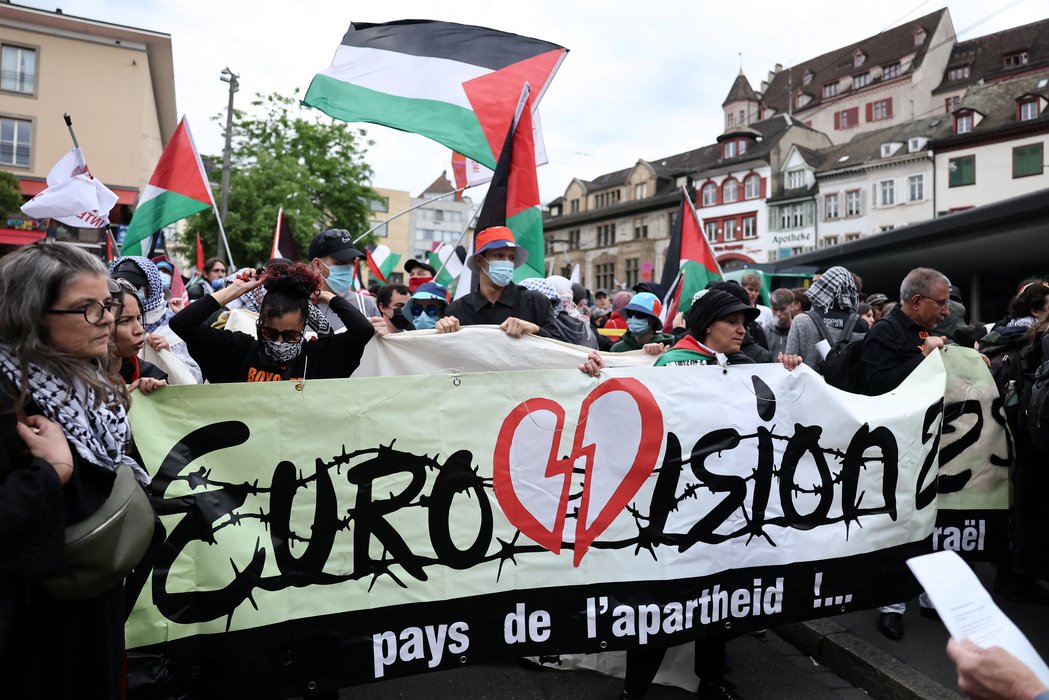
In May 2025, Switzerland hosted the Eurovision Song Contest, which was met with protests over the decision to allow Israel to compete amid the genocide in Gaza. On 11th May, pro-Palestinian supporters gathered outside Basel’s town hall during the opening ceremony to denounce Israel’s participation, call for humanitarian aid delivery, and express solidarity with Palestinians. One protester carrying a Palestinian flag was arrested after attempting to approach the artists along the official parade route.
On 17th May, several hundred protesters gathered in Basel during the Eurovision final to denounce Israel’s participation amid the ongoing Israeli offensive on Gaza. According to 20 Minutes, around 300 protesters took part, some setting fire to Israeli and American flags. Clashes broke out as police attempted to block the march from advancing through the city centre, using tear gas, physical force, and deploying a water cannon. According to the Swiss news agency Keystone-ATS, the confrontation began when police intervened to stop an altercation after two men waving Israeli flags rushed towards the protesters.
Inside the arena, a Eurovision crew member was hit with paint after two people attempted to rush the stage during Israeli singer Yuval Raphael’s performance. No one was injured, and the man and woman involved were escorted from the venue.
EXPRESSION
Ahead of World Press Freedom Day in May, Reporters Without Borders warned that Swiss media face mounting economic pressure, even as Switzerland retained 9th place in the World Press Freedom Index. Globally, press freedom is at its most threatened level ever, with 90% of media outlets struggling for financial stability and many forced to close.
Amid these pressures, Geneva daily Le Courrier collected over 4,500 signatures calling for stronger support for an independent regional press. The newspaper urged authorities, politicians, and businesses to help finance journalism “at a fair price” through subscriptions or advertising, stressing the need for urgent local action to sustain independent reporting.
Legal threats against investigative journalists citing banking secrecy
On 31st March 2025, lawyers representing Swiss bank Reyl Intesa Sanpaolo warned five journalists and the OCCRP against publishing findings from an investigation into the bank’s anti-money laundering practices. The law firm claimed criminal offences had been committed in obtaining the information and threatened prosecution under Article 47 of the Swiss Banking Act, which criminalises the disclosure of confidential banking data.
Despite the warning, the report of the investigation—jointly conducted by OCCRP, Le Monde, Paper Trail Media, and IrpiMedia—was published on 9th April under the title “Leaked Letters Give Insight Into Anti-Money Laundering Gaps at Swiss Bank Reyl.” The report revealed that the Swiss Financial Market Supervisory Authority (FINMA) had investigated Reyl for weaknesses in money-laundering controls and the mishandling of high-risk clients, based on leaked correspondence between the regulator and the bank. The publication prompted confirmation of Reyl’s criminal complaint, highlighting the chilling effect of Swiss secrecy laws on public-interest journalism.
On 28th April 2025, the International Press Institute (IPI) condemned the legal threats and urged Switzerland to reform its banking secrecy legislation. The organisation warned that Article 47 poses a serious risk to press freedom and whistleblowing by allowing the prosecution of journalists who expose corruption or financial misconduct. IPI called on the authorities to introduce public-interest exemptions and drop legal actions against reporters, stressing that the law’s misuse undermines investigative journalism and shields illicit financial activities from scrutiny.
Protests over dismissal of pro-Palestinian academic from Lausanne University
In April 2025, mobilisation continued at the University of Lausanne (UNIL) in support of Professor Joseph Daher following his dismissal in February, widely seen as politically motivated due to his pro-Palestinian activism. UNIL officially cited his lending of a campus card to a student during the occupation of the Géopolis building, alleging that this enabled a participant deemed potentially risky to access the premises.
The student involved denied the accusations, saying she had not taken part in any altercations and that claims of misconduct were false or exaggerated. Supporters argue that the incident was used as a pretext to target Daher’s political engagement. Demonstrations and petitions—signed by thousands of students, academics, and international supporters—called for his reinstatement and defended academic freedom.
Detention of Palestinian-American journalist in Zurich
In January 2025, Palestinian-American journalist Ali Abunimah was detained in Zurich ahead of a planned speech, with Swiss authorities citing an entry ban and other measures under the country’s immigration law. Abunimah, executive director of The Electronic Intifada, described the detention as punishment for his advocacy on Palestinian rights.
Held for three days, he was unable to contact his family and only had his phone returned upon deportation to Istanbul. He also reported being interrogated by intelligence authorities while in custody. His detention sparked outrage among Palestinian rights advocates, who condemned Switzerland’s actions as targeting a journalist for his views on Palestine, and contrasted it with the country’s simultaneous hosting of Israeli President Isaac Herzog.
In February, documents obtained by The Electronic Intifada revealed that Swiss federal authorities had initially rejected a request by Zurich cantonal police to impose an entry ban on Abunimah, concluding that his social media posts were protected under freedom of expression and that he posed no threat to national security. Federal police (Fedpol), the migration authority, and the intelligence service all dismissed claims by Zurich police that Abunimah’s planned events could endanger public order. However, hours after his lawful entry into Switzerland on 24th January, the ban was suddenly issued and an expulsion order followed the next day, suggesting possible political interference. Reports indicate pressure from senior Zurich officials, including Security Chief Mario Fehr, who had publicly described Abunimah as an “Islamist Jew-hater” before the arrest.
Dismissal of RSI journalist over social media post
In early December 2024, Italian-German journalist Paola Nurnberg was dismissed from Radiotelevisione svizzera (RSI), a subsidiary of the Swiss national broadcaster operating in Italian-speaking Switzerland, following a post on the social network X/Twitter in which she criticised “right-wing thinking”. On 5th December 2024, the trade union Unia announced legal proceedings for unfair dismissal, calling the case unprecedented.
Summoned by management immediately after the post, Nurnberg admitted her mistake and offered to publish a public apology in line with internal rules on social media use. However, RSI management did not accept the proposal and, one year later, decided to terminate her employment.