Association
Death of Leco defender exposes risks facing Indigenous communities in Madidi National Park
On 11th February 2025, Indigenous leader Francisco Marupa, a former Leco authority and widely regarded guardian of the territory, died in circumstances that remain unclear in the Torewa Indigenous community inside Madidi National Park, one of Bolivia’s largest and most biodiverse protected areas. Marupa was known for defending Indigenous lands and for opposing the Chepete-Bala hydroelectric project, a controversial plan that threatened to displace communities in the Amazonian region.
While police reported that Marupa died from severe cranioencephalic trauma and hypovolemic shock, local Indigenous organisations linked his death to the broader climate of impunity surrounding illegal mining, logging, and land trafficking in the area.
The killing drew national and international concern, as Madidi National Park, located in north-western Bolivia near the Peruvian border, has increasingly faced pressure from criminal economies operating inside and around Indigenous territories. Environmental experts and civil society organisations warned that the case illustrates a wider failure by the state to maintain effective control over protected areas.
Three days later, police arrested a 20-year-old Tsiman man as the alleged perpetrator. The Minister of Government, Eduardo del Castillo, rejected any connection to territorial disputes and publicly characterised the killing as a “personal dispute”, a statement delivered before the investigation had advanced. His remarks triggered criticism from civil society organisations. They argued that the government downplayed the structural violence affecting Amazonian communities.
The UNITAS Defenders Programme stressed that the killing of a human rights defender activates heightened state obligations under Inter-American human rights standards. They called for a prompt, impartial, and effective investigation; adequate protection for witnesses; and an examination of whether Marupa’s work defending Indigenous territory constituted a motive.
More than 70 national organisations and 10 regional institutions signed a joint statement demanding a transparent investigation and accountability for both material and intellectual authors. The Delegation of the European Union in Bolivia also urged the government to guarantee protection for the Leco people and other Indigenous communities exposed to similar risks from extractive and criminal networks.
Sanitation workers report violence and reprisals against union organising
On 25th March 2025, union leader and sanitation worker Lita Mercado, a 36-year-old street sweeper in La Paz, reported a violent assault outside the Ministry of Labour after she demanded the reinstatement of colleagues dismissed by La Paz Limpia and Trebol, the private companies contracted to manage sanitation services in La Paz and the neighbouring city of El Alto.
Mercado — whom the companies fired in mid-February along with at least five other union leaders, including several young single mothers — said company-aligned co-workers beat her, dragged her to the Ministry’s entrance and stole her belongings. Witnesses recalled that one police officer attempted to intervene before another ordered him to “let them beat her”. Other union leaders described similar intimidation and earlier assaults linked to labour disputes.
Workers stated that both companies have been targeting organisers who report abuses or demand improved working conditions. In El Alto, Trebol dismissed Tatiana Mamani, Milton Quispe, and Jhonny Apaza after they opposed the removal of seniority benefits and raised concerns about planned salary cuts. Trebol reportedly filed criminal complaints of “defamation” against them. Testimonies from predominantly female sanitation workers — many of them single heads of household — describe precarious employment, harassment, unsafe night-shift conditions, low pay, and reprisals for union activity, including reports of attempted sexual assault.
Rangers removed after acting against illegal mining
Between October and November 2024, the National Service of Protected Areas (Sernap), the state agency responsible for managing Bolivia’s parks and reserves, removed two long-serving rangers from the Manuripi Amazon Wildlife Reserve in Pando: Luke López Beyuma, Head of Natural Resources Protection with 23 years of service, and Ignacio Huary Palomequi, a ranger with 15 years’ experience.
López reported that Sernap acted shortly after he opened 15 administrative proceedings against miners who had entered the protected area to extract gold. He said the agency then launched a summary disciplinary process against both men to justify their removal, ignored their written defences, and centred the case on an allegation, denied by both, that they received irregular payments from miners to repair a camp.
López described a sharp increase in illegal mining inside the reserve since 2020, driven in part by depleted deposits along the Madre de Dios River and weakened institutional control, including a shortage of fuel for patrols.
Their removal has significantly reduced oversight capacity. Manuripi previously employed seven rangers in addition to López, yet interim director Denis Navarro now performs López’s duties and, according to López, played a role in the irregular proceedings that resulted in their dismissal. In January 2025, Sernap director Johnson Jiménez was removed from his position following separate allegations of misusing public assets.
Activists face criminal charges for peaceful solidarity action in Cochabamba
On 6th February 2025, the media outlet Sumando Voces reported that the Prosecutor’s Office charged two activists with “destruction or deterioration of state property”, an offence carrying a one-to six-year prison sentence under Bolivia’s Criminal Code. The Cochabamba Municipal Government, then led by mayor and now presidential candidate Manfred Reyes Villa, initiated the case. The charges stem from a peaceful demonstration in May 2024, when the activists placed a Palestinian flag, three green scarves, and several signs on the Heroines of la Coronilla monument, a public memorial honouring women who resisted colonial rule, during an action supporting Palestinian women.
The activists and allied collectives argued that the intervention caused no physical damage and therefore failed to meet the legal threshold for criminal prosecution. One of the accused explained that the action was intended to link the monument’s historic symbolism with the situation of Palestinian women. She recalled that, at the municipality’s request, police inspected the site on the day of the protest and released the activists after confirming there was no damage. Despite this, the municipal Department of Culture filed a complaint months later, which resulted in the activists being summoned four months after the event.
Expression
Journalists assaulted during pro-Morales mobilisation
On 13th January 2025, Bolivia TV demanded an immediate investigation after one of its cameramen was assaulted during an attempted takeover of the Cochabamba Campesino Federation (Fsutcc) headquarters by supporters of former president Evo Morales. During the incident, pro-Morales groups injured the Bolivia TV cameraman, causing harm to his arm and ribs, and blocked a reporter and cameraman from the private outlet Unitel from carrying out their work.
Additional assaults occurred in La Paz, where journalists covering the arrival of a march of Morales’ supporters near the Vice-Presidency building also faced aggression (see peaceful assembly). Reporters on the scene said the hostile environment prevented them from documenting the mobilisation safely.
Bolivia TV condemned the attacks as violations of press freedom.
Media outlets face legal threats from self-proclaimed “State of Kailasa”
On 31st March 2025, Bolivian media outlet Brújula Digital reported receiving two legal threats from the self-proclaimed “State of Kailasa”, which demanded the retraction and deletion of investigations into irregular land-lease agreements signed between Kailasa representatives and Indigenous communities in the Amazon. Kailasa accused Brújula Digital of a “malicious campaign of defamatory publications targeting KAILASA” and warned of legal action. Brújula Digital rejected the claims and stated it would not remove or amend its reporting. Other Bolivian media outlets received similar notices.
The incident follows investigations revealing that at least three Indigenous groups signed 1,000-year leases covering 480,000 hectares of fiscal land with Kailasa in exchange for annual payments that never materialised. Authorities subsequently voided the agreements and launched deportation proceedings against foreign nationals acting on Kailasa’s behalf. In late March 2025, authorities arrested and deported 20 people associated with Kailasa, accusing them of “land trafficking”.
The 41-page legal notice, signed by a purported Kailasa representative, asserted that Kailasa constitutes a legitimate state despite lacking recognition from the United Nations or any government. It framed media scrutiny as a malicious campaign aligned with “colonial powers” and alleged defamation, incitement, and discrimination.
International reporting, including from The New York Times, has described Kailasa as a fictitious “nation” linked to fugitive Indian guru Swami Nithyananda, who faces criminal charges in India.
Journalists face movement restrictions during mototaxi drivers’ blockade
On 18th March in Cobija, members of the “9 de Febrero” Departmental Federation of Mototaxi Drivers blocked journalists from circulating while they carried out a road blockade, raising concerns about journalists’ ability to report safely and without interference during public demonstrations. The drivers sought to pressure municipal councillors to resign, accusing them of failing to address the city’s worsening economic crisis, reflected in sharp increases in the price of essential goods and persistent fuel shortages.
Peaceful Assembly
Police use tear gas against pro-Morales march in La Paz amid rising political tensions
On 13th January 2025, police in La Paz used tear gas to disperse supporters of former president Evo Morales who marched into the city demanding action on the economic crisis and the suspension of judicial proceedings against Morales for the alleged sexual abuse of a minor in 2016. Police blocked the demonstration from entering the central plaza that houses the Government Palace, prompting clashes and the arrest of two protesters.
The march began in Patacamaya, covering roughly 100 kilometres, and took place one day before Morales’ scheduled hearing. Protesters denounced what they called “political persecution”. Morales did not participate and has remained in the coca-growing region he leads, avoiding an arrest order and travel ban linked to the case.
Authorities reported confrontations when protesters tried to break police lines, alleging attempts to seize police equipment. The Minister of Government, Eduardo del Castillo, downplayed the mobilisation as poorly attended and described it as a protest “in defence of paedophilia”, while accusing protesters of ambushing police buses. He said three police officers and two civilians sustained injuries.
The march unfolded against a backdrop of heightened political conflict between Morales and President Luis Arce, including a 24-day nationwide blockade in October 2024 that generated an estimated USD 1 billion in losses.
Protesters interrupt government conference
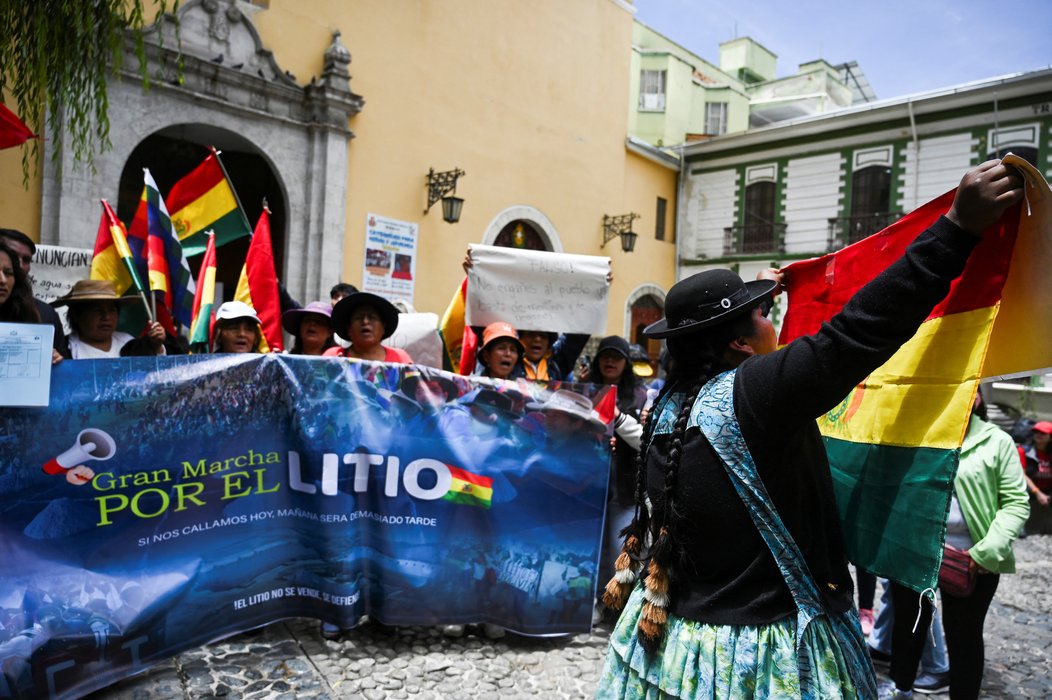
On 14th February 2025, protesters interrupted a government conference in Bolivia where officials were discussing lithium-extraction contracts with Chinese and Russian companies. They argued that Bolivia’s extensive lithium reserves must generate tangible benefits for the population and should not be negotiated behind closed doors. They insisted that communities have a right to participate in decisions concerning strategic natural resources.
Protesters also denounced the absence of consultation with affected Indigenous communities, noting that Bolivian law and international standards require such consultation before approving extractive projects. They raised concerns about the environmental risks associated with lithium extraction, including soil degradation, water scarcity, and disruption of fragile high-altitude ecosystems.
Economic crisis triggers mobilisations
On 24th March 2025, protesters in La Paz and Santa Cruz held parallel demonstrations demanding urgent action to address Bolivia’s worsening economic crisis, marked by rising prices, persistent fuel shortages, and a scarcity of US dollars. In La Paz, a faction of the Federation of Neighbourhood Councils (Fejuve) of El Alto marched to the government district to present a list of demands, calling for austerity measures and salary reductions for senior public officials. Protesters described severe economic hardship, with leaders warning that communities in El Alto were “dying of hunger”.
Later that afternoon in Santa Cruz, the Civic Committee and students from the Gabriel René Moreno University mobilised through the city centre, demanding increased fuel supply, solutions to the dollar shortage, and stronger measures to curb inflation. Civic Committee president Stello Cochamanidis read a seven-point plan urging legislators to authorise free fuel importation, support opposition unity ahead of the August election, and release political detainees. He warned that protests would escalate if fuel distribution did not stabilise.
These demonstrations unfolded amid prolonged fuel shortages, which the government attributes to reduced domestic production and limited import capacity.
Teachers and rural workers face police restrictions during national protest
On 18th March 2025, members of the urban teachers’ union and the Single Federation of Rural Workers of Omasuyos entered Plaza Murillo, the central political square in La Paz, to protest rising food prices, fuel shortages, and the broader economic crisis affecting Bolivia. Police attempted to block teachers from accessing the square, prompting the rural workers — known as the Ponchos Rojos, a traditional Aymara organisation with a long history of political mobilisation — to intervene and escort them into the plaza. Protesters described the joint action as a response to mounting economic pressures and to tightening restrictions on access to symbolic public spaces in the capital.
The teachers’ mobilisation formed part of a nationwide protest convened by the Confederation of Urban Education Workers, which demands salary increases aligned with the cost of living, an inflation-adjusted wage scale, and a pension based on 100 per cent of contributions.
Addressing the crowd, Ponchos Rojos leader Enrique Mamani accused the government of mismanaging the economy and warned that the group would launch road blockades if authorities tried to expel demonstrators. He issued a 24-hour ultimatum demanding the removal of several senior officials.