Introduction
Baku hosts Global South NGO Platform amid restrictions on civic space
Azerbaijan hosted the inaugural conference of the Global South NGO Platform from 28th to 29th April 2025. The event, initiated by the Azerbaijan National NGO Forum and logistically and financially supported by the State Agency for NGO Support, brought together representatives from approximately 100 countries. The Platform was presented as a new framework for cooperation among civil society organisations from the Global South in the context of preparations for COP29.
President Ilham Aliyev actively supported the event, delivering a speech in which he welcomed the initiative as a confirmation of Azerbaijan’s position in the non-aligned movement and its role in promoting the “Baku Breakthrough” – a symbolic moment for South–North dialogue. The Azerbaijani leader expressed his motivation to establish Baku as the permanent headquarters of the NGO Platform and to enhance Azerbaijan’s influence in the global architecture of cooperation among developing countries.
The conference, however, took place within a climate of tension. While promoting an image of international openness and cooperation, the Azerbaijani authorities have been accused of intensifying repression of civil society, independent journalists, and exiled opponents. International organisations and watchdogs have reported that the regime is using such initiatives to rehabilitate its global image. At the same time, however, the state continues to repress critical voices and restrict civic space.
Freedom of Association and Peaceful Assembly
Azerbaijani opposition in exile faces ongoing pressure
Azerbaijan has stepped up its pressure on exiled opponents, accusing them of organising protests and attempting to overthrow the government. For example, Ilgar Hajiyev, the former owner of the Akkord construction company and an exiled critic, is charged with fraud. On 14th July 2025, Hajiyev was summoned to the Prosecutor General’s Office, along with bloggers Mahammad Mirzali and Gabil Mammadov, business owner and journalist Gurban Mammadov, and other activists, such as Tural Sadigli.
The authorities have leveled what are considered to be politically motivated charges against the above mentioned individuals. For example, Mirzali is accused of calling for a forced seizure of power and “mass uprisings” in 2018, and Mammadov of repeated calls in 2019 for a “forcible seizure of power,” “terrorism,” and inciting “social chaos”.
The international community has expressed grave concern over the increasingly harsh repression of dissent in Azerbaijan. Remote investigations, complaints about mass demonstrations, and the invocation of “national security” concerns suggest an authoritarian trend designed to silence critical voices and discredit the opposition in the diaspora.
Freedom of Expression
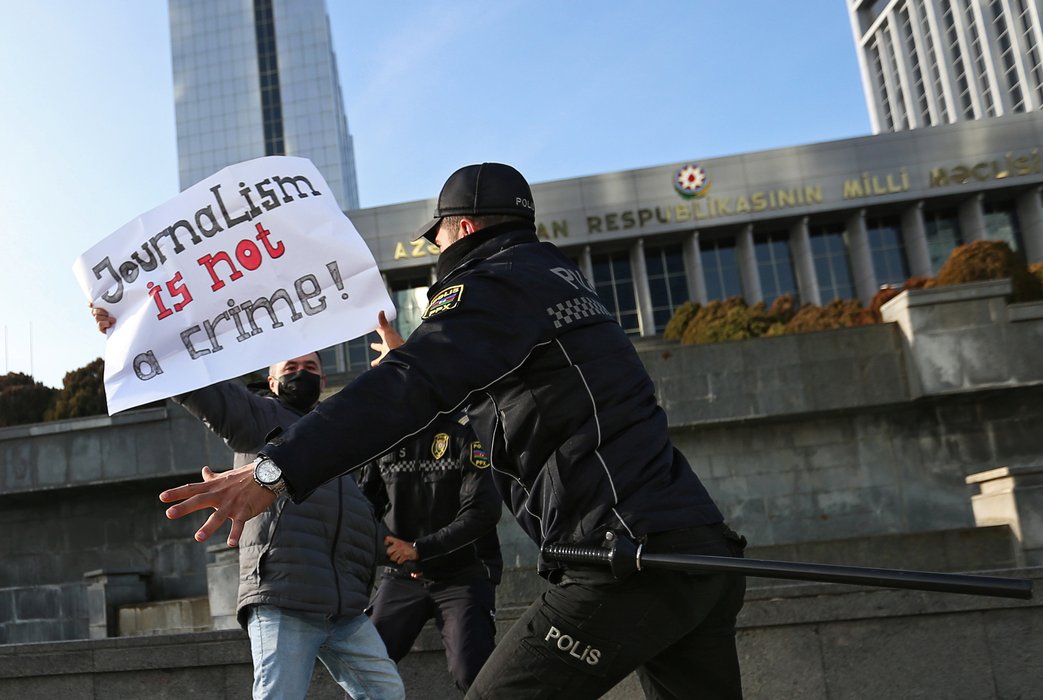
Azerbaijani authorities continue crackdown on independent media and critical voices
According to the Committee to Protect Journalists (CPJ), at least 25 journalists have been detained in the past 18 months, including Ulviyya Ali and Ahmad Mammadli, who were arrested in early May 2025 on charges of involvement in “currency smuggling” - reportedly connected to the Meydan TV case (see previous CIVICUS Monitor update). The arrests are part of a wave of repression that has forced outlets such as Toplum TV and Abzas Media into exile, and journalists who remain in the country face constant pressure and the risk of detention.
In a recent round of sentencing, the authorities upheld the Abzas Media case, with seven journalists sentenced to between 7.5 and nine years in prison for alleged economic crimes — among them Sevinj Vagifgizi and Farid Mehralizada, who were accused of “smuggling”, “illegal economic enterprise”, and “tax evasion”. Amnesty International and Reporters Without Borders have described the trials as politically motivated and warned that the judicial system is being used to suppress independent journalism.
The OSCE Representative on Freedom of the Media has expressed “serious concern” over the growing number of cases against journalists and urged the Azerbaijani authorities to comply with their OSCE commitments, including ensuring decent detention conditions and access to independent legal aid. International pressure reflects that attacks on the press are not isolated incidents but part of a systematic strategy of censorship and intimidation.
A particularly stark case is that of Aysel Umudova, a journalist for Meydan TV, who was detained in December 2024 and held in pre-trial detention on charges of “currency smuggling”, despite a lack of evidence. Her imprisonment and the poor conditions have caused a deterioration in her health, and the court has repeatedly refused to release her to house arrest.
The case of Tofig Yagublu, a prominent opposition activist from Azerbaijan, also returned to the public eye. He went on a hunger strike for about 40 days in detention. Tofig Yagublu's daughter has called for his urgent transfer to a civilian hospital amid the deteriorating condition of his health. Amnesty International has condemned the Azerbaijani authorities for failing to immediately release Yagublu and provide him with necessary medical care.