Introduction
Finns losing faith in future as trust in local democracy weakens
The latest Futures Barometer, published in March 2025 by Sitra, shows declining trust among Finns in social progress and in local and regional democracy. Sitra, the Finnish Innovation Fund, is an independent public foundation operating under the supervision of the Finnish Parliament.
According to the report, faith in the future remains relatively strong, as only 14 per cent believe their personal future will be worse or significantly worse than the present. However, confidence in local and municipal authorities is undermined by their decisions on issues such as employment, welfare provision and national security. Only 18 per cent of respondents see Finland’s future as better than the present—an 11-point drop from the 2023 survey. This underscores the close connection between trust in democracy and the delivery of social policies.
Freedom of association
Extinction Rebellion Finland targeted by investigation; Court ruling establishes legality of their actions
In October 2024, the environmental group Extinction Rebellion Finland (Elokapina) came under scrutiny when National Police Commissioner Ilkka Koskimäki announced that authorities were gathering evidence to assess whether the group should be dissolved. The investigation followed acts of civil disobedience, including the spraying of Parliament House on 25th September. Right-wing politicians supported the initiative: Justice Minister Leena Meri and Interior, Transport and Communications Minister Lulu Ranne (PS) both called for investigations and urged officials to consider whether current legislation grants authorities sufficient powers.
In April 2025, the Helsinki District Court ruled that Extinction Rebellion Finland had not engaged in the alleged crimes of fraud, public incitement to commit a crime, or providing false testimony to a public authority. According to the group, the decision demonstrates that the Finnish Constitution protects their activities and contrasts Finland’s approach with that of other European countries where environmental CSOs face criminalisation.
Funding cuts threaten civil society organisations
In April 2025, Prime Minister Petteri Orpo’s government announced a major fiscal policy shift during mid-term economic negotiations, combining further spending cuts with substantial tax breaks for corporations and high earners. The measures include reducing the corporate tax rate from 20 to 18 per cent and cutting the top marginal tax rate from 58 to 52 per cent, moves projected to widen annual deficits by nearly one per cent of GDP while weakening earlier commitments to consolidate public finances by EUR 9 billion annually. Critics argue the government is using fiscal sustainability as a pretext to erode the welfare state and weaken organised labour, with austerity measures already linked to rising poverty, homelessness, and unemployment. While business lobby groups welcomed the tax cuts, economists and civil society organisations warned that the policies would suppress domestic demand, deepen inequality, and shift power further towards capital at the expense of workers.
According to reports, public spending cuts across different sectors are already jeopardising organisations working on critical social issues. The budget of the Funding Centre for Social Welfare and Health Organisations (STEA) is set to fall from EUR 384 million in 2024 to EUR 253 million in 2027. This reduction poses an existential threat to organisations that rely on these funds to provide services, including support for women facing gender-based violence. In addition to representing an existential threat to the organisations themselves, critics warn that the cuts will ultimately result in higher social and economic costs.
The same approach to public spending by the Finnish government is eroding funds for Sámi Giellagáldu, the Sámi language preservation body, which will also be reduced by EUR 193,000. Similar cuts are planned in Sweden, heightening concerns that Indigenous languages face an increased risk of extinction.
Freedom of peaceful assembly
Arrests and accusations of police misconduct at anti-far right counter-protest
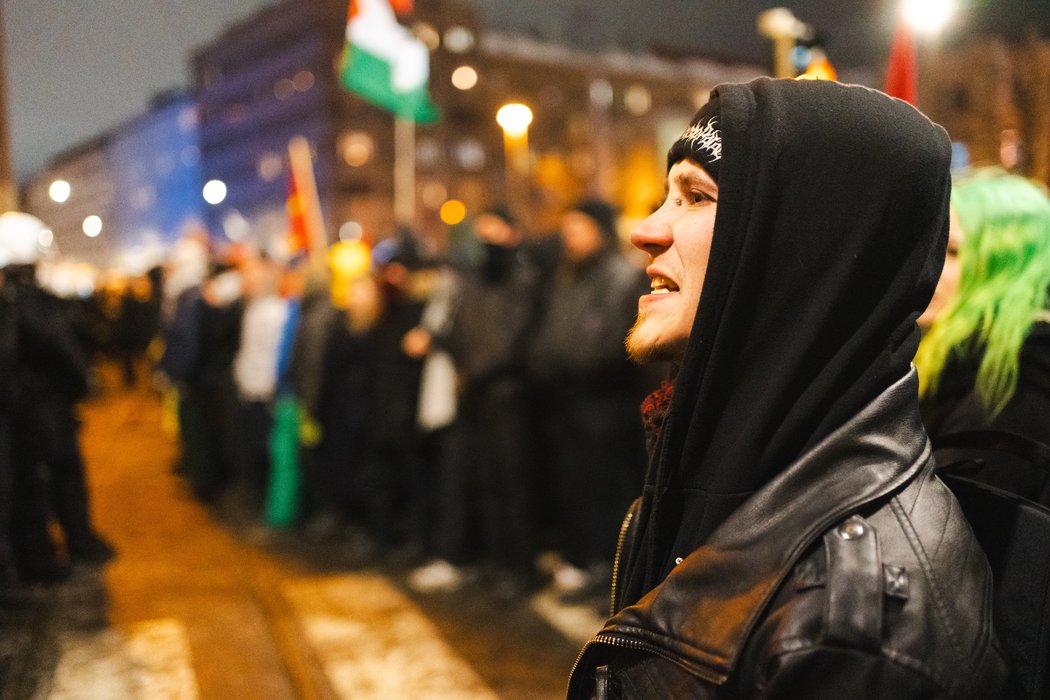
On Finland’s Independence Day, 6th December, clashes broke out between police and protesters during the so-called “612 torch march”, organised by far-right groups and supported by extremist politicians, including Tuukka Kuru, chairman of the openly fascist far-right group Sinimusta Liike (Blue-and-Black Movement). A self-described fascist and racist organisation, the group includes former members of the Nordic Resistance Movement, a neo-Nazi group. A counter-protest organised by the group Helsinki without Nazis, a coalition of anti-fascist organisations, gathered at the same location before the march began. Police moved to clear the square in order to secure space for the far-right gathering, clashing with and arresting counter-demonstrators. In all, police detained 41 of the counter-protesters, some of whom are suspected of violently resisting police officers.
Members of Helsinki without Nazis accused the police of using excessive force, including striking protesters in the throat with their elbows, which allegedly caused some to faint. They argued that police favoured the far-right march by targeting their peaceful protest without provocation. Video footage shot by Yle shows what appears to be a police officer rushing to escort a protester away from the scene and causing an elderly man to fall to the ground in the process. Amnesty International Finland also criticised the police’s use of force, noting that security forces used horses to disperse the crowd, pushed people forcefully, and held people on the ground for long periods of time with their faces against wet asphalt.
Journalists also reported obstruction by police while covering the events. The police, however, denied all accusations, maintaining that their intervention was prompted by protesters’ refusal to disperse.
Police clear Helsinki library after another Sinimusta Liike event sparks protest
On 6th January, Helsinki police intervened to disperse an event organised by Sinimusta Liike. The group had hosted a reading circle in a public library in the capital to discuss the book “A Minority in One’s Own Country?” by Finns Party politician Simo Grönroos.
The event triggered counter-protests from those outraged at the use of public facilities by extremist groups. Around 20 participants attended the reading, while more than 100 counter-protesters gathered outside. Demonstrators chanted slogans such as “No Nazis anywhere” and applauded as members of Sinimusta Liike left the library.
Police intervened to manage minor scuffles, reportedly issuing one fine for disobedience. No serious injuries were reported, although emergency services treated one individual who suffered a medical episode.
Tensions persisted even after the reading concluded, as demonstrators surrounded remaining members of Sinimusta Liike, who refused to leave despite police instructions. They were eventually escorted out by police and library staff.
Deputy Mayor for Culture and Leisure Paavo Arhinmäki (LA) stated that the city has the authority to shut down such initiatives when they are clearly intended to provoke disorder. He added that the group had not sought permission to meet in the library, and such permission would not have been granted.
Thousands rally in Helsinki against welfare cuts and government policies
On 18th May, around 4,000 people gathered in central Helsinki for a protest called the “Vote of No Confidence,” opposing the Finnish government’s social welfare cuts, fiscal priorities and policies seen as discriminatory. Organised by teachers, students, cultural workers and healthcare professionals, the demonstration began at Senate Square, where a video booth allowed participants to record personal “votes of no confidence,” before marchers moved to Parliament House carrying placards and chanting slogans. Similar actions were held in Oulu and Kuopio. The event featured speeches and music, with organisers warning that budget cuts undermine basic social security and public services, while participants voiced anger at benefits for the wealthy and fears for the country’s future. Helsinki Police reported the protest was peaceful and orderly.
Environmental and pro-Palestine protests
In 2025, environmental and pro-Palestinian protests remained frequent across the country. Environmental groups like Elokapina continued to stage demonstrations and civil disobedience demanding urgent climate action, while pro-Palestinian activists held regular protests, including weekly Friday gatherings near the Israeli embassy in Helsinki. However, police and public responses continued to reflect a generally negative attitude toward civil disobedience.
On 22nd March 2025, around 50 activists from the animal rights group Eläinkapina (an affiliate of Elokapina) staged a protest at Atria’s broiler factory in Nurmo, Seinäjoki, blocking traffic and surrounding a truck to denounce factory farming’s ethical and environmental impacts. Some demonstrators entered the factory grounds and sat in front of vehicles, prompting police to issue an order to disperse. When protesters refused, officers arrested 26 people on suspicion of resisting police.
On 5th May, around 40 environmental and pro-Palestinian activists, including those from Elokapina and Students for Palestine Finland, demonstrated in front of the headquarters of logistics company Mærsk Finland in Helsinki, accusing the company of facilitating Israel’s war in Gaza by transporting US military goods intended for use by the Israeli army. The protesters pointed to the delivery of vehicle parts, aircraft components and ammunition systems as evidence of the company’s complicity in enabling violence against civilians, alongside its negative impact on the environment. Police intervened during the action and arrested three activists.
On 15th May, a pro-Palestinian protest organised by Students for Palestine took place inside the University of Helsinki, demanding the university cut ties with Israeli institutions over the war in Gaza. Police were called by university authorities around 8 p.m., citing the institution’s closing hours. Police then declared the protest illegal as it lacked university permission and ordered demonstrators to leave the main building. According to police, four people who refused to leave were arrested for insubordination and violating assembly laws, with one also suspected of violently resisting police after allegedly kicking an officer. The student group condemned the police “excessive and intimidating tactics” and the university’s refusal to engage in dialogue about their demands.
On 28th May, during a protest in Helsinki’s Narinkkatori Square, demonstrators sang a pro-Palestinian song set to the tune of Finlandia by legendary Finnish composer Jean Sibelius, an event later shared on Instagram by the Finnish Women’s League Union. The performance, accompanied by Palestinian flags, sparked strong backlash from right-wing politicians and commentators, with Finance Minister Riikka Purra and MEP Sebastian Tynkkynen, both from the Finns Party, condemning the use of a national symbol to support what they described as a misogynistic regime in Gaza.
In response, the estate of Jean Sibelius stated that permission should have been sought to use the melody and alter the lyrics, though no formal legal action was announced. The estate noted that such permission would not have been granted, as it maintains a policy against using the song for political purposes. The organisers expressed regret, telling Ilta-Sanomat that they were “sorry” for any offence caused to the estate and emphasised that they had drawn inspiration from the song’s use during a 2022 support concert for Ukraine.
Freedom of expression
Proposal to limit public research funding based on alignment with national security causes controversy
In January 2025, a debate erupted over a new law that was due to come into force on 1st April and which would oblige the Research Council of Finland (formerly the Academy of Finland) to only fund research that is compatible with the country’s national security and foreign policy. Critics, including senior professors, warned that the measure threatened academic freedom, which is protected by the constitution, as it could subject research to political control. The government defended the law as necessary to ensure that the outcome of research was not going to be utilised by authoritarian countries under the international sanctions policy. The controversy takes place against the backdrop of a general change in the political climate in Finland since joining NATO, with academics warning of increasing political influence on universities and a narrowing of the space for critical enquiry.
On 31st March, the Parliamentary Committee on Education recommended removing the bill’s reference to Finland’s foreign and security policy, following widespread criticism. Instead, the revised wording would require the Academy of Finland to ensure the security of research and assess risks in projects and cooperation, while explicitly safeguarding researchers’ right to choose their topics and methods. Both the Constitutional Affairs Committee and the Ministry of Education and Culture supported the removal, with officials stressing that the law cannot pass without the amendment.
Reduced transparency on arms exports
In April, a Yle investigation revealed that since 2021 the Finnish government has encrypted information on arms exports, reversing its previous policy of full transparency. Authorities justified the shift by citing geopolitical changes and security concerns. However, critics stress that transparency is essential for democratic oversight and security concerns must be balanced against the right to access information.
Proposed Law on Holocaust Denial
In May 2025, the government introduced a bill criminalising Holocaust denial and the denial of other crimes against humanity defined by the International Criminal Court. Penalties would range from fines to two years’ imprisonment. While Finland follows countries such as France and Germany, concerns remain that this law could be abused given the increasingly hostile climate for pro-Palestinian voices that rights watchdogs including the CIVICUS Monitor have reported on.
Editorial interference allegations at regional newspaper
On 7th May 2025, the editor-in-chief of regional newspaper Keskipohjanmaa, Suvi Tanner, and news editor Jonna Nikumaa were dismissed by Hilla Group’s CEO, Mikko Luoma. Whistleblowers alleged that Luoma acted in retaliation for public criticism of his management style and that he increasingly interfered in editorial decisions, especially regarding local business coverage. The sackings raised serious concerns about press independence, particularly as the paper had recently won the Great Finnish Journalism Prize under the leadership of the dismissed Tanner.
Harassment case against journalist Ida Erämaa
In March 2025, it was reported that prosecutors had dropped an investigation into threats and defamatory comments targeting Iltalehti journalist Ida Erämaa, arguing she was partly responsible for the harassment she received due to the “highly stigmatising” nature of her reporting. Erämaa had faced an online harassment campaign after criticising the Finns Party in 2023, with the party’s MPs and supporters posting threats and abusive messages. In response, the journalist filed several criminal complaints against individuals who had threatened her, spread false information, and made derogatory and sexually suggestive comments about her.
Justifying the decision to terminate the investigation, the lead detective stated: “[...] considering the highly stigmatising and, according to some critics, offensive content of the original article written by Erämaa, the exceptionally high contribution of the plaintiff [...] would mitigate the punishment. Erämaa has written about all Finns Party members, which includes all party members and can be interpreted as also targeting all people who voted for the Finns Party. Erämaa must have been aware that her writings would cause criticism and commentary when she labelled a large group of people as far-right and, according to some interpretations, even as Nazis.”
Erämaa and the Union of Journalists in Finland strongly condemned the decision. On 2nd April, the union filed a complaint, arguing that normal journalistic work cannot be considered “contributory” to crimes against reporters. On 17th April, Prosecutor General Ari-Pekka Koivisto reversed the earlier decision, ordering the investigation to continue, stressing that harassment of journalists poses a direct threat to freedom of expression and public access to information.
Pressure on whistleblowers in tax avoidance reporting
On 25th February 2025, Helsingin Sanomat (HS) reported that social media influencer Natalia Salmela had urged her 112,000 followers to identify the whistleblower who leaked details of her tax planning arrangements with KPMG. On 17th February, HS published a story about how Salmela, together with the consultancy firm KPMG, had marketed to other public figures a controversial corporate arrangement to minimise dividend taxation. Salmela later dismissed her comments as a joke, but her posts raised concerns about the targeting of journalistic sources. Days later, the civil society organisation Finnwatch, which monitors business ethics, filed a complaint to the OECD, accusing KPMG of violating tax guidelines by promoting aggressive avoidance schemes.
Attacks on public broadcaster Yle
On 3rd February 2025, Finns Party MEP Sebastian Tynkkynen called for Yle, Finland’s public broadcaster, to be shut down, arguing taxpayers should not be forced to support “biased” media. Tynkkynen stated on his X account that his intention is to get Yle's closure as part of PS' official party line. The MEP stated: “It is important to protect the freedom of the press, and private media can play into the hands of the left or the right if they want to, as in the United States. But taxpayer-funded state media must not be biased because citizens have no choice but to pay, even if the broadcaster is constantly attacking the values of the payer.” He has long campaigned for cuts to Yle’s funding, which were passed in September 2024, leading to mass layoffs in early 2025. Tynkkynen’s stance reflects a wider pattern of hostility towards independent media from parts of the Finns Party.