Bangladesh’s civic space is rated as ‘repressed’ by the CIVICUS Monitor. While the interim government has taken positive steps to address civic space concerns following mass protests that led to the fall of former Prime Minister Sheikh Hasina and her government in August 2024, there are ongoing concerns on the need to protect journalists, repeal restrictive laws, ensure an enabling environment for civil society and accountability for past crimes.
The interim government will hold parliamentary elections on 12th February 2026, in what would be the country’s first national vote since the 2024 uprising. A referendum of the 'July Charter' for state reform will also be held on the same day. The July Charter introduces a series of bold constitutional reforms aimed at curbing authoritarian tendencies and restoring institutional balance.
Among the most consequential proposals is a term limit for the prime minister — no individual may hold the office for more than ten years. There is also a proposed amendment to Article 48(3) of the Constitution, which empowers the president to appoint the heads of six key state institutions independently. These include the National Human Rights Commission, the Information Commission, the Bangladesh Public Service Commission, the Law Commission, Bangladesh Bank, and the Bangladesh Energy Regulatory Commission. This is aimed at rebalancing authority between the president and prime minister, reducing the latter’s partisan control over regulatory and oversight bodies.
Additional reforms include barring the prime minister from holding party leadership roles while in office, reinstating the caretaker government system to oversee elections, and establishing a 100-member upper house elected through proportional representation.
A majority of political parties signed the charter in October 2025 but the National Citizens Party (NCP), formed by the leaders of last year's movement and four left-leaning parties, have boycotted it.
In November 2025, the interim government reformed the National Human Rights Commission (NHRC) Act through an ordinance. The new law brings significant changes to make the NHRC a strong, independent, and effective body. The updated law acknowledges Bangladesh's obligations under international human rights laws, broadens the legal mandate of the NHRC, expands its investigative authority, stipulates remedial measures against human rights violations, introduces a national preventive mechanism to prevent cruel, inhuman, or degrading treatment, guarantees financial autonomy, and improves alignment with international standards like the Paris Principles. However, concerns remain, including the role of the cabinet secretary on the selection committee of the NHRC and the removal of the mandatory reporting of non-compliance.
Sheikh Hasina was sentenced to death in November 2025 for crimes against humanity over her crackdown on the 2024 student-led protests. She was tried in absentia by the International Crimes Tribunal (ICT) and found guilty of allowing lethal force to be used against protesters, 1,400 of whom died.
On 15th January 2026, the government approved the July Mass Uprising Protection and Liability Determination Ordinance, granting indemnity to participants of the July 2024 mass uprising for actions organised as part of political resistance.
In recent months, the anti-terror law has been used to criminalise the opposition, journalists and others, while a political activist was killed. There has been a crackdown on protests against the July Charter, teachers, left-leaning groups and traders. There have also been attacks on media outlets and cultural institutions. On a positive note, cases have been filed against perpetrators of enforced disappearances, the enforced disappearance ordinance was approved, the foreign donations law was revised, and mass criminal cases filed against garment workers were dropped.
Association
Crackdown under anti-terrorism law
In October 2025, Human Rights Watch said that the interim government led by Muhammad Yunus is increasingly using the recently amended counterterrorism law to arrest alleged supporters of the deposed Awami League government.
The interim government ordered a “temporary” ban on the Awami League, using new authority under draconian amendments to the Anti-Terrorism Act in May 2025. The ban includes prohibitions on meetings, publications, and online speech supporting the party and is being used to arrest Awami League members and peaceful activists.
According to HRW, thousands have been arrested under the interim government, many on dubious murder allegations, while scores are being held under the Anti-Terrorism Act. Several have alleged mistreatment in custody, including lack of access to medical care.
Police detained 16 people, including journalists and academics, on 28th August 2025 at a discussion organised by Mancha 71, a platform that celebrates Bangladesh’s independence from Pakistan in 1971. At the public meeting in the office of the Dhaka Reporters Unity, an independent media association, a mob surrounded and heckled the participants, accusing them of being loyal to the Awami League because the party promotes its role in the freedom struggle.
Lawyer at risk of arrest
According to JusticeMakers Bangladesh in France (JMBF), on 8th November 2025, Akhaura police, accompanied by several local members of the Bangladesh Nationalist Party (BNP), conducted a raid on the Ruti village residence of human rights defender Mohammad Alamgir, Secretary-General of JMBF, with the intention of arresting him. However, Advocate Alamgir had left his home earlier in the afternoon to go to Dhaka, and the police failed to apprehend him.
JMBF said that Alamgir has been the target of repeated threats and attacks for over a year. These acts of intimidation aim to silence him because of his professional activities and his commitment to fundamental rights. He is a Bangladeshi lawyer dedicated to protecting victims of political and religious violence and has defended people from minority groups, particularly the LGBTQI+ community, who are often targeted by fundamentalist groups or extremist political factions.
Political activist dies from gunshot wounds
Who was Sharif Osman Hadi?
— Al Jazeera English (@AJEnglish) December 19, 2025
Hadi was a leading figure in last year’s student-led uprising that ousted PM Sheikh Hasina, helping to launch street protests, campaigns denouncing her rule and criticised the influence of neighbouring India.
🟠 LIVE updates: https://t.co/dJurKOUzuL pic.twitter.com/su1s3BNFRO
Prominent youth leader Sharif Osman Hadi died on 18th December 2025 from gunshot injuries he sustained during an assassination attempt on 12th December in Bangladesh’s capital, Dhaka.
Hadi, 32, was a prominent leader of Bangladesh’s 2024 student-led uprising. He acted as a spokesperson for Inquilab Mancha, or “Platform for Revolution”, and was planning to stand as a member of parliament for the Dhaka-8 constituency in the Bijoynagar area of the city in the upcoming elections. Hadi was also an outspoken critic of India - to where Bangladesh’s ousted Prime Minister Sheikh Hasina fled following the uprising last year - and its influence on domestic politics in Bangladesh.
He was shot in the head by two assailants on a motorcycle, which pulled up beside the battery-powered auto-rickshaw he was travelling in. The assassination came a day after Bangladesh announced a date for the first national elections since the 2024 uprising.
His murder has sent shockwaves through Bangladesh’s already fragile political landscape. Major political parties, including the National Citizen Party and the Bangladesh National Party, issued public statements condemning the attack and offering condolences to his family.
Following the news of Hadi’s death, hundreds of protesters took to the streets of Dhaka and other parts of the country, demanding justice and accountability. For many, Sharif Osman Bin Hadi had come to symbolise the aspirations of a generation seeking political reform, accountability, and a democratic future free from violence.
On 28th December 2025, police said that the main shooter and his accomplice had fled to India. Dhaka police have arrested 11 people in connection with the case, and the investigation is nearing completion
Charges filed in enforced disappearance cases
On 9th October 2025, The Investigation Agency of the International Crimes Tribunal filed charges against 28 people for enforced disappearances, secret detention and torture. They were related to two cases alleged to have occurred at the Task Force for Interrogation Cell and the Joint Interrogation Cell.
Among those charged were Bangladesh’s deposed prime minister Sheikh Hasina, former home minister Asaduzzaman Khan, and former defence adviser Major General (retd.) Tarique Ahmed Siddique. Most of the accused are former high-ranking officers of the Directorate General of Intelligence Forces and the Rapid Action Battalion.
UN Human Rights Chief Volker Türk said the initiation of proceedings against those accused of carrying out enforced disappearances and torture under the previous government in Bangladesh was an important step towards accountability.
The crime of enforced disappearances is now formally recognised in Bangladesh for the first time following ratification in August 2024 of the Convention on Enforced Disappearances and an amendment to the International Crimes Tribunal Act.
In December 2025, the International Crimes Tribunal framed charges in a crimes against humanity case against 17 accused, including former prime minister Sheikh Hasina, over allegations of enforced disappearances. Of the 17 accused, 10 former Rapid Action Battalion (RAB) officers from the army were produced before the tribunal during the proceedings.
Enforced disappearance ordinance approved
In November 2025, the government gave final approval to the draft of 'Enforced Disappearance Prevention and Redress Ordinance 2025'. The ordinance defines enforced disappearance as a continuing offence and makes both the establishment and use of secret detention centres a punishable crime.
The National Human Rights Commission (NHRC) has been authorised to receive and investigate complaints of enforced disappearance. The law also makes it mandatory to complete trials within 120 days after the setting up of special tribunals to investigate the complaints on enforced disappearance.
The ordinance ensures protection of victims, witnesses, and information givers, and guarantees compensation and legal aid. A special fund and database will be created for prevention, redress, and protection over enforced disappearances.
Human rights groups remain concerned that the ordinance includes the death penalty as a criminal sentence and permits trials to be conducted in absentia - procedures that risk undermining fair trial standards and accountability.
In December 2025, amendments were made to the ordinance that allows a tribunal to officially declare a person as "disappeared" if they remain missing for at least five years without returning. The amendment also strengthens legal access for victims. Victims or complainants will be allowed to appoint lawyers of their own choice to represent them before the tribunal.
On 13th January 2026, the final report of the Commission of Inquiry on Enforced Disappearances was published. The report titled "Unfolding the Truth: A Structural Diagnosis of Enforced Disappearance in Bangladesh", documents the brutal realities of enforced disappearances during the period, detailing how such incidents occurred in a structured and organised manner.
Foreign donations law revised
On 30th November 2025, the Council of Advisers approved in principle the draft of the Foreign Donations (Voluntary Activities) Regulation (Amendment) Ordinance, 2025.
Md Daud Miah, Director General (Additional Secretary) of the NGO Affairs Bureau under the Chief Adviser's Office, said the revised ordinance aims to simplify procedures, enhance clarity and strengthen accountability for NGOs operating in Bangladesh.
According to reports, several sections of the existing Foreign Donations Act have been amended, and the rules for NGO registration have been simplified. Conditions for the release of foreign donations have also been eased. Under the proposed amendment, approval will no longer be required for foreign donations of up to Tk 50 lakh (USD 40,816) per year.
The Foreign Donations (Voluntary Activities) Regulation Act 2016 has been used to control civil society organisations and restrict international funding. The law required all foreign-funded CSOs to submit almost all activities for approval to the NGO Affairs Bureau (NGOAB) that sits under the prime minister’s office, without clear criteria for grounds for rejection or a timeframe in which decisions should be made.
Peaceful Assembly
Protests against July charter dispersed
Protesters, who locked horns with the police in Dhaka, claimed the new political charter doesn't address their concerns despite their loved ones making sacrifices in the 2024 uprising.
— The Federal (@TheFederal_News) October 17, 2025
#MuhammadYunus #Bangladesh #Dhakahttps://t.co/5Dl7wRQYjg
On 17th October 2025, police fired tear gas and used grenades and batons to disperse protesters gathered outside Bangladesh’s national Parliament complex to express dissatisfaction with the interim government’s new political charter.
The charter was drafted more than a year after demonstrations that led to former Prime Minister Sheikh Hasina’s removal. The charter paves the way for a number of political reforms.
Bangladesh’s most powerful political parties signed the charter aimed at ensuring democratic reform after next year’s elections. The protest broke out as some expressed anger that their concerns had not been addressed in the new charter, despite their loved ones dying during the mass uprisings against Hasina, who fled to exile in India.
They were demanding state recognition of those killed in the 2024 mass uprising as "martyrs," recognition of the injured as "July Warriors," a specific roadmap for the rehabilitation of martyrs' families, and legal assistance for the injured, among others.
Some protesters allegedly vandalised a police vehicle and makeshift tents, while others clashed with soldiers and security officials in the capital Dhaka. Witnesses said several people were injured.
Police used excessive force to disperse protesting primary teachers at Shahbagh
Bangladesh teachers sprayed with water cannons during pay protest pic.twitter.com/VBznUPCEBR
— New York Post (@nypost) November 9, 2025
On 8th November 2025, several people were injured as police charged batons, fired sound grenades and used water cannon to disperse a group of government primary school teachers during a demonstration in Dhaka's Shahbagh area.
The incident took place when the teachers tried to march there after staging a sit-in at the Central Shaheed Minar to press home their three-point demand, including upgrading their pay scale to the 10th grade, resolving issues related to higher-grade eligibility after 10 and 16 years of service, and ensuring 100 percent departmental promotion.
As they attempted to move towards Shahbagh, police intercepted them and fired tear gas shells and sound grenades to disperse the protesters.
According to police, the situation escalated after some of the demonstrators tried to break through the barricades and hurled brick chips. The teachers, however, alleged that police attacked their peaceful demonstration without provocation.
The Bangladesh Primary Teachers' Association, Bangladesh Primary School Assistant Teachers' Association, and Assistant Teachers 10th Grade Implementation Council jointly organised the demonstration.
Police disrupt protest by left alliance protesters
On 4th December 2025, police obstructed a protest march towards the official residence of the interim government’s chief adviser. It was organised to demand the cancellation of what the demonstrators termed a national interest–violating lease agreement for the Laldia–Pangaon Terminal in Chattogram port with a foreign company, as well as to halt the process of leasing out the New Mooring and Patenga terminals to foreign operators.
The march came under police obstruction at Kakrail intersection in the capital. A scuffle broke out, and police subsequently baton-charged the protesters, leaving several injured including Abdullah Kafi, general secretary of the Communist Party of Bangladesh (CPB), and Ruhul Amin, a CPB central committee member. At least ten injured were given primary treatment at Dhaka Medical College Hospital (DMCH), the hospital sources said.
The rally was jointly organised by the Left Democratic Alliance, the Anti-Fascist Left Bloc, Bangladesh JASAD, and the Jatiya Gano Front.
Police use excessive force to disperse mobile traders
At least 20 mobile phone traders were injured and 12 reportedly detained as police dispersed protesters from several key intersections in the capital on 4th January 2026 using baton charges, water cannon, tear shells and sound grenades, as shop owners staged sit-ins demanding the withdrawal and postponement of the National Equipment Identity Register (NEIR) system.
As part of a nationwide shutdown of mobile phone shops, traders staged blockades, and altercations with the police continued sporadically near the Sonargaon intersection, Basundhara City Shopping Complex, Panthapath, and Kathalbagan.
Tejgaon Division Deputy Commissioner (DC) Ibne Mizan said the mobile phone traders were blocking the Karwan Bazar intersection, causing inconvenience to the public.
Former PM Hasina and two others convicted for 2024 crackdown
In November 2025, former Bangladeshi Prime Minister Sheikh Hasina was convicted of crimes against humanity and sentenced to death by International Crimes Tribunal 1 (ICT) in Dhaka. Hasina, who is in exile in India, was tried in absentia on charges related to her government’s deadly crackdown on student protests in 2024.
Hasina was sentenced to imprisonment until natural death after being found guilty on three counts under the first charge: incitement, ordering killings, and inaction to prevent the atrocities and failing to take punitive actions against the perpetrators. For charge two, Hasina was found guilty of crimes against humanity by her order to use drones, helicopters and lethal weapons. She was handed the death sentence.
Former Home Minister Asaduzzaman Khan, who was on trial alongside Hasina, has also been found guilty of the first charge and sentenced to death. Former police chief Chowdhury Abdullah Al-Mamun was also found guilty of the first charge and has been sentenced to five years in prison.
Amnesty International said the trial and sentence was neither fair nor just. It said that trial was conducted before a court that it has long criticised for its lack of independence and history of unfair proceedings. Further, the unprecedented speed of this trial in absentia and verdict raises significant fair trial concerns for a case of this scale and complexity. Although Sheikh Hasina was represented by a court-appointed lawyer, the time to prepare a defence was manifestly inadequate.
The UN human rights office (OHCHR) described the verdict as “an important moment for victims of the grave violations committed during the suppression of protests.” A UN-led investigation into alleged crimes found that 1,400 people – including many children – may have been killed while thousands were injured during July and August 2024. At the same time the OHCHR reiterated its opposition to the death penalty in all circumstances.
Mass criminal cases filed against garment workers dropped
In October 2025, Bangladesh’s interim government dropped outstanding criminal cases against more than 48,000 garment workers who were arrested during pay protests two years ago.
Workers’ rights campaigners welcomed the decision, saying that the cases were filed in an attempt to block protests over the minimum wage, which left four dead, dozens injured, scores of factories damaged and led hundreds more to close their gates temporarily.
Trade union leader Kalpona Akter said: “This is a massive victory for workers in Bangladesh, for trade unions anywhere in the world and for international solidarity.”
More than 130 people were arrested during the protests but mass criminal charges were later filed after factory owners lodged complaints against their own workers, without having to provide evidence.
Expression
Mob attacks on media outlets and cultural institutions
🇧🇩 #Bangladesh: IPI is alarmed by last night’s attack on the @dailystarnews and @ProthomAlo buildings, which endangered the lives of more than two dozen journalists.
— IPI - The Global Network for Independent Media (@globalfreemedia) December 19, 2025
We call on authorities to act quickly to investigate and prosecute those responsible.https://t.co/iwXEVj3i5G
On 18th December 2025, the offices of Prothom Alo and The Daily Star, two of Bangladesh’s oldest and most reputed media institutions, were attacked. The attacks occurred following the death of Sharif Osman Hadi, a political activist and leading figure of Bangladesh’s 2024 July Uprising (see case above).
Journalists and staff were trapped inside burning newsrooms and both newspapers were forced to temporarily suspend print and online publication, underscoring the severity of threats facing news media.
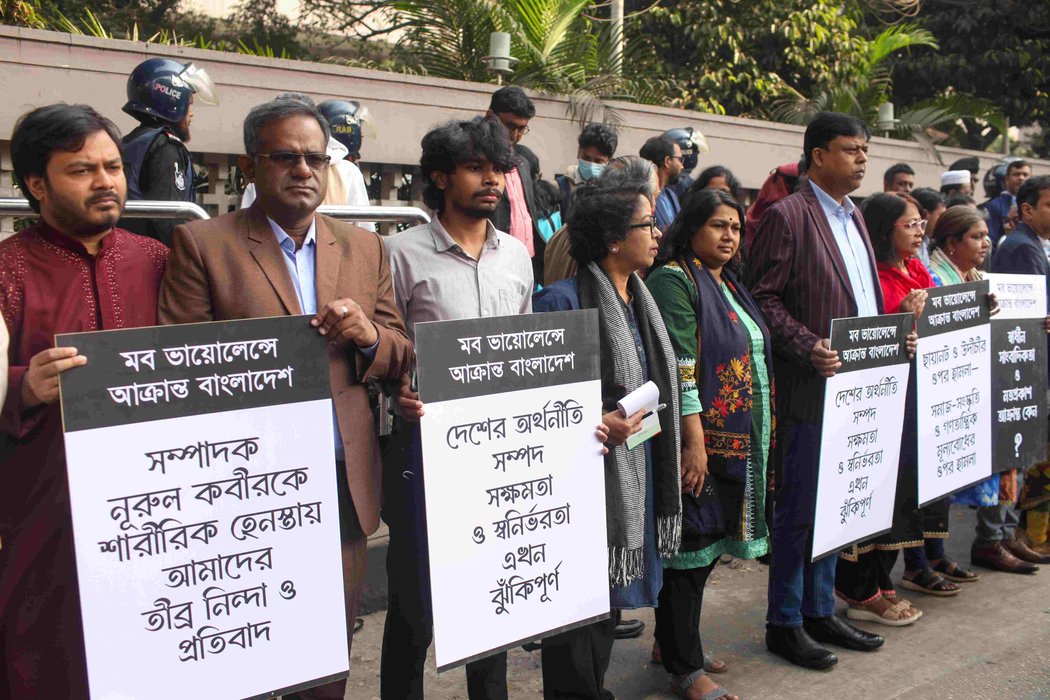
Nurul Kabir, editor of the English daily New Age and president of its editors’ council, was subjected to harassment while visiting to assess the situation of journalists trapped during the attack on the offices of the country’s leading English daily, The Daily Star. Video footage circulating on social media showed a group of attackers surrounding Nurul Kabir, shouting that he is an agent of the Awami League. Some grabbed and pulled at his shirt collar, while several assailants attempted to attack him multiple times.
Mobs also vandalised Chhayanaut, one of Bangladesh’s most respected cultural and educational institutions. On 19th December 2025, the cultural organisation Udichi was also attacked and set on fire.
Dipu Chandra Das, a Hindu garment worker and employee at the Pioneer Knit Composite factory, was beaten, tied to a tree and brutally assaulted to death on 18th December 2025 on allegations of blasphemy.
Human rights group Odhikar condemned the attacks, saying that “these killings, acts of sabotage and threats are deliberate attempts to derail the upcoming election”. They added that “the lack of intelligence surveillance and timely action by law enforcement agencies ahead of such grave acts of violence and sabotage has placed citizens’ security at serious risk.”
Other human rights groups said these apparently coordinated acts of violence represent a grave escalation in attacks against independent media, journalists, activists, and cultural spaces in Bangladesh.
The UN said that the mob attacks on leading media outlets and cultural centres in Bangladesh were “deeply alarming and must be investigated promptly and effectively by the government, and the perpetrators brought to justice without delay.”
Journalist targeted with anti-terror legislation
Prominent #Bangladeshi journalist Anis Alamgir has been taken to Dhaka Metropolitan Police’s Detective Branch. He was picked up from a gym in Dhanmondi for his outspoken voice & criticism against the govt. A ridiculous act as the govt claim to support freedom of speech.#Dhaka pic.twitter.com/elekPFew9e
— Nuruzzaman Labu (@labu8080) December 14, 2025
In December 2025, the authorities brought terrorism charges against veteran journalist Anis Alamgir.
According to the Committee to Protect Journalists (CPJ), on 15th December 2025, police opened an investigation against Alamgir and three other individuals under Bangladesh’s Anti-Terrorism Act, accusing the suspects of spreading propaganda in talk shows and social media posts, and conspiring to rehabilitate the banned Awami League party.
Alamgir, a former war correspondent who covered conflicts in Afghanistan in 2001 and Iraq in 2003, was arrested by the Detective Branch of Dhaka Metropolitan Police at a gym in the capital on 14th December 2025.
The arrest followed a complaint from an individual who identified himself as an organiser of a 2024 protest movement. Alamgir could face a maximum punishment of life imprisonment and a substantial fine if convicted under Bangladesh’s Anti-Terrorism Act.
A Dhaka magistrate granted police a five-day remand to question Alamgir in connection with the case.
Human rights group Ain o Salish Kendra condemned the arrest: “Using a law, originally enacted to prevent terrorist activities, against freedom of expression and journalism is against the fundamental principles of a democratic state,” it said in a statement.
Journalists criminalised and detained
#Bangladesh 🇧🇩: Journalist Monjurul Alam Panna was among 16 people taken into custody by police in Dhaka on 28 August, with a case filed under Bangladesh’s Anti-Terrorism Act (ATA). We demand a full investigation https://t.co/DM5eBcqMra
— IFJ (@IFJGlobal) September 4, 2025
Journalist Monjurul Alam Panna, who runs the YouTube channel Manchitro, spent 75 days in detention before being released on bail on 12th November 2025.
Panna was invited to speak as a journalist at a roundtable debate about Bangladesh's war of liberation and the constitution on 28th August 2025. Organised by the civil society platform Mancha 71 – dedicated to preserving the memory of the War of Independence – this public meeting was held at the auditorium of the independent association Dhaka Reporters Unity, in the capital, Dhaka. It suddenly degenerated when a group of individuals stormed in and accused the participants of “sympathy” for former Prime Minister Sheikh Hasina.
Instead of arresting the attackers, the police arrested 16 people who had been attending the meeting, including the journalist himself. Panna was detained under Bangladesh’s anti-terrorism law on the baseless charge of “conspiring to overthrow the interim government.”
Four other journalists are currently detained pending trial: Ekattor TV’s Farzana Rupa and Shakil Ahmad, Ekattor TV’s Mozammel Babu, and Shyamal Dutta, editor of the daily newspaper Bhorer Kagoj, on murder charges. According to CPJ, there is a lack of credible evidence supporting the allegations against them. It appears that these cases were filed vindictively due to their reporting and possible political affiliations.
Case brought against individuals and platform for political satire
In December 2025, ARTICLE 19 reported that a criminal case had been brought against 18 individuals, the satirical platform Earki, and at least 15 Facebook pages, on allegations of so-called ‘cyber harassment/defamation’. It was filed by Dhaka University Central Students’ Union (DUCSU) Vice President Abu Shadik Kayem on 1st December 2025.
The matter is likely to fall under the newly-enacted Cyber Protection Ordinance 2025, which replaced the Digital Security Act 2018 and the Cyber Protection Act 2023 — both of which were widely criticised for being tools of harassment against dissenting voices, political opponents, and to suppress freedom of expression
ARTICLE 19 stated that the accused include journalists, political activists, members or supporters of political parties – mostly affiliated with the Bangladesh Nationalist Party – and students. It is also relevant to note that the complainant is a member of the student wing of the Bangladesh Jamaat-e-Islami political party. Earki is a satirical platform operated by journalist and political satirist Simu Naser, and the case also targets Facebook pages featuring satirical content.