Freedom of association
The European Civic Forum’s Civic Space Report 2025, published in June 2025, warns of a sharp decline in civic freedoms in Bulgaria, amid a prolonged political crisis, the rise of far-right forces, and an increasingly hostile institutional climate. NGOs continue to face smear campaigns, stalled funding reforms, restrictive legislation targeting LGBTQI+ rights, and repeated restrictions on freedoms of expression and association.
One key concern highlighted in the report is the draft law on the registration of “foreign agents”, widely seen as an attempt to stigmatise and silence independent organisations. In a legal opinion issued in November 2024, the OSCE/ODIHR identified several flaws in the draft law, including vague definitions, a low reporting threshold, and potential for arbitrary interpretation. The opinion also criticised the lack of consultation with affected NGOs, warning that the stated goal of “transparency” does not justify unnecessary restrictions on fundamental freedoms. As reported in the previous update, the most recent bill, which was one of many attempts by the far-right Revival (Vazrazhdane) party to pass a “foreign agent” law, was voted down in Parliament in February 2025.
Freedom of peaceful assembly
Wave of Socio-Economic Protests
In recent months, Bulgaria has witnessed a surge of protests over economic hardship, stalled reforms, and the government’s plan to join the Eurozone.
Public transport workers in Sofia organised several rallies in May and June, demanding the approval of the city’s budget, warning that delays threatened both their salaries and essential public services. Trade unionists have warned that without immediate solutions, the system risks collapsing. The tense situation has led to the interruption of transport services and strong calls for the authorities to release the necessary funds.
At the national level, young doctors protested in several cities on 2nd June against poor working conditions and low pay, demanding urgent healthcare reforms. On 6th June, musicians from the Bulgarian National Radio Symphony Orchestra demonstrated against chronic underfunding of culture, while on 29th May, the Sofia Bar Association called for more funding for public legal aid.
In Varna, protests erupted on 9th June after the suspicious death of a young man allegedly involving police officers, sparking outrage over police violence and lack of accountability. Together, these movements highlight growing public frustration and a deepening crisis of trust in state institutions.
Anti-euro protests intensify
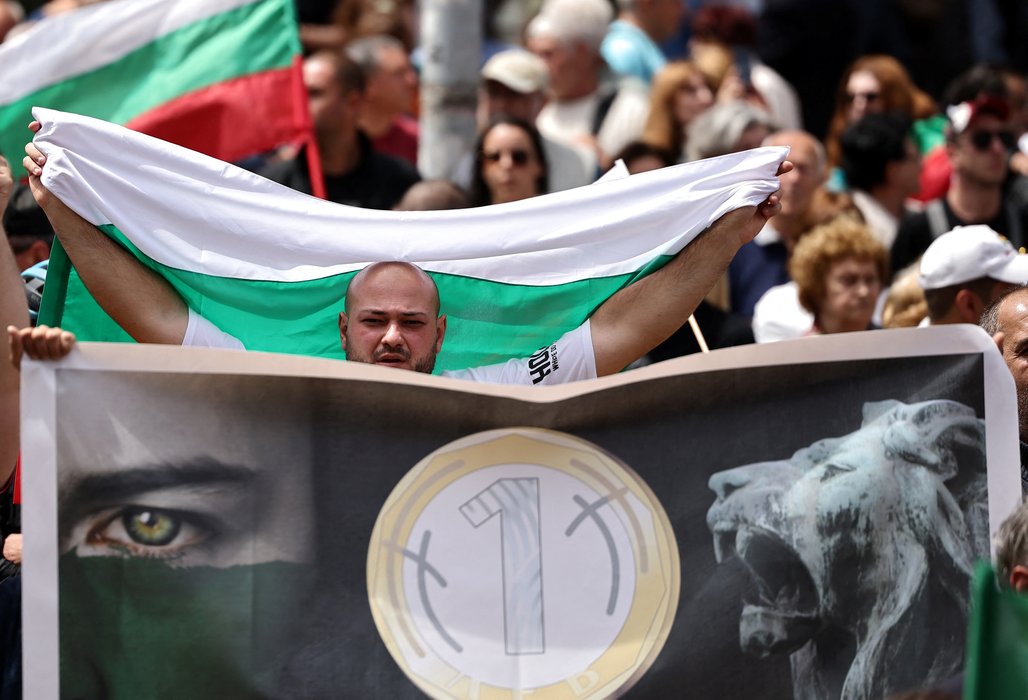
Anti-euro demonstrations, previously covered by the CIVICUS Monitor, have intensified. Over the weekend of 31st May–1st June, more than 100 protests took place across Bulgaria against the planned adoption of the euro in 2026, most organised by the pro-Russian far-right Revival (Vazrazhdane) party and endorsed by President Rumen Radev.
The largest rally took place in Sofia, where several thousand people gathered near the Presidency and the old National Assembly, waving Bulgarian and Russian flags, demanding a referendum to retain the lev and calling for the government’s resignation. The protest blocked traffic in the city centre for several hours but remained largely peaceful under a strong police presence. Smaller protests were held across the country, heavily promoted online and through the media.
Further mass protests against the euro took place in June and July. The demonstrations coincided with growing nationalist opposition ahead of the European Commission’s assessment of Bulgaria’s readiness to join the Eurozone. On 4th June, the European Commission released a convergence report confirming that Bulgaria is ready to adopt the single currency from 2026, meets the criteria, and can maintain economic stability and integrate into the eurozone’s economic framework. During a demonstration that same day, tensions rose when protesters stopped a police van and briefly blocked the road, leading to a scuffle in which a woman fell before officers broke through the cordon. After confirming the van was empty, protesters allowed it to pass.
In late June, under the slogan “Leva City”, protesters linked to the Vazrazhdane party set up a protest camp outside key government institutions in central Sofia, condemning what they described as the loss of economic sovereignty and the rushed pace of euro adoption. The demonstrators vowed to continue their protest until 8th July, when the EU’s ECOFIN Council was scheduled to vote on Bulgaria’s accession to the Eurozone. Clashes with police were reported in early July, including on 4th July when protesters attempted to reach the entrance to parliament, resulting in one arrest for hooliganism and another temporary detention. On 8th July, EU finance ministers formally endorsed Bulgaria’s plan to adopt the euro, following positive assessments from the European Commission and the European Central Bank.
Trade unionist arrested at forestry workers’ protest
On 14th July 2025, Todor Kapitanov, Vice President of the Confederation of Independent Trade Unions in Bulgaria (CITUB) and Chair of the National Strike Committee, was arrested during a peaceful protest by forestry workers on the Trakia highway. According to CITUB, the demonstration, held to demand fair wages and decent working conditions, was met with a heavy police presence, and Kapitanov was detained violently and held in handcuffs for several hours, reportedly sustaining injuries. The European Trade Union Confederation (ETUC) condemned the incident as an unacceptable act of repression and a serious breach of trade union rights, calling on the Bulgarian government to end intimidation and ensure workers can exercise their democratic freedoms without fear.
Protests over the Arrest of Varna’s Mayor
The arrest of Varna Mayor Blagomir Kotsev on 8th July 2025 on corruption charges triggered a wave of protests across Bulgaria and abroad. Demonstrations took place in Varna, Sofia, Ruse, and cities such as Brussels, Berlin and London, uniting thousands in what participants described as a defence of democracy and justice. The largest rally was held in Varna, where deputy mayors, councillors and residents demanded the release of Kotsev and two detained councillors. In Sofia, hundreds marched from the Palace of Justice to the National Assembly under the slogan “The law is not a weapon”, joined by MPs and civic activists who accused the authorities of orchestrating political repression. In Ruse, protesters gathered along the Danube to collect signatures for a petition supporting Kotsev, while in Brussels, Bulgarian expatriates and Renew Europe MEPs rallied outside the European Parliament, calling for an independent judiciary and an EU fact-finding mission to Bulgaria.
Kotsev, who belongs to the centrist, anti-corruption party We Continue the Change (PP), is accused of soliciting a bribe. However, a key witness later claimed his testimony had been coerced by officials from the Anti-Corruption Commission. Kotsev’s party and its coalition partner Democratic Bulgaria (DB) contend that the prosecution is part of a broader campaign by Prosecutor General Borislav Sarafov and the GERB-led government to silence opposition voices. Another PP member, Sofia Deputy Mayor Nikola Barbutov, had been arrested on similar charges just weeks earlier.
Kotsev was elected mayor of Varna in November 2023, during PP’s brief spell in government alongside GERB in 2023–2024. In January 2025, a new government led by GERB’s Rosen Zhelyazkov came to power in coalition with the Bulgarian Socialist Party – United Left (BSP–OL) and the populist There Is Such a People (ITN) party, backed in parliament by the Movement for Rights and Freedoms (DPS). This alignment ended nearly four years of political instability but, according to critics, consolidated conservative control over state institutions.
In Brussels, the Renew Europe Group, to which PP belongs, denounced the arrest as part of an “escalating assault on democracy and the rule of law”. Its president, Valérie Hayer, urged EU institutions to respond, citing increasing state capture and the politicisation of the judiciary and anti-corruption bodies in Bulgaria. Protesters have criticised the silence of EU institutions on the issue, noting that Commission President Ursula von der Leyen’s CDU belongs to the same European parliamentary alliance as Bulgaria’s ruling GERB.
Freedom of expression
PM publicly discredits journalist
On 2nd July, Bulgarian journalist Petya Vladimirova, from the daily Dnevnik, was publicly discredited by former Prime Minister Boyko Borisov for posing what he called an “inappropriate” question. Borisov accused Vladimirova of being an opposition hack after she asked about criminal proceedings against activists from the opposition We Continue the Change (PP) party. Borisov responded loudly and aggressively, ridiculing Vladimirova for acting as a “lawyer” for the PP. The prime minister later apologised, admitting his tone was improper but explicitly refusing to retract the accusation.
In response, the Association of European Journalists (AEJ) Bulgaria condemned Borisov’s behaviour, stressing that Vladimirova’s questions were legitimate and of public interest. The organisation warned that accusing journalists of political bias for asking critical questions undermines democratic accountability and reflects a broader pattern of hostility towards reporters.