Civic space in Afghanistan remains rated as ‘closed’. Since the Taliban seized power in August 2021, the de facto authorities continue to commit human rights violations and crimes under international law against the Afghan people, especially women and girls, with absolute impunity. Civil society activists, journalists and others face severe restrictions, and activists have been arbitrarily arrested and detained for their criticism of the Taliban. Those who are detained are often denied access to urgent medical and legal assistance. Others have faced harassment, intimidation and violence, and some have been killed. The Taliban have also raided media offices and detained journalists. Some activists have been tortured and ill-treated.
On 6th October 2025, the UN Human Rights Council approved a landmark resolution creating an independent investigative mechanism for Afghanistan. The resolution was led by the European Union and adopted by consensus. The new mechanism is tasked with systematically collecting, preserving, and analysing evidence of serious violations of international law — including war crimes and crimes against humanity — as well as severe human rights abuses. It will prepare case files to assist prosecutions in national, regional, or international courts. Importantly, the mandate goes beyond Taliban actions; it also covers abuses committed by former government officials, warlords, non-state armed groups, and international forces in Afghanistan.
On the same day, alongside the adoption of the independent investigative mechanism, the UN Human Rights Council also extended the mandate of the Special Rapporteur on the situation of human rights in Afghanistan, Richard Bennett.
From 8th to 10th October 2025, the Permanent People’s Tribunal (PPT) held its 55th session in Madrid, titled “Women of Afghanistan.” The Tribunal examined extensive evidence and testimonies on the systematic persecution of Afghan women and girls under Taliban rule since August 2021.The prosecution argued that the Taliban’s decrees—over a hundred in total—form an intentional system of oppression amounting to crimes against humanity, specifically gender persecution and other inhumane acts under the Rome Statute. Witnesses described bans on education and work, restrictions on movement, and widespread abuses including detention, torture, and disappearances. These measures have caused deep psychological, social, and economic harm across the country. A full verdict will be issued within two months.
In recent months, the Taliban has shut down the internet and restricted social media platforms. It has also cracked down on the media with censorship and arrests. Activists have also been arrested while a political analyst was shot. The Taliban has also banned women from working at the UN.
Expression
Taliban imposes internet shutdown and restricted social media platforms
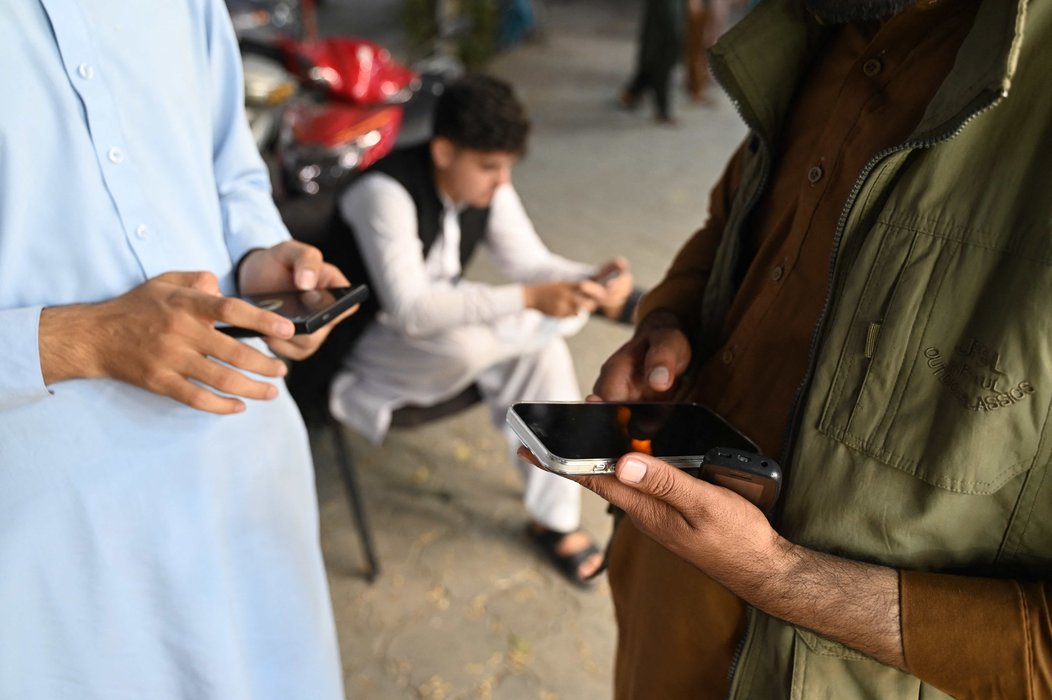
Afghanistan experienced a major internet shutdown beginning on 16th September 2025, when the Taliban authorities cut fibre-optic and wi-fi access in Balkh province, under the pretext of preventing the “misuse of internet” and spread of “immoral acts”. Within days, the restrictions expanded to other provinces including Takhar, Kunduz, Baghlan, Badakhshan, and Kandahar. By 29th September 2025, a nationwide blackout had affected both fixed and mobile internet services, leaving millions disconnected.
According to Human Rights Watch, journalists in Afghanistan reported being unable to make local and international calls because the shutdown had affected both mobile and fibre-optic networks, including platforms like WhatsApp and Signal. Documenting the impact of the shutdown has been difficult because it is not possible to reach anyone inside the country while internet and phone networks are down.
Further, humanitarian aid groups said that the blackout hindered their response in Afghanistan, which depends on internet connectivity for outreach, coordination, and aid delivery. Indrika Ratwatte, the United Nations’ humanitarian coordinator in Afghanistan, said the shutdowns were affecting day-to-day business and the provision of critical aid: “This is another crisis on top of the existing crises, and the impact is going to be on the lives of Afghan people.”
With girls and women already barred from schools, universities, and most jobs, online access had been their last link to education and income. The shutdown crippled remote learning and digital employment opportunities, silencing thousands of women educators, entrepreneurs, and activists.
Inside Afghanistan, women responded to the internet shutdown with acts of visible defiance, scrawling slogans on walls: “We write, even on the walls.”
UN Women stated: “When the Taliban recently cut off the Internet and phone networks across Afghanistan, millions of women and girls were silenced. For those with connectivity, the blackout severed their last link to the outside world – a fragile connection that had kept education, work, and hope alive.”
Connectivity was largely restored on 1st October 2025. However, on 7th October 2025, the Taliban also restricted access to popular social media platforms. Filters were applied to restrict certain types of content on sites including Facebook, Instagram and X, said sources at the Ministry of Communications and Information Technology. It was not clear exactly what sort of posts are subject to filtering.
Access to the internet is widely recognised as an indispensable enabler of a broad range of human rights. The Office of the UN High Commissioner for Human Rights (OHCHR) has reported on the dramatic effects of internet shutdowns, including the impact on freedom of expression and political participation. The OHCHR and the UN Human Rights Council have urged governments to refrain from imposing such shutdowns.
Crackdown on the media
Afghanistan: Taliban Tramples Media Freedom https://t.co/yTx4QW6eHR
— Human Rights Watch (@hrw) October 23, 2025
In the four years since the fall of Kabul on 15th August 2021, the International Federation of Journalists (IFJ) has documented the Taliban’s sustained campaign against freedom of expression and association, deteriorating working conditions, and the closure of independent media. Hundreds of Afghan journalists have been forced into exile around the world as a result.
Research by HRW published in October 2025 found that remaining news outlets in the country face surveillance and censorship, and journalists and other media workers are punished for any perceived criticism. Afghan journalists in exile who fled Taliban persecution now face increasing threats of forced return to Afghanistan, where they fear retaliation.
News outlets report that the Taliban’s intelligence agency monitors all content and the “morality police” ensure adherence by staff to prescribed dress codes and other regulations. Local officials enforce official rules arbitrarily, leading to varying degrees of censorship across provinces. The Taliban’s severe restrictions on women have caused a sharp decline in the number of female journalists in the country.
Reporters whom the Taliban accuse of working with media in exile or having contacts with opposition groups face detention, severe beatings, and death threats. The Taliban’s Ministry for the Promotion of Virtue and Prevention of Vice (PVPV) regularly inspects media offices. Officials have detained media workers for violating the ministry’s law on the separation of workspaces for men and women, prohibitions on broadcasting women’s voices, and playing music on television and radio.
Taliban authorities review reports prior to publication and have curtailed women’s representation in the media, instructing the media not to air soap operas and dramas featuring women. They have required women employed in the media to wear hijabs.
Afghan journalist Shikib Ahmad Nazari was detained by the Taliban in July 2025 after a raid at his office. Nazari, who reports for Japan’s Nippon TV News among others, was detained after around 15 Taliban intelligence agents and morality police raided his office in the capital Kabul. Nazari was held at a detention centre of the morality police for a week and was later transferred to a Taliban intelligence prison in Kabul. He faced charges of “collaborating with Afghan media abroad.”
Nazari’s arrest was only confirmed publicly after a Taliban-linked account on social media platform X released a video of the journalist on 21st August 2025. The post was deleted shortly after publication, for unknown reasons.
On 17th October 2025, the Taliban’s General Directorate of Intelligence (GDI) ordered the suspension of broadcasts by Shamshad TV, one of Afghanistan’s most prominent private media outlets. According to reports, the directive came directly from Kandahar, the political centre of the Taliban leadership.
The suspension halted Shamshad’s television, radio, and social-media services across several provinces, including Kandahar, Takhar, and Badghis, leaving audiences without access to one of the country’s few remaining independent news voices. No official reason for the shutdown was provided.
Shamshad TV resumed operations on 19th October 2025, following a 48-hour suspension.
Taliban-Pakistan clashes result in journalist casualties
On 15th October 2025, Pakistani forces launched cross-frontier strikes into Afghanistan’s Khost province. During the attacks, three staff members of the Taliban-controlled Radio Television Afghanistan (RTA) — reporter Abdul Ghafor Abed, broadcast manager Tawab Arman, and their driver — were caught in the bombardment while covering the situation in Zazi Maidan district. Abed was killed, while Arman and the driver were injured.
The Afghanistan Journalists Center (AFJC) condemned the attack by Pakistani security forces on Afghan journalists in Khost province and called for a thorough investigation and justice for those responsible.
Media rights organisations and journalist unions have echoed this demand, urging the international community to ensure stronger protections for journalists and media workers reporting from conflict-affected frontiers.
Association
Arrest and detention of activists
According to reliable information obtained from prison, Mr. Mojtaba Mohammadi, a human rights activist, has been imprisoned in Parwan province after being deported from Iran and is subjected to severe physical and psychological torture. His condition is extremely concerning, and… pic.twitter.com/RYHkhTgXTF
— ًSanam kabiri (@sanam_kabiri) September 11, 2025
In Parwan province, Mojtaba Mohammadi, a young civil rights activist, was reportedly being held in Taliban custody in Charikar following his forced deportation from Iran, his family confirmed. Mohammadi’s brother said that Taliban intelligence agents arrested him in August 2025 in the Bayan Olya area of Parwan, shortly after his return to Afghanistan. Mohammadi had reportedly participated in anti-Taliban protest activities abroad.
Civil society organisations and women’s protest movements have expressed deep concern over his detention, alleging that Mohammadi has been subjected to severe physical and psychological torture while in custody. They have called for his immediate and unconditional release.
Taliban intelligence agents in Balkh province have detained Hamid Ansari, a civil activist and university lecturer, over allegations of receiving funds from the UN mission in Afghanistan (UNAMA), local sources reported.
— KabulNow (@KabulNow) September 9, 2025
Read more: https://t.co/M320gS4E5x pic.twitter.com/OXDd7sCe7Q
Hamid Ansari, a civil society activist and university lecturer from Balkh, was reportedly arrested by Taliban intelligence forces in Kabul province about a month before media reports emerged on 9th September 2025. He was allegedly detained on accusations of receiving financial support from the United Nations Assistance Mission in Afghanistan (UNAMA).
Ansari leads Northern Youth for Peace, a Balkh-based organisation that has conducted peace and civic engagement campaigns across several northern provinces. According to people familiar with the case, his arrest followed accusations by the Taliban’s provincial Department of Economy that his organisation continued projects with UNAMA without coordinating with local authorities.
His family has been denied contact since his detention, and his whereabouts remain unknown. Taliban authorities have not issued any statement regarding his arrest or the allegations against him.
In the same month, Taliban intelligence members detained a social media activist - Mohammadullah Gran - in southeastern Khost province for publishing critical posts online. Relatives said his detention was linked to critical commentary he had shared on Facebook. Sources added that after his arrest, Taliban officials deleted the posts from his account.
Political analyst shot
Political analyst Salim Paigar was shot and critically wounded in an armed attack near his home in Kabul in October 2025. The shooting occurred near Hanzala Mosque in the Shahr-e-Naw district, one of the capital’s busy neighbourhoods. Witnesses said neighbours rushed to his aid after hearing gunfire and managed to overpower and detain the suspected assailant until security forces arrived.
Sources inside the hospital reported that Taliban authorities have restricted access to Paigar, preventing family members and acquaintances from visiting him.
Paigar, a well-known commentator in Kabul, had publicly supported some Taliban policies but had also voiced criticism over issues such as the closure of girls’ schools. His nuanced position reportedly drew attention from various political factions.
Taliban bans women from working at the UN
The Taliban has also banned women working with the United Nations. In a statement on 11th September 2025, the United Nations Assistance Mission in Afghanistan (UNAMA) reported that Taliban authorities have prohibited Afghan women from working in UN offices throughout the country, a move the organisation warns could severely disrupt humanitarian operations.
The ban was first implemented on 7th September 2025 when Taliban guards prevented female employees from entering UN facilities in Kabul. It has since been extended nationwide through both written and verbal directives.
UNAMA noted that Taliban security personnel are now deployed outside UN compounds in Kabul, Herat, and Mazar-i-Sharif to enforce compliance and have restricted travel by female staff to field locations, including earthquake-affected zones and border areas where Afghan refugees are returning from Iran and Pakistan.
“The United Nations in Afghanistan is engaging the de facto authorities and calls for the immediate lifting of the restrictions to continue critical support to the Afghan people,” UNAMA said, emphasising that the measures contravene international protocols protecting UN personnel.
UN Special Rapporteur Richard Bennett echoed this position on X, stating: “Blocking women from accessing workplaces or supporting communities in need is further proof that the Taliban must not be normalized until they change course.”