about-demo
About Us
The CIVICUS Monitor is a global research tool that tracks the state of civic space in every country. Created by civil society, it provides timely data and analysis on the freedoms of association, peaceful assembly and expression, while monitoring the actions and trends that shape these rights. Through an interactive world map and live updates from local partners, the Monitor helps people understand where civic freedoms are being protected, restricted or under threat.
Methodology
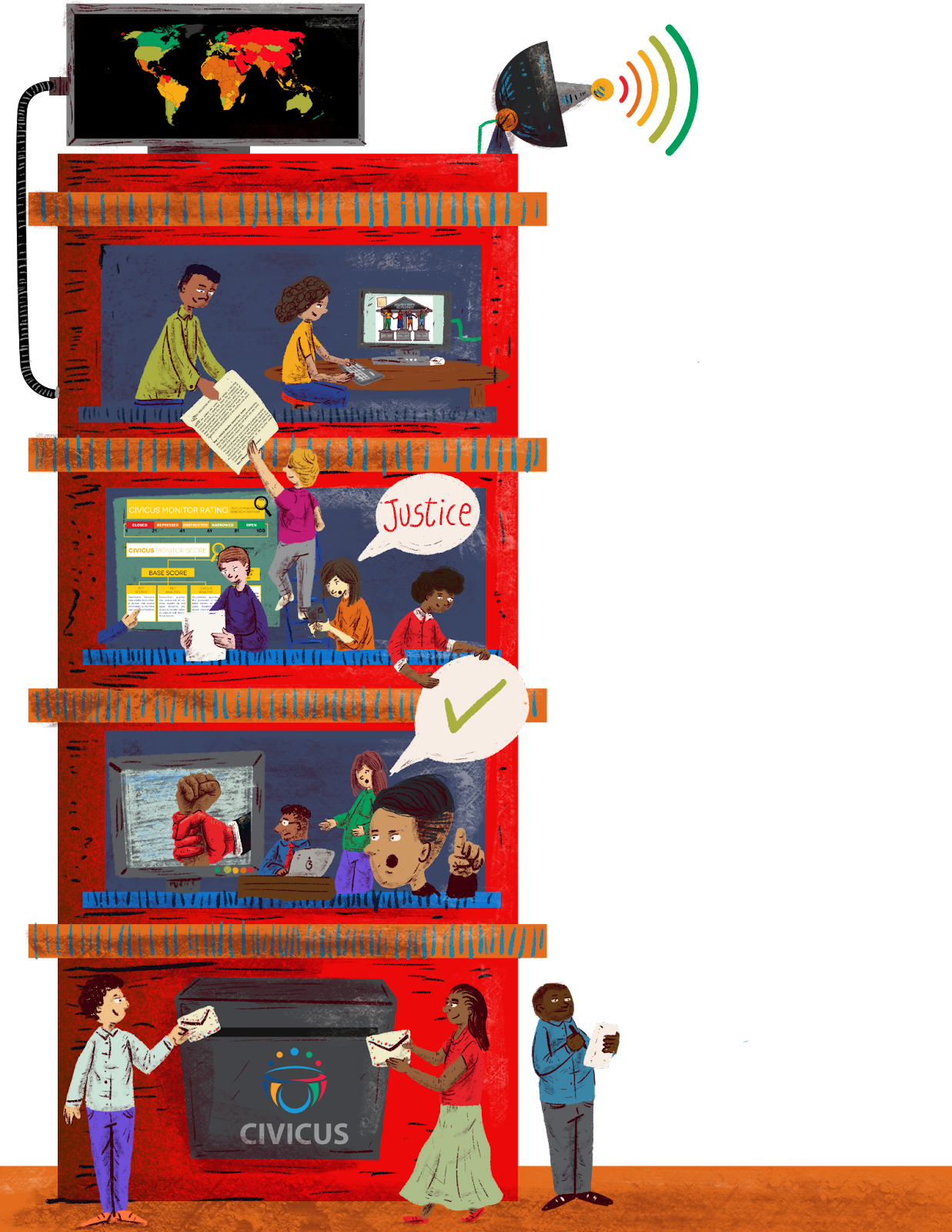
The CIVICUS Monitor combines data from a range of sources. Through a series of standard calculations and verification checks, we produce a guiding score for each country that we use to assign ratings on the state of civic space. Civic space is defined as the respect in law and practice for the freedoms of association, peaceful assembly and expression. Built into each of the three core freedoms is the understanding that a state has a duty to protect civil society, and must go beyond simply refraining from interfering in citizens' enjoyment of their rights.
Through a structured approach, we ensure that our treatment of data is transparent and that consistency is achieved in the analysis of different countries. Data generated by local civil society influences the ratings more strongly than data from other sources and this is reflected in the weight that we give to different data sets.
The cornerstone of the CIVICUS Monitor methodology is the combination of several independent sources of data on civic space. Because civic space is influenced by complex economic, social and political processes, the CIVICUS Monitor draws upon a number of quantitative and qualitative data for its analysis and ratings. The intention is to mitigate sampling errors and data bias and prevent over-reliance on any particular data set.
CIVICUS will always reflect on the data generated by the CIVICUS Monitor and ensure that its methodology includes the latest thinking and data sources on civic space. As part of the development process of the CIVICUS Monitor, we have updated the methodology twice since 2018. The CIVICUS Monitor methodology was designed to include a multiplicity of sources that are used to get to the final ratings. This was intentionally done to reduce over-reliance on any particular data source and to enhance the stability and sustainability of the CIVICUS Monitor ratings in the face of changes. Therefore, despite the methodological improvements, the rating information is still comparable over time and between countries.
Read our detailed methodology paper here.
GUIDING
PRINCIPLES
The core mission of CIVICUS is to strengthen citizen action and civil society throughout the world. Consistent with this, the CIVICUS Monitor is built by civil society for civil society and is guided by four core principles:
Transparency
We publish our methodology and approach on this website, and demonstrate where we draw information from and how we arrive at our ratings. While information from activists working in very dangerous circumstances is protected, as a general rule we will ensure that as much data as possible is published in its original form. This reflects our longstanding commitment to promoting legitimacy, transparency and accountability within civil society.
Inclusivity
Perhaps the most important innovation of the CIVICUS Monitor is its attempt to incorporate directly the voices and views of local civil society organisations into an international measurement of civic space. We have developed multiple methods for prioritising the views of local groups in our analysis and ratings. We believe this will ensure a broad ownership which, as internet connectivity continues to increase, can be further enhanced over time. Further, we are making every effort possible to receive and analyse content in major world languages.

Flexibility
The CIVICUS Monitor is being developed through an intentionally iterative process of conversations with experts and civil society groups from all over the world. As its development and roll out continues, we will continue to seek feedback and shape our approach in line with comments and advice received from a growing cohort of users. While our primary focus is on generating an international dataset to monitor global trends, we also know we need to be flexible and ensure that the data is useful at the country level, where civil society groups may wish to use evidence from the CIVICUS Monitor to further their advocacy initiatives. In this, we will strive to remain flexible, listen to our membership and partners and strike a balance between the competing priorities of all users.
Activism
We want the data shared through the CIVICUS Monitor to be used to improve the
quality and
effectiveness of civic space and activism everywhere. We believe strongly that a
robust
measurement
of civic space, truly owned by civil society, will be an invaluable new tool in the
hands of
activists across the globe. We will work hand in hand with our members to promote
the
growing
ownership and use of this platform for campaigns, further research and monitoring of
the
performance
of governments against their international commitments.
If you have ideas about how we can improve any aspect of the CIVICUS Monitor, we
would love
to hear
from you. Feel free to use the form below to send us a message and we'll get back to
you to
start a
conversation.
RESEARCH PARTNERS

Contact Us
Contact Us
We are always looking to expand our community and would love to hear your questions, comments and feedback on the CIVICUS Monitor.