Iran
PRESS RELEASE
Iran added to human rights watchlist amid violent crackdown and regional conflict
- Thousands killed and tens of thousands arrested following nationwide demonstrations and a military‑style crackdown
- Complete national internet shutdowns imposed twice in two months, severely restricting communication and documentation
- Unlawful US‑Israel airstrikes trigger further restrictions, heightening risks for detainees, journalists and activists
25 March 2026 – Iran has been added to the CIVICUS Monitor Watchlist as civic space rapidly deteriorates following a deadly crackdown on nationwide protests and the escalation of regional conflict. As US and Israeli airstrikes trigger further restrictions and neighbouring countries tighten controls in response, fundamental freedoms in the country and the region face unprecedented threats.
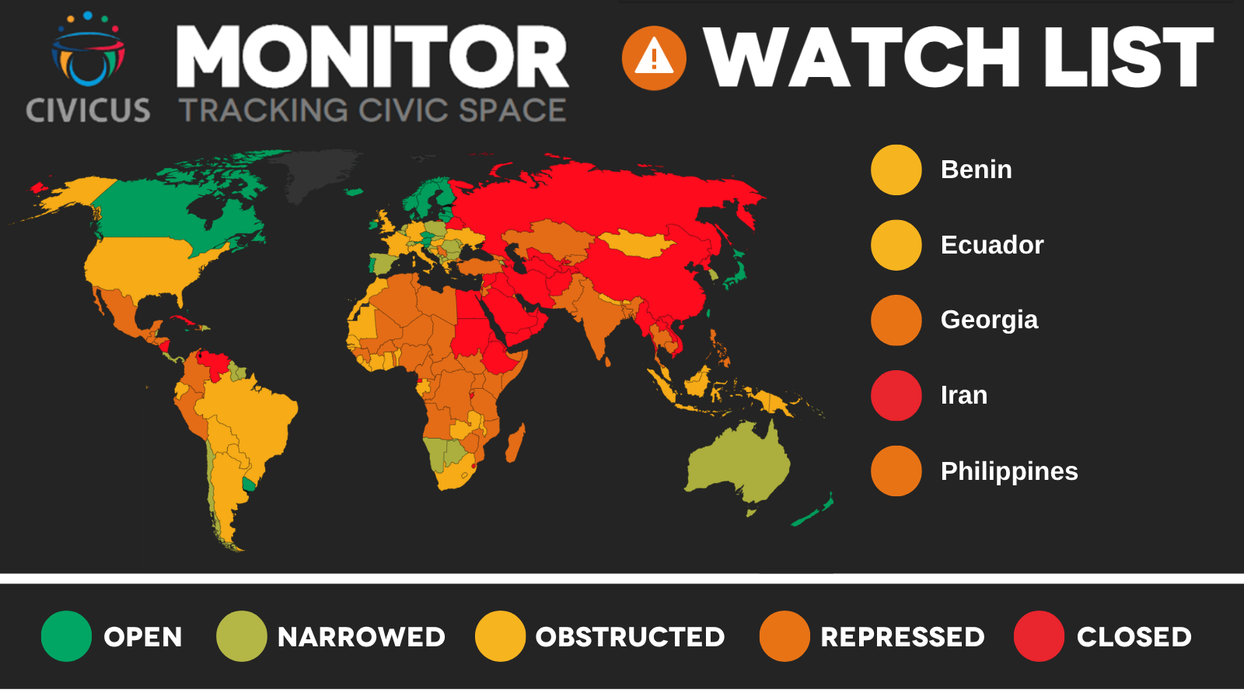
The CIVICUS Monitor currently rates Iran as “Closed”, the worst rating a country can receive, indicating serious restrictions to the freedoms of expression, peaceful assembly, and association. Alongside Iran the latest Watchlist also includes Benin, Ecuador, Georgia and the Philippines, all countries where there has been a recent and rapid decline in civic freedoms.
Mass protests met with lethal force
The biggest demonstrations since 2009 erupted on 28 December 2025, driven by public anger over a sudden currency depreciation, spiralling economic instability and demands for political reform. On 8 January 2026, authorities imposed a complete internet and telecommunications shutdown before launching a military‑style assault on protesters.
Between 8 and 11 January, security forces mass‑killed thousands using overwhelming firepower. Reuters later reported that officials had verified at least 5,000 deaths, including around 500 security personnel, with the HRANA network documenting more than 24,000 arrests. Some detainees now face the death penalty, following public threats by Iran’s head of judiciary that consequences would be “decisive, maximum and without any legal leniency.”
“These actions represent one of the most violent reprisals against peaceful dissent in recent Iranian history,” said Sylvia Mbataru, CIVICUS Civic Space Researcher for the MENA region. “The scale of killings, arrests and enforced disappearances indicates a systematic attempt to extinguish protest.”
Conflict drives further repression
Conditions further deteriorated further after US and Israeli forces launched coordinated airstrikes on 28 February 2026, killing at least 1,255 people and injuring thousands. Authorities responded with a second nationwide internet blackout within two months, blocking major platforms and VPNs and severely disrupting the flow of lifesaving information.
Journalists have resorted to satellite links, encrypted channels and smuggled footage despite severe risks and bans on tools such as Starlink. Meanwhile, concerns are mounting over the fate of thousands detained during the protests, including forcibly disappeared demonstrators and prominent prisoners of conscience such as Narges Mohammadi, recently handed an additional seven‑year sentence.
Public mobilisation continues despite extreme danger
Despite the repression and ongoing conflict, thousands have continued gathering to express diverse views following the death of Supreme Leader Ali Khamenei and the appointment of Mojtaba Khamenei as his successor.
“The Iranian people continue to demand dignity, justice and accountability even at unimaginable personal risk,”said Mbataru. “Their courage underscores the urgent need for international action to protect civic freedoms and ensure the safety of detainees and protesters.”
Notes to the Editor
On Iran’s civic space rating of Closed:
Iran is currently rated Closed by the CIVICUS Monitor. There are a total of 33 countries in the world with this rating (see all). This rating is typically given to countries where there is complete closure - in law and in practice - of civic space. Any criticism of the ruling authorities is severely punished and there is virtually no media freedom (see the full description of ratings). See Frequently Asked Questions about the Watchlist here.
About the CIVICUS Monitor:
The new watchlist is released by the CIVICUS Monitor, an online platform that tracks the latest developments to civic freedoms, including the freedoms of expression, association and peaceful assembly, across 198 countries and territories.