Benin
PRESS RELEASE
Benin added to human rights watchlist as repression intensifies ahead of April elections
- Government crackdown following December 2025 failed coup attempt
- Arrests, prosecutions, online restrictions and excessive force deployed to silence dissent
- Growing pressure on opposition, journalists, activists and civil society ahead of 12 April presidential elections
25 March 2026 – Benin is added to the CIVICUS Monitor Watchlist as the country faces a rapid deterioration in conditions for political participation and public debate ahead of the presidential elections scheduled for 12 April 2026. Only two candidates were qualified by the Constitutional Court to run for president – Romauld Wadagni and Paul Hounkpè – with candidates from other parties, including opposition party Les Démocrates, barred from running due to stringent 2024 Electoral Code requirements. Additionally, the legislative and municipal elections on 11 January 2026 resulted in a National Assembly with no opposition representation, demonstrating how democratic space has substantially eroded. A wave of repression following the December 2025 failed coup attempt has severely undermined fundamental freedoms.
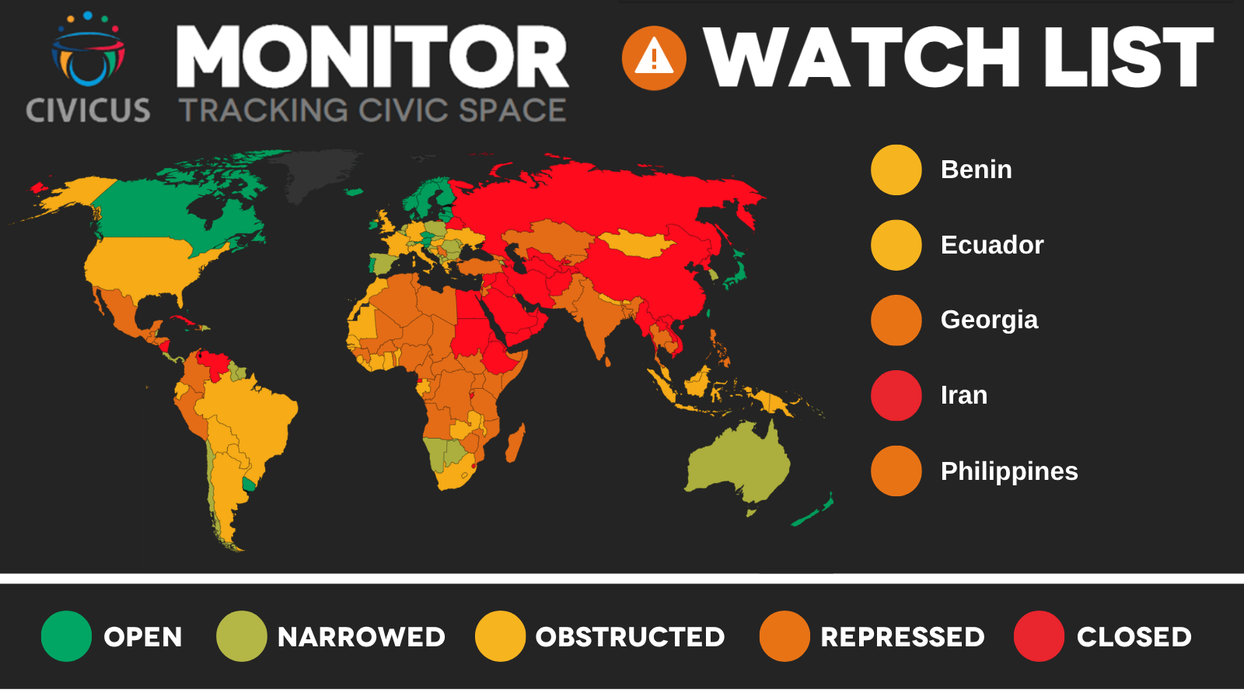
The CIVICUS Monitor currently rates Benin as “Obstructed”, indicating serious challenges to the freedoms of expression, peaceful assembly and association. Benin joins Ecuador, Georgia, Iran and the Philippines in the latest Watchlist of countries experiencing a significant decline in civic freedoms.
“The post‑coup environment has triggered a sharp and deeply worrying contraction of democratic space in Benin,” said spokesperson “The climate of fear emerging around the elections threatens meaningful participation and open public dialogue.”
Since the attempted coup led by Lieutenant Colonel Tigri Pascal in December 2025, authorities have responded with sweeping measures that go far beyond addressing the security incident itself. Opposition politicians, journalists, activists and ordinary social media users have faced high-profile arrests and prosecutions under broad charges including incitement to rebellion and electronic harassment. Rights groups report that these charges are being applied in an overly expansive and politically motivated manner, particularly against individuals critical of the government’s handling of the crisis.
Restrictions on civil liberties have intensified ahead of the April elections. Legal provisions limiting peaceful assembly, coupled with the excessive use of force by security personnel, have deterred public gatherings and opposition mobilisation. Civil society organisations report multiple instances in which demonstrations were prohibited or dispersed under vague security justifications. At the same time, authorities have suspended digital platforms and social media channels, citing unverified misinformation concerns. These are actions that have curtailed online organising, public communication and independent reporting. Authorities have frequently used restrictive provisions in the Digital Code (Law 2017-20) against critics since its adoption in 2018, particularly article 550 which criminalises “publication of false news” and “harassment via electronic means”, with journalists and critics often prosecuted before the Repression of Economic Crimes and Terrorism Court (CRIET).
“Benin was once regarded as a model of democratic stability in West Africa, but the current pattern of repression marks a worrying shift,” said spokesperson. “Ensuring open political participation, safeguarding independent voices and allowing peaceful mobilisation are vital for a credible electoral process.”
Benin’s increasingly restrictive environment risks severely undermining political dissent and opposition mobilisation during the upcoming vote. The targeted repression of dissenting voices, coupled with the intimidation of political opponents, is contributing to a deeply unbalanced electoral landscape. Several opposition figures have reportedly been detained under arbitrary conditions, raising concerns about due process and the ability of political actors to campaign freely.
Independent media and civil society organisations also face mounting pressure. Journalists have reportedly been subjected to intimidation or investigation for critical reporting, while activists have expressed concern that the threat of arrest or digital surveillance is limiting their ability to speak out. This has contributed to a widespread sense of self‑censorship essential to a credible and inclusive electoral process. .
The combined effect of these measures such as restrictions on peaceful assembly, arbitrary detentions, digital platform suspensions, and pressure on media creates an environment incompatible with the basic dignity of being able to speak, organise or criticise power without it turning into a personal risk.
NOTES TO THE EDITOR
On Benin’s civic space rating of Obstructed:
This rating is typically given to countries where civic space is heavily contested by power holders, who impose a combination of legal and practical constraints on the full enjoyment of fundamental rights (see full description of ratings). See Frequently Asked Questions about the Watchlist here.
There are a total of 39 countries in the world with this rating (see all).
About the CIVICUS Monitor:
The new watchlist is released by the CIVICUS Monitor, an online platform that tracks the latest developments to civic freedoms, including the freedoms of expression, association and peaceful assembly, across 198 countries and territories.