Watchlist July 2025
July Watchlist 2025
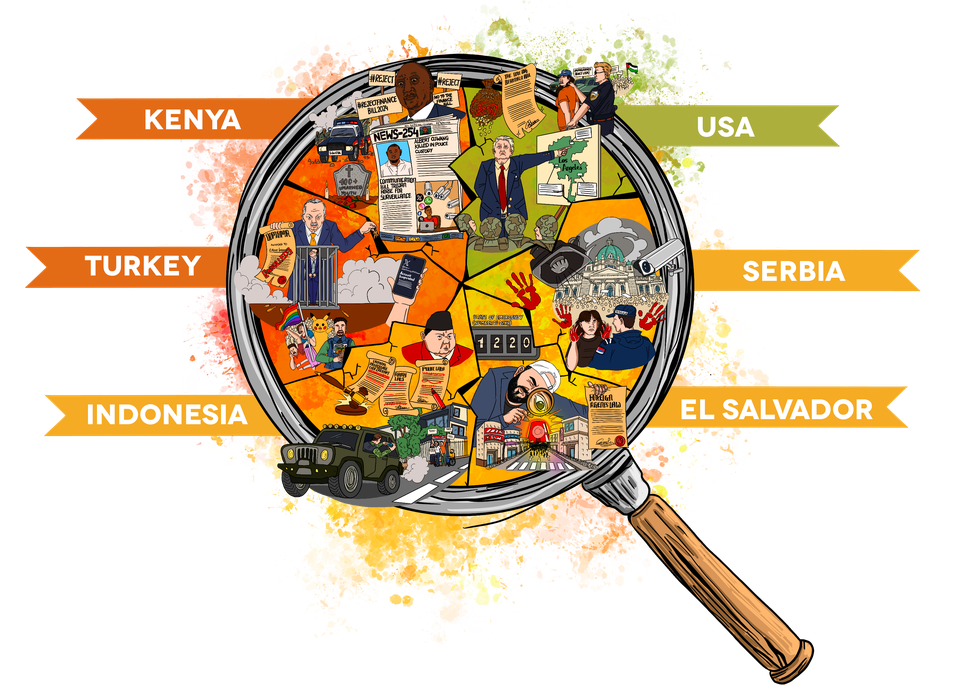
Latest Update: 30 July 2025 - The new CIVICUS Monitor Watchlist highlights serious concerns regarding the exercise of civic freedoms in El Salvador, Indonesia, Kenya, Serbia, Turkey and the United States of America .
The Watchlist draws attention to countries where there is a serious decline in respect for civic space, based on an assessment by CIVICUS Monitor research findings, our research partners and consultations with activists on the ground. In the coming weeks and months, the CIVICUS Monitor will closely track developments in each of these countries as part of efforts to ensure greater pressure is brought to bear on governments. CIVICUS calls upon these governments to do everything in their power to end the ongoing crackdowns immediately and ensure that perpetrators are held to account. Descriptions of the civic space violations happening in each country are provided below. If you have information to share on civic space in any of these countries, please write to monitor@civicus.org

El SALVADOR'S CIVIC SPACE RATING: OBSTRUCTED
El Salvador has intensified its repression of human rights defenders, journalists, and civil society organisations (CSOs). The country has remained under a state of emergency for over three years, renewed 40 times since March 2022.
This is the third time El Salvador has been added to the Watchlist under President Nayib Bukele’s administration, following its inclusion in March 2022 and July 2024. Its repeated inclusion underscores persistent concerns over the assault on civic freedoms and the erosion of democratic institutions, illustrating Bukele’s increasingly authoritarian grip on power.
Alarming cases of criminalisation targeting human rights defenders have been documented in 2025. On 18 May, authorities arbitrarily detained Ruth Eleonora López, head of Cristosal’s Anti-Corruption and Justice Unit, on embezzlement charges - allegedly in relation to her work at the Supreme Electoral Tribunal. López has been recognised internationally for her work investigating corruption and defending human rights. On 6 June, constitutional lawyer Enrique Anaya, known for criticising government abuses, was also detained on alleged money laundering charges. Both remain in custody.
The government has responded to protests with crackdowns and retaliatory measures targeting critics. In May 2025, more than 300 families from the El Bosque community organised a peaceful vigil to assert their right to adequate housing in the face of imminent eviction. On 12 May, during the vigil held outside the presidential residence, police officers arbitrarily detained community leader José Ángel Pérez. The following day, authorities also detained environmental defender Alejandro Henríquez, legal representative of the El Bosque cooperative, in connection with the same demonstration. Both have reportedly been charged with public disorder and obstruction of justice and remain in custody. Law enforcement officers subsequently engaged in acts of intimidation, including surveillance, against several participants in the vigil and members of the cooperative.
In retaliation for protests outside the President’s residence, on 20 May, the Legislative Assembly adopted the Foreign Agents Law, targeting organisations and individuals receiving international funding. The law entered into force on 7 June 2025 and imposes a 30 per cent tax on foreign funding, with only limited exceptions. Furthermore, it establishes a mandatory registry (RAEX) for “foreign agents”, granting authorities broad powers to monitor, approve, or deny civil society activities.
Non-compliance with the Foreign Agents Law may result in severe sanctions, including fines of USD 100,000 to 250,000, suspension or cancellation of entities’ legal status or operating authorisation, and administrative or criminal proceedings. Although recently enacted, the law has already significantly restricted the legitimate activities of CSOs in the country.

In this hostile environment, renowned human rights CSO Cristosal suspended its operations on 17 July 2025, after 25 years documenting serious human rights violations in the country. The decision followed mounting harassment and legal threats, including the arbitrary detention of López, surveillance and public vilification.
There also exist serious concerns about freedom of expression and press freedom. On 1 May 2025, the independent outlet El Faro published an investigation alleging government-linked pacts with criminal organisations, which triggered online attacks accusing its journalists of protecting gang members. On 3 May, two of its journalists reported that the Attorney General’s Office was preparing arrest warrants against at least seven journalists on charges of ‘incitement to criminal acts’ and ‘illicit association’. In addition, senior officials publicly portrayed their work as criminal, reinforcing a hostile environment for independent journalism.
In June 2025, the Association of Journalists of El Salvador (APES) documented the forced exile of at least 40 journalists involved in investigative reporting on human rights violations and corruption, following sustained patterns of intimidation and undue restrictions on journalistic activities.

INDONESIA'S CIVIC SPACE RATING: OBSTRUCTED
Nearly a year into the administration of President Prabowo Subianto, serious concerns have been raised by civil society groups and activists about efforts by the authorities to restrict civic space and silence dissent.
According to a human rights group, more than a hundred human rights defenders (HRDs) were targeted in the first half of 2025. The HRDs faced arrest, criminalisation, intimidation and physical attacks. Among those targeted were land rights activists, student activists, environmental activists, academics, anti-corruption activists and labour activists, among others.
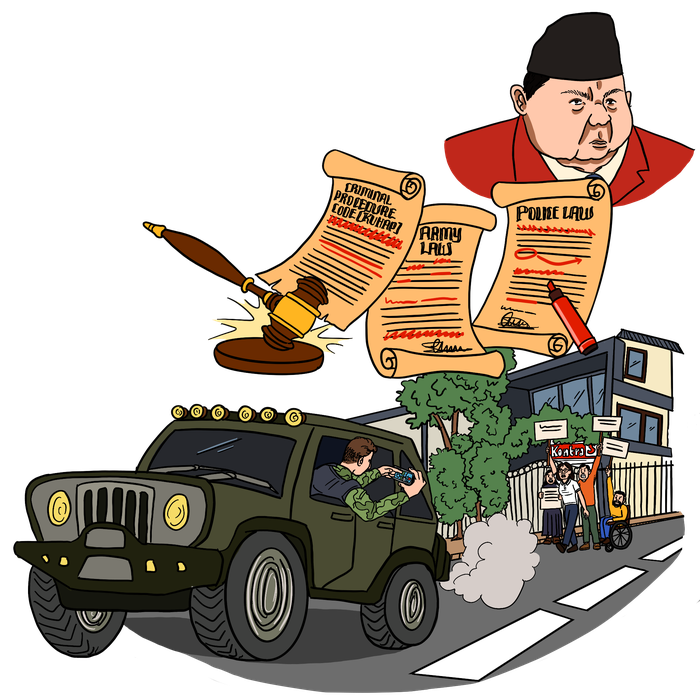
A leading human rights organisation, the Commission for the Disappeared and Victims of Violence (KontraS) - that has been actively advocating against problematic legal amendments - experienced intimidation and surveillance between March and May 2025. Vehicles repeatedly passed by and stopped in front of their office in Jakarta. They also received numerous missed calls from unknown phone numbers, including one associated with a security intelligence official, and there were unsuccessful attempts to break into their office.
The government is also bulldozing through a number of legal revisions that could have a serious impact on civic space. In March 2025, revisions to the National Armed Forces Law (or TNI Law) was passed that will significantly expand the military’s role in civilian governance and weaken legal checks on abusive officials. There was minimal public participation and a severe lack of transparency in the drafting process. Activists who voiced their opinions and concerns over the proposed revisions faced intimidation and harassment.
Civil society is also concerned about the lack of transparency around ongoing revisions to the Criminal Procedure Code (KUHAP). Proposed revisions will expand the authority of law enforcement agencies without effective control and diminish the role of victims, legal counsel and citizens in the criminal justice process. Another law that is being revised is Law No. 2 of 2002 on the National Police that wil grant excessive powers to the police without improving oversight mechanisms.
There are also concerns around the brutal crackdown on protests with impunity. In March 2025, there were arrests and excessive force by both police and the military against students, labour groups and activists in Indonesia, who took to the streets to protest the controversial military law revisions. There was also widespread violence and repression committed by the police against peaceful May Day protesters. The police reportedly arbitrarily arrested 14 protestors - including four paramedics. Thirteen of the arrested were allegedly subjected to beatings and assault resulting in significant injuries. To disperse the peaceful protests, the police blasted water cannon and shot tear gas.
The government has continued to use the draconian Electronic Information and Transactions Law (ITE Law) to criminalise online expression, while a wiretapping pact signed in June 2025 between the government and four major local telecommunications operators increases the risk of arbitrary surveillance.
The media also has faced threats and attacks. A new police regulation issued in March 2025, requires foreign journalists to obtain police clearance before reporting in the country. Journalists were targeted while covering the mass protests against the revision of the military law in the city of Surabaya in March 2025. They were assaulted and had to delete photos they had taken of the protests. The media outlet Tempo, which has a long history of public criticism in Indonesia, has been especially targeted, apparently because of its critical coverage of the Prabowo administration. In March 2025, a journalist who hosts a popular podcast received a package containing a pig’s head without its ears. She was also doxed, her mother’s phone was hacked, and a relative received threatening anonymous phone calls.
The government has also continued to repress activism in the Papuan region, where there have been longstanding grievances against systematic abuses by the security forces and exploitation of resources by the government and private businesses. In April 2025, Papuan students and solidarity organisations who held protests in Nabire and Jayapura around exploitation and the militarisation of Papua, were met with police violence, tear gas, arrests, and forced dispersals. In May 2025, a peaceful protest against increased tuition fees organised by students of Cenderawasih University (UNCEN) in Jayapura was also met with violent repression by the police.
KENYA'S CIVIC SPACE RATING: REPRESSED
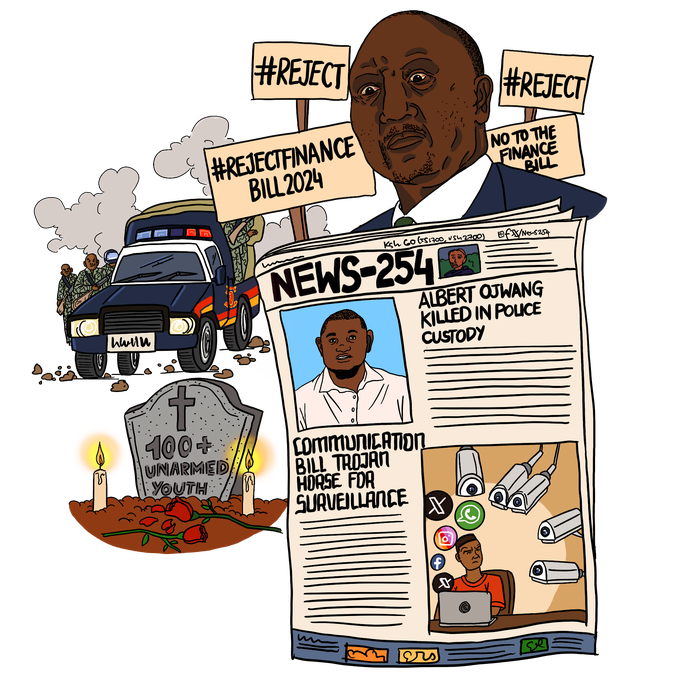
A year after the June 2024 nationwide #RejectFinanceBill protests began, a chilling crackdown on civic freedoms has continued unabated. State-sanctioned abductions and repression of protesters have continued, while authorities double down on the clampdown on free speech, online and offline.
As Kenyans returned to the streets in June 2025 to mark a year since the protests began, and to call for major economic and governance reforms which are yet to be addressed, the government continues to unleash brutality against unarmed protesters, including through use of excessive and lethal force, continued use of masked, plainclothes security officers in unmarked vehicles to arrest protesters despite a court order barring this practice, and the suspected use of armed goons to infiltrate protests, attack protesters and loot businesses, among other brutal tactics. At least 65 people were killed and hundreds injured, with cases of rape, including gang rape, being reported. At least 1500 people have been arrested since the protests began in June 2025, and are facing various charges, including murder, rape, and terrorism charges. The use of terrorism charges by the state raises serious questions about the misuse of laws and the legal system to label peaceful protesters as terrorists, and is especially troubling given growing allegations that much of the violence witnessed during recent protests has, in fact, been instigated by state-sponsored actors.
As people turn to digital spaces to seek safer, alternative ways to express dissent, state repression has escalated even in online spaces. In June 2025, activist Albert Omondi Ojwang died after being severely tortured while in police detention after being held over a social media post alleging the implication of a senior government official in corruption, while software developer Rose Njeri was arrested and prosecuted for allegedly breaching the 2018 Misuse of Computer and Cybercrimes Act for designing an online tool enabling people to object to the latest finance bill. Creative arts have also faced censorship with protest-themed art and programmes facing bans in public spaces and schools. Recent proposed laws and policy directives aim to control digital spaces. A new Communications Bill threatens mass surveillance by granting the government expansive tracking powers without adequate safeguards or accountability, while Parliament’s recent proposal to increase budgetary allocation to the Directorate of Criminal Investigations (DCI) to procure and service an Optimus 3.0 system that may allow authorities to track social media users, identify their posts and locations, and track the devices they use raises surveillance and privacy questions. Similarly, a January 2025 directive requiring social media companies to establish physical offices in Kenya—issued amid rising online criticism of the government and President Ruto—raises concerns about its underlying intent, and could serve as a veiled attempt to undermine free speech and digital rights under the guise of national security.
HRDs and CSOs now face increased surveillance and targeting. After attending a jurists' conference in South Africa, Martin Mavenjina, a Ugandan national and senior adviser on transitional justice at the Kenya Human Rights Commission (KHRC), was deported upon arriving at Nairobi's JKIA airport on 6 July 2025. He was refused entry even though he has been in possession of valid work and residency permits for more than ten years. Mavenjina has spoken out against extrajudicial killings, police brutality, and corruption in the government. Immigration officials at the airport had questioned his travel days earlier. KHRC Executive Director Davis Malombe had experienced a similar situation in May 2025, reflecting growing pressure on KHRC amid its outspoken criticism of state repression during ongoing protests.
On the day of Mavenjina’s deportation, armed goons, believed to be state-sponsored, violenty disrupted a press conference at the KHRC offices which had been organised to demand an end to extrajudicial killings, enforced disappearances, and arbitrary arrests of protesters ahead of more nationwide protests the next day.
SERBIA'S CIVIC SPACE RATING: OBSTRUCTED
Serbia remains on our Watchlist as civic space continues to deteriorate. Widespread anti-corruption protests and a nationwide student strike have persisted since November 2024, triggered by the collapse of a railway station that killed 16 people. A government reshuffle in April failed to appease public anger, with demonstrators continuing to demand systemic change and calling for snap elections. In response, the authorities have escalated repression: protesters and supporters face violence from police and ruling party-linked groups, alongside mass detentions, surveillance, and intimidation.
In March 2025, government-organised counter-protesters set up encampments around key institutions in Belgrade. These camps, backed by municipal authorities and protected by police, have become flashpoints for violence, with frequent clashes between residents and anti-government demonstrators. Violence against protesters by supporters of the ruling Serbian Progressive Party (SNS) continues to be encouraged and legitimised by the authorities. Senior officials have exerted pressure on prosecutors and judges, accusing them of bias in favour of protesters. In July, President Aleksandar Vučić pardoned four men linked to his party who had severely beaten a female student in Novi Sad—the attack that prompted the government’s collapse in January. He then announced plans to pardon a woman charged with attempted murder for driving her car into a group of protesters, and stated that more pardons would follow.
Repression of civic activists has intensified. Ahead of a major demonstration on 15 March, a private meeting of opposition and civil society activists was illegally recorded by security services and broadcast on pro-government media. Six of those targeted—Marija Vasić, Mladen Cvijetić, Lado Jovović, Davor Stefanović, Srđan Đurić and Lazar Dinić—were arrested and charged with attempting to overthrow the constitutional order, with prosecutors seeking the maximum sentence of five years in prison. Six others, now abroad, face trial in absentia. After over two months in detention, all six were placed under house arrest in late May. The same tactics were repeated ahead of another large protest on 28th June: more wiretapped conversations were aired, and plainclothes police arrested eight student activists outside university buildings. They were charged with the same offence, and even though the prosecution sought to keep them in pre-trial detention, all eight have been released pending trial after lodging appeals.
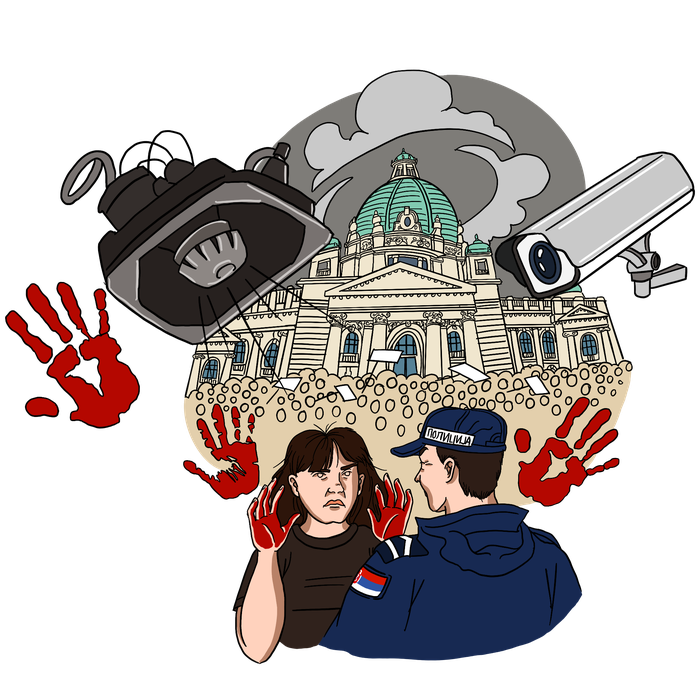
There are growing concerns about excessive use of force by law enforcement officers, including suspicions that police unlawfully deployed a sonic weapon during the largest protest to date on 15 March, attended by around 300,000 people. During a silent vigil for the victims of the station collapse, the quiet was abruptly broken by a loud, disorienting noise, described by attendees as resembling a low-flying aircraft or fast-approaching vehicle. The disturbance triggered panic and a stampede. CSOs have demanded an investigation, backed by six UN special rapporteurs and an interim measure from the European Court of Human Rights. Police initially denied involvement but later admitted that Long Range Acoustic Devices (LRADs) were present at the protest, while continuing to deny that they were activated.
Tensions further escalated following a major protest on 28 June, with over 150,000 participants demanding elections and the removal of pro-government encampments. The protest was violently dispersed, with 77 people detained, some of whom were seriously injured by police and were denied medical assistance. In response, protesters launched widespread acts of civil disobedience, erecting barricades and staging small, spontaneous protests at various locations across the country. Police have repeatedly used excessive force to disperse the gatherings, detaining dozens at a time. Over 400 detentions were recorded in the first week of July alone, with credible reports of serious injuries and ill-treatment in detention.
In addition to open repression, the authorities continue to intimidate protest supporters. Many have faced smear campaigns, job dismissals, and threats. Foreign citizens have been expelled or threatened with deportation for expressing support. Railway and bus services have been suspended without explanation ahead of major rallies. One private bus operator, harassed by police for transporting protesters, including by being fined, sabotaged, and threatened, attempted to self-immolate on 1 July outside a ruling party office, in protest against the ongoing harassment and the detention of his son.
TURKEY'S CIVIC SPACE RATING: REPRESSED
Turkey is added to our Watchlist as civic space faces existential threats due to the jailing of opposition politicians, the violent suppression of mass protests, and a dramatic escalation in censorship, arrests, and intimidation. The wave of repression began following the detention of Istanbul Mayor Ekrem İmamoğlu, widely seen as President Erdoğan’s main challenger in the 2028 presidential elections, and the subsequent outbreak of the largest protests since the 2013 Gezi Park movement, with crowd estimates reaching up to two million people.
İmamoğlu announced his presidential candidacy on 27 February 2025. Less than three weeks later, Istanbul University annulled his diploma, citing alleged procedural irregularities dating back over three decades—rendering him ineligible to run under constitutional rules requiring a university degree. The next day, on 19 March, İmamoğlu was detained along with more than 100 others, including municipal officials and district mayors. He faces a range of charges, including corruption, bribery, and aiding the outlawed guerrilla group, the Kurdistan Workers' Party (PKK). These charges are linked to the cooperation between İmamoğlu’s Republican People’s Party (CHP) and the pro-Kurdish People’s Equality and Democracy (DEM) Party during the 2024 local elections. This is despite the disbandment and disarmament of the PKK in July 2025, following reconciliation efforts with the Turkish state in which the DEM Party played a central role.
Since İmamoğlu’s arrest, Erdoğan’s government has intensified its crackdown on the opposition. In the 2024 local elections, the CHP achieved a historic result by winning 35 out of 81 municipalities—now, nearly half of all CHP mayors have been arrested or detained alongside dozens of others affiliated with the party, including senior party officials, former Members of Parliament, and İmamoğlu’s own lawyer, who remains in custody. The arrests, often justified with vague allegations of corruption, organised crime and terrorism-related charges, appear aimed at dismantling the political opposition entirely.
Mass demonstrations erupted on the day of İmamoğlu’s detention. The youth-led movement, driven largely by university students, quickly grew beyond the CHP, drawing widespread support from opposition groups, civil society and participants from diverse political backgrounds.
The authorities responded with aggressive suppression, imposing protest bans and restricting entry into Istanbul. By April, up to 2,000 people had reportedly been arrested. Overwhelmingly peaceful protesters were met with tear gas and rubber bullets; many were injured and hospitalised, and reports emerged of strip searches of female detainees. Those arrested—mostly students, and in some cases journalists—were subjected to rushed mass trials, with hearings held simultaneously for hundreds of defendants. Charges include participating in unauthorised demonstrations, disobeying police orders, and incitement to commit a crime based on social media activity. If convicted, they face prison sentences ranging from six months to five years. Since the protests began, a number of lawyers, including the former President of the İzmir Bar Association, have been arrested for supporting protesters.
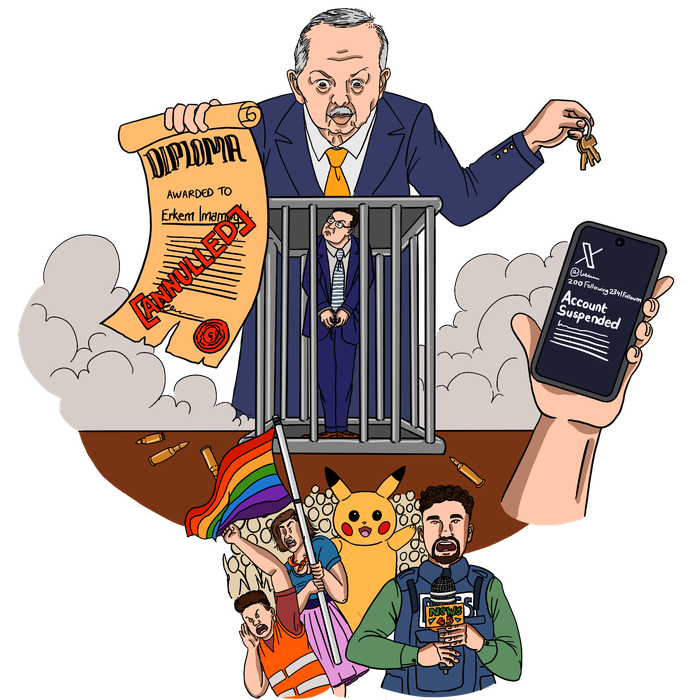
Censorship has intensified. At least 11 journalists were detained in coordinated dawn raids across several cities on 24 March for covering the protests, and at least 12 others were physically assaulted by police. Foreign press have also been targeted: a BBC journalist was deported, and a Swedish journalist was arrested on terrorism charges. He was held for seven weeks and released pending trial in September. Simultaneously, internet users across Turkey experienced a 42-hour throttling, severely restricting access to social media and independent news sites. More than 700 Twitter/X accounts belonging to journalists, activists, and opposition figures were blocked.
Further repression followed during traditional flashpoints for dissent. Ahead of May Day, police arrested dozens of people preemptively to prevent the annual demonstration in Istanbul’s Taksim Square, which has remained banned since 2013. Over 400 people were detained across the country. In June, both the Istanbul Pride March and the Trans Pride March were violently broken up by police. At the Istanbul Pride, around 55 activists, lawyers, and journalists were detained, with three activists arrested—the first arrests in the history of Pride in Turkey. Due to the blanket ban on LGBTQI+ events, individuals were detained even in unrelated areas after being profiled based on appearance. Before and after the Trans Pride March, 42 participants were violently detained, including three minors. Another four people, including a tourist, were randomly detained in the vicinity.
On 1 July, the CHP marked the 100th day since the arrest of Istanbul’s elected officials with a mass rally in Saraçhane. Police again intervened forcefully, using tear gas and detaining at least 42 participants, including students and journalists.
USA'S CIVIC SPACE RATING: NARROWED
The USA remains on the Watchlist as the assault on civic freedoms continues. The first six months of President Donald Trump’s second term exhibited clear signs of democratic backsliding: power consolidated in the executive, loyalists installed across institutions, independent media stifled, dissent criminalised and marginalised groups targeted.
Amid an environment of intense political polarisation, tensions escalated following an incident of political violence against lawmakers from the Democratic Party. On 14 June 2025, an armed assailant in Minnesota shot and killed House Representative Melissa Hortman and her husband, both of whom had been outspoken supporters of social justice and reproductive rights. In a separate but closely connected incident, the same armed man stalked and shot State Senator John Hoffman and his wife and attempted to shoot their daughter. According to the Centre for Strategic and International Studies (CSIS), politically motivated attacks against officials have surged, nearly tripling over the past five years compared to the previous 25 years combined.
The crackdown on peaceful assembly has intensified. Since early June 2025, large-scale peaceful protests have taken place across the country in response to sweeping Immigration and Customs Enforcement (ICE) unlawful tactics, including raids, on undocumented immigrants. Between 6 and 10 June, over 350 protesters have reportedly been arrested in five cities (Los Angeles, San Francisco, Austin, New York, Dallas).
On 7 June, President Trump ordered the deployment of 700 Marines and 2,000 National Guard personnel in Los Angeles, representing an alarming escalation of militarisation and federal overreach against migrant communities and peaceful protesters. The 40-day deployment raised concerns over the use of military forces to police protests and to support ICE operations. It also reflects the deepening conflicts between federal immigration policy and practice and sanctuary jurisdictions seeking to shield migrant communities from aggressive deportation tactics. The level of confrontation between protesters and law enforcement is the most severe since the peak of the Black Lives Matter protests in 2020.
Journalists covering protests have been targeted. On 9 June, police officers in Los Angeles shot journalist Lauren Tomasi with a rubber bullet while she reported on anti-ICE protests in the city. Tomasi, a US correspondent for Australia’s 9News, sustained an injury to her leg. Similar cases of physical attacks against journalists covering protests in Los Angeles have also been recorded.
On 14 June, Doraville police arrested Mario Guevara, a Salvadoran journalist, during “No Kings” massive and peaceful protests against President Donald Trump in Georgia. Guevara, identified as a member of the press, was livestreaming the demonstration. Authorities charged him with obstruction, unlawful assembly, and walking on a roadway. Following his arrest, Guevara was transferred to ICE custody, despite holding legal residence status. At the time of writing, he remains detained.
Press freedom faces mounting pressure under the Trump administration, with judicial harassment and drastic funding cuts targeting independent media. For example, on 18 July 2025, Congress voted to cut nearly USD 1.1 billion from the Corporation for Public Broadcasting, threatening PBS, NPR and, critically, local stations. The move, the first successful presidentia request to cancel pre-approved funding in nearly three decades, signals serious concerns over media pluralism.

The bill also includes rolling back billions of dollars in previously approved foreign aid, slashing humanitarian, development and global health programmes, as well as support for the United Nations and its agencies.
Further curtailing freedom of association, recent state legislation would threaten the operational capacity of civil society. Since April 2025, Florida, Nebraska, and Arkansas have passed laws aimed at perceived foreign influence—particularly from China—targeting nonprofits. According to the International Centre for Not-For-Profit Law (ICNL), the new wave of state bills introduces broader provisions, including “foreign influence registration schemes and restrictions on charitable solicitation, which could have significant—and often unintended—impacts on charitable activity.”For example, Nebraska’s Foreign Agent And Terrorist Agent Registration Act (Legislative Bill 644), enacted in June 2025 and effective in October 2025, imposes sweeping registration requirements for any “agent” of a “foreign principal” from designated foreign adversaries under U.S. federal code (China, Cuba, Iran, North Korea, Russia, and Venezuela).
Additionally, on 4 July, President Donald Trump officially signed the “One Big Beautiful Bill Act” (H.R.1), a 900-page tax package legislation with implications for the nonprofit sector. According to the National Council of Nonprofits, some provisions are projected to reduce nonprofit funding by an estimated USD 81 billion over the next decade, impeding the ability of civil society organisations to deliver essential services, particularly in underserved communities.
Authorities have intensified crackdowns on those expressing solidarity with Palestinian rights. Foreign-born students and activists continue to face disproportionate reprisals, with cases such as the ongoing prosecution of Mahmoud Khalil, a student activist recently released on bail, illustrating the growing criminalisation of solidarity actions. The targeting of Francesca Albanese, the UN Special Rapporteur on human rights in the occupied Palestinian territories since 1967, through illegitimate sanctions further underscores a broader attempt to silence international voices exposing the genocide, war crimes, and crimes against humanity in Israel and the Occupied Palestinian Territories.