Freedom of association
Charity Act Partial Commencement
The Charities (Amendment) Act 2024 was partially commenced in January 2025. Once fully operational, the Act will allow the “advancement of human rights” to be recognised as a charitable purpose. The Charities Regulator is currently working on guidelines in advance of the full operationalisation of this part of the legislation.
Enacted in July 2024, the Charities (Amendment) Act was partially brought into force on 27th January 2025, when a commencement order activated 12 of its 35 sections. The provisions now in effect include a revised definition of a “member of the charitable organisation” (particularly relevant for non-company charities), expanded powers for the Charities Regulator to share information with other bodies, new obligations on how and when charities must provide information, and a High Court application power in cases where trustees fail to exercise effective oversight.
As previously reported by the CIVICUS Monitor, the original Charities Act, introduced in 2009, aimed to strengthen regulation of Ireland’s charities sector by promoting better governance, transparency, and accountability. However, human rights organisations were excluded from charitable status due to the absence of a legal basis recognising their purpose.
Freedom of peaceful assembly
In Ireland, the right to peaceful assembly remains fundamental. However, increasing security measures and proposals such as road closures and facial recognition risk creating a chilling effect. Civil liberties advocates have urged authorities to focus on targeted policing of violent actors rather than imposing restrictions that deter legitimate protest.
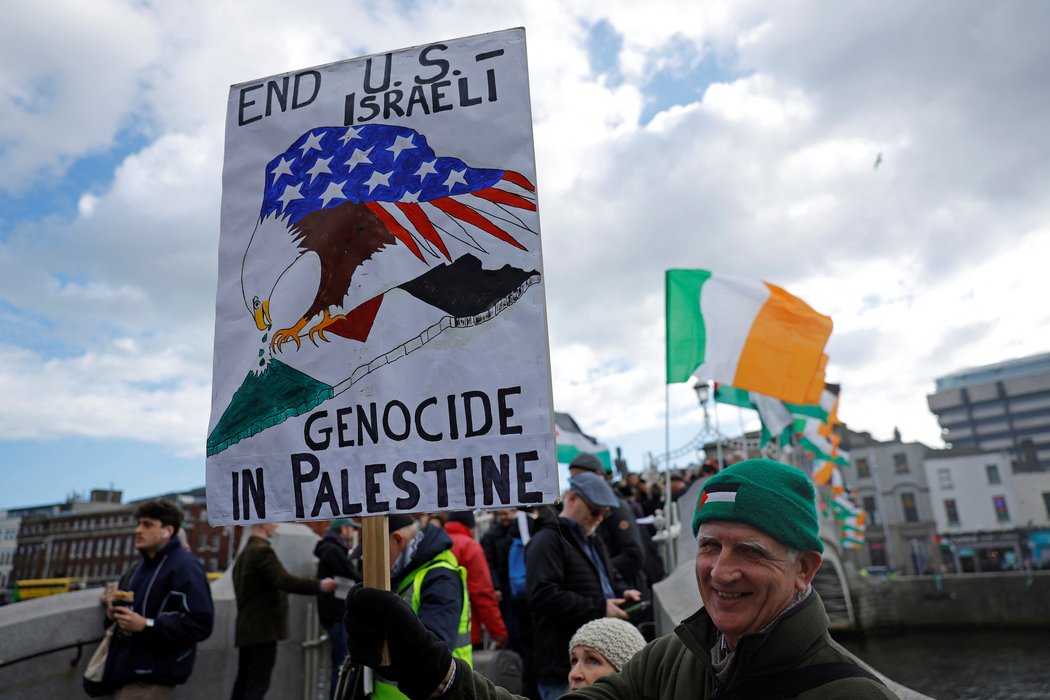
Pro-Palestine protests
While frequent pro-Palestine protests are generally well facilitated by the Gardaí, recent incidents suggest a hardening of attitudes towards peaceful civil disobedience. According to data from the Irish Council for Civil Liberties (ICCL), within five days (Monday 31st March – Friday 4th April), 23 peaceful protesters associated with the Palestinian solidarity movement were arrested in Dublin.
Mothers Against Genocide vigil forcibly dispersed, allegations of ill-treatment
On 31st March, protesters from the Mothers Against Genocide group were forcibly removed from the front gates of the parliament buildings and arrested. According to Garda sources, 11 people were detained under the Criminal Justice (Public Order) Act 1994 and released with formal warnings.
The protesters had been holding an overnight vigil for Mother’s Day to highlight the impact of displacement and violence on women and children in Gaza. Outside Leinster House, they arranged a visual display including children’s shoes, teddy bears, and ‘pillow babies’ symbolising children killed in Gaza and grieving mothers. Seventy pictures of children, representing the estimated daily child deaths in Gaza, were also displayed.
Videos circulating on social media show protesters sitting in front of the vigil, blocking the entrance, before Gardaí dismantled the display and forcibly removed participants. Footage published by People Before Profit TD Paul Murphy shows a woman being lifted into a garda van by multiple officers and another being escorted by Gardaí.
Gardai forcibly removing mothers protesting against genocide at the Dáil. pic.twitter.com/E3R4KXwkgr
— Paul Murphy 🇵🇸 (@paulmurphy_TD) March 31, 2025
The protesters allege they were subjected to strip and cavity searches while in custody, among other rights violations. ICCL expressed concern that the forcible removal and arrest of peaceful protesters was unnecessary, disproportionate and served to stifle democratic dissent. ICCL representatives met with those arrested and documented reports of their treatment in custody. According to ICCL, their testimony raises serious concerns regarding Garda compliance with the law governing treatment in custody, including not being told of the reason for their arrest in ordinary language, not being informed of their right to legal representation, no access to food, and limited access to toilets.
Those arrested have announced they plan to lodge complaints with the policing oversight authority. The matter is complicated by the Garda Commissioner’s letter to the Speaker of Parliament alleging that opposition TDs used parliamentary privilege to make false claims about Garda conduct, asserting “categorically” that an internal investigation found “no strip searches [...] no cavity searches took place”. The Minister for Justice also publicly denied the claims regarding strip searches.
Student protester arrested at Dublin City University
On 3rd April, a student was arrested during a pro-Palestine protest at Dublin City University (DCU) during the visit of Prime Minister Micheál Martin. Protesters, who advocate for boycott, divestment and sanctioning (BDS) against Israel, oppose Martin’s stance towards US President Donald Trump, the government’s refusal to pass the Occupied Territories Bill which would ban trade with Israeli settlements, and the transit of munitions bound for Israel through Ireland’s Shannon Airport.
According to the DCU BDS group, several students knocked on the window of the building hosting the Prime Minister’s event. One student was dragged to the ground and “wrongly and violently arrested,” despite asking Gardaí if their actions constituted a crime and being told they did not. Footage posted online shows the protester being dragged on the ground by police. The student was released the same afternoon and has since been charged; a court appearance is pending. DCU BDS criticised the treatment of students by Gardaí, campus security, and university administration, stating they were “astounded” by the response to their protest.
Disproportionate force used against protesters against Central Bank Governor
One arrest followed a protest at the Westbury Hotel on 30th April, during a dinner hosting Gabriel Makhlouf, Governor of the Central Bank of Ireland. Video footage posted to social media shows disproportionate use of force against protesters. ICCL has spoken with affected protesters; seven plan to lodge complaints with the Police Ombudsman.
We were at the Westbury Hotel today to protest Gabriel Makhlouf, Governor of the Central Bank, for his role in overseeing the regulation of Israeli genocide bonds. Outrageously the Gardaí manhandled protesters brutally, and arrested one person. This is disgraceful. pic.twitter.com/gjLb1GGhn8
— IPSC (@ipsc48) April 30, 2025
Earlier, on 10th March, the Ireland-Palestine Solidarity Campaign (IPSC) staged a demonstration inside the Central Bank over its role in approving Israel bond sales in the EU. Following Brexit, the Central Bank of Ireland became the designated authority for Israel Bonds, which have exceeded $54 billion since 1951, including over $4 billion since the 7th October attacks.
Three detained at Shannon airport protest
On 1st May, three members of Palestine Action Éire were detained after breaching Shannon Airport’s perimeter, attempting to access a US military plane they allege is linked to wars in Israel and Yemen. The activists in orange jumpsuits forced the airport to suspend operations for an hour. The group claims US military flights through Shannon facilitate war and “fuel genocide,” citing investigative reports that weapons and personnel transit Ireland despite legal restrictions. The government maintains that only limited, non-combat-related clearances have been granted.
Far-right protests
While the number of far-right protests in Ireland has declined sharply, a number of high profile incidents are worth noting.
Anti-immigrant protests and counter-protests by rights groups
In April, a large anti-immigration protest took place in Dublin. Attended by multiple local officials, the protest was addressed by UFC fighter Conor McGregor, who in 2024 was convicted of rape in a civil trial. McGregor has been championed by far-right agitators and was invited to attend the White House for St. Patrick’s day by the Trump administration. He has also expressed a desire to run in the Irish presidential election in October 2025, while seemingly not understanding the very limited powers the president has over policy or having a viable path to a nomination.
On 26th April, thousands attended the anti-immigration rally and a counter-demonstration organised by United Against Racism and backed by opposition parties. According to RTE, the anti-immigration protest, framed as an Easter Rising commemoration, attracted around 5,000 participants, while the counter-protest drew approximately 1,000. Gardaí, including Public Order, Air Support, and Mounted Units, maintained a heavy presence and kept the groups apart, although some hostile exchanges occurred as the anti-immigration march passed the GPO.
Protesters carried tricolours, “Make Ireland Great Again” caps, and placards reading “Irish Lives Matter,” while counter-demonstrators held “Stand Against Racism” signs and chanted support for refugees. The anti-immigration march concluded with speeches from several Dublin councillors, who criticised the government on housing, immigration, and living costs, called for “mass deportations,” and urged voters to reject establishment parties. Gardaí confirmed three public order arrests, but stated that the event passed largely without major incidents.
Threats of far-right protests force venue changes of human rights-related events
Far-right threats have also forced venue changes for human rights-related events. A Labour Party event in Dublin marking ten years since the marriage equality referendum was moved to a secret venue on 12th May due to threats of protest, with the original venue citing staff safety concerns. These threats coincided with local tensions over plans to expand an International Protection centre in the area. Previous demonstrations had targeted a local Labour councillor, who reported incidents of “aggression and intimidation” and an alleged racial slur at a protest at the IPAS centre. Labour condemned the intimidation, stressing that far-right hostility would not prevent celebration of marriage equality or discussions on the future of LGBTQ+ rights.
Similarly, ICCL was forced to relocate a conference on policing the far right in May due to credible threats of disruption by anti-rights actors.
Police attempt to curb misinformation following shooting incident
A tragic shooting in Carlow was exploited by far-right activists to spread online disinformation regarding the deceased. On 1st June, a gunman died by suicide after opening fire in Fairgreen Shopping Centre. No one else was killed, and only one child sustained minor injuries while fleeing. In response to false claims circulating online—alleging multiple deaths, Garda involvement, and explosives—the Gardaí issued four statements within 24 hours. They confirmed early that the gunman was “white Irish” to diffuse tensions and prevent further misinformation. Despite these efforts, right-wing figures continued to spread false narratives about the event, highlighting the ongoing challenge of combating disinformation in the context of violent incidents.
Freedom of expression
Rights watchdog criticises government’s disinformation strategy
On 17th April, the Irish Council for Civil Liberties (ICCL) condemned the Government’s new National Counter Disinformation Strategy, warning that it fails to tackle the core problem of social media recommender algorithms shaping public debate. ICCL, which quit the working group last year over this issue, argues that algorithms used by platforms such as YouTube, TikTok, and Instagram amplify extremism, suppress credible journalism, and expose young people to harmful content. The organisation criticises the Government for ignoring the urgent threat posed by foreign-controlled algorithms manipulating democratic discourse, despite strong public support in Ireland for measures to disable them.
A US legal case and whistleblower memoir have further highlighted concerns over Big Tech influence on the Irish government. In March, a US court issued an emergency order preventing former Facebook executive Sarah Wynn-Williams from promoting her book Careless People. The memoir alleges that the Irish government provided Facebook with a “special phone” to deal directly with officials, and details secret dealings with the Chinese government, complicity in the Myanmar genocide, and internal misconduct at Meta. ICCL condemned the gag order as an egregious attack on freedom of expression and whistleblower rights.
Man convicted to 11 years in prison for threatening journalists
On 5th June 2025, a convicted rapist who had threatened and harassed three Sunday World journalists, was sentenced to 11 years in prison by the Dublin Circuit Criminal Court. The journalists targeted were Amanda Brunker, Deirdre Reynolds, and Nicola Tallant. In August 2023, one month after his release from custody, the women began receiving threatening messages and emails, including sexual and death threats.
Amanda Brunker told the press: “When he was in jail, he was reading my column in The Sunday World and developed a fixation on me and two other journalists at the paper.” The court heard that the man had repeatedly sent emails and messages of a violent and sexually threatening nature, escalating to threats to put a “bullet” in one of them.
The National Union of Journalists (NUJ), which welcomed the conviction, noted that McAnaw also attempted to approach the Sunday World offices but was denied entry. When he was apprehended by the gardaí, he was composing another email to Nicola Tallant.
Judge Codd ordered that the harasser must have no direct or indirect contact with the women, must not approach them, go within 16km of their homes or workplaces, or communicate with them for life. NUJ assistant general secretary Séamus Dooley described the sentence as “an important one and a welcome signal against the vile harassment of women journalists.” The man is currently detained in the Central Mental Hospital, having been diagnosed with schizophrenia and refusing medication.
Police secretly accessed conservative outlet’s posts and messages
In February 2025, online news outlet Gript revealed that police had secretly obtained a court order the previous year to access its private X/Twitter messages and IP addresses during investigations into violent anti-immigration protests near Dublin, which resulted in six arrests.
The outlet, which had published footage of the unrest—including Gardaí reportedly using pepper spray on one of its journalists—condemned the order as an “intolerable” attack on privacy and media freedom, noting it had no opportunity to contest it. X stated that it successfully challenged the request and shared Gript’s statement, which was widely amplified by conservative, populist, and far-right accounts in Ireland and internationally.
Gript’s announcement has fuelled concerns about free speech and media suppression, amplified by right-wing voices in Ireland, the US, and beyond amid broader transatlantic tensions over free expression, censorship, and immigration. The outlet has been described as a “news site known for its conservative stances on culture war issues such as mass immigration and political correctness.” According to Ireland’s Media Ownership Monitor, Gript.ie can be characterised as socially conservative populist, advocating for the preservation of “traditional” values.
According to the court order published by Gript, a judge found “reasonable grounds” to believe that footage published on X contained evidence of criminal offences. A Garda spokesperson confirmed the court order and stated: “In order to vindicate the rights of potential victims of crime, including Gardaí who have been verbally and physically assaulted, An Garda Síochána has a positive obligation to obtain all available evidence relating to particular incidents.”