Freedom of association
Norway announces five-year funding plan to humanitarian NGOs amid global aid crises
The Norwegian government signed a multi-year agreement pledging NOK 1.9 billion annually (approx. USD 171 million) through 2029 to six humanitarian NGOs, including the Norwegian Refugee Council (NRC) and Norwegian People’s Aid (NPA).
The government statements read how the support is designed to enable “rapid, flexible and targeted emergency aid” in global crises. Crucially, this long-term funding had been planned before the United States froze nearly all of its foreign aid spending in early 2025 and is not intended to substitute it.
At the same time, in an increasingly complicated funding environment, NRC (which received approximately 20% of its 2024 budget from U.S. sources) was forced to suspend operations in nearly 30 countries. These included halts to food support for 57,000 people in Ukraine, water and sanitation services for 100,000 people during cholera outbreaks in Sudan and the Democratic Republic of Congo, and closure of 700 bakeries in Darfur. The U.S. government had failed to reimburse them for over USD 20 million in completed work.
NRC’s Camilla Waszink welcomed the Norwegian support for offering “predictability and flexibility” but could not replace U.S. funds: “This is part of already budgeted Norwegian humanitarian funding and will therefore not address our many U.S.-funded programmes.
Partial reinstatement of U.S. aid and additional Norwegian emergency response to support Norwegian international NGOs
By April 2025, some of the U.S. international aid funding was partially restored. Funding to 13 out of 29 previously suspended humanitarian projects of the Norwegian Refugee Council (NRC) resumed, following the reinstatement of some of its U.S. awards.
Nevertheless, the operational damage was substantial. NRC noted that months of disruption led to the cancellation of critical services, displacement of staff, and stalled partnerships across multiple regions.
On 4th April the Norwegian government released a supplementary emergency package of NOK 300 million:
- NOK 220 million supported Norwegian organisations affected by the U.S. aid freeze,
- NOK 40 million went toward combating gender-based violence and improving sexual and reproductive health services, and
- NOK 40 million strengthened shared humanitarian systems like logistics, data collection, and coordination tools.
In its report, Amnesty International praised Norway’s intervention as “a model of principled action”, but warned that the global humanitarian system remains dangerously vulnerable to sudden donor withdrawals.
Three pro-Palestine activists acquitted
In March 2024, three pro-Palestine activists were charged for following Progress Party (Fremskrittspartiet, FrP) leader and MP Sylvi Listhaug in central Oslo and shouting slogans. They were accused under Sections 115 and 266 of the Norwegian Penal Code for allegedly intimidating a member of parliament and causing a risk to her activities. The case, which went to trial in February 2025, attracted attention for raising questions about the limits of protest and political expression.
On 27th March 2025, the Oslo District Court unanimously acquitted the three activists, ruling that Listhaug had not been subjected to any breach of the peace and that following a politician without force or threats does not constitute a reckless act, emphasising that the court recognised the activists’ “genuine and heartfelt” political commitment.
During the trial, activists from the Oslo Kampkomiteen (Struggle Committee) and the Action Group for Palestine staged demonstrations outside the court, with organisers claiming strong public backing and expressions of concern over the state’s treatment of activists.
Freedom of expression
Norwegian Parliament apologises to Sámi, Kven, and Forest Finn peoples for “Norwegianisation” policy
In the beginning of November, the Norwegian Parliament issued a formal apology to the Sámi, Kven, and Forest Finn peoples for the "Norwegianisation" policy which lasted for over a century and aimed to suppress minority languages, cultures, and identities. The apology followed recommendations from the Truth and Reconciliation Commission, which conducted years of hearings and archival research.
Sámi Parliament President Silje Karine Muotka responded to the apology by acknowledging its significance: "It is powerful to experience that the Storting is apologising and acknowledging responsibility for the Norwegianisation policy".
The president emphasised the emotional weight of the day, stating, "Today I send thoughts to those who have suffered, who lost both language and culture, and who have deep wounds. Today there is hope for reconciliation". Muotka also highlighted ongoing issues, noting that while the apology ensures long-term follow-up with financial and legal accountability, unresolved disputes over land and water rights remain a concern, as highlighted in previous CIVICUS Monitor updates.
Environmental activist Frederic Hauge assaulted in suspected political attack
On 30th May, Frederic Hauge, the founder of the Norwegian environmental NGO Bellona, was physically assaulted in Arendal. While walking to his car, he was approached by a man who accused him of “harming the poor” through environmental policies. The assailant proceeded to punch him twice, including in the head.
Hauge sustained a suspected concussion. The police apprehended the suspect. Authorities are treating the case as a politically motivated act of violence. Bellona and other environmental groups warned that the incident reflects growing aggression against climate advocates.
Freedom of peaceful assembly
Environmental protests
On 14th January 2025, Norway’s government awarded 53 new offshore oil and gas exploration licences, including plans to expand drilling in the Arctic, a move Energy Minister Terje Aasland said was needed to secure stable production. Environmental groups fiercely criticised the decision, with Extinction Rebellion, Greenpeace, Grandparents for Climate and Greta Thunberg staging a protest which blocked entrances to the hotel where the announcement was made, denouncing Norway’s move to extend oil and gas production amid the intensifying climate crisis. While the government argues exploration is vital to maintain Europe’s energy supply, campaigners warned the policy prioritises fossil fuels over urgent climate action.
On 13th February, Norway’s parliament voted to allow hydropower plants larger than 1MW in previously protected rivers if deemed of “significant” societal benefit, sparking fierce backlash from conservationists. Environmental groups warned the decision threatens salmon and wildlife, accusing the government of rushing it through without consultation. On 11th February, protesters gathered outside parliament, presenting 25,000 signatures against the move, which critics describe as a historic attack on nature.
Activists opposing highway construction forcibly evicted from protest camp
On 19th March, Norwegian police evicted activists from the Tunnel Tree House (Tunnelhuset), a month-long occupation site in the Lågendelta nature reserve set up by the group Friends of the Lågendelta (Lågendeltaets Venner) to protest against planned highway construction. The group declared the camp the first “actively protected zone” in the country, modelled on similar initiatives in France.
Activists oppose the new highway project, claiming it will irreversibly damage the nature reserve, a legally protected wetland home to hundreds of species, including many red-listed birds. They argue the project, forced through by weakening protections, wastes public funds and exemplifies destructive “green capitalist” policies that prioritise roads over ecosystems and communities.
According to the group, officers entered without court approval to clear the area for state-owned developer Nye Veier, which is building a controversial motorway through the protected wetlands. Activists condemned the eviction as unlawful and vowed to continue resisting, staging further occupations and pledging to block construction to defend the reserve.
Greenpeace Nordic protests deep-sea mining, denounces “gambling” with the environment
In April 2025, climate activists staged a protest action at an international deep-sea mineral conference in Bergen by transforming the venue’s lobby into a mock casino.
Organised by Greenpeace Nordic, the peaceful protest was followed by a blockade of the conference room. Activists positioned themselves at the entrance to prevent access, while others released balloon banners and took the stage inside the meeting room. The disruption prompted the evacuation of the conference, and police were later called to remove the protesters from the building.
The protest was aimed at drawing attention to environmental concerns over deep-sea mining and urging conference participants to reconsider their support for the industry.
“The deep-sea mining industry is clearly willing to gamble with the health of the oceans, so we want to make it clear that these mining companies are high risk gamblers that should not be trusted with neither the health of our ocean, nor their investors' money”, said Haldis Tjeldflaat Helle, Campaigner at Greenpeace Nordic.
Activists protest Mark Zuckerberg’s superyacht
On 30th April, Greenpeace activists staged a climate protest in Longyearbyen, Svalbard, against the arrival of Launchpad, the superyacht owned by Facebook founder and Meta CEO Mark Zuckerberg. The demonstration, organised under the slogan “Svalbard can’t afford the superrich” by Arctic Climate Action Svalbard, condemned what activists described as the climate-destructive lifestyle of billionaires. Greenpeace argued that Zuckerberg and other wealthy elites undermine climate efforts through excessive consumption and by enabling climate misinformation, using the yacht’s visit as a symbol of the broader problem of billionaire-driven climate harm.
People Against Fossil Power take action to protest fossil fuel sponsorships
In March, climate activists from the group People Against Fossil Power (Folk mot fossilmakta) threatened to disrupt the 5,000m race at the 2025 World Ski Championships in Trondheim, demanding organisers drop fossil fuel sponsors like Equinor and air a climate awareness video. After organisers rejected their demands, the planned protest sparked international debate about fossil fuel sponsorship in winter sports and won support from over 60 scientists. Just before the event, activists reached an agreement with top skiers to avoid disruption and instead collaborate on a proposal to the International Ski Federation (FIS) calling for stricter sponsorship rules and backing of a fossil fuel non-proliferation treaty.
On 17th May, around 30 activists from People Against Fossil Power staged a roadblock, disrupting traffic during the Bergen International Festival to protest its long-standing fossil fuel sponsorships, particularly from Equinor. The group demanded the Festival commit to phasing out oil sponsorship, displaying banners reading “Free the arts from oil sponsorship.” Although the action was announced in advance, police allowed only five minutes of protest before intervening, rejecting activists’ request for 30 minutes. The group criticised the Festival for serving as an advertising platform for the fossil fuel industry and urged a ban on fossil fuel sponsorship in culture, likening it to tobacco advertising restrictions.
Protests in solidarity with Palestine
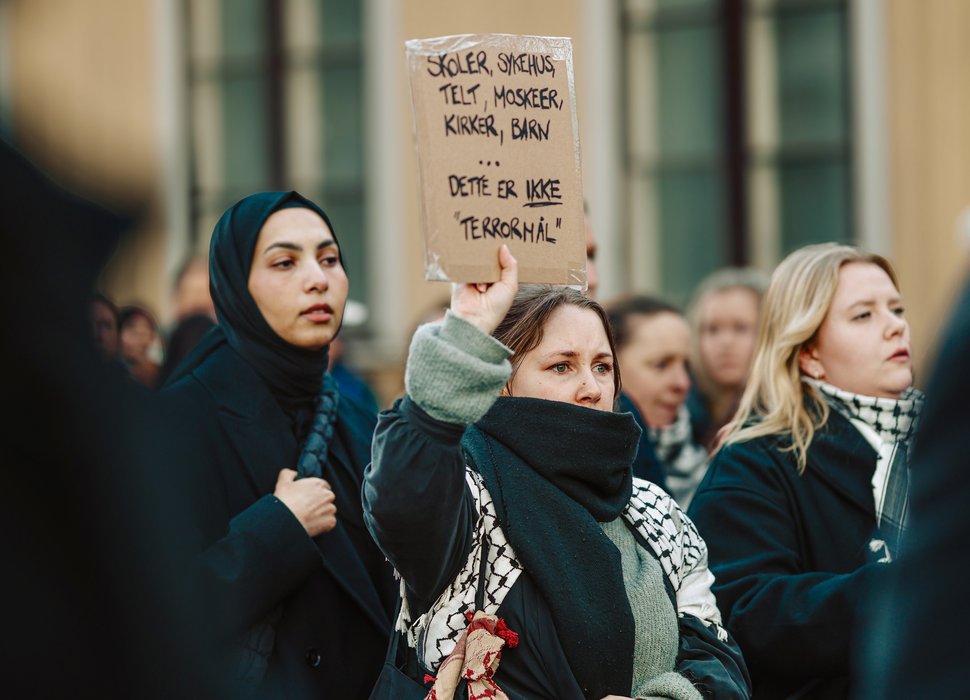
Throughout 2025, numerous Palestine solidarity demonstrations have taken place across Norway, including weekly protests in several cities, reflecting growing public concern over the situation in Gaza and broader support for Palestinian rights. Activists have consistently highlighted issues ranging from state repression to international complicity in Israel’s military actions.
Scenes from the massive weekly protests in Tromsø, Norway to support Palestine and Lebanon. pic.twitter.com/q3nvQqFL9K
— PALESTINE ONLINE 🇵🇸 (@OnlinePalEng) November 3, 2024
Oslo: “From Berlin to Jaffa” March
On 9th March 2025, activists from the Oslo Kampkomiteen (Struggle Committee) took part in a demonstration against Germany’s political and military support for Israel and the repression of Palestine solidarity activists in Germany. Organised under the banner “From Berlin to Jaffa”, the protest began with speeches and appeals from Palestinian activists, including accounts of police brutality in Germany. The demonstration also stopped at the Israeli embassy, where protesters confronted police who tried to move them onto the sidewalk. According to activists, clashes occurred as officers pushed demonstrators with fences, causing minor injuries to several participants, while one activist was hit by a megaphone.
Pro-Palestine activists interrupt PM’s May Day speech
Norwegian Prime Minister Jonas Gahr Støre was heckled by pro-Palestinian activists during his May Day speech in Oslo on 1st May, as demonstrators accused Norway of profiting from Israel’s war in Gaza. Activists unfurled a banner and shouted over Støre’s remarks, forcing him to pause until organisers appealed for calm. The protest coincided with Norway’s testimony at the International Court of Justice against Israel’s restrictions on humanitarian aid to Gaza. Støre, who later led the traditional Labour Day parade, said he understood the activists’ anger and the strong public concern over the humanitarian crisis.
Day of action at universities across Norway
On 5th May 2025, a national day of action for Palestine solidarity took place in five Norwegian cities—Trondheim, Oslo, Bergen, Stavanger, and Tromsø—coordinated to pressure universities to implement measures supporting Gaza, including an academic boycott of Israeli institutions.
At the Norwegian University of Science and Technology (NTNU) in Trondheim, protesters entered the rector’s office to demand dialogue with university leadership over unmet commitments related to Gaza, including reconstruction support and academic boycotts of Israeli institutions. When two activists, Ahmed Alamleh and Shams Jabari, refused to leave voluntarily, NTNU called the police, who removed them through a back door, recorded their personal details, and reportedly mentioned fines of 15,000–20,000 NOK each. The students said they had expected a conversation rather than police intervention and described the university’s response as a “stain of shame.” NTNU officials said that the activists’ conduct did not indicate a desire for dialogue, and security staff lacked authority to remove them, necessitating police involvement.
At the University of Oslo, nearly 100 participants gathered for a march that ended outside the rector’s office. Students hung a banner reading “Academic Boycott Now” alongside a Palestinian flag, though it was quickly removed. Demonstrators conducted a sit-in inside the building, planning to remain until 6th May, and led chants demanding divestment and action from the university. Tensions escalated when a few activists attempted to access some administrative offices, leading to a physical confrontation with Assistant University Director Johannes Falk Paulsen, who later apologised after a protester’s hand was caught in a door. University officials stated their commitment to facilitating demonstrations within agreed frameworks, while students emphasised the need for concrete implementation of their demands.
Protest against Israeli PM’s advisor in Bergen
On 29th May 2025, around 150 people demonstrated in Bergen against the visit of Hananya Naftali, an advisor to Israeli Prime Minister Benjamin Netanyahu and former IDF soldier. The protest, organised by groups including the Kampkomiteen, Bergen4Palestine, the Palestine Committee in Bergen and several left-wing organisations, condemned Naftali as complicit in genocide and demanded his arrest. Demonstrators carried flags and chanted slogans such as “No support for genocide” and “Naftali must be arrested – not invited”.
According to activists, the protest was met with a heavy police response, with dozens of officers in riot gear, and barricades and drones deployed to contain the crowd. Police repeatedly attempted to move demonstrators away from the venue, but protesters held their ground. Organisers criticised the authorities for protecting Naftali while criminalising pro-Palestinian activism, and several speakers connected the demonstration to wider struggles against repression and militarism.