Introduction
Turkey's civic space is rated “repressed” by the CIVICUS Monitor. In September and October 2026, a nationwide operation targeting LGBTQI+ organisations and rights defenders became a major source of restrictions on association, expression and peaceful assembly. Raids and pretrial detention were accompanied by police interference in solidarity protests and online blocking orders that spread to journalists, women's organisations, human rights groups and reporting on alleged government corruption. Developments in opposition-run municipalities added to concerns about political participation. Several journalists were detained, while ETHA editor Pinar Gayip and comedian Deniz Goktas were released from detention.
Investment fund collapse affects hundreds of thousands of investors
In September 2026, a crisis involving Turkish investment funds erupted after the asset management company Pusula Portföy failed to meet investors’ withdrawal requests. The pressure spread to other firms, triggering a sell-off on Borsa Istanbul, Turkey’s main stock exchange, and emergency regulatory intervention. Turkey’s Capital Markets Board ordered the liquidation of 131 funds managed by seven companies, affecting 455,758 individual investors, and assets valued at about US$18 billion, with earlier estimates exceeding US$20 billion.
Prosecutors launched investigations into suspected market manipulation, fraud and unlawful financial transactions. The investigation has also implicated figures linked to President Recep Tayyip Erdoğan’s ruling Justice and Development Party (AKP), including former Minister of Family and Social Services Fatma Betül Sayan Kaya, who resigned from her party posts, and her husband, İlyas Kaya. Attempts by the authorities to suppress media coverage and online discussion of the scandal contributed to growing restrictions on freedom of expression in September and October (see under Freedom of expression).
Changes in control of opposition municipalities
On 8th September, the municipal council of Istanbul’s Üsküdar district elected the AKP candidate Dündar Ziya Gültekin as acting mayor. The vote followed the July detention and removal of Sinem Dedetaş, the elected mayor from the opposition Republican People’s Party (CHP), on corruption allegations. Four CHP councillors had defected to the AKP and two others were detained and unable to vote.
The case fits a pattern previously reported by the CIVICUS Monitor. Since the CHP’s historic result in the 2024 local elections, Erdoğan’s government has repeatedly used detentions and criminal investigations on vague allegations of corruption, organised crime and terrorism against CHP local officials, triggering their removal from office and replacement with AKP cadres.
On 23rd September, the council of Istanbul’s Princes’ Islands (Adalar) municipality elected the AKP candidate Kemal Türkyılmaz as acting mayor. The CHP had won 10 of 12 council seats in 2024, but the balance was changed after five CHP councillors were removed from office after being detained on corruption allegations including bribery, extortion, forgery of official documents and abuse of office. The elected CHP mayor, Ali Ercan Akpolat, was suspended in June, and his replacement from the same party, acting mayor Medine Pamuk, resigned on 14th September citing health reasons.
On 7th October, Cemil Tugay, elected Izmir metropolitan mayor for the CHP in 2024, joined the AKP. Erdoğan welcomed him at the party’s parliamentary meeting. Opposition leader Özgür Özel criticised the transfer of the mayoralty of Turkey’s third-largest city to AKP control outside the electoral process, addressing President Erdoğan in parliament and saying, “You have never won Izmir at the ballot box, and you never will.”
Freedom of association
Turkey launches mass crackdown on LGBTQI+ community under “My Family Is Safe” operation
From 12th September, Turkish authorities launched a coordinated wave of detentions, arrests, digital restrictions and smear campaigns targeting LGBTQI+ people and organisations under an operation dubbed “My Family Is Safe”. Civil society organisations (CSOs) described it as the first mass crackdown of its kind under the government’s anti-LGBTQI+ agenda.
Police carried out midnight raids across five provinces – Izmir, Aydın, Ankara, Mersin and Istanbul – targeting the homes and offices of LGBTQI+ activists, including founders and leaders of prominent LGBTQI+ rights and HIV-related organisations, as well as several entertainment venues. At least 27 LGBTQI+ people with no links to any association, most of them trans women, were also detained. CSOs say this was an attempt to complicate access to legal support and to build a narrative of “organised crime” involving LGBTQI+ associations. Charges include obscenity, violating the Law on Associations, prostitution and drug offences.
At least 117 people were detained, 44 of them LGBTQI+ rights defenders. At least 83 were subsequently arrested and remanded in pre-trial detention, most of them trans women charged with prostitution and drug-related offences in addition to obscenity. At least 23 activists or people connected to LGBTQI+ associations, including founders and board members, were also remanded in pre-trial detention. Their homes were raided and their digital equipment seized.
In Ankara, police targeted Kaos GL, the country’s most prominent LGBTQI+ rights organisation, alleging obscenity and violations of the Law on Associations. They accused the group of making obscene material accessible to children through its social media and website, even though the website has been blocked in Turkey under a court order since June 2025. More than 10 people affiliated with the organisation were detained and their premises searched. Journalist Tuğba Tekerek was also arrested on suspicion of managing Kaos GL’s Instagram account, which she denies.
Following the operations, Justice Minister Akın Gürlek announced on social media that more than 160 people, nine associations and 13 businesses would face legal action as part of the operation. He said it was being carried out in line with President Recep Tayyip Erdoğan’s vision of a “2026–2035 Decade of Family and Population”. Being LGBTQI+ or advocating for LGBTQI+ rights is not illegal in Turkey, but organisations report that pressure on the community has grown since the government declared 2025 the “Year of the Family”. Prosecutions for non-explicit material under Turkey’s vaguely worded obscenity laws have also risen over the past year.
As part of the investigation, officials and pro-government media presented funding that LGBTQI+ organisations received from abroad as grounds for suspicion and as evidence of a criminal conspiracy. Justice Minister Gürlek stated that reviews by the Financial Crimes Investigation Board (MASAK) had found that large sums of money had been transferred to certain associations from abroad, and that the source of these funds and their connection to the activities under investigation were being examined. However, the MASAK report in the case file showed that these funds were legally received and duly declared to the Ministry of Interior. Yildiz Tar, Kaos GL’s news editor-in-chief and an activist, rejected this framing in an interview with Bianet. They said the associations were legally registered and inspected by the Interior Ministry, and were required to report foreign donations and project funding before using them. Tar also reiterated that the donations, project expenditure and employee advances cited by pro-government media as evidence of criminal activity had already been reported to the authorities, adding that public institutions and government-linked foundations also receive substantial foreign funding, including from the EU and UN.
LGBTQI+ rights organisations have reported procedural violations and ill-treatment in detention, including alleged physical and verbal abuse, degrading strip searches, threats, and inadequate food, healthcare and medication. Ahmet Rodi Polat, a lawyer representing 16 people arrested in Izmir on obscenity and prostitution-related charges, said police had obtained detainees’ phone passwords without a court order and used private messages and photographs as evidence.
On 19th September, Kaos GL reported that their activists detained in Sincan Prison were facing strip searches, insults and threats targeting their sexual orientation and gender identity. It said detainees had difficulty obtaining medication, hygiene products and clean drinking water, and that the activists were being deliberately separated, with around half held in solitary confinement.
On 1st October, bianet reported lawyers’ concerns about LGBTQI+ detainees in Mersin prison. Lawyers described overcrowding, difficulty delivering clothing and accessing medication, including hormone treatment, and inadequate confidentiality during consultations. They said 18 people were held in a ward designed for eight, with some sleeping on the floor. On 2nd October, bianet published an account from Sincan prison by Janset Kalan, a Kaos GL board member and trans rights activist, describing the isolation and barriers faced by trans prisoners.
Freedom of expression
Justice Ministry issues circular on ‘public morality’
On 14th September 2026, Turkey’s Ministry of Justice issued a circular to 175 chief public prosecutor’s offices across all 81 provinces, calling for investigations into content and activities deemed contrary to “public morality” or harmful to families, children and young people. The circular specifically targeted “activities encouraging children and young people towards genderlessness”. Prosecutors were instructed to promptly evaluate reports of obscene and criminal activities targeting children and young people, to examine their aims and methods and take immediate action where criminal activity was suspected. Prosecutors were also told to collect and preserve digital evidence promptly and seek the removal or blocking of online content where necessary.
Justice Minister Akın Gürlek described the measures as necessary to protect “the family institution, the future of our youth, and our social order”, saying the government would be resolute in acting against criminal organisations targeting them.
Online restrictions expand beyond LGBTQI+ organisations
The initial raids were accompanied by restrictions on websites and social media accounts belonging to Kaos GL, SPoD, Pembe Hayat, Lambdaistanbul and other organisations and activists. By 17th September, Istanbul prosecutors reported restrictions on 419 social media accounts and one URL, citing allegedly obscene content and the need to protect families and children. The restrictions also affected journalists, women’s organisations, media outlets and human rights groups, including Amnesty International Turkey, Academics for Peace and the Media and Law Studies Association (MLSA).
On 24th September, X withheld the account of law professor and rights advocate Yaman Akdeniz in Turkey following a blocking order issued under Article 8/A of the Internet Law. Akdeniz, a co-founder of the Freedom of Expression Association (IFÖD), said he had not been notified of the decision and could not identify the court that issued it or effectively challenge the order. IFÖD has long monitored and documented access restrictions targeting websites, news reports and social media content.
The restrictions extended to reporting on Turkey’s investment fund crisis (see Introduction). On 25th September, bianet reported that authorities had blocked news coverage and 194 X accounts, including accounts belonging to economists and journalists. IFÖD said the restrictions affected entire accounts rather than only posts about the crisis. On 30th September, the association identified at least 147 additional restricted X accounts, including those of financial experts, academics and lawyers. The same day, IFÖD documented further restrictions on journalists and media outlets’ accounts on national security and public order grounds, affecting more than 55 X accounts.
On 29th September, the Istanbul 1st Penal Judgeship of Peace ordered restrictions on T24’s entire website and X account, according to IFÖD’s examination of the decision. The order concerned 118 articles that authorities said undermined the family through their coverage of sexual orientation and gender identity.
Access to T24’s website was restricted on 30th September. Bianet initially reported that day that the outlet’s X account remained accessible. T24 said it had removed the specified articles within the deadline, but its website remained blocked as of 2nd October.
On 1st October, bianet reported a blocking order targeting the X account of IFÖD’s EngelliWeb project tracking online censorship and internet restrictions in Turkey. In a statement issued on 2nd October, IFÖD confirmed that X had made the account inaccessible in Turkey. The association identified a total of at least 1,270 X accounts subject to blocking measures during September, with about 90 per cent withheld by the platform. It called for the restrictions to be lifted and the decisions disclosed to affected users.
Also on 1st October, bianet reported restrictions on six journalists’ accounts, including those of editor Hikmet Adal and reporter Tuğçe Yılmaz.
On 5th October, X withheld the account of Sky News correspondent Alex Crawford in Turkey under an obscenity-related order dated 13th September, according to IFÖD. On 7th October, bianet reported that its own X account was covered by a blocking decision dated 30th September. The outlet said it had not been notified of the order and that its account remained accessible at the time of publication, although other accounts covered by the decision had been withheld.
Journalists detained over interview, social media post and alleged classified files
On 15th September 2026, Turkish journalist and author Tuğba Tekerek was detained in Istanbul as part of an investigation targeting LGBTQI+ organisations and activists (see Freedom of association). She was questioned on suspicion of “obscenity” under Article 226 of the Turkish Penal Code over an article published by Kaos GL on 26th October 2024 about the situation facing LGBTQI+ people in Georgia. The report examined anti-LGBTQI+ rhetoric during Georgia’s election campaign, legislation targeting LGBTQI+ people and security concerns raised by Tbilisi Pride head Tamar Jakeli.
The Journalists’ Union of Turkey condemned Tekerek’s detention and called for her immediate release, warning against using journalistic work as grounds for prosecution. Tekerek was subsequently transferred to Ankara. The Media and Law Studies Association (MLSA) is providing her legal representation and lodged an appeal on her behalf, requesting her immediate and unconditional release. In its petition, MLSA said she had no membership or managerial role in Kaos GL and challenged an allegation that she administered its Instagram account.
Journalists were also detained over their work in September and October in cases unconnected to the “My Family Is Safe” operation. On 28th September, a court remanded Fatih Ergin, news coordinator at the Nefes newspaper, in custody over a social media post about the death of a doctor linked to a reopened investigation into the 2011 prison death of former intelligence officer Kaşif Kozinoğlu. Ergin was detained at his home on 27th September on suspicion of “publicly disseminating misleading information”.
On 2nd October, journalist Derya Okatan was arrested in Istanbul on suspicion of obtaining classified state documents. Okatan, who previously worked for the independent broadcaster TELE1, was detained at her home in Ankara and transferred to Istanbul, where a court ordered her remanded in custody pending trial. Authorities questioned her about files found on a hard drive, including 20 PowerPoint presentations, 214 Word documents, 49 Excel documents and 10 PDF files, which they classified as state secrets.
Her lawyer, Ziya Ergin, said police had seized the same hard drive in 2019 and made a digital copy. Okatan said she did not know when, or by whom, the files had been placed on the device. The Committee to Protect Journalists called for her release pending a forensic examination of the hardware. If convicted under Article 327 of the Turkish Penal Code, she faces three to eight years in prison.
Journalist and comedian released from detention; Two sentenced for journalist’s murder
On 14th September 2026, an Istanbul court ordered the release of Pınar Gayıp, an editor at Etkin News Agency (ETHA), after more than seven months in pre-trial detention over alleged links to an outlawed organisation. Her release is subject to judicial supervision and a ban on travelling abroad. Gayıp was arrested following a February operation targeting socialist groups and faced charges based on allegations that ETHA and other organisations operated under the direction of the Marxist-Leninist Communist Party (MLKP).
During her first hearing, Gayıp argued that the accusations against her were based on her journalistic work, including reporting on workers’ rights, workplace conditions and villagers defending their land. Witnesses confirmed that she had worked as a journalist, while one said he had seen her reporting and taking photographs at an event. The prosecutor requested that she remain in detention. The next hearing is scheduled for 7th December.
On 28th September 2026, an Istanbul court ordered the release of stand-up comedian Deniz Göktaş from pre-trial detention. Göktaş was sentenced to a total of 19 months in prison (11 months and 20 days for insulting President Recep Tayyip Erdoğan and seven months and 15 days for insulting religious values), but prosecutors had requested his release from detention pending his appeal. He had spent 88 days in pre-trial detention. The court acquitted him of a third charge of praising crime and criminals.
Göktaş was detained on 2nd July after returning from abroad. The case followed complaints about a comedy show published on YouTube on 25th June, which reportedly attracted a wave of complaints after a coordinated social media campaign. At his first hearing, Göktaş denied the charges, arguing that his jokes — including describing Erdoğan as a “shy dictator” — constituted political satire protected by freedom of expression. He said his detention raised concerns about freedom of expression in Turkey.
On 7th October 2026, an Istanbul court sentenced Abdurrahman Murat and Adnan Şahin to life imprisonment for the intentional killing of journalist and documentary filmmaker Hakan Tosun, who died after a street attack in October 2025. The Bakırköy 17th Heavy Penal Court handed down the sentences at the fourth hearing in the case.
Tosun was attacked in Esenyurt, Istanbul, on 10th October 2025 while walking home. He died after spending three days in intensive care. During the trial, his family’s lawyers argued that video footage contradicted witness statements and showed Tosun had not provoked the attack. They also called for Yusuf Özakdağ, a third person seen in the footage, to be tried as a defendant. The court convicted Murat and Şahin of intentional killing, while the question of Özakdağ’s potential involvement remained unresolved.
Freedom of peaceful assembly
Police break up protests against LGBTQI+ crackdown, detaining more than 100
Police in Turkey also moved against solidarity protests staged in response to the “My Family Is Safe” crackdown.
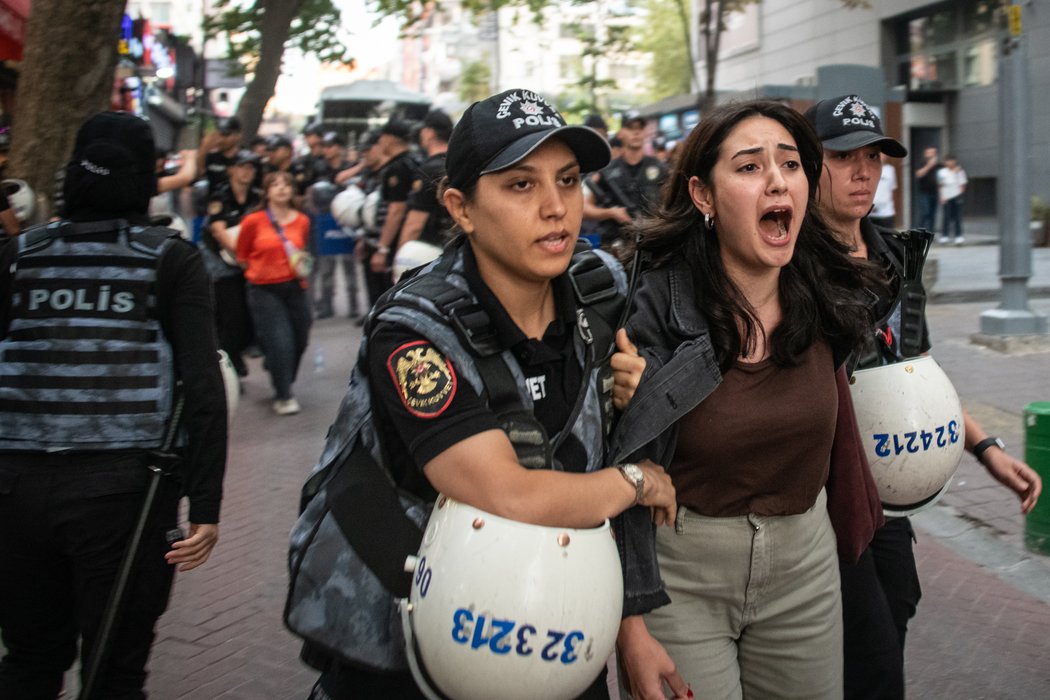
On 14th September, about 200 people gathered in Izmir to protest against the arrests, chanting slogans including “You will never walk alone” and “A year of resistance, not family”. Two people, including a lawyer, were detained at the protest and were reportedly beaten.
On 15th September, police surrounded a solidarity gathering outside Istanbul’s Çağlayan courthouse. Activists, feminists, leftist groups and union members attended. Police said the demonstration was unauthorised and removed the protesters from the courthouse in police buses. According to bianet, officers first cleared most journalists from the area before dispersing the protest, though at least two journalists were still detained. The Turkish Journalists’ Union (TGS) said BirGün reporter Sarya Toprak and ARD television reporter Şener Azak were detained while covering the events. The Human Rights Association (İHD) said police ordered the encircled crowd to disperse without providing an exit corridor.
In total, 106 people, including lawyers and journalists, were detained. They spent the night at three police stations and were released the next day. A lawyer representing the detainees said all of them were subjected to torture or ill-treatment by officers, including being kept handcuffed behind their backs for hours, insults, physical assault, discriminatory treatment and attempts to force them to undergo medical examinations in the presence of police officers.
In Ankara, police intervened in a solidarity demonstration at Sakarya Square and reportedly detained around 30 people. They were reported to have been released after giving statements at the police station.
Constitutional Court rules on protest bans in Van
On 6th October 2026, bianet reported that Turkey’s Constitutional Court had ruled that repeated bans on public meetings and demonstrations in the eastern province of Van in 2019 violated the constitutional right to freedom of assembly. The Van Governor’s Office had imposed 18 consecutive 15-day bans between April and November, citing national security and potential threats to public order.
The court found that authorities had failed to substantiate their security concerns with concrete evidence or demonstrate why less restrictive measures would have been insufficient. It stressed that blanket bans must be a last resort and that successive restrictions require increasingly detailed justification. The court also criticised lower courts for failing to adequately assess the necessity and proportionality of the measures. It ordered a retrial and awarded applicant Mahmut Kaçan 50,000 liras (approximately €1,000) in non-pecuniary damages, plus legal costs.