Timor-Leste’s civic space is rated as ‘narrowed’ by the CIVICUS Monitor, placing it among the countries with the best ratings for civic freedoms in Southeast Asia. The country generally fosters an enabling environment for freedom of expression, peaceful assembly, and association. Journalists are largely free to report without interference, and civil society remains active and engaged. Citizens regularly participate in peaceful demonstrations, reflecting a vibrant culture of public discourse. However, the law places some unjustified restrictions on protests, and protesters have been detained.
Timor-Leste is seeking membership of The Association of Southeast Asian Nations, or ASEAN. In May 2025, ASEAN leaders agreed to admit Timor Leste as its 11th member during the upcoming October 2025 summit in Kuala Lumpur but there has been pushback from the Myanmar junta, that accused Timor Leste of interfering in its internal affairs for speaking up against the junta and for democracy and human rights. There has also been public backing by President Jose Ramos-Horta and Prime Minister Xanana Gusmão for Myanmar’s pro-democracy movement and the National Unity Government.
Demonstration met with excessive force and arrests
'Timor-Leste students protest government plan to buy new cars for parliamentarians' https://t.co/ha32pDsiPg
— Bishal K Chalise (@bishalkchalise) September 17, 2025
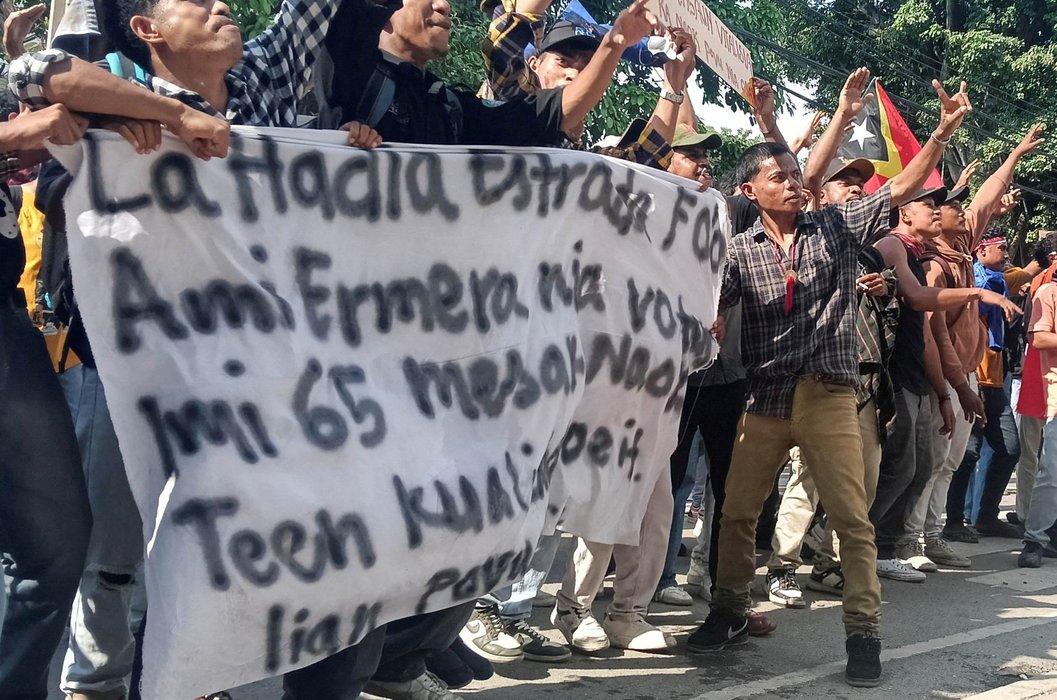
In September 2025, Timor-Leste police fired tear gas at demonstrators protesting against a plan to buy new official cars for lawmakers.
More than 1,000 people, mostly university students, rallied near the National Parliament in Dili to protest against a plan approved in 2024 to allocate USD 4 million to procure cars for each of the 65 members of parliament.
The plan was the latest flashpoint in the resource-dependent country, where more than 40 per cent of its population lives below the poverty line, according to the World Bank.
Leonito Carvalho, a student from Dili-based private university Universidade da Paz said: "We ask for the parliament members to cancel the decision to purchase the (Toyota) Prado”. Protesters carried a banner urging the authorities to “stop thieves, stop corrupters”.
The demonstration organised by the Timor-Leste University Students (EUTL) began peacefully, but police moved to fire tear gas after some protesters allegedly hurled rocks towards parliament. The tear gas injured at least four protesters, who were taken to a nearby health facility.
A short analysis of the three-day Gen Z protest in Dili by Timor-Leste journalist & editor Ato 'Lekinawa' da Costa, who was an activist against the Suharto regime while studying in Indonesia alongside other Timorese and Indonesian students.https://t.co/9KUtDnolu1
— Green Left (@GreenLeftOnline) September 17, 2025
The protesters used smartphones and social media platforms, especially Facebook and increasingly TikTok, to mobilise. Photos and videos of confrontations with police, where several students were injured, were shared instantly across networks, fuelling anger and drawing more students into the protest.
The protests continued into 16th September 2025 as about 2,000 demonstrators returned to the streets. When they were prevented from gathering near parliament, they burned tyres while police responded with tear gas. Though the protests were initially triggered by the cars issue, they then expanded to cover calls to remove lifetime pensions for retired lawmakers, repeal restrictive provisions in the protest law and increase allocations of government funds in the social sector.
According to analysts, at the heart of these demonstrations lies a deeper frustration: corruption, inequality and a sense that the promises of liberation have not materialised for ordinary Timorese.
At least 12 protesters from the student front were arrested and detained for hours by the police before being released.
Hours later, the government bowed to public pressure and scrapped the plan to give its lawmakers free cars.
In a joint statement, the National Congress for Timorese Reconstruction, the Democratic Party and the Enrich the National Unity of the Sons of Timor said the purchase "did not reflect public interests".
On 17th September 2025, MPs also agreed to scrap lifetime pension allowances for themselves, former presidents, prime ministers and cabinet ministers. Parties in the East Timor parliament said they would abolish the plan as an understanding they had struck with the students.