The state of civic space in Taiwan is rated as ‘open’ by the CIVICUS Monitor. This means the state has created an enabling environment for people to enjoy their civic freedoms. Civil society is able to operate and undertake their work without harassment or undue interference. People are free to hold protests in public places and form associations. There is also a relatively free media, and journalists are able to do their work without any major restrictions.
The ruling Democratic Progressive Party (DPP) has been consistently blocked by lawmakers of the opposition parties, including the Kuomintang (KMT) and Taiwan People’s Party (TPP), who occupy a majority of seats in the Legislative Yuan (parliament) and hence have the power to veto motions, bills, and budgets. In January 2025, the KMT and allies in the Legislature passed unprecedented 6.6 percent budget cuts that have severely undermined the operations of the ministries of National Defence, Foreign Affairs, and Digital Affairs.
Taiwan’s political system allows voters to remove their elected representatives before the end of their term through a legal process known as a recall. In March 2025, the Legislative Yuan passed new measures tightening the process by which elected officials can be recalled. Civil society groups and the DPP have raised the alarm, arguing that the new rules will create a chilling effect.
Despite this, this stand-off has triggered the Great Recall campaign. A citizen-led mass movement has mobilised to collect signatures for the recall vote. A total of 24 KMT lawmakers will face recall votes on 26th July 2025.
In recent months, there has been harassment and violence against citizen groups mobilising for a recall vote, while Chinese influencers were forced to leave the country. The budget freeze by parliament has impacted on civil society and the national human rights commission. There have been multiple peaceful protests without restrictions, but some opposition leaders are facing charges.
Expression
Harassment against citizen groups around recall vote
There have been reports of citizen groups who have been collecting or signing the recall petition facing harassment, threats and violence.
On 18th February 2025, a group of lawyers formed a legal defence team to assist civil groups and individuals who say they were harassed or intimidated for participating in petition drives.
In April 2025, citizen groups reported multiple incidents of harassment from opponents. Video of an event outside the Hualien Railway Station showed a woman calling volunteers seeking signatures “garbage” and “useless.” Police officers also questioned a woman who allegedly attacked a volunteer outside a post office in Hualien City. The volunteer said she was struck from behind by the woman before the alleged assailant ran into the post office.
In June 2025, Isolated incidents of scuffles and verbal altercations were reported. In New Taipei City, police detained a woman after she confronted citizen group volunteers working on the recall campaign in Jhonghe and Yonghe districts. The woman allegedly slapped a volunteer on the back.
In New Taipei City’s Sindian District, gang members allegedly threatened a recall movement leader. Political pundit Lee Cheng-hao was attacked with pepper spray, and Democratic Progressive Party Taipei City Councilor Lin Liang-chun said that she had been blackmailed.
Chinese influencers forced to leave country
A mainland Chinese influencer who is married to a Taiwanese man left the island on the evening of 26th March 2025, after the authorities ordered her to do so for allegedly advocating on social media for 'military unification' with China.
Liu Zhenya, a mother of three children, had her residence permit in Taiwan revoked and was told to leave the island or face deportation. Known as “Yaya in Taiwan” on Douyin, the Chinese version of TikTok, she has more than 400,000 followers. The immigration agency said that “openly advocating (for the) military invasion” of Taiwan has “crossed the boundaries of freedom of speech”.
Another Chinese influencer Enqi also left the country on 31st March 2025, before a midnight deadline to leave Taiwan voluntarily or risk being forcibly deported for advocating “unification by force” on social media.
On 1st April 2025, influencer, Xiao Wei, who had allegedly advocated for the military annexation of Taiwan on social media, was deported from the island. She had reportedly been living on the island on a dependant’s permit for 12 years and has three children with her Taiwanese husband.
The deportations have created a debate in Taiwan on free speech and national security. Those who support the government’s decision cite the solid legal basis and process in which the deportation took place, including appeals and procedures for handling a clear breach of laws. However, some argue that these deportations are a violation of Taiwan’s spirit of free speech in that speech deemed offensive to the government is silenced. They state that in the cases of Yaya, there is no evidence that she had ever had contact with Chinese Communist Party (CCP) intelligence personnel or received instructions and that she only expressed opinions and views without any organisational action or mobilisation calls.
Association
Budget freeze impacts civil society
In January 2025, it was reported that the budget cuts by parliament had been aimed at political suppression, threatening Taiwan’s democracy and civil society.
Ine one case, there were cuts of NT$77,000 (US$2,350) and freezing NT$70 million of the Ministry of Education’s Youth Development Administration’s budget that impacted on a civil society group subsidised by the youth agency, Cosmopolitan Culture Action Taichung. The group was accused of taking part in social movements.
Edwin Yang, an associate professor at the College of International Studies and Social Sciences of the National Taiwan Normal University, said that the KMT coalition in Parliament is “undermining the development of civil society and using the budget freeze as a means to suppress organisations that participate in public affairs.” He added: “This does not only affect the operation of community organisations, but also threatens freedom of speech and assembly, creating a chilling effect in civil society.”
Budget cuts to the National Human Rights Commission
In March 2025, the Asia Pacific Forum of National Human Rights Institutions (APF) raised serious concerns about the impact of proposed budget cuts by parliament on the operation and functioning of the National Human Rights Commission (NHRC) of Taiwan.
APF said that these cuts will directly impact the NHRC’s capacity to perform its mandate, including conducting research on human rights issues, investigating complaints of human rights violations and discrimination, and developing educational and promotional resources for human rights.
In a statement, the commission said it won't be able to attend international conferences this year or to conduct investigations in other counties, remote areas, or offshore islands.
The proposed budget cuts will also severely undermine the financial independence and stability of the NHRC. Insufficient funding will severely impact its ability to serve the public.
The APF called on the State to ensure the financial independence and continued functioning of the Commission, in alignment with the constitutional framework and international standards.
Peaceful Assembly
Multiple peaceful protests were documented in Taiwan since the beginning of the year.
In April 2025, the Taiwan Alliance for a Free Palestine organised a rally in support of Palestine in Taipei and demanded that the government stand up for human rights and transitional justice.
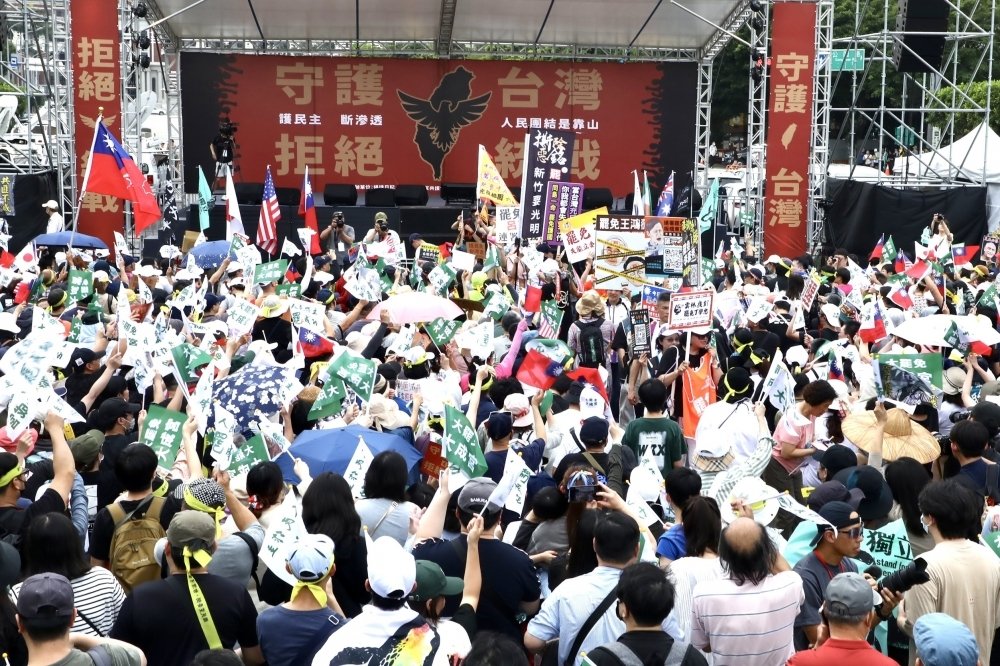
On 19th April 2025, activists opposing China's political influence held a rally in Taipei to call on people to stand against lawmakers from the KMT and support ongoing recall campaigns targeting them. The event drew an estimated 55,000 people to Ketagalan Boulevard in front of the Presidential Office Building in Taipei, according to the organisers.
Thousands of people gathered in central Taipei on 1st May 2025, International Workers’ Day, to protest the Democratic Progressive Party (DPP) authorities’ policies and demand improved welfare for workers. Approximately 100 trade unions, including the Labour Rights Association and the Taiwan Electric Power Workers Union, joined the rally.
Hundreds of people took to the streets in Taipei on 11th May 2025 to protest the government's move to require Chinese spouses to submit proof of having renounced their Chinese household registration, a rule that Taiwanese authorities have begun enforcing more strictly since April 2024. The march, organised by the Rebirth Party and the China-friendly New Party, began at Chiang Kai-shek Memorial Hall and ended outside the Legislative Yuan, drawing around 1,000 participants, according to the organisers.
Investigation of opposition for illegal protest
In April 2025, Taiwan's top law enforcement official said it had initiated legal proceedings against the leader of the island's main opposition party following an unauthorised demonstration in the capital.
Interior Minister Liu Shyh-fang said on 21st April 2025 that KMT Chairman Eric Chu had been summoned for questioning after allegedly violating the "Assembly and Parade Act" by organizsng a protest the previous week without proper permits. Speaking at a Legislative Yuan committee hearing, Minister Liu revealed that authorities have formally referred Chu's case to the Taipei District Prosecutor’s Office for criminal investigation.
On 22nd April 2025, it was reported that KMT spokeswoman Yang Chih-yu and KMT Legislator Hsieh Lung-chieh would also be summoned by police for questioning for leading an illegal assembly in contravention of the Assembly and Parade Act.
The three party members had led an assembly outside the Taipei City Prosecutor’s Office, an area where public assembly is not allowed, protesting the questioning of KMT staff in a recall petition forgery case.
According to Article 8 of the Assembly and Parade Act, groups and organisations holding demonstrations must obtain approval from the government. This is inconsistent with the position of the UN Special Rapporteur that States should not impose authorisation requirements and just put in place a notification process.
Article 6 of the Assembly and Parade Act forbids organisations and groups from holding any activities close to specified areas, such as the Executive Yuan, courts at all levels, and foreign embassies. The UN Special Rapporteur has stated on several occasions that blanket location restrictions on assemblies are intrinsically disproportionate and should thus not be imposed. This includes spaces in the vicinity of iconic buildings.