Introduction
Finnish security service reports expansion of far-right Active Club network
In late November 2025, Finnish media reported that the far-right Active Club network had expanded across Finland through local groups that combine combat sports training with nationalist activism. The Finnish Security and Intelligence Service (Supo) said the network began operating in Finland in 2023. By late 2025, the group had established eight local chapters, with the most active in Turku and Tampere. Supo described the network as part of the far-right extremist scene but did not assess it as a terrorist threat.
Researchers said Active Club has links with the Blue-and-Black Movement (Sinimusta Liike) and its affiliate Club 8. The Blue-and-Black Movement, an ethnonationalist group, re-entered Finland’s register of political parties in May 2025 after collecting the required 5,000 supporter signatures. It had previously been removed from the register after the Supreme Administrative Court ruled that its party programme conflicted with the Constitution and human rights obligations.
Finland’s data centre boom meets growing opposition
On 9th September 2026, Google announced a record €13bn investment in Finland over 2027 and 2028, its largest single investment in Europe. It will fund new data centres in Kajaani, Muhos and Vaala and expand an existing site in Hamina. Google also signed a 22-year agreement with the state-controlled energy company Fortum to buy up to half the output of the Loviisa nuclear plant, which generates about 10 per cent of Finland’s electricity. Earlier that week, TikTok said it would invest $1bn in a data centre in Kouvola. According to the BBC, Finland’s cool climate, low-carbon electricity and relatively uncongested grid have made it attractive to developers.
The expansion has, however, prompted pushback. A citizens’ initiative, “Datakeskukset kuriin” (“Rein in the data centres”), gathered the 50,000 signatures needed to go before parliament within three days of its launch on 15th September. It calls on the government to set conditions on how data centres connect to Finland’s electricity grid, including backup power and the use of waste heat, and for a separate “data centre fee” to be calculated and charged to the companies based on the environmental harm caused by their operations.
Concerns about the environmental impact of data centres escalated in October. On 6th October, the Finnish Supervisory Agency (LVV) ordered a halt to preparatory work at the Muhos and Kajaani sites over the clearance of more than 300 hectares of forest, saying one site lacked a mandatory environmental impact assessment. On 12th October, around 100 people took part in a demonstration outside Google’s Helsinki headquarters organised by the environmental group Luontoliitto. The protesters called for legislation imposing financial sanctions on companies responsible for environmental damage, with penalties linked to corporate income. Luontoliitto said the demonstration reflected growing concern over the environmental consequences of data centre projects in Finland and that further protests were planned.
Finland continues to tighten immigration and citizenship rules
On 17th April 2026, Finland’s government submitted a package of legislative proposals to parliament to tighten immigration rules, including a citizenship test expected to take effect in 2027. Applicants would have to answer 20 to 40 multiple-choice questions in Finnish or Swedish on topics such as Finnish history, culture, human rights and equality, and achieve a pass mark of around 70 per cent. Interior Minister Mari Rantanen said the test would ensure applicants met the requirements for citizenship. Amendments to the Aliens Act, which make it easier for authorities to deport people and impose entry bans, and the law introducing the citizenship test subsequently took effect in June 2026.
Migrants’ rights organisations say the framework for immigration and asylum has been tightened significantly since the current government took office in 2023, with ten legal changes affecting asylum seekers, migrants and refugees reported in 2025 alone. Rules on family reunification, financial aid for asylum seekers, work-based residence permits and the entry of foreigners have all become stricter. The right to asylum has effectively been suspended at the border with Russia, where an emergency law allowing border guards to turn away asylum seekers has been in force since December 2023 “until further notice”.
Freedom of association
Funding cuts may have “shattering” effect on Finnish civil society
Finland’s government has confirmed cuts of about €80 million, or one-third, to grants for social and health organisations awarded by the Funding Centre for Social Welfare and Health Organisations (STEA) in its 2027 budget, agreed on 1st September. According to Yle, the government plans to increase defence spending significantly and cut corporate tax, while further reducing spending on development aid and integration services.
The cuts could have a severe impact on Finnish civil society. A survey by umbrella group SOSTE and the Finnish Association of Private Care Providers, published on 28th August, was sent to all organisations that received a STEA grant in 2026, almost 700 in total. It found that 80 per cent expect to end some activities, and 40 per cent consider it possible or likely that they will have to close entirely.
On 22nd June, SOSTE, Finland’s largest umbrella organisation for social and health NGOs, with more than 240 member organisations, announced that it was launching change negotiations that could lead to the dismissal of almost its entire workforce. It employs 31 people and said up to 29 positions could be cut. On 7th September, former President Tarja Halonen warned that the cuts could weaken civil society in a “shattering” way. Media reports described the intervention as unusual, as former Finnish presidents rarely comment on domestic political issues.
The distribution of the cuts has previously caused tension within the governing coalition. In June, Social Affairs and Health Minister Wille Rydman of the far-right Finns Party proposed criteria that would exclude umbrella organisations and groups focusing on advocacy, policy or advisory services, as well as those “whose activities focus mainly on a specific non-health-related background or identity group”.
Civil society organisations and opposition parties said the wording appeared aimed at denying public funding to immigrant organisations, refugee support groups and associations representing sexual and gender minorities. Prime Minister Petteri Orpo said the proposal lacked government support and referred it to the full cabinet.
On 23rd June, the Left Alliance called a confidence vote, which Rydman survived, with Parliament voting 88-74 in his favour. The result drew attention because members of the Swedish People’s Party (RKP), a coalition partner, abstained rather than back the minister.
In August, the government approved a decree amendment requested by Orpo concerning STEA regulations, which government members said removed the discriminatory language at the centre of the dispute. However, it remains unclear whether the decree or Rydman’s criteria will be applied when STEA grants are approved. The application window opened in September.
Environmental group denied fundraising permit due to board member’s protest conviction
On 15th October 2025, Finland’s National Police Board refused climate organisation Just Shift a fundraising permit, citing a board member’s conviction for insubordination after a peaceful Elokapina protest in 2021. The authority argued that the planned use of the funds was closely linked to demonstration activities that could endanger public order. Under Finland’s Money Collection Act, soliciting donations from the public requires a permit from the police board.
Just Shift has appealed to the Administrative Court. In a statement, it stressed that it is a separate entity from Elokapina and that civil disobedience is not part of its activities, although it supports the freedom of peaceful assembly, adding that the board member had exercised their right to protest as an individual.
Amnesty Finland criticised the decision as an attempt to restrict civil society and suppress debate on climate change. Legal experts also argued that the ruling contradicted the purpose of the Money Collection Act, which exists to support the work of civil society, and noting that a previous police decision to block fundraising for Elokapina’s legal costs had been overturned by an administrative court.
Russian anti-war activists face deportation
On 9th August 2026, The Guardian reported that Russian nationals Nikita Belov and his mother, Olga, faced possible deportation from Finland after repeated asylum refusals, despite their fears that they would be subject to reprisals in Russia due to their pro-Ukraine activism.
The pair fled Russia in 2022 after reportedly receiving threats linked to their opposition to the invasion of Ukraine. Nikita had left his engineering job at a research institute after learning it was connected to the war effort, and says this drew the attention of Russian authorities. Since arriving in Finland, they have supported Ukraine through humanitarian aid and public advocacy.
Finnish authorities detained them pending deportation in April, but they were released following court intervention. Their lawyer warned that returning to Russia could expose them to persecution, and the pair said they had suffered mental health problems, including panic attacks, while awaiting the court’s decision. On 17th August, The Guardian reported that an administrative court had ordered a review of the Belovs’ case, citing international media attention as a contributing factor.
In a similar case, on 26th May 2026, Finland’s Supreme Administrative Court suspended the deportation of Russian anti-war activist Roman Golikov, whose asylum application had been rejected and who was due to be returned to Russia on 28th May. Meduza, citing a friend of the activist, reported that Golikov was released from custody following the ruling.
Golikov arrived in Finland in September 2022, shortly before Russia announced military mobilisation, and subsequently applied for asylum. He had taken part in anti-war demonstrations in Finland. Previously, he had supported independent candidates in Russia, spoken out against the war and donated to independent media and to the Anti-Corruption Foundation of the late opposition leader Alexei Navalny, which Russian authorities have designated an extremist organisation.
Freedom of peaceful assembly
Amnesty International reports barriers to peaceful assembly in Finland
On 13th November 2025, Amnesty International Finland published the findings of a qualitative study on barriers to participation in demonstrations, based on in-depth interviews with people from diverse backgrounds across the country. Participants from BIPOC (Black, Indigenous and people of colour) and other racialised groups identified racism as the most consistent barrier, citing racial profiling, excessive force and online hate speech, including doxxing and death threats. Some said protests led by immigrant communities were policed more heavily than those led by white Finns. Participants with insecure migration status said they feared that even minor encounters with police could jeopardise their residence permits or citizenship applications.
Freedom of assembly is guaranteed by Finland’s Constitution and international human rights treaties. Amnesty said about 10.8 per cent of the population speaks a first language other than Finnish or Swedish, but this diversity is rarely reflected in protests or decision-making spaces. It warned that excluding marginalised groups narrows the range of views heard by decision-makers.
On 9th March 2026, Amnesty International Finland published an assessment of protest rights based on its monitoring of 17 demonstrations in 2025, mainly in Helsinki, Tampere and Jyväskylä. Although most took place as planned, Amnesty raised concerns about police practices, including the use of an air gun against protesters in Tampere, increased resources to disperse climate protests, and insufficient protection for demonstrators, journalists and human rights observers facing harassment or violence. It said police often prioritised preventing traffic disruption over facilitating assembly, dispersing Elokapina (Extinction Rebellion) road protests without negotiation, even though international standards require disruption to be serious and prolonged before a demonstration is broken up.
Amnesty also criticised the use of telecommunications surveillance against four climate activists during the 2024 Jyväskylä World Rally Championship, arguing that the measure lacked sufficient grounds and violated their privacy. It warned that authorities increasingly treated protests as public order disturbances rather than constitutionally protected assemblies.
In July 2026, in its submission to the UN Committee on the Elimination of Racial Discrimination, Amnesty reiterated these findings, also noting its observers had documented Finnish police restricting the freedom of peaceful assembly of counter-protesters against far-right demonstrations, as well as unnecessary and disproportionate interventions in Palestine solidarity demonstrations.
Greta Thunberg charged in Finland for 2024 environmental protest
On 12th December 2025, Helsingin Sanomat reported that criminal charges for disobeying police orders had been filed in Finland against Swedish climate activist Greta Thunberg. The charges relate to her participation in a June 2024 protest by the environmental direct action group Elokapina. Thunberg was among more than 100 protesters arrested after blocking roads in central Helsinki.
Positive court rulings affirm freedom of peaceful assembly
On 24th October 2025, Helsinki District Court acquitted five environmental activists charged with disobeying police orders during an October 2023 protest against logging in Stansvik, Helsinki. The court found that the activists had acted out of necessity to safeguard the natural state of a legally protected streamlet threatened by forestry machinery. It ruled that the danger was immediate and compelling, and that other means of protecting the streamlet, including petitions, demonstrations and contacts with authorities, had been exhausted. It concluded that the activists’ actions were justified as a last resort to protect a legally protected common interest. The ruling was described as the first known case in Finland in which a necessity defence succeeded in an environmental activism case. It was not final, pending a decision on whether the prosecutor would appeal.
On 19th December 2025, the Helsinki Court of Appeal fined three police officers over the use of pepper spray against Elokapina protesters during a demonstration in Helsinki on 3rd October 2020. Police had used the spray to remove protesters blocking a street during rush hour, some of whom had locked themselves together and to objects. The court upheld the district court’s decision to fine the officer who authorised the use of pepper spray and found two other officers guilty of negligent breach of duty, ruling that they had an independent obligation to assess whether its use was justified. It otherwise upheld the district court’s ruling, which had dismissed charges against four other officers, although the prosecutor had initially sought penalties for seven.
In April 2026, Helsinki District Court acquitted two environmental protesters charged with disobeying police orders during an Elokapina demonstration on Mannerheimintie in Helsinki in May 2025. The protest, organised by the movement’s Sotekapina group against healthcare cuts and environmentally harmful subsidies, involved activists blocking a traffic lane. The court ruled that police had no legal grounds to order the demonstration to end, finding that it was small and peaceful and posed neither a serious traffic disruption nor an immediate danger. It also criticised police for ordering the protesters to disperse after about 25 minutes without attempting negotiations.
Almost 300 detained in “Wildfire Rebellion” civil disobedience campaign
On 9th June 2025, the Finnish climate movement Elokapina, the national branch of Extinction Rebellion, began a three-day protest in Helsinki. Protesters called on the government to end environmentally harmful subsidies, reduce excessive logging and strengthen biodiversity protections.
The group said around 1,500 people had registered for the “Wildfire Rebellion” demonstrations, and that more than 400 were prepared to be detained. Before the campaign, Elokapina said one of its aims was to overload police detention capacity, claiming the number came close to the capacity of detention facilities across the Helsinki metropolitan area. It said stretching police resources in this way could increase pressure on the political system by prompting police to tell the government that the issue required political rather than policing action.
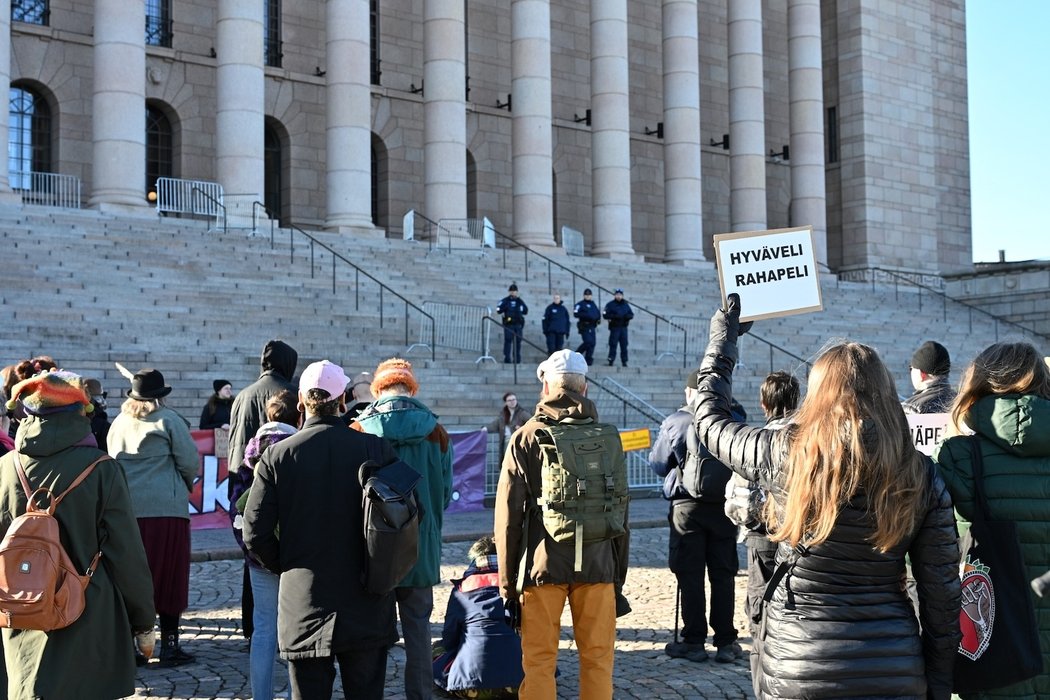
The demonstrations began with a march from Senate Square to Parliament, after which protesters blocked several major roads and intersections in central Helsinki, causing significant disruption to traffic and public transport. Police later ordered protesters gathered outside the Finnish National Opera to disperse, saying the demonstration was causing unreasonable disruption to public transport. Officers said they were prepared to carry out mass detentions if necessary, and detained 160 protesters on the first day. The protests continued on 10th June, when police detained 81 people, including minors, for allegedly failing to comply with an order to leave. Some of those detained were also suspected of obstructing an official. On 11th June, a further march took place from Senate Square.
Police said they detained a total of 297 people over the three days. Most were held in the yard of Pasila police station rather than in cells, briefly questioned and released after a few hours. Only one person was held overnight; police said that person had disrupted their operations more than others and was considered likely to continue doing so if released. Although the group had initially aimed to overwhelm police capacity, Elokapina campaign spokesperson Panu Puhakka said the outcome was not a disappointment, adding that the movement does not seek confrontation with police.
Far-right protests and counter-protests for Independence Day see fewer incidents
On 6th December 2025, Finland’s Independence Day, far-right groups again organised the annual “612 torchlight procession” in Helsinki. The march has been held every year since 2014 and is frequently met with counter-protests. According to police, the day’s demonstrations passed largely peacefully, with fewer clashes and arrests than in previous years.
Some incidents were recorded. Pyrotechnic flares were used during the far-right march, and police reported a stone being thrown at a crowd-control officer, a suspected assault and damage to a police vehicle. An ambulance responding to an emergency call was also briefly delayed. Police erected barriers around Töölöntori square to keep the 612 procession, which attracted about 700 participants, apart from the anti-fascist Helsinki Without Nazis demonstration, which drew about 2,500. Four people were detained on suspicion of offences including criminal damage, resisting an official, defamation and obstruction. Police said the demonstrations caused no major property damage or disruption elsewhere in the city.
Calls for ban on face coverings at demonstrations after assault at far-right march in Tampere
On 1st May 2026, the far-right Blue-and-Black Movement held a march called “White May Day” in Tampere, while the “Tampere without Nazis” collective staged a counter-demonstration. Police estimated that around 200 people took part in the march and a similar number in the counter-protest. Some marchers made Nazi salutes. Police said scuffles broke out between the groups and seven people were detained.
Footage filmed by Yle showed several marchers violently attacking counter-protester Tytti Hynninen, who said she and a friend were struck with fists and a knee while holding an anti-Nazi banner. Police are investigating the incident as assault but said identifying suspects may be difficult because many marchers covered their faces. Officers were stationed at the start and end of the march, but not where the assault occurred.
Politicians, including from the far-right Finns Party and the Centre Party, subsequently called for a full ban on face coverings at demonstrations. Finnish law contains no general ban; wearing a face covering in public is prohibited only when clearly linked to an intent to commit a crime.
At the Blue-and-Black Movement’s May Day protest the previous year, police detained 15 anti-fascist counter-protesters and fired a pneumatic projectile launcher at them, drawing criticism from Amnesty International Finland. Around 200 counter-protesters, whom police estimated outnumbered the 50 to 100 participants in the far-right event, threw eggs and hand flares at those taking part in the rally. All those detained were released the next day, and police said they were no longer suspected of any criminal offence, although some were fined.
Freedom of expression
Appeal court upholds journalists’ treason conviction over reporting on military intelligence
On 1st July 2025, the Helsinki Court of Appeal upheld the Helsinki District Court’s 2023 convictions of Helsingin Sanomat journalists Tuomo Pietiläinen and Laura Halminen for revealing classified information about Finland’s military intelligence services (see previous CIVICUS Monitor update). Both courts found the journalists guilty of revealing a security secret, and of attempting to reveal one in relation to an unpublished follow-up article. Pietiläinen’s four-month suspended prison sentence and Halminen’s fine were upheld. The court also confirmed the acquittal of former political editor Kalle Silfverberg.
The case began in December 2017, when Helsingin Sanomat published a series of articles on proposed legislation to expand the powers of Finland’s security services to conduct surveillance and covert operations at home and abroad. Prosecutors announced charges four years later, accusing the three journalists of disclosing, and attempting to disclose, state secrets, which is classified as a crime of treason under Finnish law, and sought prison sentences for all three defendants.
The journalists denied the charges throughout the proceedings, arguing that the information was outdated, available from public sources and did not constitute state secrets. The Court of Appeal ruled that both the published article and the unpublished draft were intended primarily to reveal security secrets rather than to contribute to public debate. It held that, in the circumstances, protecting national security outweighed the journalists’ right to freedom of expression. It also upheld an earlier order requiring Helsingin Sanomat to remove the published article from its website.
The International Press Institute (IPI) and its Finnish National Committee expressed alarm at the ruling, saying it raised significant press freedom issues, particularly because one of the convictions related to an article that was never published. The organisation also criticised the use of national security legislation to prosecute reporting carried out in the public interest.
Yle reports delays and high fees in obtaining public court records
On 10th September 2025, Yle journalist Mari Jäntti reported that her team had faced significant delays and demands for high fees when requesting public court records from district courts across Finland. The records were needed for an investigation into the courts’ handling of assault cases. Although verdicts are public documents under Finland’s constitutional principle of openness, obtaining them through freedom of information requests took more than a year.
Between January 2024 and early 2025, Yle requested more than 10,000 PDF files containing over 16,000 assault indictments and verdicts. Finnish law requires public information requests to be processed within one month, but Yle asked for six to eight weeks because of the volume of documents. Some courts supplied the records promptly. Others estimated charges of up to €6,500 for one month of clerical work, or €1,850 for one week, citing the time needed to retrieve, encrypt and process the files, as well as the absence of some documents from electronic systems. An expert interviewed by Yle noted that under Finnish law, extensive amounts of data or secrecy classifications cannot be used as grounds for charging fees for freedom of information requests, and that authorities are obliged to organise their systems so that the principle of openness is upheld, suggesting that the courts’ response indicated an attempt to make access to public records unnecessarily difficult.
Far-right activist fined for incitement against Jewish people over flag-burning video
On 24th August 2025, the Southwest Finland District Court fined a member of the far-right Blue-and-Black Movement €1,650 after convicting him of incitement against Jewish people. The man admitted to burning an Israeli flag and publishing a video of the act on websites linked to the movement and on other social media platforms. The court found that the video was hateful and violated the human dignity of Jewish people.
Finns Party MP’s husband targets journalists in Facebook comments
On 23rd May 2026, Ari Reijonen, husband of Finns Party MP Minna Reijonen, posted offensive comments on Facebook targeting Minna-Liisa Mathalt, editor-in-chief of the local newspapers Pitäjäläinen and Koillis-Savo, and a Savon Sanomat journalist. The comments appeared beneath a post about an article assessing his wife’s performance as an MP. Reijonen called Mathalt a “serial drowner”, a term used to describe a convicted murderer in a prominent 2017 case, in reference to a drowning accident in which the journalist lost her spouse and 9-year-old child. He also described her as “the cheerful widow of the local newspaper”, and named the Savon Sanomat journalist as a “paedophile”.
Savon Sanomat editor-in-chief Matti Pietiläinen criticised the comments as personal and inappropriate, noting that neither journalist had anything to do with the article. Ari Reijonen later deleted the comments and apologised, as did Minna Reijonen on her husband’s behalf. On 28th May, it was reported that Mathalt planned to file a criminal complaint asking police to investigate whether the comments constituted defamation.
Florence and the Machine restrict media photography at Helsinki festival
On 15th August 2026, the British band Florence and the Machine reportedly prohibited media outlets from photographing their performance at Flow Festival in Helsinki with professional cameras. According to Helsingin Sanomat, media representatives were told before the concert that the band would stop playing if they spotted a professional camera in the audience, while members of the public were allowed to take photographs with mobile phones. No reason was given for the ban. The festival declined to comment, and the band’s record label, Universal Music Finland, denied that the instruction had come from it.
On 16th August, the second day of the festival, Helsingin Sanomat also reported that US artist Sombr required photographers to sign an agreement granting him worldwide, uncompensated usage rights to their photographs, as well as the right to approve images before publication. The newspaper said such approval requirements conflict with journalistic principles.
Supreme Court convicts former minister of incitement over homophobic pamphlet
On 26th March 2026, Finland’s Supreme Court convicted Päivi Räsänen, a Christian Democrat MP and former Minister of the Interior, of incitement against a minority group and fined her €1,800. The conviction concerned a 2004 pamphlet in which she described homosexuality as “a disorder of psychosexual development”.
By a 3-2 vote, the court found that Räsänen had incited hatred by republishing the pamphlet on Facebook in 2019 and on her website the following year. It ruled that her claim about homosexuality was incorrect and had been presented as fact rather than as protected religious expression. The court upheld her acquittal over a separate 2019 social media post that quoted a Bible verse to criticise the Evangelical Lutheran Church of Finland for sponsoring Helsinki Pride and described homosexuality as “shameful and sinful”. It deemed that post to be religious expression.
The ruling drew criticism from Finnish and US politicians, including Deputy Prime Minister Riikka Purra of the far-right Finns Party and the US Embassy in Finland. The Alliance Defending Freedom, a US-based Christian legal advocacy group classified by the Southern Poverty Law Center as an anti-LGBTQI+ hate group, had supported Räsänen throughout the case and presented it as an example of censorship in Europe.