South Korea’s civic space is rated as ‘narrowed’ by the CIVICUS Monitor. Among the civic space concerns documented previously are the targeting of unions, restrictions and investigations of civil society groups working on North Korea, press freedom and the right to privacy.
On 3rd June 2025, Liberal candidate Lee Jae-myung was elected to become South Korea’s new president after a snap election triggered by a brief period of martial law imposed by the now-impeached former leader. Yoon Suk Yeol. Lee, from the Democratic Party, won almost 50 percent of the vote, ahead of his conservative rival Kim Moon-soo on 41 percent.
Upon taking the presidential oath, Lee delivered his inaugural address at the National Assembly’s Rotunda Hall, outlining a sweeping vision centred on democratic restoration, inclusive growth, national unity and renewed global leadership. However, he currently faces five different criminal charges involving alleged corruption, election law violations from his 2022 presidential campaign, the misuse of public funds, and subordination of perjury. Lee has denied all charges, arguing that such accusations are merely politically motivated.
In recent months, students were arrested for protesting US-Korea joint military exercises in front of the US embassy, while police restricted anti-China protests in Myeong-dong. A UN expert has raised concerns around violations of the right to privacy, while the ruling party is seeking to revive the anti-North Korea leaflets ban in the Aviation Law.
Peaceful Assembly
Three students arrested for protesting US-Korea joint military exercises
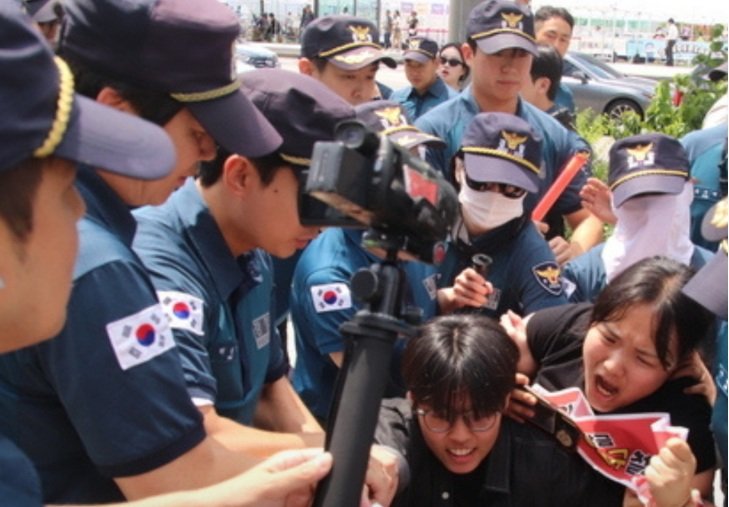
On 5th August 2025, police arrested three student protesters who tried to enter the US embassy in South Korea (picture above) to request a meeting with the acting US ambassador in order to demand an end to US-South Korea joint military exercises, a longstanding demand of South Korea’s progressive movements.
The students also sought the withdrawal of Trump’s defence cost-sharing proposal, which would force South Korea to pay USD 10 billion annually to the US, on top of the billions already paid by Koreans.
In response, South Korea deployed dozens of police to arrest the students. They were arrested in violation of the law on assembly and demonstration, which requires any protester to report to the police at least 48 hours before an outdoor assembly or demonstration. After 32 hours in custody, police released the detained students.
The protest occurred ahead of 15th August 2025, which marks 80 years since the end of Japanese colonialism and the beginning of the US occupation of the southern half of Korea.
Seoul police restrict anti-China protests in Myeong-dong
Seoul police to restrict anti-China protests in Myeong-donghttps://t.co/nGj9Yq3vq5
— The Korea Times (@koreatimescokr) September 10, 2025
In September 2025, South Korean Prime Minister Kim Min-seok ordered acting police chief Yoo Jae-seong to take "strong measures" when necessary against anti-China rallies taking place in Seoul. The orders came after a recent protest held near the Chinese Embassy in the capital’s busy Myeong-dong shopping district.
In response, police imposed restrictions barring protesters from entering Myeong-dong. According to the Namdaemun Police Station, which has jurisdiction over the area, authorities are reviewing formal notices of limitations on assembly for groups such as Free University, which have organised recurring protests in the embassy’s vicinity. Police said the measures will specifically prohibit actions likely to trigger friction, including verbal abuse and physical altercations targeting foreign diplomats and passersby.
The latest directive also comes just days after South Korean Foreign Minister Cho Hyun met with his Chinese counterpart Wang Yi in Beijing.
The anti-China rallies are reportedly driven by conservative political groups often tied to former President Yoon Suk Yeol who allege Chinese interference in South Korea's elections. Demonstrators have chanted slogans such as “China Out” and “Xi Jinping Out”, using horns, and drums.
Expression
UN experts raise concerns around violations of the right to privacy
In September 2025, it was reported that Ana Brian Nougrères, the UN Special Rapporteur on the right to privacy, had sent an allegation letter to the Korean government on 1st May 2025, alleging that the system for providing telecommunications user information under the Telecommunications Business Act violates international human rights law, including the International Covenant on Civil and Political Rights (ICCPR).
In the allegation letter, the Special Rapporteur cited as a particularly concerning example the case where prosecutors collected telecommunications user information of over 3,000 people, including journalists, under the pretext of investigating defamation charges against former President Yoon Suk Yeol in 2023. At that time, prosecutors indiscriminately collected telecommunications user information from civil society activists, ordinary citizens, and politicians who had no direct connection to the case, all under the justification of investigating defamation against former President Yoon Suk Yeol. They also arbitrarily delayed notification of the provision of telecommunications user information for the maximum legal period of six months.
Information rights civil society organisations demanded that prosecutors clarify the truth and punish those responsible, but prosecutors took no action and closed the defamation investigation before the presidential election.
The Special Rapporteur also emphasised that the Telecommunications Business Act still allows investigative agencies to collect telecommunications user information without a warrant, and pointed out that the Act may violate Article 17 of the ICCPR, which guarantees the right to privacy, and Article 14 of the ICCPR, which guarantees due process.
Ruling party revives anti-North Korea leaflets ban in the Aviation Law
Packed with leaflets, hygiene supplies, and USBs, these giant balloons are launched by activists in South Korea toward North Korea, aiming to breach its information blackout and offer a glimpse of the world beyond the border. 🔗 https://t.co/oFPgh5UU7y
— National Geographic (@NatGeo) July 18, 2025
A revised aviation safety law, which prohibits the dispersal of anti-North Korea leaflets near the inter-Korean border, passed a subcommittee of the National Assembly’s Land, Infrastructure and Transport Committee on 24th September 2025, led by the Democratic Party of Korea.
The Democratic Party had previously enacted a similar “Anti-North Korea Leaflet Ban Act” during the Moon Jae-in administration, but the Constitutional Court ruled it unconstitutional in 2023, citing violations of freedom of expression. The party is now pushing the same policy under a different legal framework. The People Power Party opposed the move, calling it a “revival of unconstitutional legislation” and walked out in protest.
Under current law, government approval is required to launch unmanned devices weighing over two kilograms due to aviation safety concerns. However, devices under two kilograms face no restrictions. North Korean human rights groups have exploited this loophole, sending balloons weighing less than two kilograms carrying anti-regime leaflets across the border. These leaflets typically criticise North Korea’s authoritarian regime and expose human rights abuses.