South Korea’s civic space is rated as ‘narrowed’ by the CIVICUS Monitor. Among the civic space concerns documented previously are the targeting of unions, restrictions and investigations of civil society groups working on North Korea, press freedom and the right to privacy.
In February 2026, South Korea's ex-president Yoon Suk Yeol was jailed for life for masterminding an insurrection by trying to impose military rule. Yoon attempted to subvert the constitution by deploying military troops to seal off the National Assembly and ordering the arrest of politicians on 3rd December 2024.
In recent months, a media law was amended to include provisions criminalising fake news while a facial recognition policy for new mobile phones raises concerns around privacy. Unjustified restrictions on foreigners during elections have been proposed, a new law was passed allowing police to stop leafleting toward North Korea, and trade union activists were arrested for a sit-in protest.
Expression
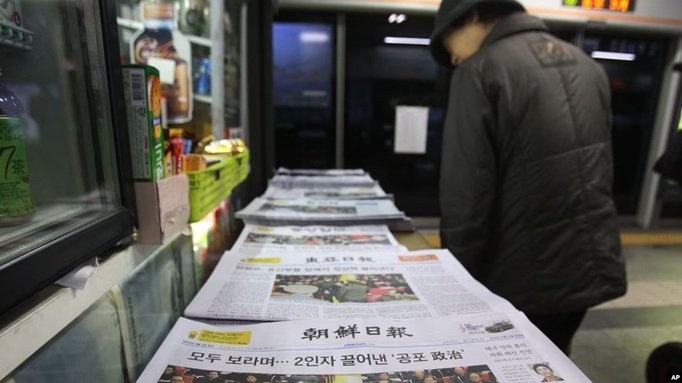
Anti-fake news provisions could be used to stifle expression and press freedom
Concerns have been raised about amendment to South Korea's media law that could stifle a free and fair media.
In December 2025, the government passed revisions to the Information and Communications Network Act in the National Assembly, insisting that the updates are necessary to cover media outlets beyond traditional newspapers and television broadcasts.
Dubbed the “anti-fake news bill,” the new law punishes media outlets or YouTubers that publish or circulate false, manipulated or illegal information with the “intent to cause harm to others” or “obtain illicit gains.” Those found liable may be required to pay up to five times the assessed damages. The bill also retains South Korea’s criminal penalty for defamation.
What specifically constitutes “false and fabricated” information and “public harm” is vaguely defined in the law, raising concerns the bill could make it easier for government officials and corporate actors to file complaints against the press, and that outlets will engage in self-censorship.
Other changes to the law are the obligatory removal from online sites of comments deemed to be false or defamatory by the Korea Media and Communications Commission, which is also able to impose fines of up to 1 billion won (USD 690,000). It also includes the right to demand corrections or rebuttals to editorials or opinion pieces.
It also stipulates that defamation through the dissemination of factual information with intent to slander would be punishable by up to three years in prison or a fine of up to 30 million won (USD 20,593).
Five media organisations, including the Journalists Association of Korea and the National Union of Media Workers, issued a joint statement warning that ‘regulating false or fabricated information by law would inevitably constrain freedom of expression and that the introduction of punitive damages could invite excessive lawsuits by those in power, eroding press freedom’.
Others state that the bill is disproportionately punitive and unnecessary, as mechanisms already exist for those who are victims of false news reports and hate speech under South Korean law.
Facial recognition for new mobile phones raises concerns around privacy
South Korea will begin requiring facial recognition when people sign up for a new mobile phone number in a bid to fight scams, the country's Ministry of Science and ICT announced https://t.co/hb9Zd2Ok4p
— The Record From Recorded Future News (@TheRecord_Media) December 22, 2025
Concerns have been raised about the requirement for facial recognition in order to sign up for a new mobile phone.
In December 2025, it was reported that South Korea will begin requiring people to submit to facial recognition when signing up for a new mobile phone number in a bid to fight scams. According to the Ministry of Science and ICT, the effort is meant to block people from illegally registering devices used for identity theft. Previously, users were required only to present an identification card to activate a smartphone.
The plan reportedly applies to the country’s three major mobile carriers and mobile virtual network operators. The new policy takes effect on 23rd March 2026.
Open Net Korea issued a joint statement on 26th January 2026, strongly urging the government to scrap its plan. They argued that facial data is highly sensitive biometric information that cannot be changed if leaked, making its collection inherently risky. By making this technology a requirement for accessing essential communication services, the government is effectively forcing citizens to provide biometric data without genuine “free consent,” which constitutes a clear violation of the Personal Information Protection Act and international human rights standards.
Korea's human rights watchdog has requested the government to review the upcoming mandate for facial recognition when opening up a new mobile phone subscription.
The National Human Rights Commission of Korea recommended that the Minister of Science and ICT reconsider the new policy and called for the development of alternative methods of authentication. The commission pointed out that while laws such as the Immigration Act and the Electronic Financial Transactions Act provide legal grounds for the collection and use of biometric data, the Telecommunications Business Act contains no such provisions. For that reason, a clear legal basis should be established before the policy is implemented, the Commission said.
Unjustified restrictions on foreigners during elections proposed
In February 2026, Rep. Lee Jun-seok and several other members of the National Assembly introduced a bill to amend the Information and Communications Network Act (Bill No. 2216616). The proposed amendment would require online platforms to verify users’ nationality and block foreigners from posting opinions on political news articles or editorials during election periods.
Open Net Korea strongly condemned this bill as a clearly unconstitutional measure and a dangerous attempt to mobilise exclusion and hostility toward foreigners for political purposes, and called for its immediate withdrawal.
The group said this bill collectively silences a specific group solely on the basis of nationality, thereby violating both the right to equality under Article 11 of the Constitution and the freedom of expression under Article 21.
They added: “Posting comments on news articles or expressing political views online is a form of expression distinct from the exercise of voting rights. Nevertheless, the bill presumes that political speech by foreigners is inherently suspect and seeks to silence an entire group’s expression in advance.”
Law passed allowing police to stop leafleting toward North Korea
In December 2025, the National Assembly passed a bill led by the ruling Democratic Party of Korea (DPK) that would give police legal authority to block attempts to send anti-Pyongyang leaflets near border areas.
The amendment to the Act on the Performance of Duties by Police Officers allows police to intervene in the launch of leaflets near the inter-Korean border, aiming to prevent activities that could heighten tensions between the two Koreas.
The DPK has argued that the legislation is necessary to protect the safety of border residents and to help reduce military tensions, while the PPP opposed the bill, saying it infringes on freedom of expression.
In South Korea, groups led by North Korean defectors have long sent balloons across the border carrying leaflets criticising the Pyongyang regime. In 2023, the Constitutional Court ruled that a previous government ban on launching the leaflets violated freedom of expression, finding that provisions of the Inter-Korean Relations Development Act imposed excessive restrictions on the right.
Peaceful Assembly
Arrest of trade union activists for sit-in protest
In February 2026, a dozen trade union activists were arrested for a sit-in protest.
Ko Jin-soo, head of the Sejong Hotel branch of the Korean Confederation of Trade Unions (KCTU) Service Federation together with 11 other union members and activists were arrested by police while staging a sit-in demanding the reinstatement of Sejong Hotel's fired workers.
They were detained on charges of obstruction of business and refusal to leave at Sejong Hotel in Jung-gu. The Namdaemun Police Station in Seoul released 11 people the next day.
However, they applied for a warrant for Ko on the grounds that he seriously damaged the hotel's operations and fears that he would flee under the protection of the Korean Confederation of Trade Unions. On 4th February the warrant was dismissed by Nam Se-jin, a senior judge in charge of warrants at the Seoul Central District Court, after holding a substantial review of the arrest warrant.