South Korea’s civic space is rated as ‘narrowed’ by the CIVICUS Monitor. Among the civic space concerns documented previously are the targeting of unions, restrictions and investigations of civil society groups working on North Korea, press freedom and the right to privacy.
In recent months, activists were restricted from travelling to Gaza and Ukraine, while a journalist was fined. Amendments have been proposed that would criminalise mockery as attempts were made to censor Taiwan at an arts show in Gwangju. The trial began for students that broke into a US airbase.
Association
Activists criminalised for travelling to Gaza and Ukraine
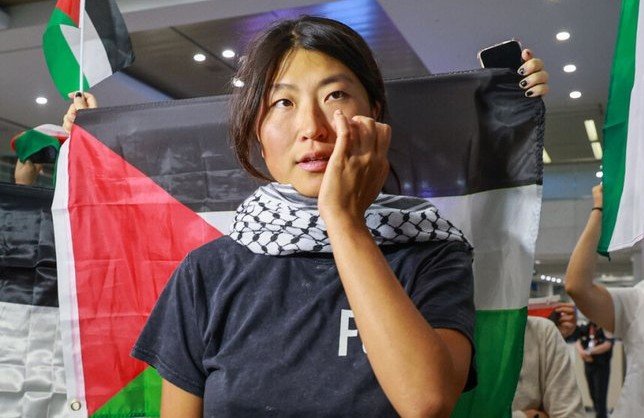
In August 2026, a Seoul court upheld the government's decision to invalidate the passport of activist Kim Ah-hyun (pictured above) - who had repeatedly attempted to reach the Gaza Strip - ruling that the state's duty to protect its citizens outweighed restrictions placed on her freedom to travel.
The Gaza Strip has been designated by the Ministry of Foreign Affairs as a no-travel area, prohibiting visits or stays without government approval under the Passport Act. The Seoul Administrative Court ruled against Kim in a lawsuit seeking to overturn an order by the Minister of Foreign Affairs requiring her to surrender her passport.
The court further found that invalidating Kim's passport was effectively the only measure available to the ministry to protect her and the country's security and interests, even though it restricted her ability to travel abroad and participate in aid efforts for Gaza.
In the same month, six South Korean activists who visited Ukraine in May 2026 to discuss the repatriation of North Korean prisoners of war (POWs) were booked by police on charges of violating passport laws.
Jang Se-yul, who leads the Seoul-based North Korean defector group Gyeoreol Unification Solidarity, said that Seoul's foreign ministry reported the group to police on suspicion of violating the Passport Act.
The activists travelled to Ukraine from 7th – 11th May 2026 in an effort to prevent the forced repatriation of two North Korean POWs captured while fighting for Russia in the Kursk region in early 2025. The two have reportedly expressed their desire to go to South Korea.
Journalist fined for travelling to Ukraine
In August 2026, a district court fined a photojournalist 5 million won (USD 3,500) for illegally travelling to Ukraine in 2022 to cover the country's war with Russia.
The Goyang branch of the Uijeongbu District Court found 46-year-old Jang Jin-young guilty of violating the Passport Act for the trip to Ukraine in March 2022.
Ukraine has been on Korea's travel ban list since February 2022 following Russia's invasion of the country.
The International Federation of Journalists (IFJ) previously said: “The use of the Passport Act, which allegedly violates the constitution of the Republic of Korea, has restricted local reporters’ right to travel to conflict areas to conduct their work, with South Korean citizens forced to rely on foreign coverage of war and conflict.
Jong-Chul Kim, a public interest lawyer, said the system was disproportionate, punishing people after they travel and stripping them of their passports before they go.
“The travel ban system, which has a strongly paternalistic character, not only infringes on individuals’ freedom to make their own choices regarding movement, but also seriously reduces the space for international civil society activities”, he said.
Aid agencies working out of South Korea face the same restrictions and have long pressed for overseas relief work to be recognised as a category in its own right, saying they cannot get permission under the current system.
Expression
Amendment proposed that would criminalise mockery
In September 2026, Open Net Korea submitted an advisory opinion to the National Human Rights Commission of Korea (NHRCK) on a proposed amendment introduced by Rep. Lee Hoonki and 10 other lawmakers (Bill No. 2219096) that would define “mockery and hate information” as illegal information under the Act on Promotion of Information and Communications Network Utilisation and Information Protection and impose criminal penalties and administrative sanctions for its dissemination.
The bill introduces a new category of “mockery and hate information,” prohibits its dissemination, and imposes criminal penalties on anyone who repeatedly or maliciously posts or distributes such information. It also requires information and communications service providers and online platform operators to take measures including deletion and blocking of access, restrictions on exposure, search, and recommendations, restrictions on account use, and restrictions on monetisation.
In addition, the bill authorises the Broadcasting, Media and Communications Commission to order such measures and, in cases of noncompliance, to impose administrative fines or even order the suspension or closure of platform services or information and communications services.
Open Net believes that the bill defines the regulated category of “mockery and hate information” in terms that are excessively abstract and vague, and that subjecting even mere mockery, derogation, contempt, and ridicule to criminal penalties and administrative sanctions would impose an excessive restriction on freedom of expression.
The bill excludes “legitimate criticism, debate, and reporting for the public interest, as well as academic and artistic activities, satire, or parody” from its scope. However, these terms are often themselves difficult to define with clear boundaries.
Open Net Korea said that when the standards for criminal punishment and administrative sanctions are unclear in this way, individuals cannot reasonably predict whether their expressions will be subject to regulation. Service providers, meanwhile, are likely to remove even lawful expressions preemptively in order to avoid sanctions.
The group has also said that hatred and discrimination against minority groups are undoubtedly serious social problems. However, the appropriate response is not broad speech regulation or criminal punishment based on vague legal concepts. Hate and discrimination should instead be addressed through democratic and proportionate measures, including education, counter speech, support for affected communities, and comprehensive anti-discrimination legislation.
Attempt to censor Taiwan at arts show in Gwangju
Sep 3: Artists from China withdrew from Gwangju Biennale, a major South Korean art show and one of Asia’s largest contemporary art exhibitions, because the organizers are using “Taiwan” as a designation in the event. Dispute began when Taiwanese artists said that organizers had initially agreed to call their exhibition the “Taiwan Pavilion” but then changed the name in June to “NTMoFA”, the acronym for Taiwan’s National Taiwan Museum of Fine Arts. The change was made “without the consent of the participating team, and brutally erased Taiwan from the poster”, the artists said in a joint statement in August, accusing organizers of “political censorship”. On Aug 25, the Gwangju Biennale foundation reversed course and agreed to restore the name “Taiwan Pavilion”. Chinese artists then halted preparations for their own pavilion, and on Sep 3, the Chinese artists announced they would formally withdraw. https://t.co/nadX4QX6EP https://t.co/gCbcA0IaHH https://t.co/rbyjso9MAd
— Byron Wan (@Byron_Wan) September 5, 2026
In August 2026, concerns were raised about attempts to censor the name of Taiwan at an art event in Gwangju
Ahead of the 16th edition of the Gwangju Biennale, considered one of Asia’s most prominent contemporary art events, the organisers changed the space “Taiwan Pavilion” to “NTMoFA Pavilion.” NTMoFA stood for the National Taiwan Museum of Fine Arts and the pavilion would showcase works by Taiwanese artists.
It drew a protest from Taiwan’s culture ministry. Participating artists also issued a joint statement on social media titled “A Pavilion Under Censorship,” saying the exhibition had been renamed without their consent and Taiwan “brutally erased” from the poster. The statement read, “It is a threat to freedom of expression and to the global artistic community.”
This forced the Gwangju Biennale Foundation to reverse its decision and approve the use of “Taiwan Pavilion.”
This in turn drew a formal expression of regret and concern from Chinese Ambassador to South Korea Dai Bing to Gwangju Mayor Min Hyung-bae. China views self-ruled Taiwan as part of its own territory under a one-China principle. Artists representing the China Pavilion subsequently halted installation work and withdrew from the event in protest.
Trial begins for students that broke into US airbase
On 22nd September 2026, the trial of three arrested students who broke into a United States air base began at the Suwon District Court's Pyeongtaek branch.
They were among a group of eight South Korean students who were detained on 4th August 2026 for breaking into the Osan Air Base in Pyeongtaek, about 60 kilometres south of Seoul, while shouting anti-U.S. slogans.
They were later transferred to the custody of South Korean authorities.
The students were investigated under a law protecting military installations in South Korea.
The Korean Progressive University Student Union said in a statement on Facebook that those detained were members who were trying to protest what it called the U.S. military's opposition to a South Korean semiconductor cluster project in the southwestern city of Gwangju.