Freedom of association
Senate rejects bill to tighten scrutiny of civil society funding
On 24th March, the Dutch Senate rejected the proposed Transparency and Countering Subversion by Civil Society Organisations (WTMO) law, which would have given authorities greater powers to scrutinise the funding of civil society organisations (CSOs) and to impose sanctions. The House of Representatives had adopted the bill on 1st April 2025.
The legislation would have required organisations to disclose donations of €15,000 or more and to keep the relevant records for five years. Mayors and the Public Prosecutor would have been able to request financial information and personal data where “necessary for maintaining public order”, or where there were serious doubts about compliance with the law or an organisation’s statutes, or about its proper management. The bill also provided for financial penalties for non-compliance and court-ordered restrictions on certain activities.
Critics raised concerns about the broad discretionary powers it would have given authorities, the lack of sufficient legal safeguards and the uncertainty over how threats to public order would be defined. They also warned that scrutiny of donors’ personal data could deter donations and undermine CSOs’ independence.
New development funding framework more than halves support for CSOs
The Dutch government’s “Focus” framework for 2026–2030 has cut development funding for CSOs by more than half compared with the previous period. According to the Civil Liberties Union for Europe’s Civic Space tracker, the framework allocates €600 million to CSOs, down from €1.4 billion under the previous “Strengthening Civil Society” framework (2021–2025). Funding is now concentrated on eight thematic priorities, including human rights, women’s rights and HIV/AIDS.
The framework explicitly excludes funding for advocacy aimed at influencing policy in the Netherlands, which could limit CSOs’ capacity to scrutinise government decisions, shape public policy and take part in domestic decision-making. It also prioritises cooperation with local organisations in West Africa and the Sahel, the Horn of Africa, and the Middle East and North Africa. In effect since 2026, it is expected to remain in place until the end of 2030.
Senate rejects asylum bill over fears of criminalising aid to undocumented migrants
On 22nd April, the Dutch Senate rejected the proposed Emergency Asylum Law by 44 votes to 31, a setback for the government’s plans to tighten asylum rules. The bill would have made staying in the Netherlands without valid residence papers a criminal offence, shortened temporary residence permits and made family reunification more difficult. Critics warned that, without adequate safeguards, criminalising undocumented stay could also expose people who provide food, shelter or other humanitarian assistance to legal risk.
The bill was defeated after an amendment intended to protect acts of charity failed by one vote, prompting Christian parties to withdraw their support. The far-right Party for Freedom (PVV) also declined to back the amendment.
The rejection did not halt the broader overhaul of asylum policy, however. The Senate approved a separate proposal introducing a two-status system, under which people with subsidiary protection receive fewer rights than recognised refugees. In October, Asylum and Migration Minister Bart van den Brink presented a new proposal that would punish undocumented migrants who deliberately obstruct their deportation with up to six months in prison. It will be open to public consultation until mid-November, after which it will be submitted to the Council of State for review.
Freedom of peaceful assembly
Government proposes wider powers to regulate demonstrations
In June, the government announced plans to give mayors additional powers to enforce conditions and move demonstrators, and to revise penalties for offences committed during demonstrations. Separately, a proposed general ban on face coverings at demonstrations drew criticism from the Netherlands Institute for Human Rights and the Council for the Judiciary, which questioned its compatibility with the right to demonstrate and the evidence for its necessity. In September, the government said it would take no further steps on the face-covering proposal, while continuing to consider other changes to protest legislation.
National Ombudsman warns right to protest is under growing pressure
On 26th May, the National Ombudsman published Sta voor protest!, a review of how authorities protect and facilitate demonstrations. The Ombudsman found that authorities increasingly prioritise preventing risks and disruption, and that some demonstrators feel monitored, face violence from police or the public, or lack an effective way to challenge decisions. The report warned that these conditions can deter people from demonstrating and called on the government, parliament, municipalities and police to protect the right in practice.
Hundreds detained after climate protesters block A12 near Utrecht
In April, police arrested around 400 people after climate activists blocked the A12 motorway near Utrecht to protest against government support for fossil fuels. The demonstration, organised by Extinction Rebellion and Debt for Climate, began when several vehicles were used to block the road and about 150 protesters occupied the motorway. Police later removed the demonstrators and arrested hundreds more who were attempting to join the action.
Most detainees were released without charge, although six people involved in the initial roadblock remained in custody and their vehicles were seized. The protesters oppose what they describe as billions of euros in annual fossil fuel subsidies, arguing that the money should instead be invested in social and environmental priorities. Police condemned the blockade as “extremely dangerous”. The action forms part of a wider campaign by Extinction Rebellion, which has repeatedly organised motorway blockades to draw attention to fossil fuel subsidies in the Netherlands.
Extinction Rebellion activists arrested after A12 blockade in The Hague
On 29th August, Extinction Rebellion (XR) activists blocked the A12 motorway in The Hague to demand urgent government action on the climate crisis. The demonstration began without prior notification, as organisers said it would otherwise not have been permitted. Mayor Jan van Zanen ordered the road to be cleared, and police repeatedly instructed protesters to leave. The motorway reopened after around two hours.
According to official figures, police arrested between 25 and 30 activists, while XR reported that 53 people had been arrested. Two protesters were initially arrested on suspicion of obstructing and endangering traffic. Those who remained on the road were subsequently taken away by bus. The Public Prosecution Service will decide whether to pursue charges for alleged violations of the Public Demonstrations Act. XR said the action was intended to press politicians to take urgent measures on the climate crisis, and activists said they would continue protesting despite repeated removals.
Police intervene at protest against asylum shelter in Apeldoorn
In May, police intervened during a protest in Apeldoorn against plans for a temporary emergency accommodation centre for asylum seekers and recognised refugees. Demonstrations had been taking place for several days in response to the municipality’s proposal to house about 240 people in an unused school building for around a year.
According to reports, a group of protesters gathered near a roundabout, setting off fireworks and disrupting traffic. The demonstration remained largely peaceful for much of the evening, but tensions escalated shortly after midnight when some participants confronted police officers. After local authorities issued an emergency order, riot police intervened and three people were arrested.
The municipality said the temporary facility is part of broader efforts to increase accommodation capacity for asylum seekers, in response to requests from the Dutch Minister for Asylum and Migration and in line with municipalities’ shared responsibility to provide emergency shelter.
Riot police break up far-right anti-immigration rally in The Hague
On 19th September, Dutch riot police dispersed an anti-immigration demonstration in The Hague after around 500 far-right protesters threw projectiles and fireworks at officers. Police used batons, dogs and water cannon to break up the rally and arrested 24 people. Authorities ended the demonstration and escorted protesters away from Malieveld park after the violence escalated, while a planned march through the city was banned.
The “Wij zijn het volk” (“We are the people”) rally was organised to oppose the government’s immigration and asylum policies. Prime Minister Rob Jetten said demonstrators had deliberately sought confrontation with police, while Justice Minister David van Weel condemned the violence, antisemitic slogans and reported Hitler salutes. Police said further investigations were under way.
Palestine solidarity demonstrations face bans, arrests
On 17th September, police arrested dozens of pro-Palestinian demonstrators in Amsterdam after they gathered near a demonstration on Dam Square organised by the group Op de bres voor Israël (Standing Up for Israel), despite a municipal ban on their planned counter-protest. The Amsterdam Palestine Coalition had sought permission to hold the counter-demonstration at Dam Square, but Mayor Femke Halsema refused on security grounds and proposed an alternative location at Oude Turfmarkt, about 500 metres away. The activist group filed for an injunction, but the judge sided with the municipality.
According to media reports, around 45 pro-Palestinian protesters gathered near the National Monument, while another group assembled on Damstraat. Police detained the demonstrators, transported them away by bus and later released them. According to police, 13 people were arrested on suspicion of offences including disrupting a demonstration and public violence.
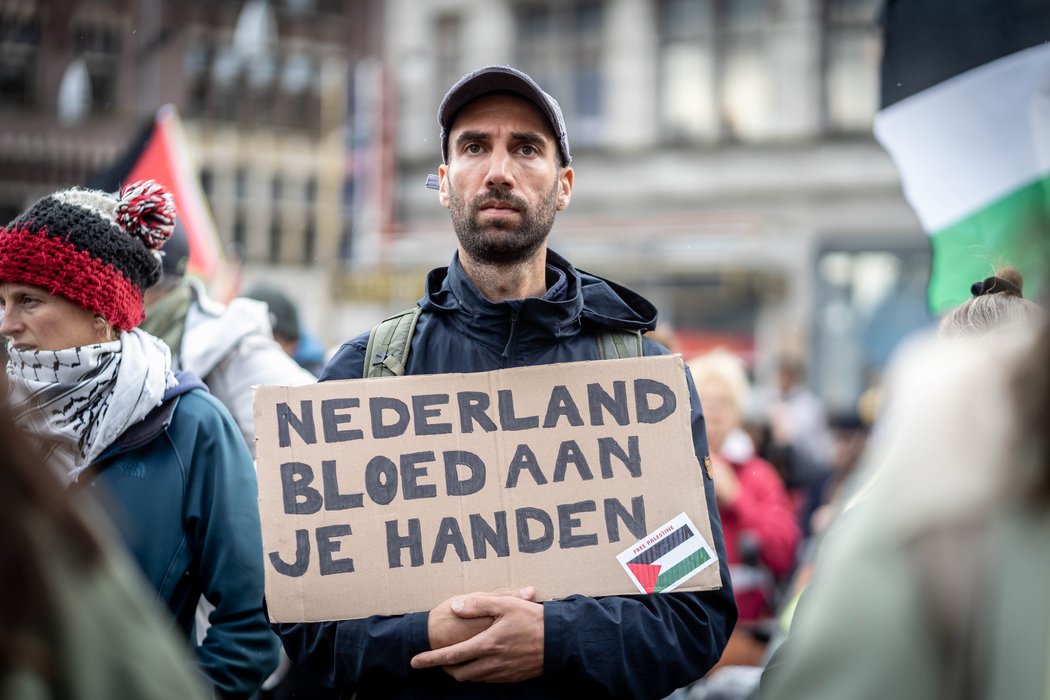
On 11th October, around 1,000 people gathered on Dam Square in Amsterdam for a national pro-Palestinian demonstration organised by Plant een Olijfboom, before marching through the city centre. Protesters chanted slogans including “Free Palestine” and “Amsterdam is saying no to genocide”, and Palestinian flags were prominent throughout the march. Earlier, around 250 people had joined a silent procession led by Amnesty International, which later merged with the larger demonstration.
Police arrested a man carrying a banner depicting a modified anti-fascist cartoon. It replaced the face of a historical Belgian fascist politician, who sees Adolf Hitler in his mirror reflection, with those of Dutch political figures Dilan Yesilgöz and Lidewij de Vos.
Freedom of expression
Watchdogs warn legislative proposals threaten civic space on “public order” grounds
In late 2025, watchdogs including the Civic Space Watch platform and Amnesty International Netherlands raised concerns about a series of legislative proposals affecting freedom of expression, assembly and association. The measures include restrictions on protests and online expression in the name of safeguarding public order.
Online Public Order Disruption Act
On 15th July 2025, the Dutch government submitted a bill on online incitement to public disorder (Wet online aangejaagde openbare-ordeverstoringen) to the House of Representatives. The proposal would give mayors expanded powers to order the removal of online content deemed to incite public disorder and to impose financial penalties on individuals who fail to comply.
On 25th February 2026, the Advisory Division of the Council of State issued a critical opinion, warning that the bill defines “public order” too broadly and that removal orders could significantly infringe fundamental rights, including freedom of expression and the right to protest. Following the criticism, a temporary committee launched a constitutional advisory process. The bill remains at the written preparation stage in the House of Representatives.
Public Order Data Collection Act
On 27th March, the Dutch government approved draft legislation giving police expanded powers to monitor publicly available online information about individuals, including people not suspected of planning a crime. The proposed Public Order Data Collection Act (Wet gegevensvergaring openbare orde) is intended to help police prevent serious public disorder, including during demonstrations, and would allow monitoring under the supervision of local mayors.
The plans have prompted concerns about privacy, freedom of expression and assembly, and the risk of discriminatory surveillance of protesters on the basis of their political views. The Dutch Data Protection Authority warned that the limits of the proposed powers remain unclear and raised concerns about possible automated monitoring. The Netherlands Institute for Human Rights also warned of risks to fundamental rights, including protection against discrimination.
On 2nd September, the Council of State’s Advisory Division issued an opinion recommending amendments to the bill. It called for a comprehensive review of public order legislation rather than the ad hoc introduction of new police powers, and urged clearer definitions of publicly accessible online sources and stronger safeguards to ensure that monitoring is proportionate and not open to abuse. The Council recommended revising both the bill and its explanatory memorandum.
Criminalisation of the glorification of terrorism
On 25th June, the Dutch government introduced a bill criminalising the public glorification of terrorist offences, the dissemination of material praising such offences and the public expression of support for organisations designated as terrorist. The bill was submitted to the House of Representatives after being amended in line with recommendations from the Council of State. It has prompted concerns about its potential impact on freedom of expression, assembly and religion.
The European Legal Support Center (ELSC) and Meld Islamofobie warned that vague terms such as “excessive praise” could lead to arbitrary enforcement and self-censorship, particularly among Palestine solidarity groups and individuals who oppose the Dutch government’s policies on Israel. They also warned that politically determined terrorist designations could be used to restrict legitimate political expression.
Dutch police seize server of Italian anti-fascist collective at US request
On 12th October, Dutch police seized a server belonging to the Italian internet service provider Autistici/Inventati (A/I) at a data centre in Amsterdam, following a request from US authorities. Dutch authorities are reportedly preparing to hand over its data. In August, the Trump administration designated the anti-capitalist and anti-fascist group a “Specially Designated Global Terrorist”, alleging that it provides digital infrastructure to violent Antifa groups and other far-left militants. The designation prompted A/I to disband, amid concerns about potential repercussions for its users and donors.
The seizure has raised concerns that cross-border cooperation could be used to target politically motivated groups. Legal experts and advocates interviewed by the technology outlet Decrypt noted that the US designation has no legal standing in the Netherlands. They questioned whether Dutch authorities had adequately considered grounds for refusing the request, including that the case involves political offences, and warned that the seizure could set a dangerous precedent. The case has also raised questions about safeguards for digital infrastructure and the potential impact on freedom of association and privacy.
Vlogger and cameraman assaulted while reporting in Delft
On 22nd January 2026, Dutch YouTuber Benjamin Buit and his cameraman, Frits-Willem van der Hoeven, were assaulted by a large group of people in Delft while covering the arrival of Geert Wilders, leader of the far-right Party for Freedom (PVV). Buit was reportedly struck twice on the back of the head, while van der Hoeven was pushed against a wall and attacked as he tried to shield his colleague. The incident was captured on video.
The attackers fled when police arrived. Two minors believed to have played a significant part in the assault were later arrested. Although Buit declined to press charges, the Public Prosecution Service opened an investigation ex officio. In a statement, the authorities stressed the importance of protecting press freedom and ensuring that journalists and media workers can work safely and without interference in the Netherlands.
Damage to reception of DPG Media headquarters in protest at news coverage
On 6th March, a man caused damage and disruption at the reception area of DPG Media’s Mediavaert headquarters in Duivendrecht, near Amsterdam. According to the company, he wanted to express his dissatisfaction with the media in general and did not target any particular outlet or subject. The building houses several prominent Dutch media organisations, including the newsrooms of NU, Trouw and de Volkskrant, as well as the radio stations JOE and Qmusic.
The suspect was arrested shortly afterwards and remains in custody while an investigating magistrate examines the case. DPG Media described the incident as an isolated act by one individual, but said it had had a significant impact on staff and on the sense of safety within the building. The company has since introduced additional security measures across its offices in the Netherlands and Belgium, including stricter access controls and visitor screening.
Iranian journalist Javad Montazeri targeted with online threats, including death threats
On 10th April, Iranian freelance journalist Javad Montazeri, who is based in the Netherlands, reported a series of online threats to Dutch authorities. He said the threats included calls for violence against him, among them a public post on X threatening to behead him over content on his YouTube channel. Members of his family were also threatened with death.
According to Montazeri, the most serious incidents occurred in early March across several social media platforms, including X, Instagram and Telegram. Montazeri said personal information about him and his wife had been circulated online, prompting harassment and serious concerns for their safety.
Freelance photojournalist threatened over metro photograph
In April, a Rotterdam-based freelance photojournalist was reportedly threatened online by a metro driver. The man demanded that the photojournalist remove a photograph he had taken of an incident involving a metro train. He also demanded immediate compensation of €5,000 and total compensation of €25,000, warning that he would otherwise begin legal proceedings.
Court rules police wrongly arrested journalist at pro-Palestinian protest
In June, a Dutch court ruled that police violated the rights of a video journalist who was arrested while covering a pro-Palestinian protest in Amsterdam.
Jacqueline de Bruijn was held for nine hours after officers accused her of taking part in an unauthorised demonstration. The arrest took place two days after violent incidents surrounding a football match between Ajax and Israeli club Maccabi Tel Aviv (see previous CIVICUS Monitor update).
Police had argued that De Bruijn could not be distinguished from other demonstrators because she allegedly failed to show her press credentials until she reached the police station. The District Court of The Hague rejected that account as inaccurate and ordered the police to issue a public apology.
Evidence, including audio recordings and video footage shared online, showed that De Bruijn presented her press card to the arresting officer before being taken into custody. According to the recordings, the officer replied: “Too late.”
The court found there was no lawful basis for either the arrest or the detention. It also ruled that the police action breached Article 10 of the European Convention on Human Rights, which guarantees freedom of expression and protects the work of journalists.
Welcoming the ruling, De Bruijn criticised the circumstances that led to it. She said it was deeply concerning that she had been required to prove the police account was false, describing the situation as “the world turned upside down.”